just now

Liquidity Finder Ltd is incorporated in England and Wales, company number 10610740, registered address 167-169 Great Portland Street, Fifth Floor, London W1W 5PF, United Kingdom.
Published: just now

Investors aren’t turning cautious on AI because of headlines. They’re reacting to something deeper: the capital and energy demands behind the AI boom now look difficult to sustain. The concern isn’t about innovation. It’s about the infrastructure needed to power it.
AI labs are committing trillions to data centres, chip supply, and power capacity. Utilities are pushing back. Chip depreciation cycles are tightening. Financing structures behind the boom now look stretched.
This has created the first real wobble in the AI rally in months. Even so, the technical picture isn’t uniformly bearish. Some leaders are still healthy. Others are flashing early warnings.
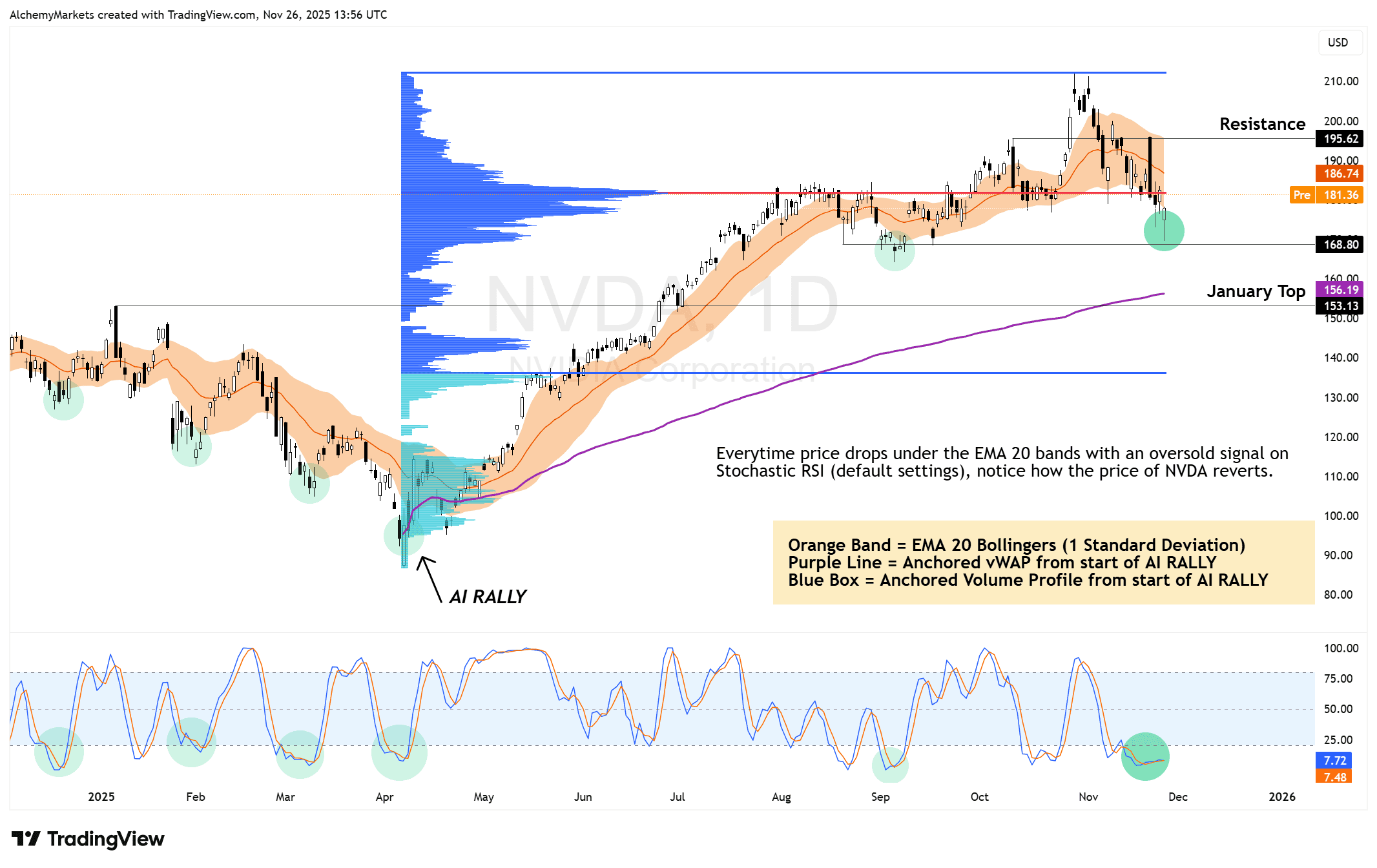
NVDA is at a tactically important level. Price sits beneath the EMA-20 Bollinger band with an oversold Stoch RSI signal, the same combination that triggered every major NVDA rebound during the 2025 AI rally. Historically, NVDA reclaimed the EMA-20 quickly and rode the upper half of the band higher.
Today, that reclaim is missing.
This is the difference between a normal pullback and the start of a deeper unwind. January showed the pattern clearly:
We are back at the same setup. A bounce is likely, but NVDA only recovers its trend if it breaks and holds above the top of the orange band. If it fails at the band again, the structure weakens. NVDA is no longer the cleanest of the leaders.
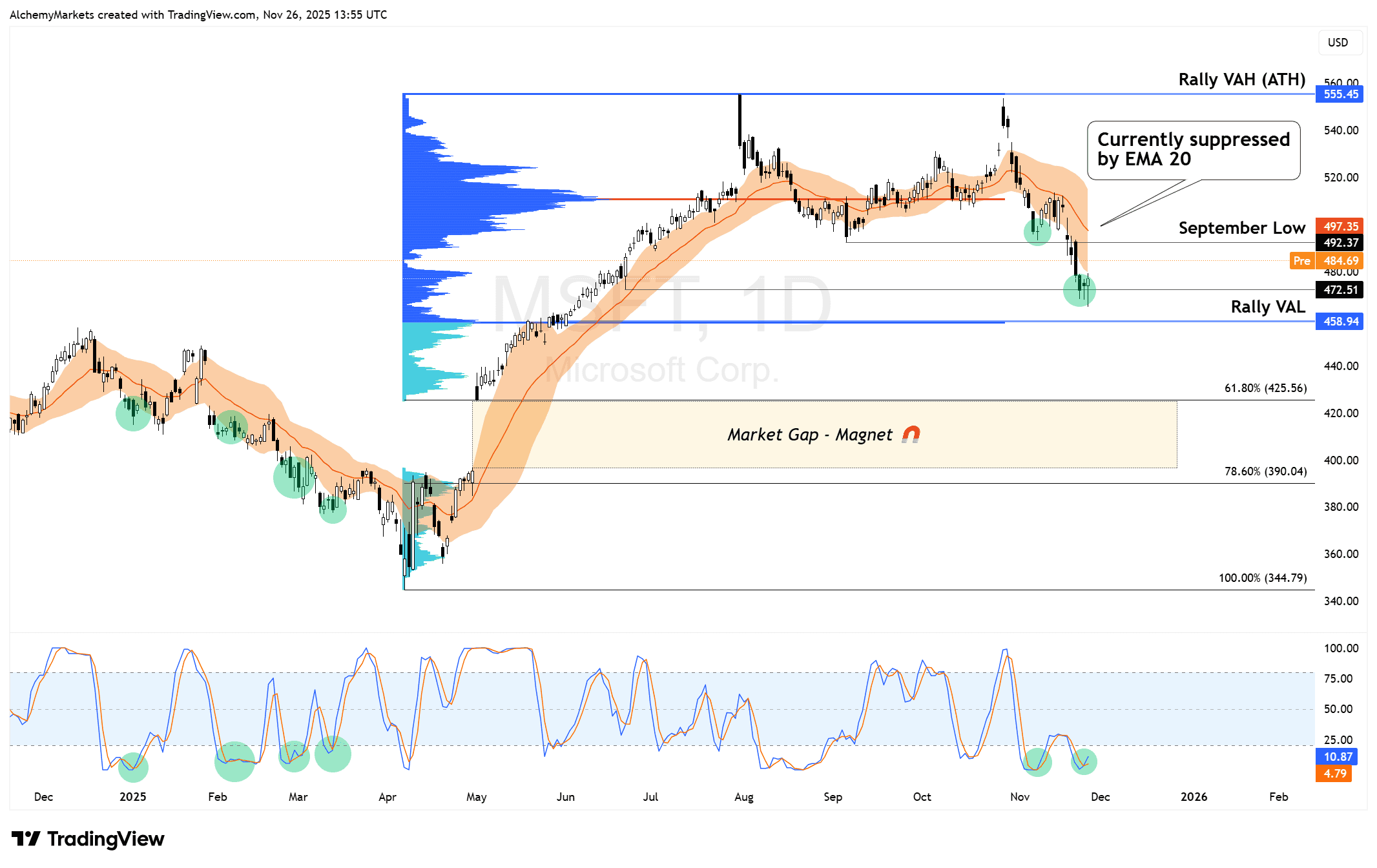
Microsoft mirrors NVDA’s weakness, but with even less strength behind it. MSFT is sitting near the Rally VAL and testing the lower boundary of the entire AI rally structure.
Price is still suppressed by the EMA-20. Historically, when MSFT breaks below the band, it tends to revert back into the band before choosing direction. That is the likely path now: a relief move into the orange bands, then a decision.
MSFT is currently the weakest of the big three:
A short-term bounce is still likely, but it lacks the momentum that GOOG currently has.
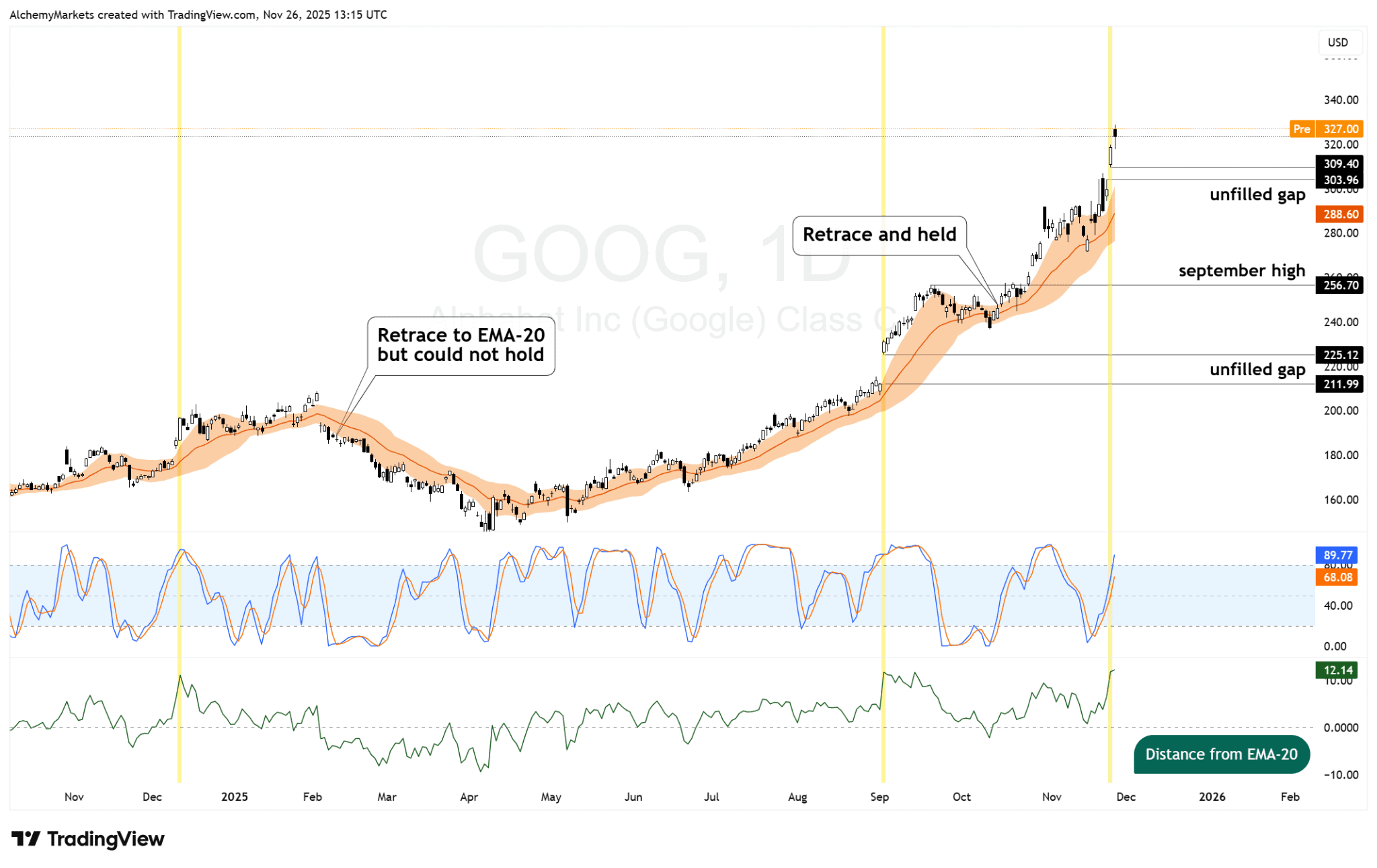
GOOG is the strongest AI leader for now. Fundamentally, Google is funding its AI expansion through real cashflow: TPU v6 rollout, Gemini Ultra integrations, and significant internal capex. Google is not relying on circular financing or trillion-dollar promises.
Technically, GOOG remains in a strong trend:
Every time GOOG reaches this level of stretch, it returns into the EMA-20 band. This is normal for strong trends. It is not bearish by itself. As long as GOOG holds the band on any retracement, the broader AI trade, and the SPX by extension, remains in good shape.
This is the real issue. It isn’t the charts. It’s the demands behind the technology.
Amazon has already clashed with utilities over power delivery. Nvidia warned in filings that future demand is now limited by access to electricity and capital.
OpenAI’s CFO stated that a single gigawatt-scale data centre costs around $50B:
OpenAI’s long-term plan involves up to 23 such centres. The math quickly becomes extreme.
GPUs depreciate in 12–18 months. Lenders do not want them as collateral.
This is why OpenAI floated the idea of a government “backstop”.
It is a loop. Investors understand that loops break under stress.
The AI buildout requires power equivalent to multiple nuclear reactors. The USA built only one new nuclear plant in thirty years.
This mix of capital pressure, energy limits, and financing complexity is what is making investors uneasy.
We are in a moment where AI hype is still strong, technical setups are mixed, and the bottlenecks behind the scenes are becoming hard to ignore.
If NVDA and MSFT reclaim their EMA-20 bands, the AI rally stabilises. If GOOG holds the band on retracement, SPX remains supported. If the leaders fail at their bands, the market may be pricing in something bigger: the AI expansion may not scale as fast as promised.
DISCLAIMER: For educational purposes only. Trading comes with substantial risk, leading to possible loss of your capital. Traders are advised to do their own due diligence before investing.
You may also be interested in:
Alchemy Markets is a multi-asset brokerage providing retail traders with the same elite trading conditions, tools, and transparency typically reserved for institutions.

Select the categories and companies you wish to follow directly to your person rss feed.
Create Custom RSS FeedSign up and join over 5,000 professional members who receive personalized news alerts, curated professional connections, and more for free!
Bybit has launched Perp Options, described as the first options contracts built on TradFi perpetuals, giving traders round-the-clock access to US equity options. SpaceX and Nvidia are the first underlying assets, with USDT settlement and integration into Bybit's Unified Trading Account.
Use this trading preparation checklist to plan your session, define entry rules, manage risk, and build a disciplined trading routine in seven steps.
Your Bourse expands its crypto liquidity ecosystem with Caladan, giving brokers access to broader market coverage, institutional execution capacity and streamlined settlement.
Scope Markets, the retail brokerage part of Rostro Group, has appointed Ibrahim Hossny as Head of Research and Marketing for the Middle East and North Africa.
Hantec Prime, the institutional division of Hantec Markets, has reported trading volume up more than 300% year-to-date, alongside the addition of 42 new institutional clients since December, capping one of its strongest years of growth to date.
Learn how to refine XAUUSD support and resistance on the daily chart using candle bodies, market structure and weekly gold levels for swing trading. A slug alone cannot guarantee a top Google ranking. Keep it focused rather than adding every supporting keyword.
The week in Dubai will be focused on connecting directly with the industry and discussing how technology can help modern brokerages simplify operations, automate workflows, strengthen operational control, and scale efficiently.
Devexperts has launched a turnkey solution giving brokers in South Korea access to US equity markets, combining its DXtrade trading platform, dxFeed market data, and execution services. The offering targets South Korea's growing retail demand for US stocks, worth several billion USD monthly.
Assess why WTI crude oil surged past $105 per barrel amid Saudi pipeline disruptions, record tanker charter rates, and escalating geopolitical tensions.
Bitcoin price forecast: BTC/USD retests $78,460–$80,215 resistance. Watch bearish confirmation toward $72,480 or a bullish breakout toward $86,150.