just now


Liquidity Finder Ltd is incorporated in England and Wales, company number 10610740, registered address 167-169 Great Portland Street, Fifth Floor, London W1W 5PF, United Kingdom.
Published: just now

The Reserve Bank blinked first — but not the way the Aussie wanted.
The RBA held the cash rate at 4.35% this morning, snapping a three-meeting hiking streak and delivering exactly what the market had penciled in. Yet the decision arrived wrapped in a familiar warning: this is a pause, not a pivot. Governor Bullock kept the door to further tightening firmly ajar, reminding traders that inflation — still running near 3.4% on the underlying measure — remains the central concern, with higher fuel and commodity costs now bleeding into housing and construction.
Here's the catch the market is wrestling with: a hawkish hold should support a currency. Instead, short-term rates drifted lower and the Aussie struggled to find a bid. Why? Because for AUD/USD right now, the RBA isn't the one holding the pen — the Fed is.
With the US central bank settling into a prolonged hold of its own and the dollar reclaiming ground lost after the Iran de-escalation, the rate-differential story that would normally lift the Aussie on a hawkish RBA simply isn't firing. Bullock can sound as vigilant as she likes; until the Fed narrative softens, the Aussie's upside stays on a short leash. The second-half bull case — the one that points toward 0.73 — leans almost entirely on US data cracking, not Australian rates climbing.
So the market knows the RBA is on hold. What it might be missing is that the next leg for AUD/USD probably won't be written in Sydney at all.
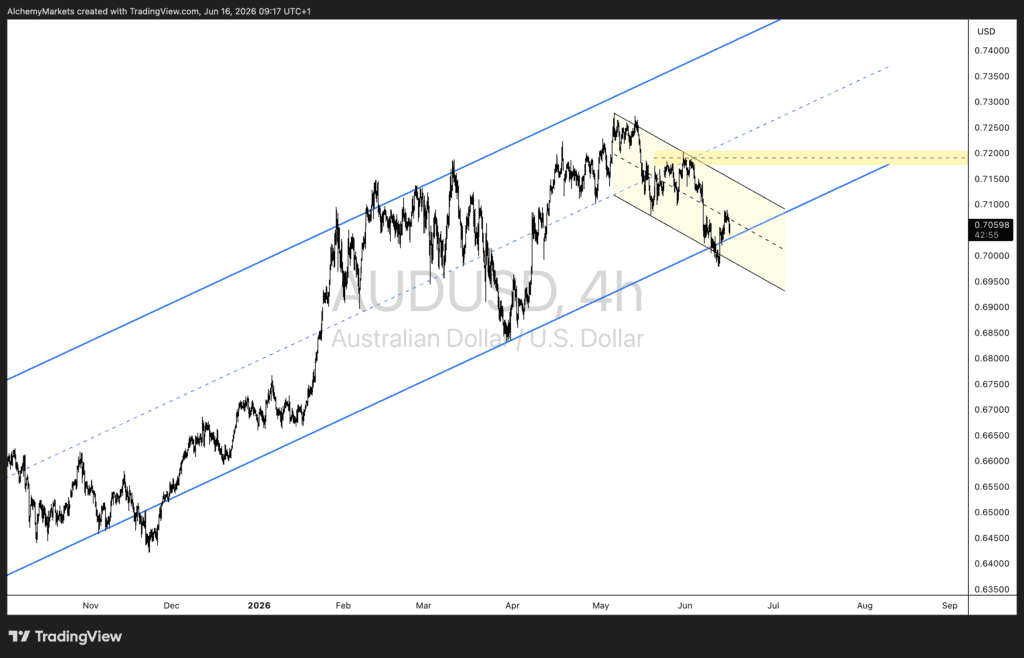
The price action tells the same story of suppressed momentum. On the 4-hour, AUD/USD continues to track inside the broad ascending channel that has framed the entire move higher since November — the structural uptrend is not broken.
But zoom in, and the near-term picture is more cautious. Since topping out near 0.7270 in early May, price has been carving lower inside a descending channel — a corrective drift that has guided the Aussie down toward the 0.7000 handle, where it found support and is now attempting to recover back toward the channel's midline around current levels near 0.7060.
The level that matters sits overhead. 0.72 is our initial resistance projection — the prior pivot zone and the area where the descending channel's upper boundary now converges. As long as price trades beneath it, the corrective structure stays intact and rallies are best read as tests rather than breakouts. A clean reclaim of 0.72 would be the first real signal that the May–June drift is over and the broader uptrend is ready to reassert.
Until then, the Aussie is caught between two channels and two central banks — supported by structure, capped by the dollar, and waiting for a catalyst it can't supply itself.
Alchemy Markets is a multi-asset brokerage providing retail traders with the same elite trading conditions, tools, and transparency typically reserved for institutions.

Select the categories and companies you wish to follow directly to your person rss feed.
Create Custom RSS FeedSign up and join over 5,000 professional members who receive personalized news alerts, curated professional connections, and more for free!
ATARIA CRM helps brokers manage a growing client base by bringing client information into one organized platform. It highlights key client statuses such as total, active, inactive, and blocked clients, making it easier for teams to track records, manage communication, automate follow-ups, personalize engagement, and use data insights to strengthen relationships, improve collaboration, save time, and support business growth.
The biggest macro events of Q3 may be behind us. Now comes the next question: what happens when the market starts separating companies rather than trading the macro narrative? Following the Fed’s 25-basis-point hike, a flattening yield curve and sharply elevated tanker rates, the investment landscape is shifting. The same forces can create very different pressures across technology, energy, financials, industrials and consumer sectors. In this week’s BitDelta Pro Weekly Outlook, we look beyond the headlines to examine where those differences may start to matter most. Read the full article for our breakdown of the rate path, the inflation signal hiding in shipping costs, and the sector dynamics taking shape. BitDelta Securities Financial Services LLC, regulated by the Capital Market Authority under Category 5 (Introduction Only), acts solely as an introducer and does not provide trading, execution, dealing, advisory, portfolio management, or custody services. All trading, execution, and investment-related services are provided by BitDelta Limited, Mauritius, a licensed Investment Dealer. All trading and investments involve risk. The value of investments may fluctuate, and you may receive less than your initial investment.
An analysis of how Federal Reserve policy, geopolitical risks in the Persian Gulf, and shifting global yields drive the US Dollar (DXY) near the 100.3 level, alongside market scenarios and technical outlooks.
audcad-price-forecast-support-retest-bullish-breakout
Gold holds weekly support as XAUUSD breaks above its daily EMA. Explore key support and resistance levels and the next bullish confirmation.
Detailed market analysis and technical outlook for WTI Crude Oil prices near $100 per barrel for the week of September 21 to 25, 2026, combining macroeconomic drivers, EIA inventory data, and key chart indicators.
Learn how to convert custom Gold (XAUUSD) price action tutorials into MetaTrader 5 AI prompts using external AI, analyze live charts, audit risk, and auto-generate MQL5 code.
MarketsVox has introduced 24/7 trading on Gold, Silver, WTI and Brent crude CFDs, giving clients round-the-clock access to key commodity markets. The launch is part of the broker's 2026 roadmap, alongside Client Area and Partner Area updates. CEO Joe Roeder says clients "should not have to wait for a trading session to open."
DXtrade, Devexperts' flagship multi-asset trading platform, has become one of only two platforms approved by Indonesia's Bappebti. The approval authorises DXtrade for licensing by commodity futures and derivatives brokers in Indonesia, and is expected to support future applications to OJK, including for digital asset services.
Exchange FZE (GCEX) has appointed Alya Marrakchi as Managing Director, following approval from Dubai's Virtual Assets Regulatory Authority (VARA). Marrakchi joined GCEX in June 2025, building institutional relationships across the UAE and GCC. Her promotion follows Mohammed A. Mulla's appointment as a GCEX Dubai board member.