just now


Liquidity Finder Ltd is incorporated in England and Wales, company number 10610740, registered address 167-169 Great Portland Street, Fifth Floor, London W1W 5PF, United Kingdom.
Published: just now

If you’ve made it this far through the Swing Trading Series, you’re no longer just a beginner-you’re building the foundation of a professional trader. From understanding what swing trading is to refining technical foundations and stepping into Smart Money Concepts, this final piece ties it all together. Because consistency isn’t about one great trade-it’s about building a system that produces repeatable results even when emotions try to take the wheel.
Let’s turn what you’ve learned into a lasting edge.

Every successful swing trader has a plan-not because it guarantees profit, but because it filters chaos. Think of it as your flight manual: when turbulence hits, you don’t improvise; you follow protocol.
Your plan should define:
Above all, your plan should fit on one page. The more concise it is, the more likely you’ll actually follow it under pressure.

You can’t improve what you don’t measure. Reviews transform you from reactive to adaptive. Each week, capture your best/worst trade, the rule you broke (if any), and the emotion you felt when you clicked the button. At month-end, narrate your equity curve: did you grow because of discipline or luck?
If you’ve struggled to journal consistently, borrow structure from The Psychology of Risk Management in Swing Trading (how emotions distort risk) and put it into practice with a simple trading journal & reflection routine. The combination gives you both the why (mindset) and the how (mechanics).
Track a few core metrics that actually drive outcomes: win rate, average R multiple, expectancy, and peak-to-valley drawdown. You don’t need a thousand stats; you need the few that change behavior.
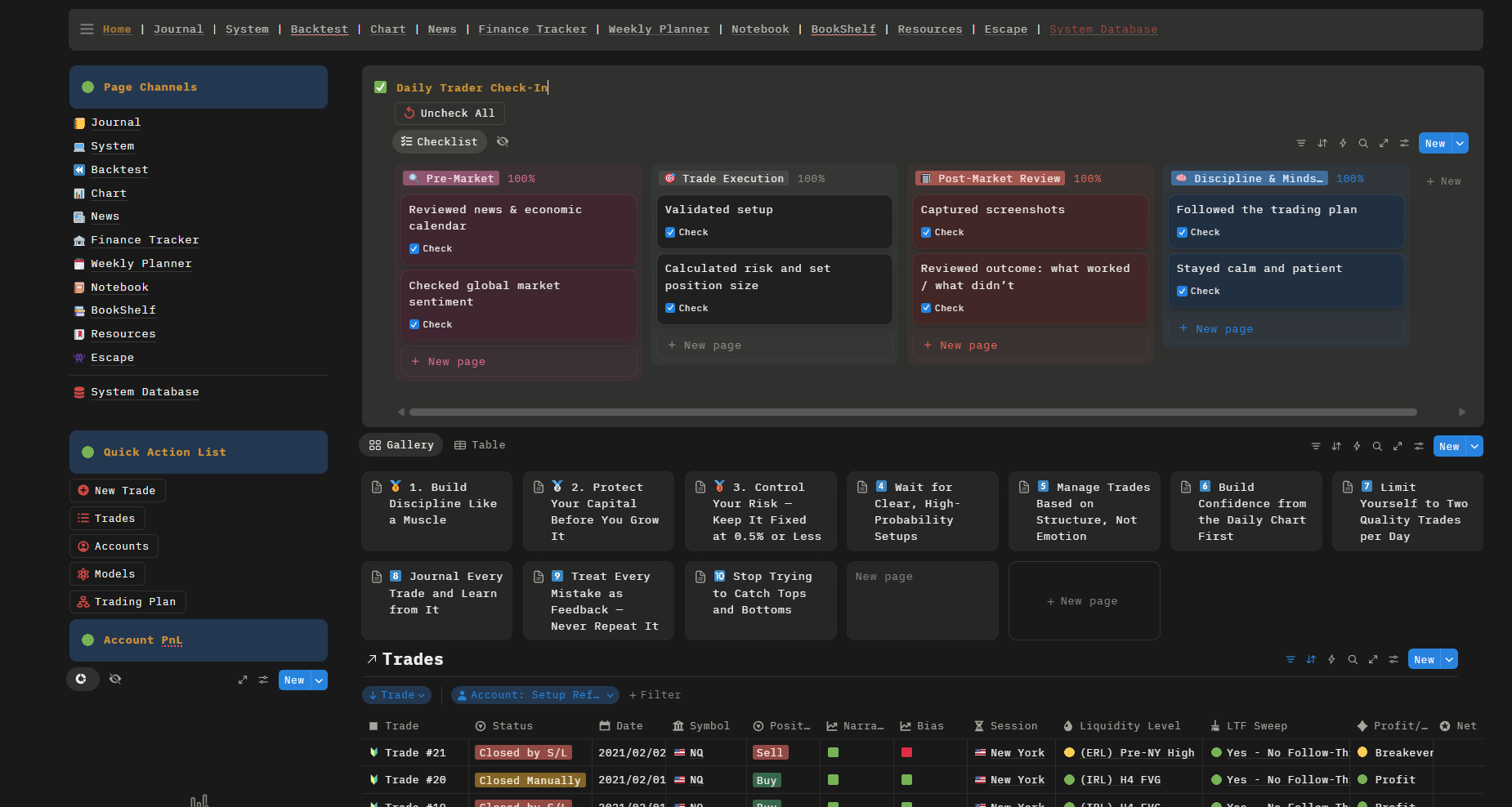
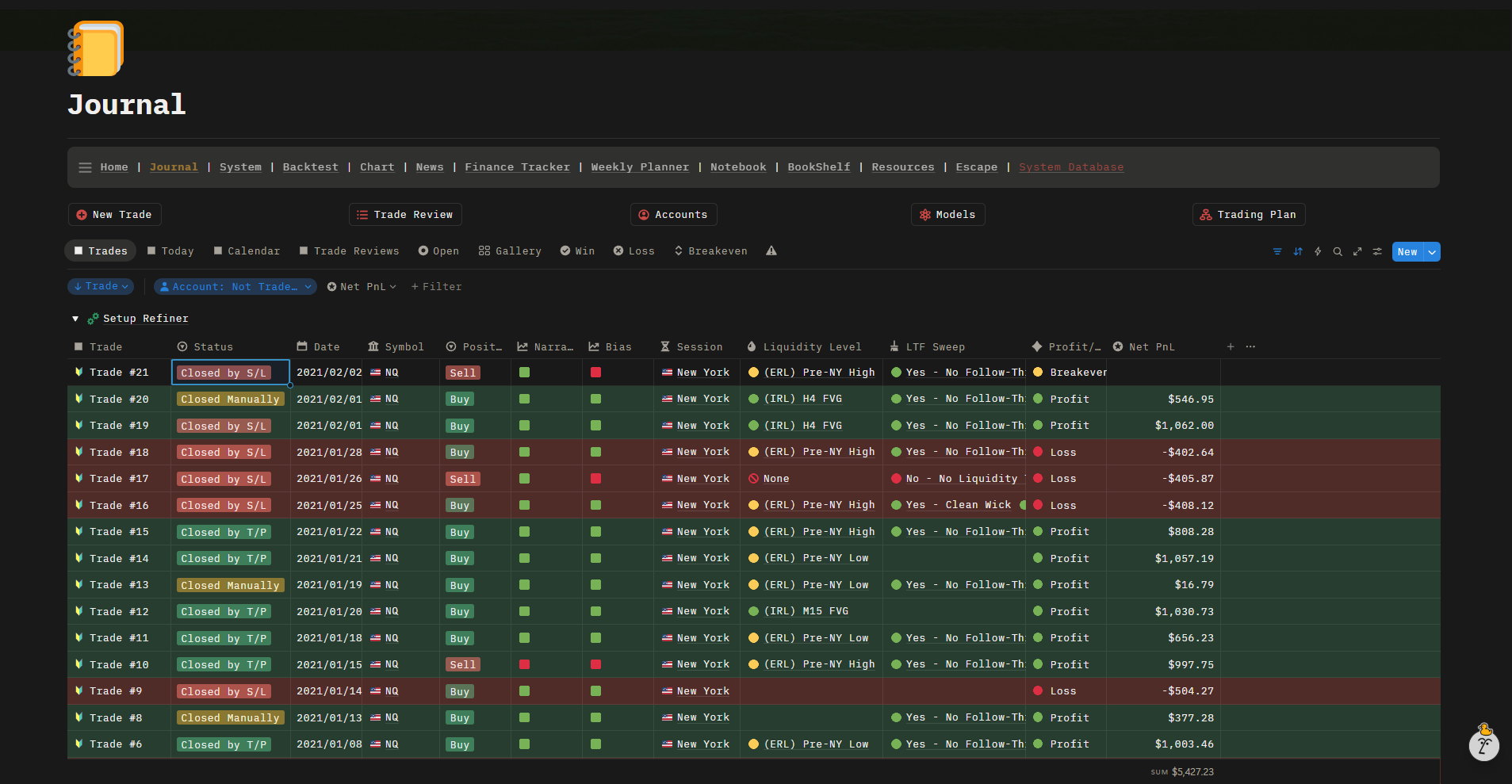
This is the heart of my process - my daily check-in and trading journal.
Every morning starts with a pre-market review: checking news, global sentiment, and the economic calendar. It’s how I make sure I’m trading with context, not impulse.
Each section has a purpose - Pre-Market, Execution, Post-Market, Discipline. Together, they keep me anchored. Before a trade, I validate setups and position size; after, I capture screenshots and note what worked and what didn’t. It’s not about perfection - it’s about accountability.
The second dashboard tracks every single trade in detail - session, bias, liquidity level, entry type, and outcome. Over time, it shows me the truth about my trading: which setups deliver, which ones drain energy, and how my behavior affects results.
It’s easy to say “be disciplined,” but this system makes it visible.
When I review my journal, I don’t just see numbers - I see patterns, growth, and habits forming.
This is where I measure my real progress, not by profit, but by consistency.

Swing traders have a unique edge-time. You’re not forced to trade every day, which means you can balance exposure across uncorrelated ideas. Don’t stack the same macro bet in different wrappers (e.g., long Gold, long Silver, and long AUD/USD often rhyme). Instead, think like a portfolio manager: one metals theme, one currency idea, one equity index.
To sharpen this, study how markets move together with market correlations & intermarket analysis. When a USD bull run pressures risk assets, or when real yields lean on gold, you’ll see it faster-and position size accordingly. The goal isn’t more trades; it’s smarter exposures that complement (not duplicate) risk.

Scaling is mostly psychological. Plenty of traders can execute on demo; fewer can preserve discipline once capital size and external rules kick in.
A practical progression:
If your path includes prop programs, align your risk rules with this concise guide for challenge environments: The Ultimate Risk Management Plan for Prop Firm Traders (2025). And when timing matters-especially on indices-tighten execution windows with how to trade & scalp indices at the open using SMC. The same discipline that helps on the open strengthens your funded account performance overall.
Consistency grows in repetition. Give your trading a heartbeat: a Sunday scan for bias, a mid-week check-in, and a weekly post-mortem. A little structure compounds into calm execution. If you need a nudge to make your habits stick, this quick primer on daily habits of profitable traders pairs perfectly with your review loop. And as your sample size grows, your results will start to reflect the math of compounding more than the noise of any single week.
Backtesting is where theory meets truth.
It’s how I take ideas from charts and test whether they actually work when repeated over hundreds of trades. Without it, every trade feels like guessing - with it, I trade with proof.
When I started journaling seriously, I realized that tracking live trades only showed part of the picture. I needed something faster - a way to see years of data in days. That’s when I turned to backtesting.
It’s the bridge between learning and trusting your system.
By replaying price data and marking setups the same way I would live, I learned three things that changed my consistency forever:
Patterns Repeat More Than You Think.
You start recognizing liquidity sweeps, fair value gaps, and structural shifts forming again and again.
Your Edge Only Exists When Quantified.
Until you measure win rate, average R, and drawdown, you’re just hoping.
Confidence Comes from Data, Not Motivation.
When you’ve seen your model perform through hundreds of candles, hesitation fades - because your conviction is backed by evidence.
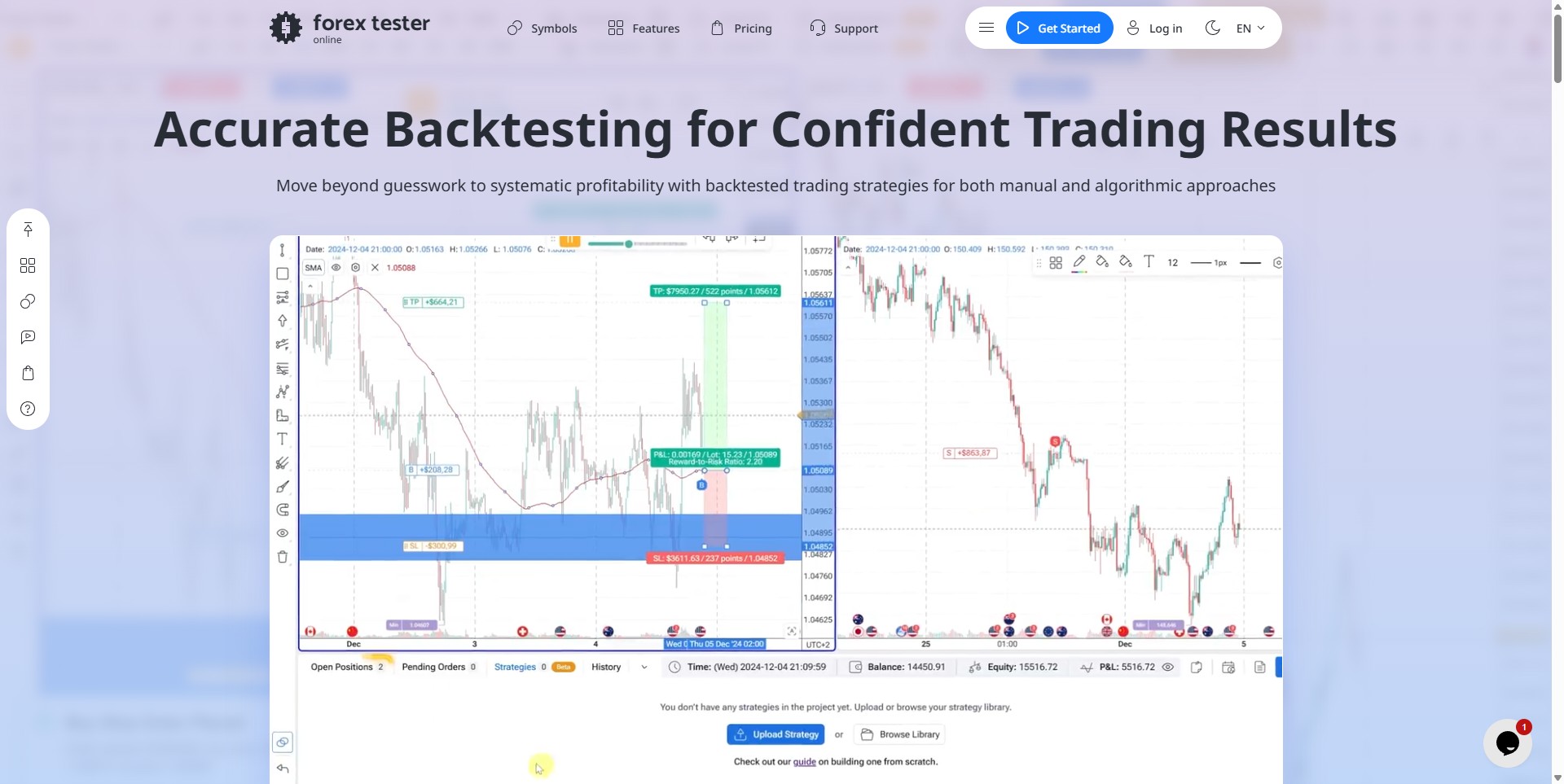
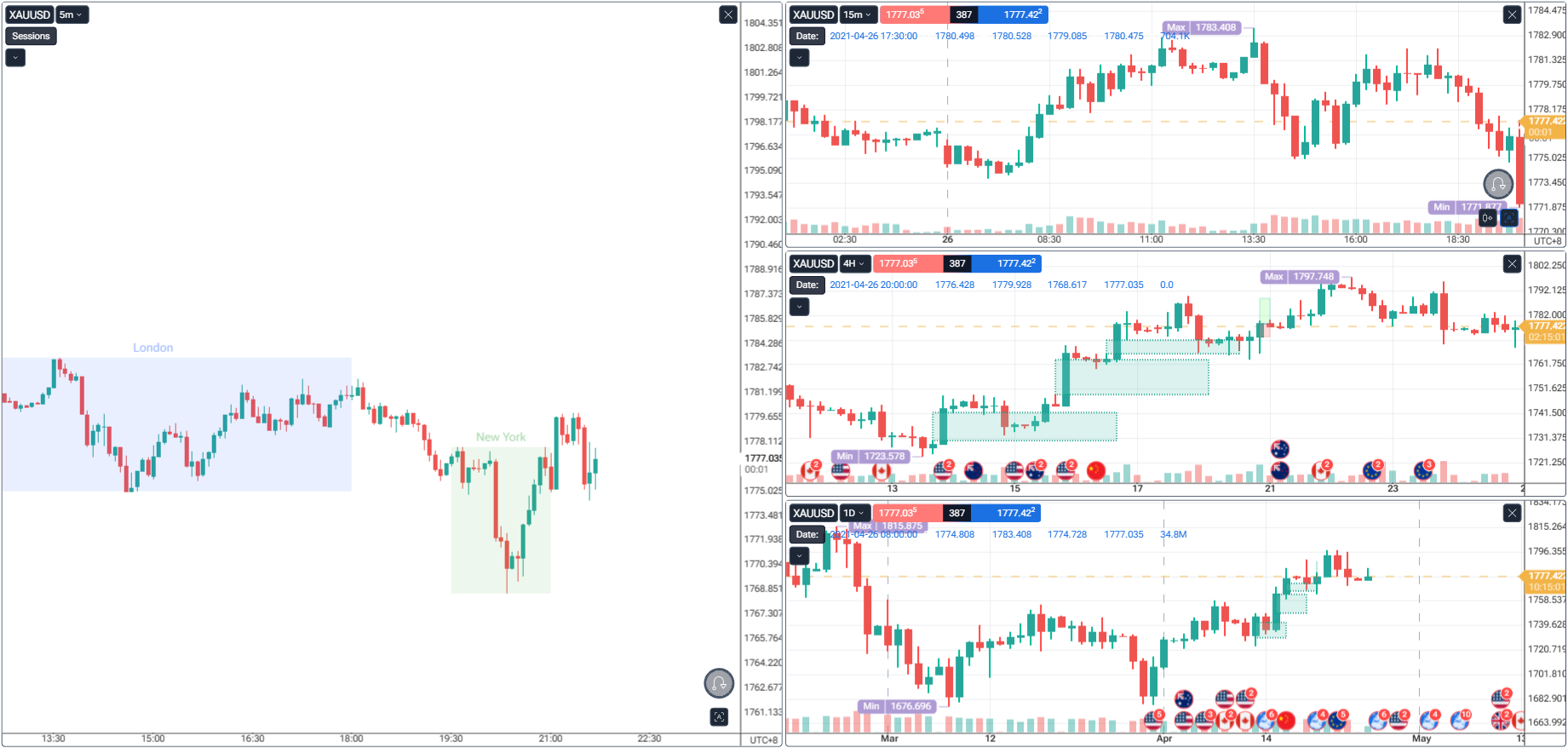
This is what I use when refining strategies - Forex Tester Online, a clean, professional platform built for realistic backtesting. It lets me replay the market on fast-forward, test entry rules across assets like EUR/USD or Gold, and evaluate my results with metrics that matter.
Advanced Analytics in Forex Tester Online
Forex Tester Online’s Advanced Analytics suite transforms backtesting into a complete performance laboratory - helping traders quantify, refine, and validate their strategy edge with precision.
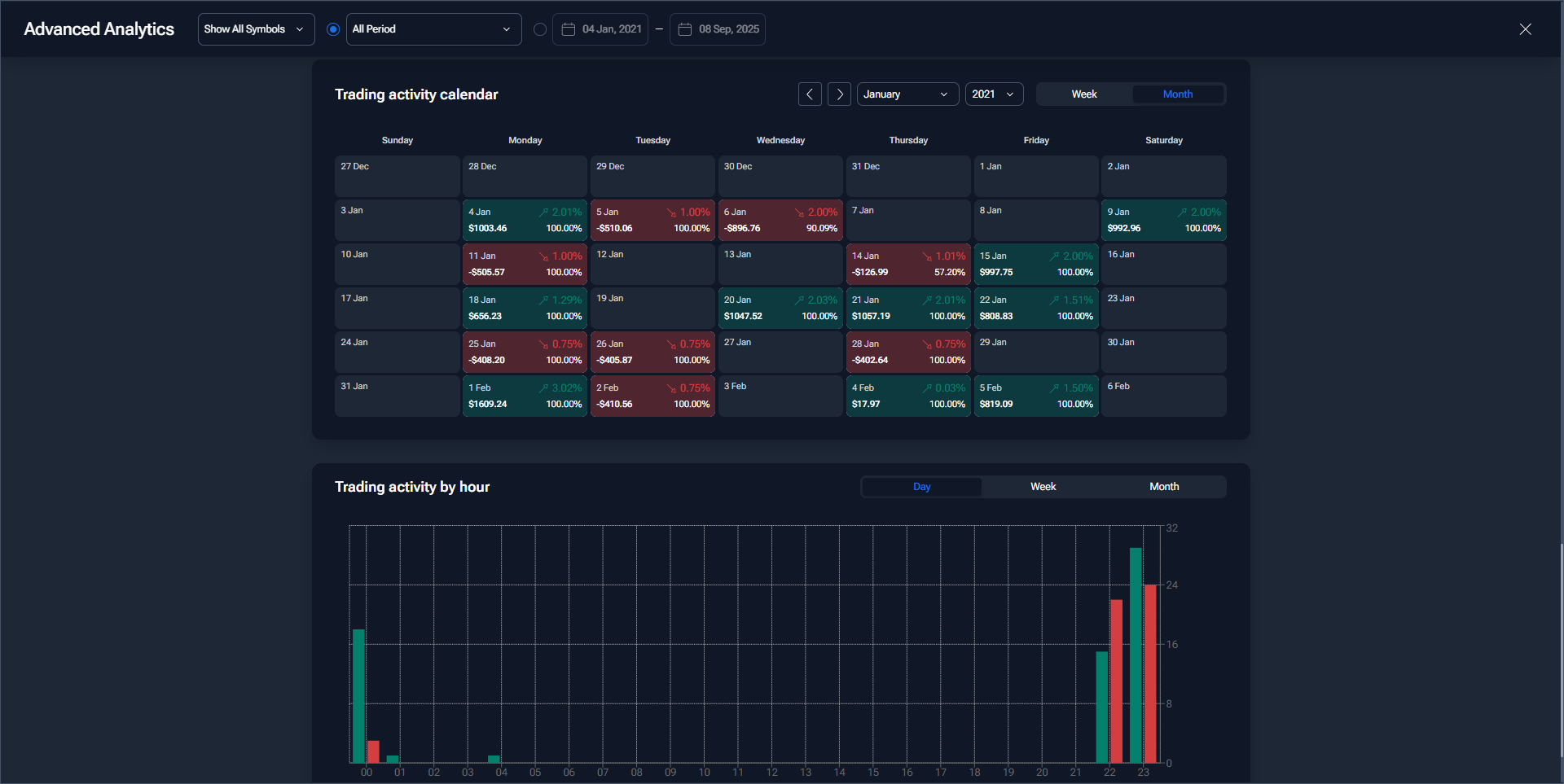
The Trading Activity Calendar highlights profitable and losing days, allowing traders to identify their strongest sessions and optimal trading hours. This visual heatmap reveals hidden behavioral patterns - from weekdays that yield the best results to specific hours of consistent execution.
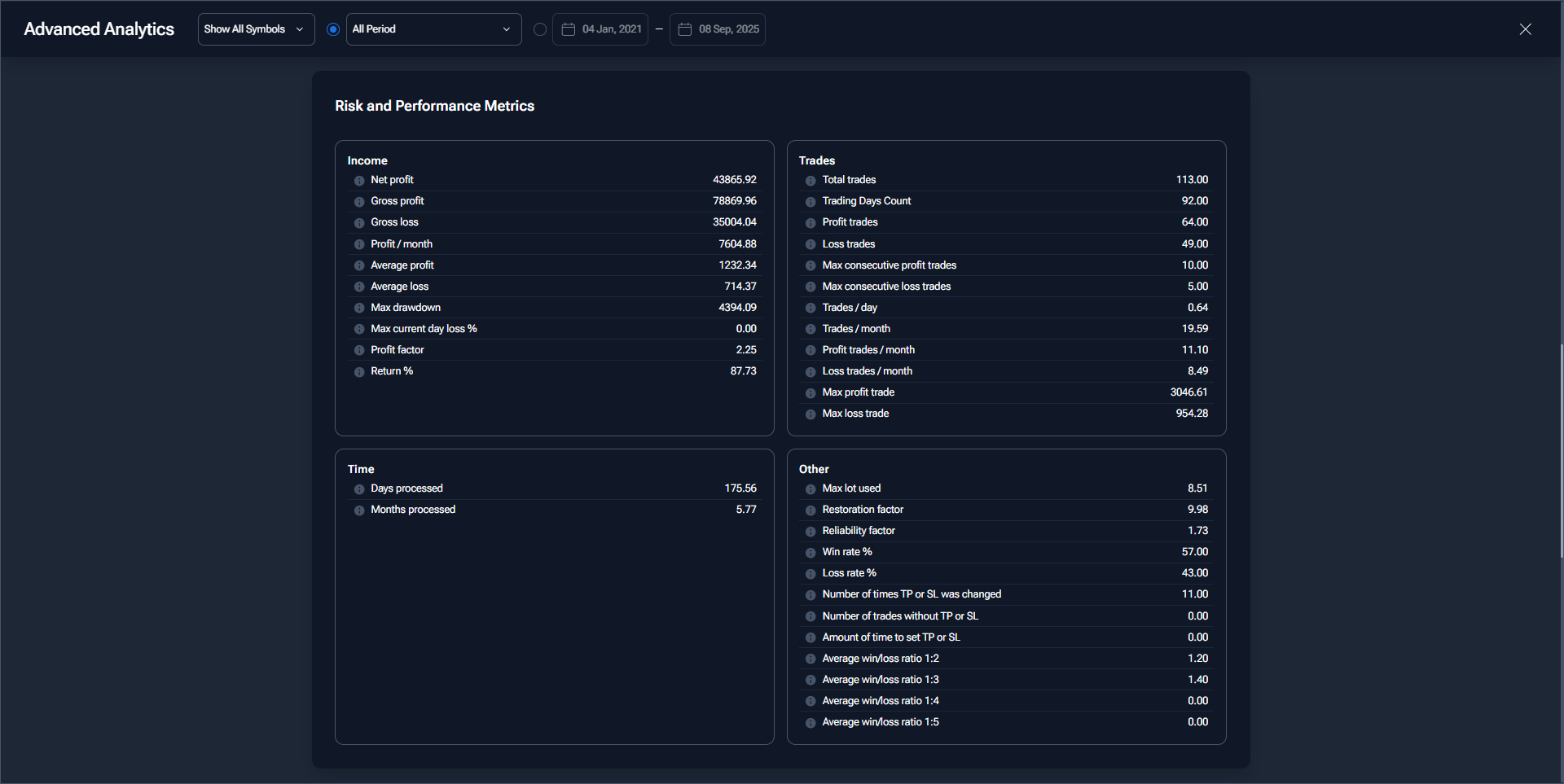
The Performance Dashboard compiles key trading metrics such as profit factor, drawdown, win rate, and average R-multiple, offering a clear snapshot of system stability over time. Traders can instantly assess whether their strategy remains robust across different market conditions.
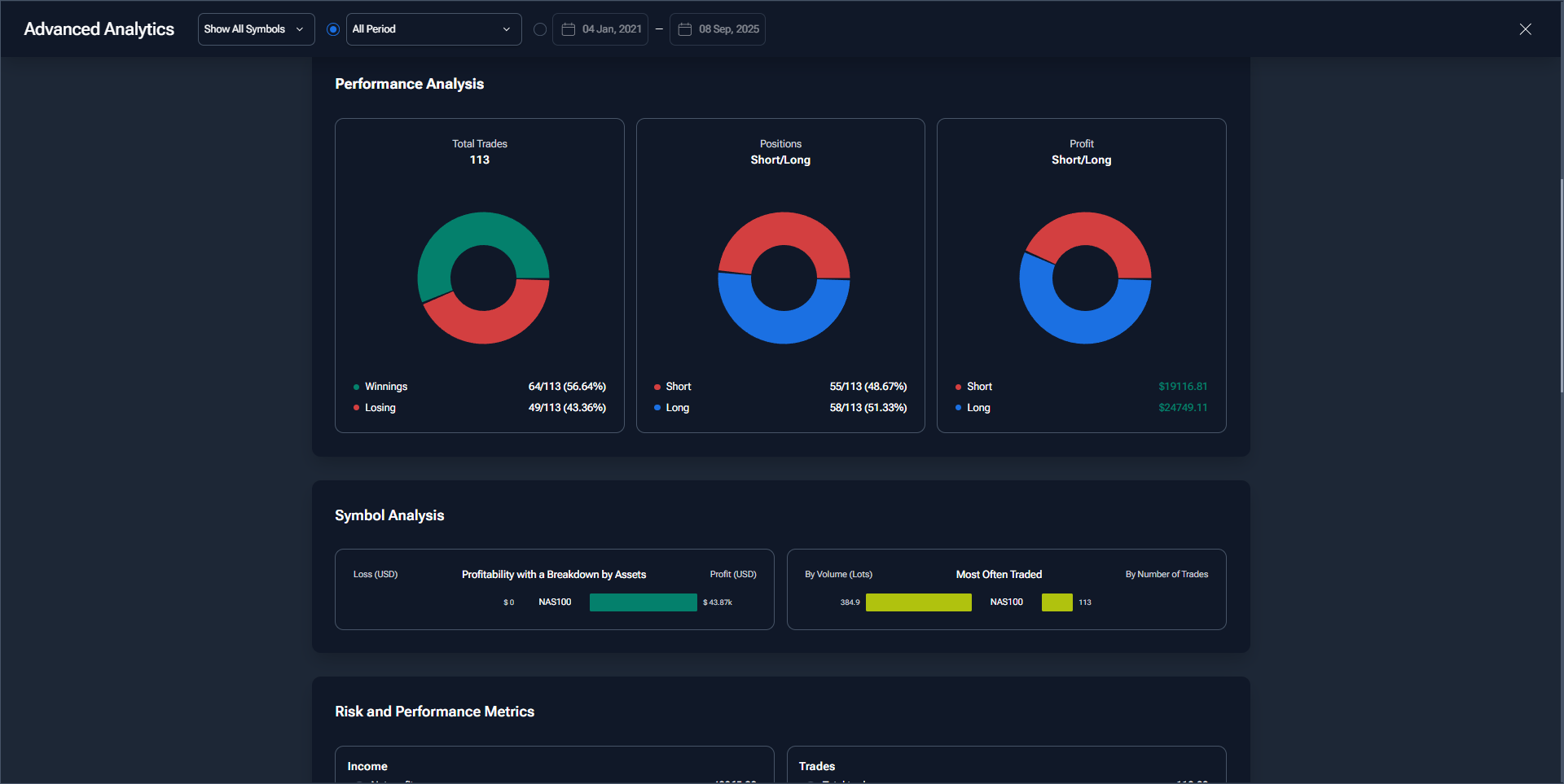
Through Symbol and Position Analysis, users can pinpoint which assets contribute most to profitability and whether long or short positions dominate performance. This helps balance exposure and refine market focus.
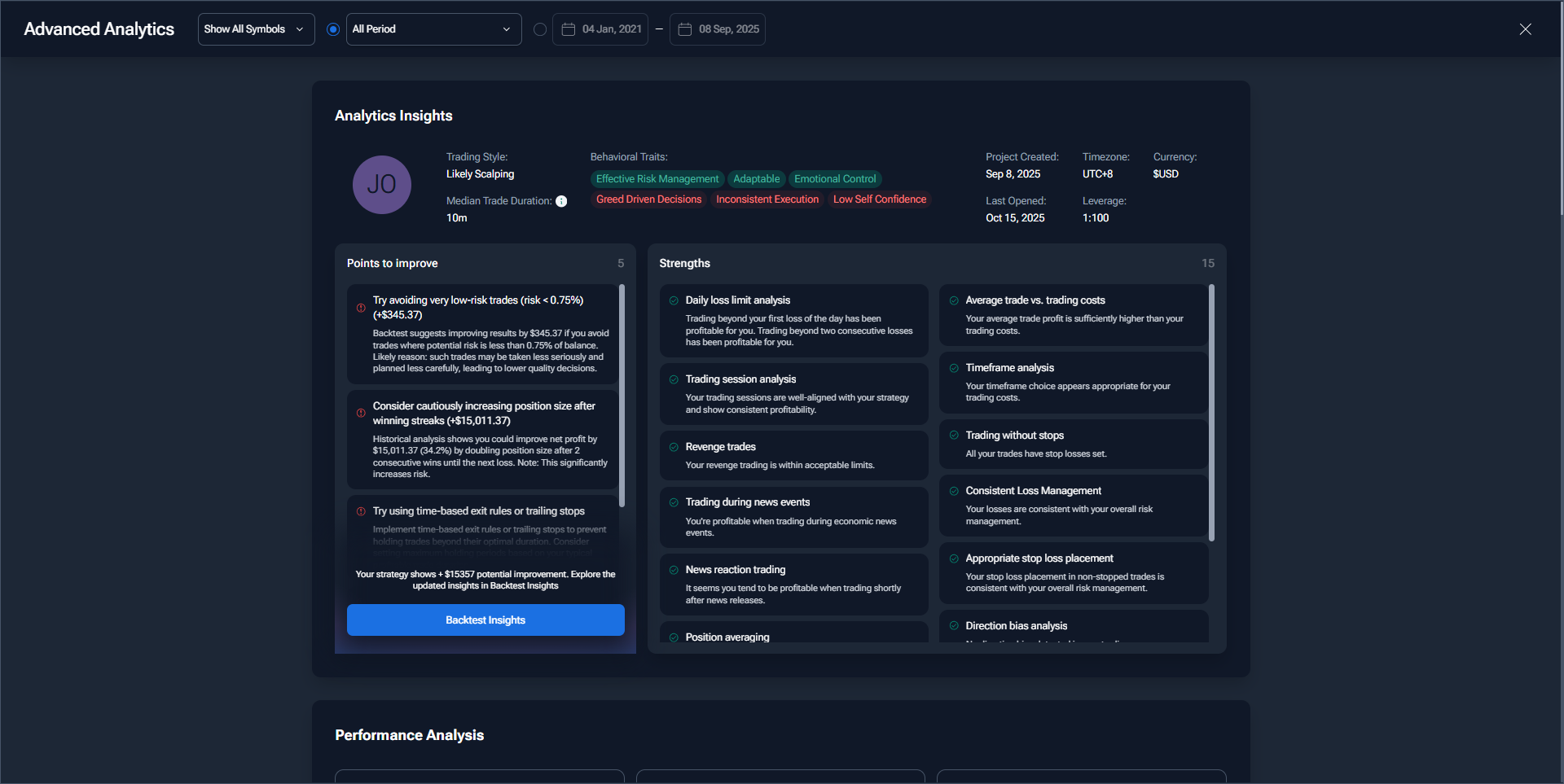
Finally, the Behavioral Insights Panel bridges psychology with data - highlighting tendencies like overtrading, risk concentration, or inconsistency after winning streaks. It provides strengths and improvement points backed by historical outcomes, making backtesting both quantitative and behavioral.
Together, these analytics make Forex Tester Online not just a backtesting tool, but a strategic development environment - where traders evolve from testing setups to mastering data-driven consistency.
I can simulate years of trading data in hours, adjust risk settings, and track how each change affects my equity curve. It’s not just practice - it’s precision training for traders.
If you want to explore it, check out Forex Tester Online - it’s been one of the most practical ways for me to strengthen my setups before risking real capital.
Backtesting gives me something emotional control never could - trust in the math.
When I take a trade now, I’m not trading hope; I’m trading a system I’ve already proven to myself hundreds of times in simulation.
It’s how I know when to hold, when to cut, and when to walk away - because I’ve already seen it play out before.
That’s how consistency is built: one tested idea at a time.

A professional pilot never relies on memory. Every flight, condition, and error is logged. That’s how they survive turbulence and keep improving. Your trading journal is the same. Over time it becomes your personal radar-highlighting when you overtrade, which setups carry you, and where your discipline slips. It’s not about perfection. It’s about auditability: you can see what to fix next.

You’ve reached the end of the Swing Trading Series-but this is where real trading begins. You now understand rhythm, structure, psychology, risk, and institutional confluence. The next step isn’t to collect more strategies; it’s to apply the right one the same way, over and over. Markets reward clarity, not intensity. Keep your plan tight, your process repeatable, your patience unshakable-and let time do the compounding.
Aim for 6–12 quality trades. Selectivity beats frequency in swing trading.
Start with one until structure reading is second nature. Then add a non-correlated market to balance exposure (e.g., one index + one FX pair).
Even 45–50% can produce strong results if your average reward is ~2R. The key is protecting downside and letting winners breathe.
When your rules don’t change under stress, your drawdowns are controlled, and your last 6–8 weeks show positive expectancy.
It’s time to go from theory to execution - risk-free.
Create an Account. Start Your Free Demo!
Looking for step-by-step approaches you can plug straight into the charts? Start here:
Sharpen your edge with proven tools and frameworks:
News moves markets fast. Learn how to keep pace with SMC-based playbooks:
From NASDAQ opens to DAX trends, here’s how to approach indices like a pro:
Gold remains one of the most traded assets - here’s how to approach it with confidence:
Candlesticks are the building blocks of price action. Master the most powerful ones:
Ready to go intraday? Here’s how to build consistency step by step:
Markets swing between calm and chaos. Learn to read risk-on vs risk-off like a pro:
Step inside the playbook of institutional traders with SMC concepts explained:
Forex pairs aren’t created equal - some are stable, some are volatile, others tied to commodities or sessions.
If you’ve ever been stopped out right before the market reverses - this is why:
Mindset is the deciding factor between growth and blowups. Explore these essentials:
The real edge in trading isn’t strategy - it’s how you protect your capital:
If you’re not sure where to start, follow this roadmap:
This way, you’ll grow from foundation → application → mastery, instead of jumping around randomly.
Follow me for more daily market insights!
Jasper Osita - LinkedIn - FXStreet - YouTube
This content may have been written by a third party. ACY makes no representation or warranty and assumes no liability as to the accuracy or completeness of the information provided, nor any loss arising from any investment based on a recommendation, forecast or other information supplies by any third-party. This content is information only, and does not constitute financial, investment or other advice on which you can rely.
ACY Securities is one of Australia's fastest growing multi-asset online trading providers, offering ultra-low-cost trading, rock-solid execution, technologically superior account management and premium market analysis.

Select the categories and companies you wish to follow directly to your person rss feed.
Create Custom RSS FeedSign up and join over 5,000 professional members who receive personalized news alerts, curated professional connections, and more for free!
Bybit has launched Perp Options, described as the first options contracts built on TradFi perpetuals, giving traders round-the-clock access to US equity options. SpaceX and Nvidia are the first underlying assets, with USDT settlement and integration into Bybit's Unified Trading Account.
Use this trading preparation checklist to plan your session, define entry rules, manage risk, and build a disciplined trading routine in seven steps.
Your Bourse expands its crypto liquidity ecosystem with Caladan, giving brokers access to broader market coverage, institutional execution capacity and streamlined settlement.
Scope Markets, the retail brokerage part of Rostro Group, has appointed Ibrahim Hossny as Head of Research and Marketing for the Middle East and North Africa.
Hantec Prime, the institutional division of Hantec Markets, has reported trading volume up more than 300% year-to-date, alongside the addition of 42 new institutional clients since December, capping one of its strongest years of growth to date.
Learn how to refine XAUUSD support and resistance on the daily chart using candle bodies, market structure and weekly gold levels for swing trading. A slug alone cannot guarantee a top Google ranking. Keep it focused rather than adding every supporting keyword.
The week in Dubai will be focused on connecting directly with the industry and discussing how technology can help modern brokerages simplify operations, automate workflows, strengthen operational control, and scale efficiently.
Devexperts has launched a turnkey solution giving brokers in South Korea access to US equity markets, combining its DXtrade trading platform, dxFeed market data, and execution services. The offering targets South Korea's growing retail demand for US stocks, worth several billion USD monthly.
Assess why WTI crude oil surged past $105 per barrel amid Saudi pipeline disruptions, record tanker charter rates, and escalating geopolitical tensions.
Bitcoin price forecast: BTC/USD retests $78,460–$80,215 resistance. Watch bearish confirmation toward $72,480 or a bullish breakout toward $86,150.