just now


Liquidity Finder Ltd is incorporated in England and Wales, company number 10610740, registered address 167-169 Great Portland Street, Fifth Floor, London W1W 5PF, United Kingdom.
Published: just now

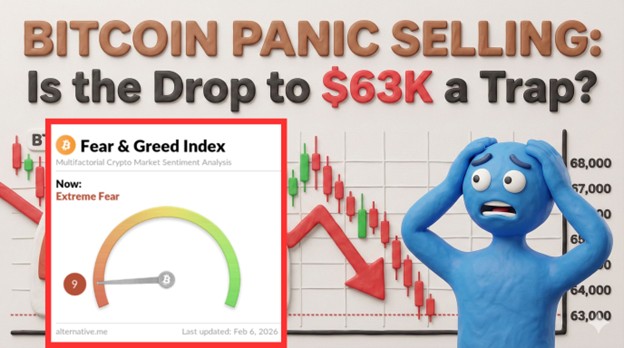
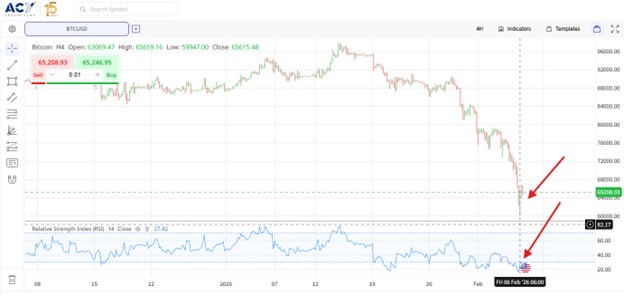
The Crypto Fear & Greed Index has flashed a reading of 14, indicating "Extreme Fear” as Bitcoin (BTC) sliced through the psychological support at $70,000. This isn't just a standard correction; the market is currently digesting over $545 million in ETF outflows. This signals that institutional "stable hands" are turning defensive, leaving retail traders to panic-sell into a demand vacuum.
When the crowd is convinced, the sky is falling; opportunities often emerge for those willing to look past the immediate noise. Is this the beginning of a crypto winter, or a classic liquidity trap before the next leg up?
Keep track of key economic events impacting global liquidity: Check the ACY Securities Economic Calendar


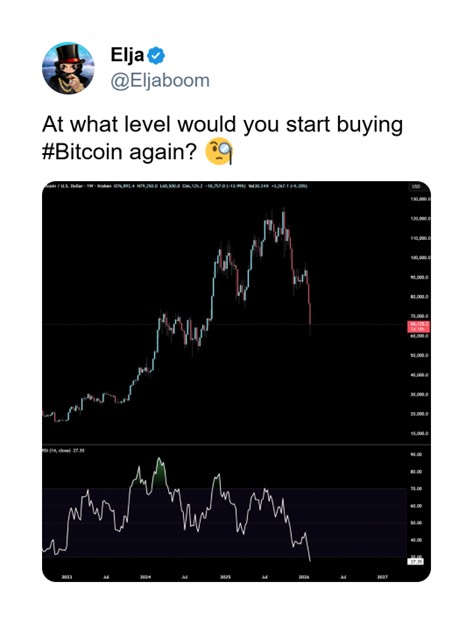
A scan of crypto discussions on X (formerly Twitter) reveals a textbook capitulation mindset. The retail crowd is predominantly posting about selling to "stop the bleeding" or waiting to buy back in at $63,000.
Common Themes on X:
The "Priced-In" Trap: When the majority of the market expects a move to a specific number (in this case, $63,000), they often position themselves ahead of time. This creates a situation where the downside momentum is fueled by realized losses rather than new fundamental drivers. According to our Sentiment strategy, when everyone is looking one way, the market often runs out of sellers before reaching the crowd's target.
Master the art of reading crowd psychology: Download our 'Trading with Sentiment' eBook
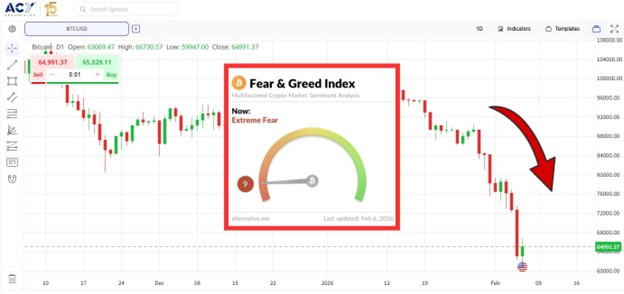
In this environment, we look to the principles outlined in "Fading Sentiment" (Page 15 of our eBook). This strategy suggests that when sentiment hits extreme extremes (like an Index reading of 14), the asset is often oversold purely on emotion rather than valuation.
The logic is simple: If everyone who wanted to panic sell has already sold, who is left to push the price lower? The $545M in ETF outflows represents a significant transfer of supply, but once that selling pressure dries up, a "reversion to the mean" often occurs.
We are watching for a False Break scenario. If BTC dips towards $64,000-$65,000 but quickly reclaims the $68,000 level, it confirms that the "weak hands" have been flushed out, potentially trapping the late bears.
Bitcoin's volatility is spilling over into the broader digital asset ecosystem:
Based on the "Sentiment Fade" approach (eBook pg 15) and "Dual-Sided Breakout" logic (eBook pg 25).
The Setup: We are observing price action for a rejection of lower prices. We are not trying to catch the falling knife, but waiting for the floor to stabilize.
Note: This setup relies on the market proving that the selling pressure has exhausted itself.
Test this strategy risk-free before going live: Open a Demo Account with ACY Securities
Bitcoin's drop to "Extreme Fear" levels is uncomfortable, but it is exactly where contrarian strategies are designed to operate. While the ETF outflows are real, the crowd's reaction often overshoots reality. By using our Sentiment Fade technique, traders can look for the moment when the panic selling stops and the rational accumulation begins. Always manage your risk, as volatility in these zones can be significant.
Disclaimer: The content of this article represents the personal views and opinions of the author and is for educational purposes only. It does not constitute financial advice. All trading involves risk.
ACY Securities is one of Australia's fastest growing multi-asset online trading providers, offering ultra-low-cost trading, rock-solid execution, technologically superior account management and premium market analysis.

Select the categories and companies you wish to follow directly to your person rss feed.
Create Custom RSS FeedSign up and join over 5,000 professional members who receive personalized news alerts, curated professional connections, and more for free!
Multi-asset trading broker AvaTrade has agreed to acquire the majority of FXCM Group’s business and brand, in a transaction that would bring a longstanding retail FX franchise into the AvaTrade Group.
LSEG and CMC Markets have signed a multi-year strategic data agreement expanding CMC's access to LSEG's real-time and delayed pricing, reference and corporate actions data, news and analytics, plus AI-ready content, to support new products, entry into new markets and the growth of CMC's institutional and B2B partnerships.
The Tel Aviv Stock Exchange is considering a bid for the Cyprus Stock Exchange, with Israeli media citing its EU licence, trading platform and clearing house. Euronext’s Athens exchange and India’s National Stock Exchange are also seen as contenders, and Cyprus aims to sign a sale agreement by the end of this year.
CME Group will launch baseball futures on 12 October, pending regulatory review, tracking CME FutureSports Performance Indexes built on Official League Data. Standard and micro contracts will start with the 2026 Postseason and the four clubs in the League Championship Series, trading around the clock.
ESMA has published an opinion stating that MiCA-authorised crypto-asset service providers should cease services tied to non-MiCA-compliant stablecoins for EU clients across MiCA crypto-asset services. National authorities should require remediation of existing exposures within three months, by early January 2027.
Nasdaq Ventures has made a strategic investment in Amsterdam-based derivatives and crypto exchange One Trading, with both firms to explore 24/7 trading of equity futures. The undisclosed investment follows Nasdaq's US$100 million investment in Payward, the parent of Kraken, and CME Group's move to 24/7 trading.
cTrader has opened multi-platform plugins to brokers and prop firms, which can pre-install their own tools for clients or list them in cTrader Store. The plugins run across Mobile, Web, Windows and Mac, and can be built and launched independently of core-platform releases, including trading journals and calculators.
Institutional brokerage and financial infrastructure provider Clear Street has joined TradingView’s broker network, allowing its clients to trade US stocks, exchange-traded funds and options directly through the charting and analysis platform.
Learn how to improve trading psychology, manage fear and greed, avoid revenge trading, and follow your trading strategy with discipline and a trading journal.
GTC Prime has announced a strategic partnership with Centroid Solutions to manage and distribute its liquidity through CS 360 Bridge, Centroid's multi-asset connectivity and execution engine, giving brokers and institutional clients access to tailor-made pricing, low-latency execution and real-time risk management.