just now


Liquidity Finder Ltd is incorporated in England and Wales, company number 10610740, registered address 167-169 Great Portland Street, Fifth Floor, London W1W 5PF, United Kingdom.
Published: just now

Much like equities, the FX market has spent recent months trading with a “glass-half-full” mindset, largely brushing aside the growing geopolitical and macroeconomic risks building beneath the surface. Investors continue to lean into risk assets, encouraged by the ongoing AI-driven rally and optimism surrounding a potential de-escalation between the US and Iran.
However, this optimism may be masking a more dangerous reality.
Inflationary pressures are beginning to broaden across major economies, while growth expectations are simultaneously weakening — a classic stagflationary backdrop. Historically, this combination creates instability across both equity and currency markets, especially when central banks are forced to maintain tighter monetary policy for longer than markets anticipate.
The result is a market environment where the US dollar may remain stronger in the short term before eventually weakening later in the year as economic momentum slows and the Federal Reserve pivots toward rate cuts.
Despite mixed performance so far this year, the dollar still has room for additional upside in the near term. Markets are increasingly pricing in the possibility that the Federal Reserve may need to maintain restrictive policy as inflation remains sticky.
With US economic activity still relatively stable, rising inflation expectations could temporarily support higher Treasury yields and renewed dollar demand.
This dynamic creates pressure on EUR/USD in the short run, particularly as traders reassess expectations for aggressive Fed easing.
Even though the European Central Bank is still expected to hike rates in June, the euro could struggle initially if US inflation surprises to the upside again. Under this scenario, EUR/USD could revisit the 1.15 region before finding stronger support.
Still, the broader macro outlook suggests that dollar strength may ultimately fade later in the year as:
That longer-term outlook continues to support a year-end EUR/USD target near 1.20.
As inflation becomes the dominant market theme once again, central bank reaction functions will remain the primary driver of FX trends.
Currencies backed by:
are likely to continue outperforming.
Among the G10 currencies, the Norwegian krone and Australian dollar remain attractive due to their favorable export mix and relatively hawkish central bank positioning.
Meanwhile, currencies with deeply negative real rates and weaker commodity exposure — particularly the Japanese yen — are likely to remain under pressure.
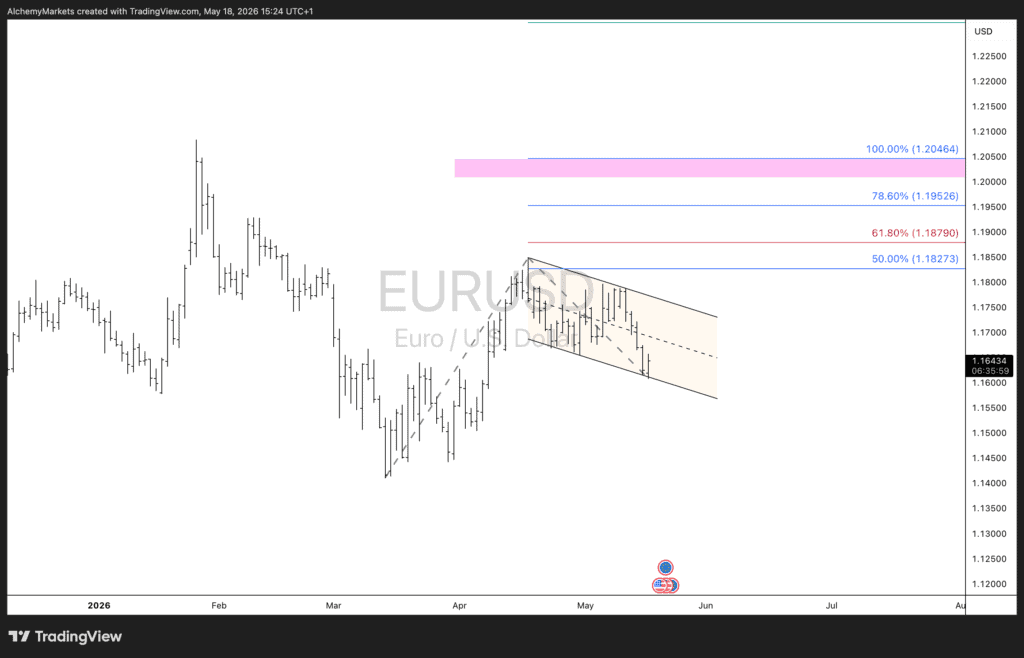
From a technical perspective, EUR/USD is currently trading inside a descending bull flag formation following its impulsive rally earlier this year.
The recent consolidation appears corrective rather than bearish, suggesting the broader uptrend may still be intact.
A confirmed breakout above the upper trendline of the bull flag could trigger a continuation move toward the 1.20 region.
Importantly, the 1.20 level is not just a psychological round number.
It also aligns with:
This confluence adds substantial technical weight to the 1.20 target and strengthens the probability of a larger upside extension if momentum accelerates.
The chart structure suggests that once the bull flag breaks decisively, buyers could quickly target the 1.18 region initially before extending toward 1.20.
Several catalysts could determine whether EUR/USD reaches the 1.20 target:
For now, markets remain heavily positioned toward optimism. But if inflation continues broadening while growth weakens, volatility across FX markets could increase sharply heading into the second half of the year.
The FX market may currently be underestimating the risks associated with stagflationary pressures and geopolitical uncertainty. While the dollar could remain firm in the near term as markets price tighter Fed policy, the broader macro backdrop still points toward eventual dollar weakness later this year.
Technically, EUR/USD remains constructive despite recent consolidation. A breakout from the current bull flag structure could pave the way toward the 1.20 level — a major psychological target that also coincides with the 100% Fibonacci extension and significant horizontal resistance.
If momentum and macro conditions align, EUR/USD could be setting up for one of the market’s most important FX moves of the year.
Alchemy Markets is a multi-asset brokerage providing retail traders with the same elite trading conditions, tools, and transparency typically reserved for institutions.

Select the categories and companies you wish to follow directly to your person rss feed.
Create Custom RSS FeedSign up and join over 5,000 professional members who receive personalized news alerts, curated professional connections, and more for free!
Multi-asset trading broker AvaTrade has agreed to acquire the majority of FXCM Group’s business and brand, in a transaction that would bring a longstanding retail FX franchise into the AvaTrade Group.
LSEG and CMC Markets have signed a multi-year strategic data agreement expanding CMC's access to LSEG's real-time and delayed pricing, reference and corporate actions data, news and analytics, plus AI-ready content, to support new products, entry into new markets and the growth of CMC's institutional and B2B partnerships.
The Tel Aviv Stock Exchange is considering a bid for the Cyprus Stock Exchange, with Israeli media citing its EU licence, trading platform and clearing house. Euronext’s Athens exchange and India’s National Stock Exchange are also seen as contenders, and Cyprus aims to sign a sale agreement by the end of this year.
CME Group will launch baseball futures on 12 October, pending regulatory review, tracking CME FutureSports Performance Indexes built on Official League Data. Standard and micro contracts will start with the 2026 Postseason and the four clubs in the League Championship Series, trading around the clock.
ESMA has published an opinion stating that MiCA-authorised crypto-asset service providers should cease services tied to non-MiCA-compliant stablecoins for EU clients across MiCA crypto-asset services. National authorities should require remediation of existing exposures within three months, by early January 2027.
Nasdaq Ventures has made a strategic investment in Amsterdam-based derivatives and crypto exchange One Trading, with both firms to explore 24/7 trading of equity futures. The undisclosed investment follows Nasdaq's US$100 million investment in Payward, the parent of Kraken, and CME Group's move to 24/7 trading.
cTrader has opened multi-platform plugins to brokers and prop firms, which can pre-install their own tools for clients or list them in cTrader Store. The plugins run across Mobile, Web, Windows and Mac, and can be built and launched independently of core-platform releases, including trading journals and calculators.
Institutional brokerage and financial infrastructure provider Clear Street has joined TradingView’s broker network, allowing its clients to trade US stocks, exchange-traded funds and options directly through the charting and analysis platform.
Learn how to improve trading psychology, manage fear and greed, avoid revenge trading, and follow your trading strategy with discipline and a trading journal.
GTC Prime has announced a strategic partnership with Centroid Solutions to manage and distribute its liquidity through CS 360 Bridge, Centroid's multi-asset connectivity and execution engine, giving brokers and institutional clients access to tailor-made pricing, low-latency execution and real-time risk management.