just now

Liquidity Finder Ltd is incorporated in England and Wales, company number 10610740, registered address 167-169 Great Portland Street, Fifth Floor, London W1W 5PF, United Kingdom.
Published: just now

Category: Retail Brokers · Institutional FX · FinTech Read time: 6 min
The FX market has a habit of punishing brokers twice.
First during the spike — when positions move against the book faster than anyone can react. And then during the recovery — when the calm returns, controls are relaxed, and the next move arrives before the desk has finished processing the last one.
May 2026 is the second phase. And it deserves more attention than it is getting.
April was dramatic. Iran. Tariff whiplash. The dollar posting its worst quarterly performance since 1985. EUR/USD moving 400 pips in a single session. Gold through $3,000 and beyond.
May looks quieter on the surface. Spot FX volumes have retreated from March's war-driven peaks following the Iran ceasefire. EUR/USD has found a range. Volatility indices are easing.
But look closer and the picture is more complicated.
The US Producer Price Index just printed at 6% — the hottest reading in nearly four years. That is not a calm market signal. That is a market that has not yet decided what it believes about inflation, the Federal Reserve, and the trajectory of US rates. Gold, having run to historic highs, is now correcting sharply — falling toward the $4,500 region as the dollar strengthens and Treasury yields rise. The 30-year US bond yield briefly touched 5.1%, its highest since May 2025. New Fed chair Kevin Warsh is an unknown quantity. The Strait of Hormuz remains a live variable.
This is not stability. This is a market holding its breath.
Here is the question that tends to get asked after the fact, not before:
When your dealing desk was managing the April spike — what percentage of your risk controls were automated, and what percentage required a human to be present and watching?
Most brokers, if they answer honestly, will admit the number is lower than it should be. The morning check still involves opening multiple MT4 Manager windows. The hedge trigger still requires a dealer to see the exposure, make a decision, and execute it manually. The spread widening rules around news events are still set manually before each session.
This is not a criticism. It is a description of how most dealing desks in the industry were built. The infrastructure was designed for a market that moved at a different speed.
The market no longer moves at that speed.
1. Platform consolidation is accelerating
OANDA Japan announced this week that it will discontinue MT4 and MT5 Web Terminal services on May 31, 2026. This is a single data point, but it reflects a broader pattern: the MT4/MT5 ecosystem is undergoing structural change. Brokers who have built risk management workflows around specific platform interfaces are facing a period where those interfaces are shifting.
For dealing desks, this means now is the right moment to audit which risk controls are platform-dependent and which are genuinely infrastructure-level. Controls that live inside a platform interface are fragile. Controls that operate at the data layer — across all platforms simultaneously — are not.
2. The gold trade has reversed sharply
Gold hit an all-time high of $5,589 in January 2026, powered by geopolitical fear and dollar weakness. It is now correcting sharply — trading around $4,538 today, its lowest since late March. This matters for broker risk desks because gold became, during the Iran crisis period, the instrument of choice for the exact type of retail momentum trader that creates the most challenging B-book flow. High win rates. Short durations. Concentrated entries around macro events.
As gold corrects, this flow shifts. The traders who were systematically profitable on long gold positions are now in a different environment. Some will adapt. Some will become unprofitable. Some will shift to other instruments and carry the same behavioural patterns with them. Routing decisions made during the gold run need to be revisited.
3. The dollar is strengthening — and that changes everything about retail flow direction
For most of 2026, retail FX sentiment has been structured around dollar weakness. Brokers with B-book exposure to USD pairs have benefited from retail clients who were consistently on the wrong side of that trade. A dollar that is now strengthening — driven by hot PPI, rising yields, and a hawkish Fed pivot — reverses that dynamic. The clients who were losing are now potentially winning. The exposure profile of the book has changed.
This is exactly the kind of structural shift that manual B-book management misses until it has already cost money.
The brokers who navigated April without material damage share a common characteristic: their risk infrastructure was operating continuously, not reactively.
Automated hedge triggers that execute without waiting for a dealer to notice. Real-time exposure monitoring that surfaces position changes as the market moves, not at the end of the session. Client scoring that updates continuously — so that when the gold trade reverses and a previously unprofitable client starts winning, the routing logic catches it before the exposure builds.
This is not a technology argument for its own sake. It is a practical observation about the gap between the speed at which risk materialises in 2026 and the speed at which manual dealing desk workflows can respond.
That gap is where brokers lose money.
The market calendar for the week of May 19 illustrates exactly why "fragile stability" is the right description. FOMC minutes release on May 20. PMI data for manufacturing and services on May 21. University of Michigan inflation expectations on May 22. Any one of these, in the current environment, is capable of moving EUR/USD by 80 pips in a session.
Over the weekend, drone strikes targeted energy infrastructure in the Persian Gulf — including a nuclear facility in the UAE. Oil prices are rising again. The Iran-US stalemate continues, with Tehran and Washington deadlocked on nuclear terms. Gold, already under pressure from dollar strength and hawkish Fed expectations, is now caught between two competing forces: inflation pressure pushing it down, and geopolitical fear pushing it up. It is trading around $4,558 today — its lowest since late March.
For a broker dealing desk, this is not a quiet week. It is a week where automated controls either earn their place or prove their absence.
The calm of May was real. It lasted about ten days.
For dealing desks, the question is not whether to prepare. It is whether to prepare now, or explain later why you didn't.
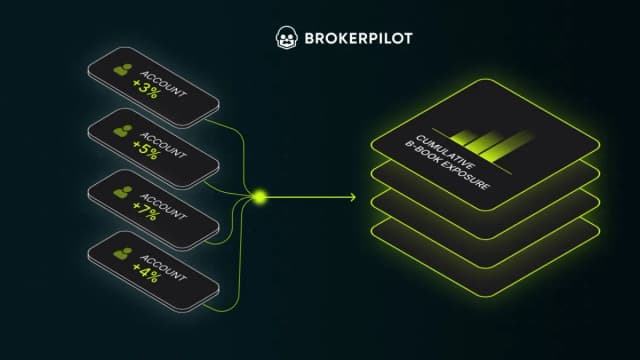
BrokerPilot provides real-time risk management and dealing automation for FX and CFD brokers on MT4, MT5 and cTrader. If you want to understand what continuous, automated risk infrastructure looks like in practice — we are happy to walk you through it.
Brokerpilot is a SaaS risk management platform for multi-asset brokers. It helps monitor trade servers, detect fraud, and automate reporting to enhance dealing transparency and operational control.

Select the categories and companies you wish to follow directly to your person rss feed.
Create Custom RSS FeedSign up and join over 5,000 professional members who receive personalized news alerts, curated professional connections, and more for free!
Multi-asset trading broker AvaTrade has agreed to acquire the majority of FXCM Group’s business and brand, in a transaction that would bring a longstanding retail FX franchise into the AvaTrade Group.
LSEG and CMC Markets have signed a multi-year strategic data agreement expanding CMC's access to LSEG's real-time and delayed pricing, reference and corporate actions data, news and analytics, plus AI-ready content, to support new products, entry into new markets and the growth of CMC's institutional and B2B partnerships.
The Tel Aviv Stock Exchange is considering a bid for the Cyprus Stock Exchange, with Israeli media citing its EU licence, trading platform and clearing house. Euronext’s Athens exchange and India’s National Stock Exchange are also seen as contenders, and Cyprus aims to sign a sale agreement by the end of this year.
CME Group will launch baseball futures on 12 October, pending regulatory review, tracking CME FutureSports Performance Indexes built on Official League Data. Standard and micro contracts will start with the 2026 Postseason and the four clubs in the League Championship Series, trading around the clock.
ESMA has published an opinion stating that MiCA-authorised crypto-asset service providers should cease services tied to non-MiCA-compliant stablecoins for EU clients across MiCA crypto-asset services. National authorities should require remediation of existing exposures within three months, by early January 2027.
Nasdaq Ventures has made a strategic investment in Amsterdam-based derivatives and crypto exchange One Trading, with both firms to explore 24/7 trading of equity futures. The undisclosed investment follows Nasdaq's US$100 million investment in Payward, the parent of Kraken, and CME Group's move to 24/7 trading.
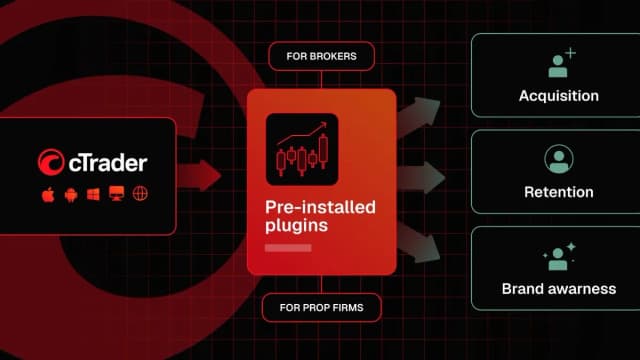
cTrader has opened multi-platform plugins to brokers and prop firms, which can pre-install their own tools for clients or list them in cTrader Store. The plugins run across Mobile, Web, Windows and Mac, and can be built and launched independently of core-platform releases, including trading journals and calculators.
Institutional brokerage and financial infrastructure provider Clear Street has joined TradingView’s broker network, allowing its clients to trade US stocks, exchange-traded funds and options directly through the charting and analysis platform.
Learn how to improve trading psychology, manage fear and greed, avoid revenge trading, and follow your trading strategy with discipline and a trading journal.
GTC Prime has announced a strategic partnership with Centroid Solutions to manage and distribute its liquidity through CS 360 Bridge, Centroid's multi-asset connectivity and execution engine, giving brokers and institutional clients access to tailor-made pricing, low-latency execution and real-time risk management.