
just now


Liquidity Finder Ltd is incorporated in England and Wales, company number 10610740, registered address 167-169 Great Portland Street, Fifth Floor, London W1W 5PF, United Kingdom.
Published: just now

As we head into a week packed with major central bank meetings, global markets are bracing for a cautious tone from policymakers. The Federal Reserve, European Central Bank (ECB), Bank of England (BoE), and Bank of Canada (BoC) are all widely expected to leave interest rates unchanged, but guidance around inflation risks and the timing of future rate cuts could still trigger significant volatility across FX markets.
Rising energy prices, ongoing geopolitical tensions, and still-resilient economic growth are forcing central banks to walk a delicate line. While inflation has cooled from its peak, the risk of it reaccelerating above target levels means policymakers may keep rates higher for longer.
Below is a breakdown of what to watch this week — and how GBP/USD and EUR/USD technical setups could react.
The Federal Reserve is widely expected to hold interest rates steady this week.
Recent economic data has shown some cooling in the labour market, with job creation slowing and unemployment edging higher. However, the broader economy continues to demonstrate resilience, keeping policymakers cautious about cutting rates too quickly.
One major concern is the recent rise in energy prices, which could push inflation back above the 3% level. Because of this risk, the Fed may signal that rate cuts could be pushed further into the future, with markets beginning to consider the possibility that meaningful easing may not arrive until much later than previously expected.
Markets will be particularly focused on:
A more hawkish tone could strengthen the US dollar across the board.
The ECB is also expected to keep interest rates unchanged.
Like the Fed, policymakers are facing renewed inflation risks, largely due to rising energy prices and geopolitical tensions in the Middle East. Energy inflation historically feeds quickly into broader price pressures across the eurozone.
Because of this backdrop, the ECB may adopt a more cautious and hawkish stance, reinforcing the idea that they remain ready to tighten policy again if inflation proves persistent.
Markets will watch for:
The Bank of England is also expected to leave rates unchanged, with policymakers likely to emphasize continued caution.
Earlier expectations for a March rate cut have largely faded, primarily due to the same global factor affecting other economies: rising energy costs.
Instead of focusing on the decision itself, markets will closely monitor the vote split within the Monetary Policy Committee.
Key focus:
If more policymakers than expected vote for cuts, markets could interpret that as a dovish signal, potentially weakening the pound.
The Bank of Canada is also expected to leave interest rates unchanged at its upcoming meeting, as policymakers continue to balance cooling domestic growth with persistent inflation risks.
While Canadian inflation has eased from its peak, the recent rise in global energy prices could slow the disinflation process. Energy costs feed directly into Canada’s inflation outlook, particularly through fuel and transportation prices.
Because of this, the Bank of Canada is likely to maintain a wait-and-see approach, keeping policy restrictive while monitoring incoming economic data.
Officials have previously signalled that the current policy stance is already sufficiently restrictive, suggesting there is little urgency to adjust rates unless economic conditions shift materially.
Markets will be watching closely for:
If the Bank maintains a more cautious tone, it would reinforce the broader global theme emerging this week — central banks remaining patient before moving toward policy easing.
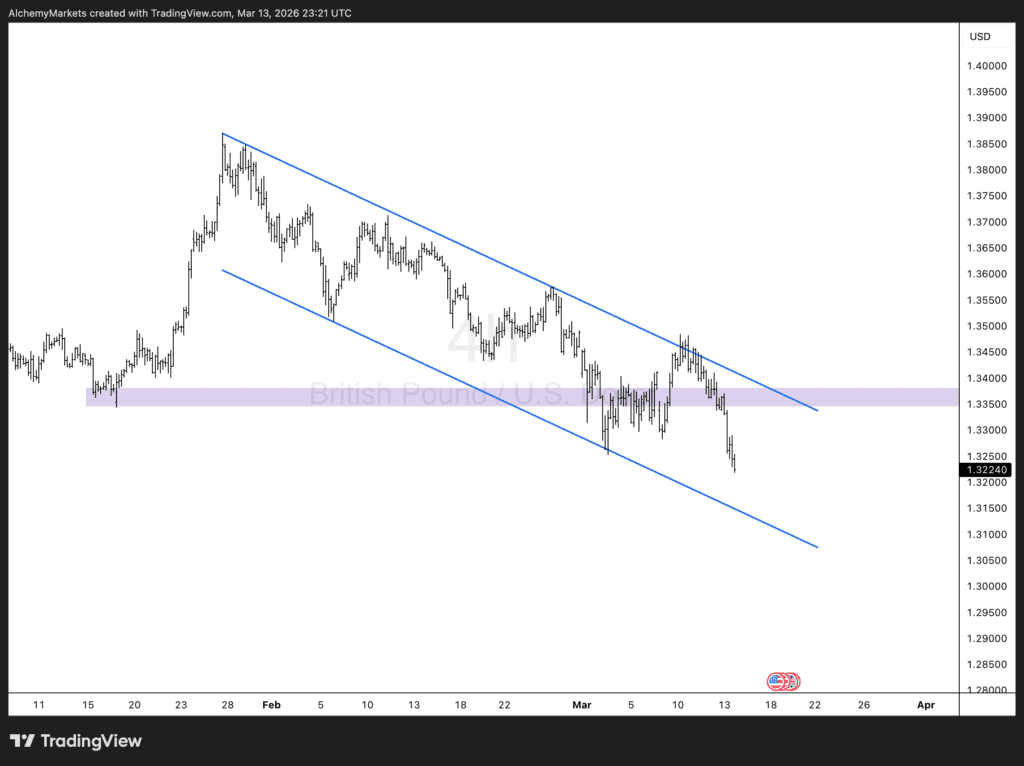
From a technical perspective, GBP/USD remains firmly within a descending channel, highlighting the broader bearish structure that has developed over recent weeks.
Price action has consistently respected both the upper resistance trendline and the lower support boundary of the channel.
Recently, the pair attempted a short-term recovery, briefly retesting the mid-to-upper portion of the channel before facing rejection. This suggests that sellers remain in control of the broader trend.
The latest breakdown through the horizontal support zone reinforces the bearish momentum.
If central banks maintain rates and the Federal Reserve delivers a relatively hawkish message, the US dollar could strengthen further. In that case, GBP/USD may continue its move toward the lower boundary of the descending channel.
This lower trendline could act as a technical support area, where buyers may step in and slow the decline.
For now, the structure favors continued downside pressure unless the pair can reclaim the broken support zone.
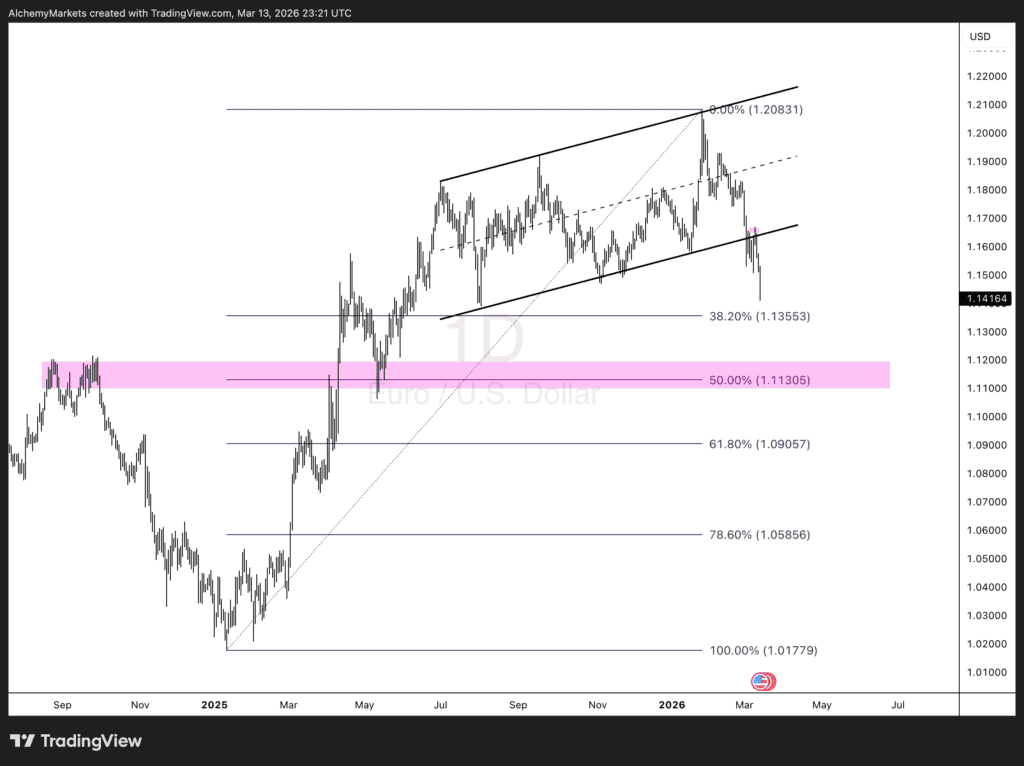
The EUR/USD technical picture has recently shifted bearish after the pair broke below its ascending channel.
For months, the pair had been trending higher within this structure, but the breakdown suggests a loss of bullish momentum and a potential deeper correction.
Once a channel breaks, price often seeks out the next major Fibonacci retracement level of the prior trend.
The next significant support sits near the 50% retracement level around 1.113, which also aligns with a major horizontal support zone.
This type of confluence — where Fibonacci levels and historical support intersect — often attracts strong market attention.
The 1.113 area represents:
If bearish momentum continues following the ECB meeting, EUR/USD may gradually move toward this area.
A move toward this level would represent a healthy correction within the broader trend, rather than a full structural reversal.
Several macro themes could drive FX markets:
1. Central Bank Messaging
Even if rates remain unchanged, forward guidance will be key.
2. Energy Prices
Rising oil prices could reignite inflation concerns globally.
3. Geopolitical Risk
Tensions in the Middle East could continue impacting energy markets and risk sentiment.
4. US Dollar Strength
If the Fed signals higher rates for longer, the USD may remain supported.
This week’s central bank meetings may not deliver rate changes, but the tone from policymakers could still drive major currency moves.
With macro uncertainty rising and inflation risks re-emerging, the FX market could see increased volatility as traders reassess the timing of global rate cuts.
Alchemy Markets is a multi-asset brokerage providing retail traders with the same elite trading conditions, tools, and transparency typically reserved for institutions.

Select the categories and companies you wish to follow directly to your person rss feed.
Create Custom RSS Feed
just now
Sign up and join over 5,000 professional members who receive personalized news alerts, curated professional connections, and more for free!
Why did gold keep falling after reaching $3,880? See how a failed 4-hour retest confirmed weakness in XAUUSD and why $3,400 is the next weekly support to watch.
Reality television personality Aaron Chalmers and finfluencer Jason Agbodza have been fined after pleading guilty to illegally promoting an unauthorised foreign exchange trading scheme on social media.
UK retail sales rose a stronger-than-expected 0.7% in October, giving sterling some support, while a deepening tech sell-off pushed the dollar lower overnight against all major currencies. Thanim Islam, Head of FX Analysis at Equals, says the dollar remains in charge as the week ends, with the Fed expected to raise rates more than both the Bank of England and the ECB.
Nvidia beats expectations, reporting $115.8bn in revenue and raising its long-term growth outlook, but the stock still struggled to sustain its gains. AI remains fundamentally strong, but investor expectations are becoming more demanding, particularly around capex and profitability. Wall Street suffered a major sell-off, with the S&P 500 entering a six-session losing streak as rate concerns intensified.
iSAM Securities reviews the ris of weekend gold trading
Webull Corporation reported record third quarter 2026 revenue of $218.7 million, up 39% year-on-year, with customer assets reaching $32.4 billion and options contracts volume up 79%. Net income attributable to the company was $31.2 million, while margin debit balances passed $1 billion for the first time.
Anthropic, the company behind the Claude family of AI models, begins trading on the Nasdaq today under the ticker ANT. It priced its shares at $83 last night, above its marketed range of $70 to $78, and raised about $81.3 billion. That makes it the largest initial public offering on record, ahead of the roughly $75 billion SpaceX raised in June. This note covers what investors need to know: the terms, the business, how the company is governed, and what to watch.
Nvidia's first results without Jensen Huang answered the question that has hung over the AI trade since October. Revenue of $115.8 billion beat consensus by about $7 billion, fourth-quarter guidance of $130 billion came in roughly $5 billion above expectations, and the company raised its outlook for next fiscal year to around 75% growth. All of this assumes no data-centre sales to China.
Marex has entered the football financing market through a partnership with specialist sports investment and advisory firm Pinto Capital, targeting clubs in the Premier League and EFL Championship.
Around 110,000 UK retail investors have secured $300 million worth of Anthropic shares in its record-breaking $81 billion IPO. The heavily oversubscribed offer, coordinated by RetailBook, saw smaller investors prioritised, with 63% of applicants receiving their full allocation.