just now


Liquidity Finder Ltd is incorporated in England and Wales, company number 10610740, registered address 167-169 Great Portland Street, Fifth Floor, London W1W 5PF, United Kingdom.
Published: just now

The Hang Seng Index (HSI) has been rallying hard since mid-2025, and perhaps now it’s time for the rally to reach its crescendo.
Looking back over the last five years, Chinese New Year has always preceded a significant pivot on the Hang Seng Index.
That alone does not mean Chinese New Year causes reversals… but it is worth mentioning that 4 out of the 5 last CNY celebrations marked the beginning of a significant pivot.
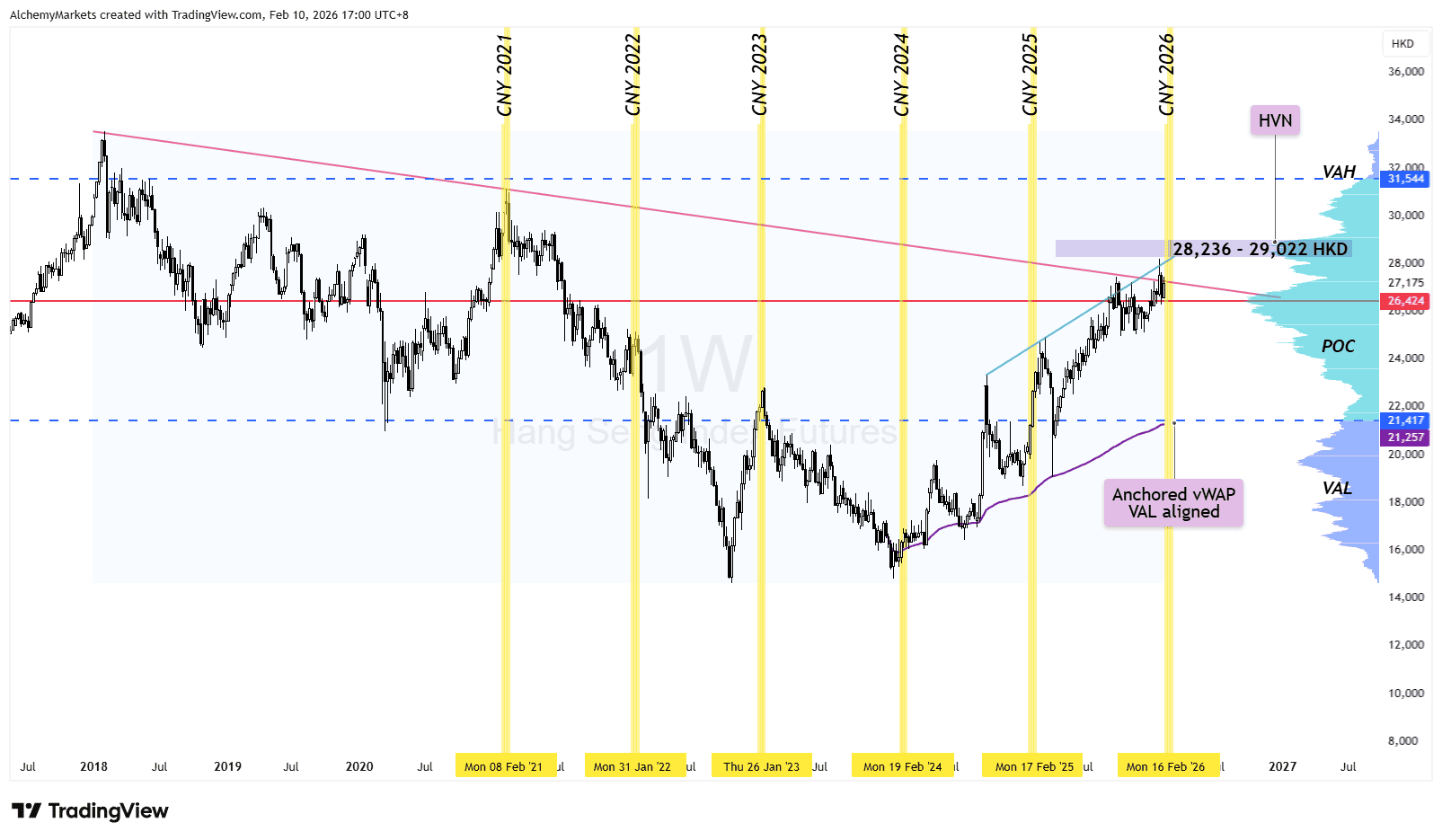
The market has repeatedly reached moments of reassessment around this period.
So now the core question is simple: Is the Hang Seng approaching another pivot as Chinese New Year approaches?
The setup heading into Chinese New Year 2026 feels familiar. The Hang Seng has rallied strongly. Momentum remains positive, but the pace has slowed, and we are heading into clear overhead resistance (in a multiyear trendline).
This is the kind of environment where past pivots have tended to emerge. While an immediate reversal isn’t guaranteed, it does suggest that trend continuation becomes less forgiving.
We recommend watching how the CNY weekly candles develop; if the candlestick for CNY 2026 is bearish on the final week, or the week after. The likelihood for a bearish reversal increases.
Due to the historically large reversal nature of CNY, a target to watch would be $21,417 HKD. This is where the Value Area Low of the volume profile since 2018, and the anchored vWAP support from Feb 2024 aligns.
Looking at the chart, the relationship between the Hang Seng and the S&P 500 becomes clearer once we separate local pivots from global stress.
The black and white price action (HSI) shows pronounced pivots around each Chinese New Year. The blue line (SPX), however, behaves very differently depending on the underlying conditions.
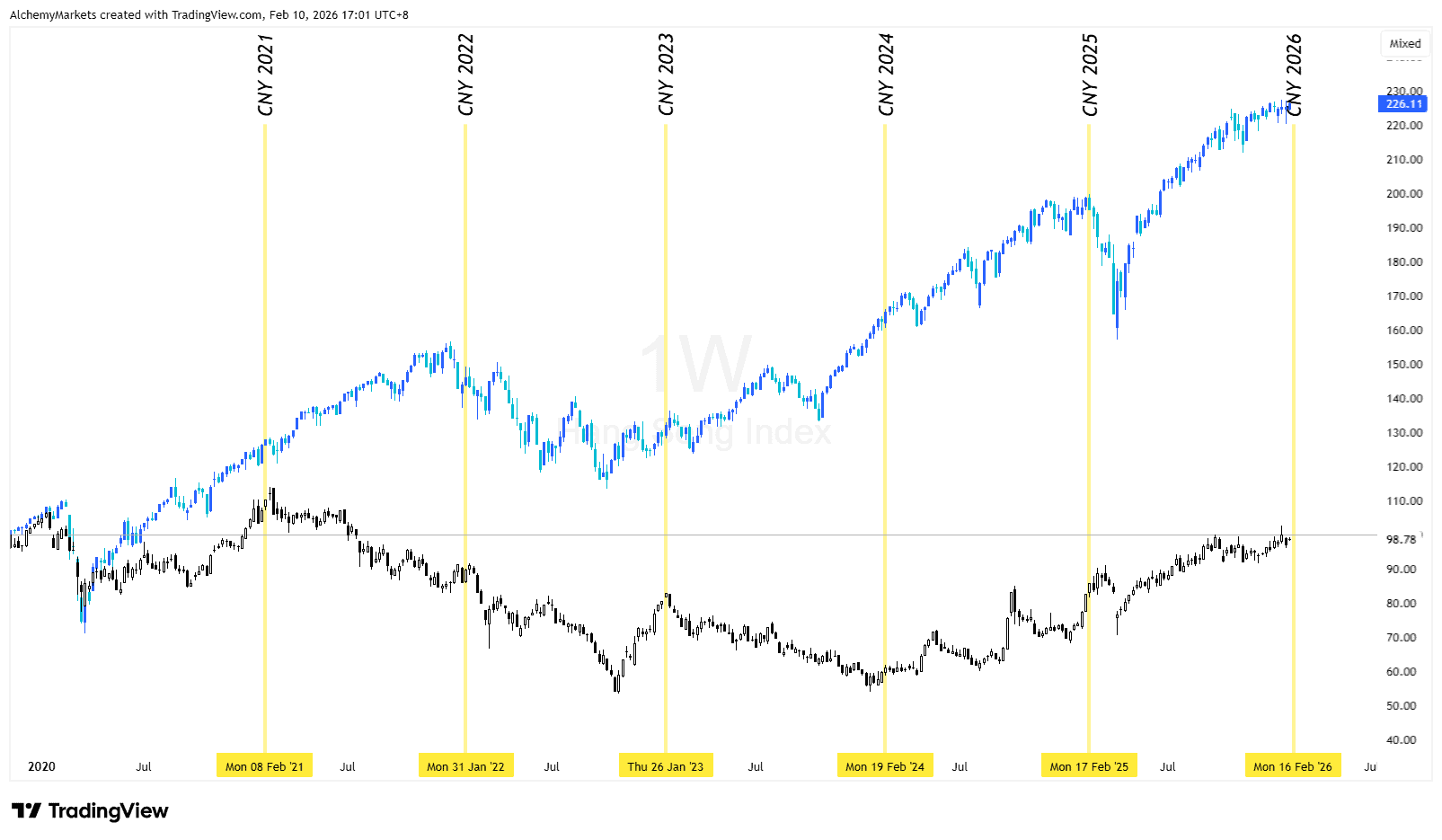
In 2021, the Hang Seng rolled over sharply after Chinese New Year as regulatory pressure hit domestic technology firms. The SPX, shown in blue, continued higher with little interruption. The divergence is obvious on the chart.
This was a period where China risk was policy-driven and contained. It mattered deeply for Hong Kong equities, but it did not force US investors to reprice growth, earnings, or financial conditions.
A similar dynamic played out in 2024. The Hang Seng pivoted higher after Chinese New Year following policy support and liquidity measures. The SPX continued its own trend, largely unaffected. Again, China's risk remained local.
The picture changes in 2022 and 2025.
In 2022, both the Hang Seng and the SPX weakened around the Chinese New Year period. This was not because of China alone, but because both markets were responding to shared macro pressure, tighter financial conditions, and rising geopolitical risk. The correlation increased, but only temporarily.
In 2025, the delayed Hang Seng reversal after Chinese New Year coincided with renewed trade and tariff tensions. This time, the SPX did react. The blue line softened as global growth expectations and trade-sensitive sectors came under pressure.
In these cases, the Hang Seng acted as a pressure gauge for China risk, and that pressure was no longer confined to domestic factors. Trade and technology conflict forced a broader repricing.
Heading into Chinese New Year 2026, the Hang Seng is extended after a strong rally, while the SPX remains near highs. However, the nature of China's risk today looks closer to localised pressure than systemic stress.
That does not eliminate spillover risk to American markets, but it lowers the probability.
DISCLAIMER: For educational purposes only. Trading comes with substantial risk, leading to possible loss of your capital. Traders are advised to do their own due diligence before investing.
Alchemy Markets is a multi-asset brokerage providing retail traders with the same elite trading conditions, tools, and transparency typically reserved for institutions.

Select the categories and companies you wish to follow directly to your person rss feed.
Create Custom RSS FeedSign up and join over 5,000 professional members who receive personalized news alerts, curated professional connections, and more for free!
Finance Magnates Summit London returns to Old Billingsgate on 24 November 2026 for its 15th edition. The one-day event brings together brokers, liquidity providers, institutional firms, trading technology vendors, payments businesses and digital asset firms.
iSAM Securities Apex has integrated with Match-Prime, giving brokers access to liquidity across more than 2,000 instruments, with tailored pricing and up to 10 levels of market depth.
propfunding.com's free-entry instant funding changes the order of prop funding. Start trading first. Its free-entry instant funding model offers two qualification attempts without an upfront activation fee.
US stocks closed higher on Wednesday, with the Nasdaq gaining 1%, the S&P 500 rising 0.6%, and the Dow advancing 0.7%, as renewed enthusiasm for AI-related stocks lifted market sentiment.
SpaceX went public in June as a rocket company. On October 20 it reported as something else entirely: an AI infrastructure business, financed by a satellite broadband network, with a launch division attached. Rockets generated 12% of third quarter revenue and lost money. The AI segment generated 52% of revenue and consumed 84% of capital expenditure. Starlink generated 85% of operating profit.
Standard Chartered has signed definitive agreements to acquire 100% of Zodia Custody UK Limited, folding its regulated digital asset custody business into Securities Services. Zodia Solutions will be set up under SC Ventures with bank investors including Northern Trust, NAB Ventures, Emirates NBD and Investcorp.
Bybit Fintech FZE has secured a Virtual Asset Service Provider licence from Dubai’s Virtual Assets Regulatory Authority for Exchange Services, covering spot trading. Bybit’s Peter Loo said the firm hopes to add derivatives, subject to regulatory approvals. Its international Dubai headquarters opened in 2022.
ATFX Connect has released its Q4 2026 Institutional Edge, examining the geopolitical, monetary policy and fiscal pressures shaping global financial markets in the final quarter of the year.
The Nasdaq 100 is trading at 29,382. After reaching a recent high of 29,957, the index reversed sharply and has been recording a series of lower highs and lower lows.
FM Summit London returns to Old Billingsgate on 24 November 2026 for its 15th edition, with a curated one-day format aimed at senior executives. LMAX Group, Plus500, oneZero and MetaQuotes are among confirmed exhibitors, with Business Connect meetings, roundtables and an opening event at The Folly on 23 November.