just now


Liquidity Finder Ltd is incorporated in England and Wales, company number 10610740, registered address 167-169 Great Portland Street, Fifth Floor, London W1W 5PF, United Kingdom.
Published: just now

From my perspective, this was not about signaling a pivot or even a confirmation of policy success. It was about optionality.
The ECB is choosing to stay data-dependent, flexible, and strategically quiet heading into a summer that could significantly reshape the European macro landscape.
The latest data paints a nuanced picture. On one hand, short-term growth expectations have improved marginally.
Industrial production suggests that the eurozone may have skirted a deeper Q2 slowdown, and PMI releases point to some resilience as we step into the second half of the year. The manufacturing shows lot of resilience, as it stand in the 50 area.
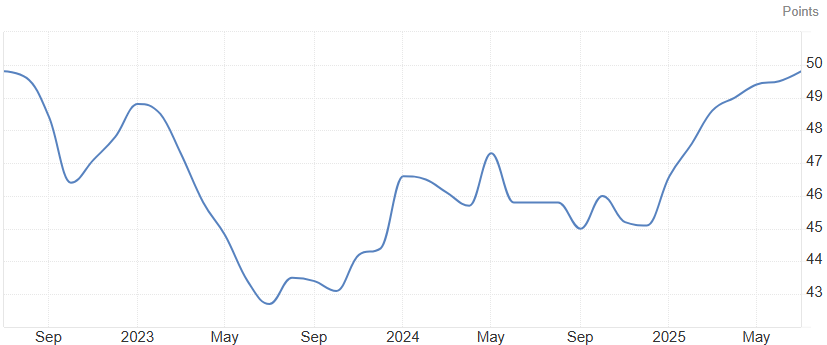
But on the other hand, there are visible cracks forming under the surface. Wage growth is softening. Labour market momentum is starting to cool.
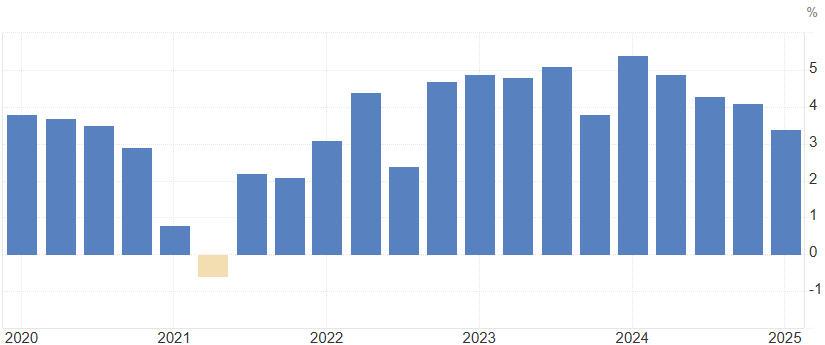
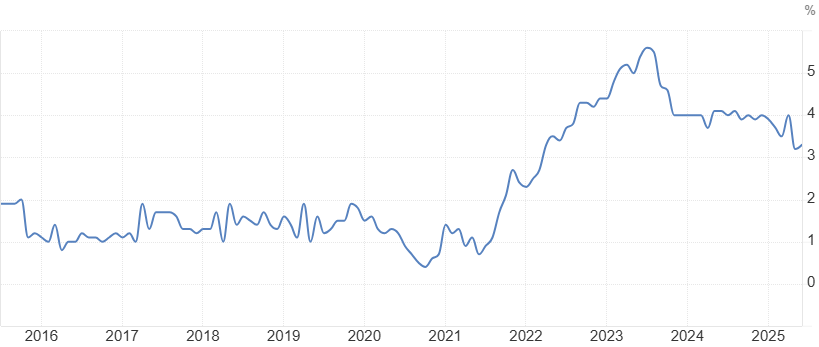
Services inflation once the stubborn outlier is also showing signs of easing. This isn’t the end of the inflation fight, but it’s a moment of recalibration.
One of the key narratives I’m watching is the potential for a trade agreement between the EU and the US.
While the ECB was quick to call current negotiations “conjecture,” markets are already starting to price in optimism.
If a deal is reached particularly one that caps reciprocal tariffs at or below the 15% mark being discussed it could reduce external uncertainty dramatically.
Why does that matter? Because trade friction has been one of the core variables driving risk premiums and growth revisions in the eurozone.
A resolution here could, in theory, provide just enough macro relief to delay or even eliminate further rate cuts. But let’s not get ahead of ourselves the durability and details of any deal will be critical.
The euro’s behavior has been fascinating. It started strengthening ahead of the ECB meeting and has largely maintained that momentum.
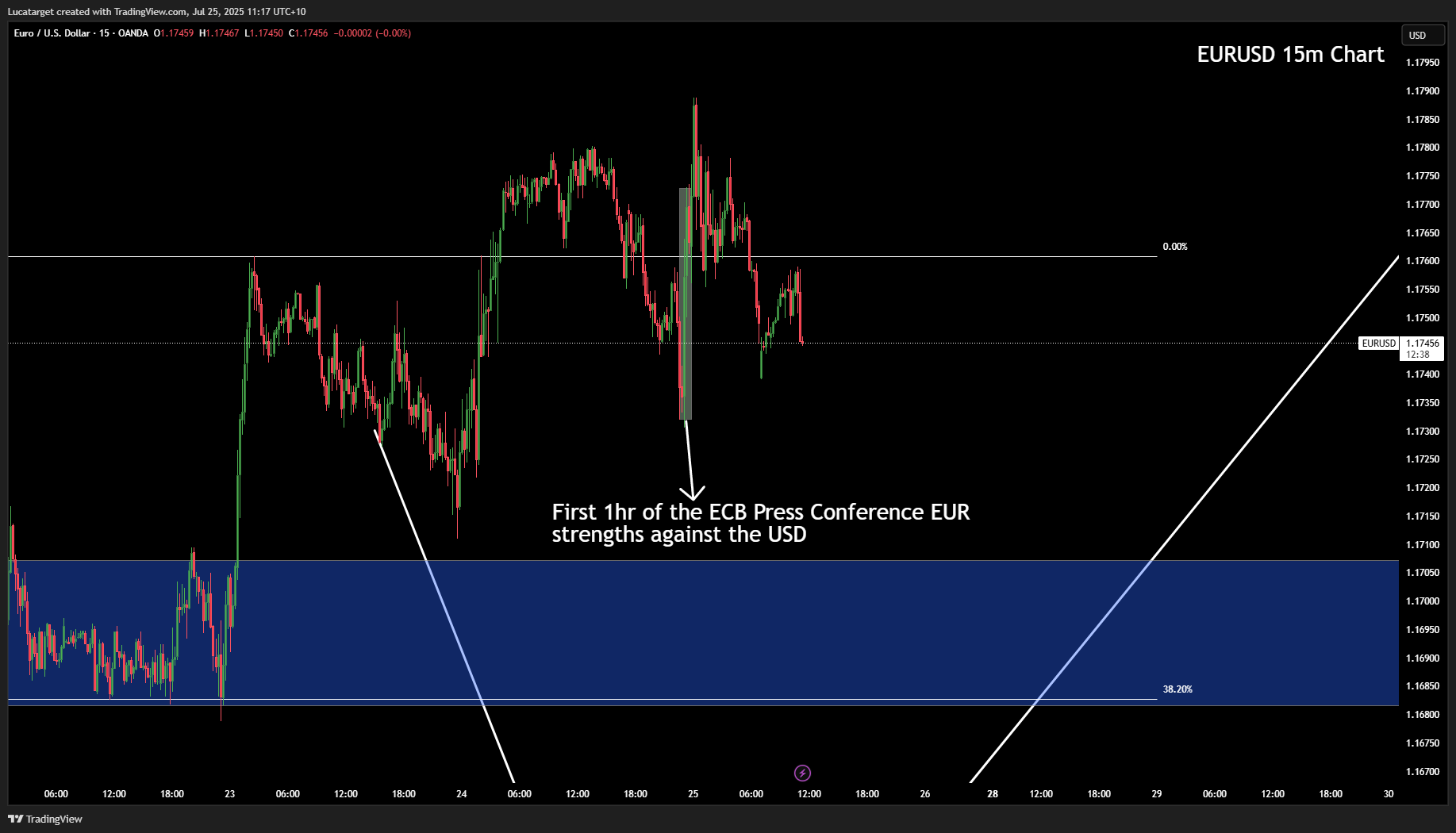
In my view, the lack of strong pushback from the ECB against euro strength says a lot. While President Lagarde noted they “monitor exchange rates,” it’s clear that the ECB isn’t particularly uncomfortable with current levels.
That said, a stronger euro can be a double-edged sword. On the one hand, it helps dampen imported inflation supportive of the disinflation narrative.
But on the other, it could make the ECB’s life more complicated if it triggers weaker export performance or premature tightening of financial conditions.
The balance is delicate, and it will only become more so if the euro breaks to new highs.
While the July decision felt like a non-event on the surface, the real inflection point will be in September. By then, we’ll have fresh data on wage growth, inflation, and potentially, the resolution (or escalation) of trade negotiations with the US.
Personally, I think policymakers are hoping to use the summer as a buffer letting the data speak while avoiding premature commitments.
If inflation undershoots and expectations keep drifting lower, the argument for at least one more cut remains strong. But a benign trade outcome could blunt that urgency.
To me, the ECB isn’t pivoting. It’s waiting. And that’s not a sign of weakness it’s strategic.
The risks ahead are still real, from potential supply chain disruptions to political volatility in the US.
But for now, the central bank appears content to let the current policy stance breathe, watching how the eurozone and the global economy navigates the next few months.
The next meeting may bring the clarity everyone’s waiting for. Until then, this pause is less about policy fatigue and more about creating space to reassess.
And in these markets, patience might just be the most powerful tool the ECB has left.
1. Why did the ECB kept the rates unchanged in July 2025?
The ECB paused its rate hikes primarily to preserve flexibility. Although inflation is easing and growth has shown modest resilience, the overall macro landscape remains uncertain particularly with ongoing trade negotiations between the EU and the US. The ECB maintained its data-dependent stance, choosing not to pre-commit before more evidence becomes available in the coming months.
2. What role do EU-US trade talks play in the ECB’s decision-making?
The potential for a trade agreement between the EU and the US is a key macro variable. If tariffs are capped at levels close to current assumptions (around 10–15%), that could reduce economic uncertainty and ease downside risks. However, the ECB isn’t factoring in an outcome just yet they’re waiting for official confirmation before adjusting the policy trajectory.
3. How has the euro reacted to the ECB’s latest announcement?
The euro has continued its upward trend, supported by growing optimism around a possible trade deal. Interestingly, the ECB didn’t push back hard against this strength. While President Lagarde noted the importance of monitoring exchange rates, the lack of strong resistance implies that current levels are not a policy concern at least for now.
4. What economic signals is the ECB watching most closely right now?
The ECB is closely monitoring wage growth, services inflation, and labour market conditions. Recent data suggests that domestic price pressures are easing and wage growth is slowing both of which support the disinflation narrative. These metrics, along with Q2 inflation and updated projections, will be key inputs for the September meeting.
5. Could we still see more rate cuts this year from the ECB?
Yes, but it depends on how the data evolves. If inflation continues to undershoot expectations and economic uncertainty remains elevated, another rate cut is likely. However, if a trade deal materializes and stabilizes the outlook, the ECB may scale back its easing path. As of now, markets are pricing in a very modest chance of additional cuts signaling growing confidence in a policy pause.
This content may have been written by a third party. ACY makes no representation or warranty and assumes no liability as to the accuracy or completeness of the information provided, nor any loss arising from any investment based on a recommendation, forecast or other information supplies by any third-party. This content is information only, and does not constitute financial, investment or other advice on which you can rely.
ACY Securities is one of Australia's fastest growing multi-asset online trading providers, offering ultra-low-cost trading, rock-solid execution, technologically superior account management and premium market analysis.

Select the categories and companies you wish to follow directly to your person rss feed.
Create Custom RSS FeedSign up and join over 5,000 professional members who receive personalized news alerts, curated professional connections, and more for free!
Standard Chartered has signed definitive agreements to acquire 100% of Zodia Custody UK Limited, folding its regulated digital asset custody business into Securities Services. Zodia Solutions will be set up under SC Ventures with bank investors including Northern Trust, NAB Ventures, Emirates NBD and Investcorp.
Bybit Fintech FZE has secured a Virtual Asset Service Provider licence from Dubai’s Virtual Assets Regulatory Authority for Exchange Services, covering spot trading. Bybit’s Peter Loo said the firm hopes to add derivatives, subject to regulatory approvals. Its international Dubai headquarters opened in 2022.
ATFX Connect has released its Q4 2026 Institutional Edge, examining the geopolitical, monetary policy and fiscal pressures shaping global financial markets in the final quarter of the year.
The Nasdaq 100 is trading at 29,382. After reaching a recent high of 29,957, the index reversed sharply and has been recording a series of lower highs and lower lows.
FM Summit London returns to Old Billingsgate on 24 November 2026 for its 15th edition, with a curated one-day format aimed at senior executives. LMAX Group, Plus500, oneZero and MetaQuotes are among confirmed exhibitors, with Business Connect meetings, roundtables and an opening event at The Folly on 23 November.
GCEX has launched European-style, fiat-settled options on Bitcoin and Ethereum with monthly expiries for eligible professional and institutional clients. The service runs through the GCEX OTC desk, with pricing from Tier 1 liquidity providers and reporting on XplorPortal. GC Exchange Limited is authorised by the UK FCA
Wall Street closed mostly higher on Tuesday, led by a nearly 1% gain in the Dow. In Asia, South Korea’s Kospi rebounded 2.7% and Japan’s Nikkei gained 0.8%.
Brent crude is trading at $111.70. The latest price action show the recovery continuing toward $111.70, suggesting that demand has returned after the sharp correction.
FOREX.com has introduced weekend trading for US SP 500 and US Tech 100 CFDs in Japan, operated by StoneX Securities Co., Ltd., a StoneX Group Inc. subsidiary. Investors can manage positions seven days a week, including Saturday and Sunday sessions, without waiting for underlying markets to reopen on Monday.
FINMA has approved Switzerland’s first exchange-traded fund investing directly in Bitcoin, classed as an other alternative investment fund under Swiss law. The regulator cited investor protection and transparency, and warned that Bitcoin investments remain highly risky despite the approval. Others have applied.