just now


Liquidity Finder Ltd is incorporated in England and Wales, company number 10610740, registered address 167-169 Great Portland Street, Fifth Floor, London W1W 5PF, United Kingdom.
Published: just now


The yen faced a tumultuous period, reaching fresh year-to-date lows and causing unease among financial circles. The currency's stability has come into question after a significant sell-off, propelling USD/JPY to a new high for the year at 149.49. This move brings the pair in proximity to the peak set in November of the previous year at 151.91. Japan's Finance Minister, Suzuki, expressed concern over the yen's renewed weakness, emphasizing the importance of stable FX movements that reflect underlying fundamentals. This suggests growing apprehension among domestic policymakers as they strive to curb yen depreciation with USD/JPY nearing last year's pinnacle.
Last Friday highlighted the yen's decline following a speech by BoJ Deputy Governor Uchida. From Friday to Saturday, BoJ Governor Ueda further addressed the issue, contemplating the continuation of negative rates considering impending price goals. Like Deputy Governor Uchida, he aimed to reassure markets that financial conditions would remain accommodative even after the conclusion of the negative rate policy.
Simultaneously, the International Monetary Fund (IMF) released its staff's concluding statement on their article IV mission to Japan. Acknowledging the BoJ's cautious approach due to Japan's history of deflation, the IMF recognized emerging upside risks to inflation. Factors such as strengthening nominal wages and a closed output gap contributed to their recommendation for the BoJ to consider exiting Yield Curve Control (YCC) and concluding Quantitative and Qualitative Easing (QQE), followed by a gradual increase in short-term policy rates. The IMF stressed the importance of clear communication to anchor market expectations, noting signals from the BoJ indicating a potential removal of negative rates in March or April.
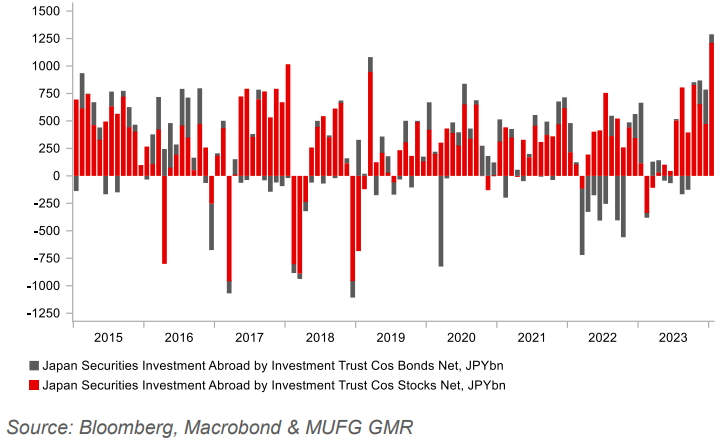
In addition, Japan's Ministry of Finance released portfolio investment flow breakdowns for January, revealing a notable surge in demand for foreign securities by Japanese Investment Trusts. With net purchases of foreign equities reaching a record high JPY1.21 trillion, a stark contrast to the JPY292 billion monthly average in 2023, the data indicates a significant impact of NISA tax-free savings regulation changes on household savings behaviour in Japan.
RECORD DEMAND FOR FOREIGN EQUITIES IN JANUARY
The external factor contributing to USD/JPY's ascent towards last year's highs lies in the unexpected resilience of the US economy. This development introduces uncertainty regarding the timing and depth of potential Fed rate cuts in the coming year. A slower and more measured rate cut cycle by the Fed could alleviate downside risks for USD/JPY in the foreseeable future. The focus now shifts to the release of revised US Consumer Price Index (CPI) data, with market participants closely scrutinizing it for indications of slowing inflation pressures, as suggested by Fed policymakers.
Insights Inspired by MUFG & Bloomberg: Credit to Their Analysis for Shaping Some Aspects of This Text
This content may have been written by a third party. ACY makes no representation or warranty and assumes no liability as to the accuracy or completeness of the information provided, nor any loss arising from any investment based on a recommendation, forecast or other information supplied by any third-party. This content is information only, and does not constitute financial, investment or other advice on which you can rely.
ACY Securities is one of Australia's fastest growing multi-asset online trading providers, offering ultra-low-cost trading, rock-solid execution, technologically superior account management and premium market analysis.

Select the categories and companies you wish to follow directly to your person rss feed.
Create Custom RSS FeedSign up and join over 5,000 professional members who receive personalized news alerts, curated professional connections, and more for free!
Theorem has integrated Symbiotic’s Liquid Lane RFQ network, letting holders of tokenised real-world assets trade against on-chain pool liquidity and market-maker quotes. The integration is live on Ethereum, with Midas’s yield-bearing mHYPER fund as the first supported asset. Holders can trade for the USDC stablecoin.
US equities were volatile with technology selloff erasing much of the earlier rebound.
FM Summit London 2026 returns to Old Billingsgate on 24 November for its 15th edition, with LMAX Group, Plus500 and oneZero among confirmed exhibitors. The one-day event adds Business Connect meetings and roundtables, and opens with a networking evening at The Folly on 23 November.
Finance Magnates Summit London returns to Old Billingsgate on 24 November 2026 for its 15th edition. The one-day event brings together brokers, liquidity providers, institutional firms, trading technology vendors, payments businesses and digital asset firms.
iSAM Securities Apex has integrated with Match-Prime, giving brokers access to liquidity across more than 2,000 instruments, with tailored pricing and up to 10 levels of market depth.
propfunding.com's free-entry instant funding changes the order of prop funding. Start trading first. Its free-entry instant funding model offers two qualification attempts without an upfront activation fee.
US stocks closed higher on Wednesday, with the Nasdaq gaining 1%, the S&P 500 rising 0.6%, and the Dow advancing 0.7%, as renewed enthusiasm for AI-related stocks lifted market sentiment.
SpaceX went public in June as a rocket company. On October 20 it reported as something else entirely: an AI infrastructure business, financed by a satellite broadband network, with a launch division attached. Rockets generated 12% of third quarter revenue and lost money. The AI segment generated 52% of revenue and consumed 84% of capital expenditure. Starlink generated 85% of operating profit.
Standard Chartered has signed definitive agreements to acquire 100% of Zodia Custody UK Limited, folding its regulated digital asset custody business into Securities Services. Zodia Solutions will be set up under SC Ventures with bank investors including Northern Trust, NAB Ventures, Emirates NBD and Investcorp.
Bybit Fintech FZE has secured a Virtual Asset Service Provider licence from Dubai’s Virtual Assets Regulatory Authority for Exchange Services, covering spot trading. Bybit’s Peter Loo said the firm hopes to add derivatives, subject to regulatory approvals. Its international Dubai headquarters opened in 2022.