

just now


Liquidity Finder Ltd is incorporated in England and Wales, company number 10610740, registered address 167-169 Great Portland Street, Fifth Floor, London W1W 5PF, United Kingdom.
Published: just now
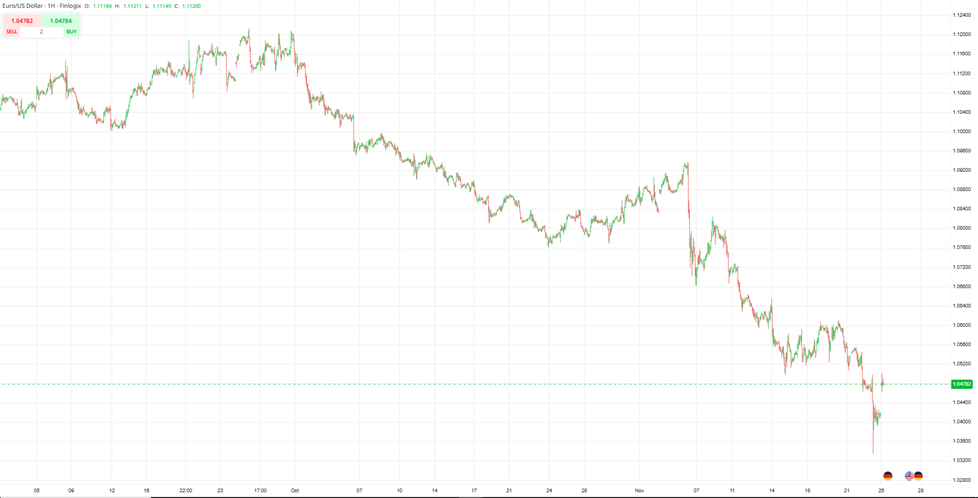
In a significant market move, EUR/USD has plunged to levels not seen in over two years, driven by a combination of economic and geopolitical pressures. This sharp decline has been raising questions about the resilience of the eurozone economy and the broader implications for global currency dynamics.
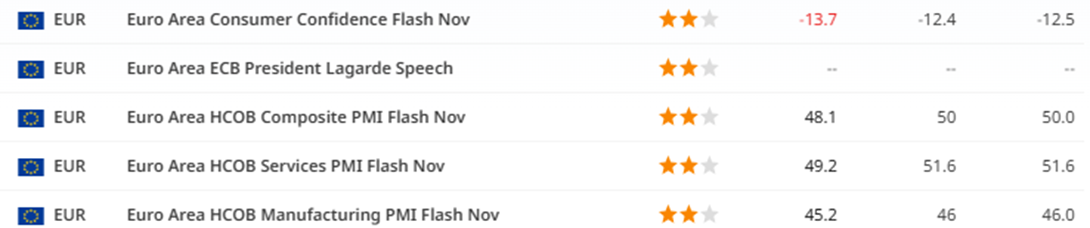
Recent economic data, including eurozone PMIs that fell below expectations, has acted as a catalyst for this downside breakout. Coupled with escalating geopolitical tensions and shifting market sentiment, the euro’s decline has accelerated, leaving traders and policymakers grappling with its implications.
Eurozone PMIs
Economic Factors Driving the Decline
The euro’s slide can largely be attributed to a weakening eurozone economy, highlighted by disappointing PMI data. These figures have revealed crumbling business confidence across the region, signalling a lack of growth momentum and exacerbating fears of stagnation. With the eurozone struggling to regain its footing, the European Central Bank (ECB) faces mounting pressure to intervene.
EURUSD H1 Chart
The Role of Interest Rate Differentials
Short-term eurozone swap rates dropped by 8-10 basis points following the PMI release, widening the interest rate gap between the euro and the dollar. This rate differential has made the euro less attractive to investors, further intensifying its decline. Market expectations now lean heavily toward a 50-basis-point rate cut by the ECB in December, with projections of a sub-neutral policy rate of 1.75% by mid-2025.
EU02Y Bonds
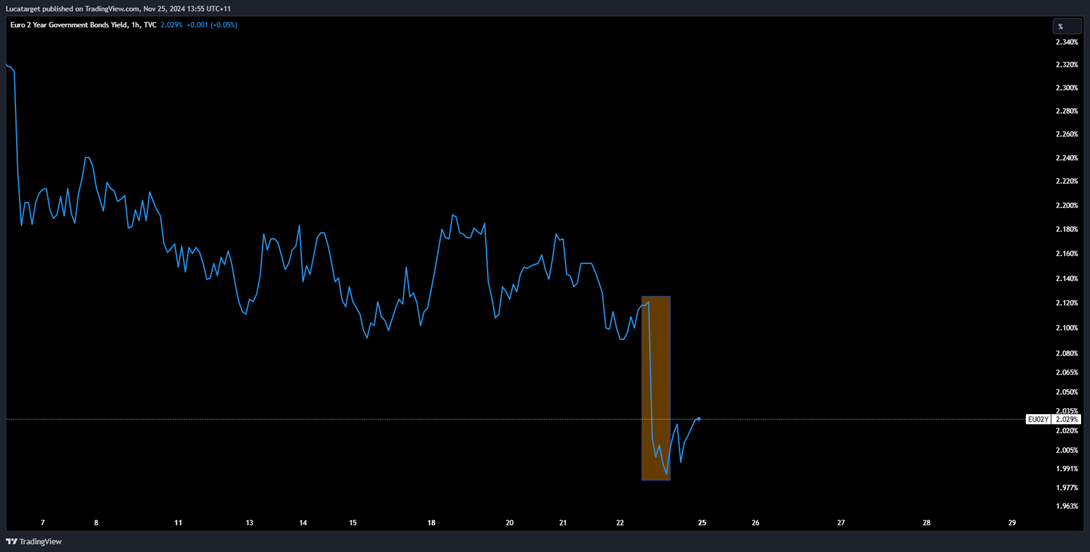
This anticipated monetary easing highlights the ECB’s role in attempting to counter the eurozone's economic woes. However, such measures also risk devaluing the euro further, particularly against the backdrop of a relatively robust US economy.
Geopolitical Tensions Adding Fuel to the Fire
Beyond economic concerns, geopolitical factors are also weighing heavily on the euro. The ongoing Russia-Ukraine conflict has intensified, raising fears of a prolonged crisis. Although energy prices have remained stable for much of the year, recent upticks in European natural gas prices suggest that energy concerns could resurface as winter approaches.
Additionally, the spectre of global trade tensions looms large. With uncertainties surrounding potential US trade policies and a possible escalation into a broader global trade war, the eurozone’s export-driven economy appears particularly vulnerable. These geopolitical uncertainties compound the challenges facing the euro and contribute to the currency pair's downward trajectory. Click HERE to know know about the geopolitical impacts on the market.
How Low Could EUR/USD Go?
The recent move represents a near 7% decline in EUR/USD over just two months—a pace that is extraordinary by historical standards. While some market participants argue that the euro may be approaching undervalued territory, others believe that further downside is possible, with parity between the euro and the dollar emerging as a realistic scenario.
Technical Analysis
With the 2023 low of 1.0448 already breached, the next significant support zone lies at 1.0190-1.0200. Market sentiment and positioning suggest that the currency pair could test these levels, particularly if economic and geopolitical pressures persist.
Volatility on the Horizon
The EUR/USD pair is also transitioning from a period of historically low volatility to a potentially more turbulent regime. Factors such as uncertainty around global trade policies and escalating geopolitical risks could drive higher volatility in 2025, making the currency pair more unpredictable.
Potential Moderators of the Downtrend
While the outlook for EUR/USD remains bearish, a few factors could slow or temporarily reverse its decline:
Wider Implications for the Eurozone
The current situation underscores deeper structural challenges within the eurozone. From political fragmentation to energy dependency, these vulnerabilities have left the region exposed to both internal and external shocks. Addressing these issues will be crucial for restoring confidence in the euro and ensuring the region's economic stability.
The EUR/USD currency pair is navigating a critical juncture, shaped by a confluence of economic and geopolitical factors. As the eurozone grapples with stagnation and external pressures, the path forward for the euro looks increasingly uncertain. For traders and investors, the current environment calls for heightened vigilance, as market dynamics remain fluid, and risks continue to evolve.
Whether EUR/USD approaches parity or stabilizes at current levels will depend on a range of factors, including ECB policy decisions, geopolitical developments, and broader global market trends. One thing is clear: the coming months are likely to be pivotal for the euro and the broader foreign exchange market.
This content may have been written by a third party. ACY makes no representation or warranty and assumes no liability as to the accuracy or completeness of the information provided, nor any loss arising from any investment based on a recommendation, forecast or other information supplies by any third-party. This content is information only, and does not constitute financial, investment or other advice on which you can rely.
Why Is Forex Trading So Difficult?
How To Master MT4 & MT5 - Tips And Tricks For Traders
The Importance Of Fundamental Analysis In Forex Trading
Forex Leverage Explained: Mastering Forex Leverage In Trading & Controlling Margin
The Importance Of Liquidity In Forex: A Beginner's Guide
Close All Metatrader Script: Maximise Your Trading Efficiency And Reduce Stress
Best Currency Pairs To Trade In 2024
Forex Trading Hours: Finding The Best Times To Trade FX
MetaTrader Expert Advisor - The Benefits Of Algorithmic Trading And Forex EAs
ACY Securities is one of Australia's fastest growing multi-asset online trading providers, offering ultra-low-cost trading, rock-solid execution, technologically superior account management and premium market analysis.

Select the categories and companies you wish to follow directly to your person rss feed.
Create Custom RSS FeedSign up and join over 5,000 professional members who receive personalized news alerts, curated professional connections, and more for free!
Standard Chartered has signed definitive agreements to acquire 100% of Zodia Custody UK Limited, folding its regulated digital asset custody business into Securities Services. Zodia Solutions will be set up under SC Ventures with bank investors including Northern Trust, NAB Ventures, Emirates NBD and Investcorp.
Bybit Fintech FZE has secured a Virtual Asset Service Provider licence from Dubai’s Virtual Assets Regulatory Authority for Exchange Services, covering spot trading. Bybit’s Peter Loo said the firm hopes to add derivatives, subject to regulatory approvals. Its international Dubai headquarters opened in 2022.
ATFX Connect has released its Q4 2026 Institutional Edge, examining the geopolitical, monetary policy and fiscal pressures shaping global financial markets in the final quarter of the year.
The Nasdaq 100 is trading at 29,382. After reaching a recent high of 29,957, the index reversed sharply and has been recording a series of lower highs and lower lows.
propfunding.com's free-entry instant funding changes the order of prop funding. Start trading first. Its free-entry instant funding model offers two qualification attempts without an upfront activation fee.
FM Summit London returns to Old Billingsgate on 24 November 2026 for its 15th edition, with a curated one-day format aimed at senior executives. LMAX Group, Plus500, oneZero and MetaQuotes are among confirmed exhibitors, with Business Connect meetings, roundtables and an opening event at The Folly on 23 November.
GCEX has launched European-style, fiat-settled options on Bitcoin and Ethereum with monthly expiries for eligible professional and institutional clients. The service runs through the GCEX OTC desk, with pricing from Tier 1 liquidity providers and reporting on XplorPortal. GC Exchange Limited is authorised by the UK FCA
Wall Street closed mostly higher on Tuesday, led by a nearly 1% gain in the Dow. In Asia, South Korea’s Kospi rebounded 2.7% and Japan’s Nikkei gained 0.8%.
Brent crude is trading at $111.70. The latest price action show the recovery continuing toward $111.70, suggesting that demand has returned after the sharp correction.
FOREX.com has introduced weekend trading for US SP 500 and US Tech 100 CFDs in Japan, operated by StoneX Securities Co., Ltd., a StoneX Group Inc. subsidiary. Investors can manage positions seven days a week, including Saturday and Sunday sessions, without waiting for underlying markets to reopen on Monday.