just now


Liquidity Finder Ltd is incorporated in England and Wales, company number 10610740, registered address 167-169 Great Portland Street, Fifth Floor, London W1W 5PF, United Kingdom.
Published: just now


The recent inflation data from New Zealand and Canada has triggered notable movements in their respective currencies, the NZD and CAD. While both countries experienced a slowdown in inflation, the market response has been different. The NZD has come under pressure due to more aggressive rate cuts expected from the RBNZ, while the CAD has shown resilience, with BoC maintaining a steadier approach despite similar economic conditions. This divergence creates opportunities in the NZD/CAD pair, so let’s break it down how you can trade the NZDCAD, first let’s have a look at the New Zeeland and Canda recent releases on the inflation follow up on the react that both currencies have had and then looking ahead how can we position yourself into the market.

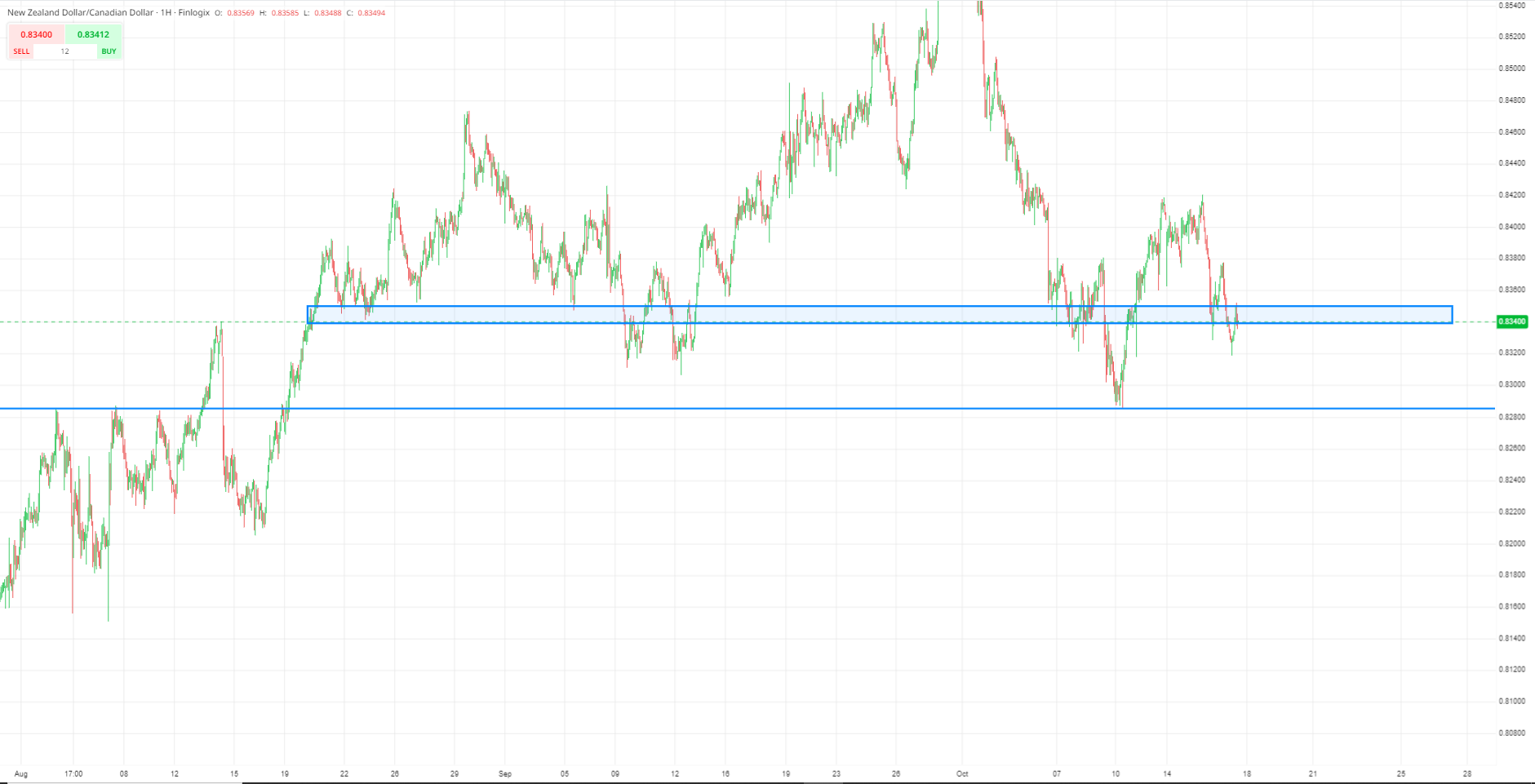
Global currency markets have experienced significant shifts following the latest inflation reports from New Zealand and Canada. The New Zealand dollar (NZD) experienced a notable decline as inflation in the country slowed more than anticipated, signalling a potential shift in the central bank's policy direction. In contrast, the Canadian dollar (CAD) showed resilience despite a similar trend of weakening inflation pressures.
The release of New Zealand’s third-quarter Consumer Price Index (CPI) data revealed that inflation had fallen back to 2.2% year-on-year, a sharp decline from 3.3% in the previous quarter. This marks the lowest level since early 2021 and brings inflation within the Reserve Bank of New Zealand's (RBNZ) target range of 1-3%. The slowdown was largely driven by domestic economic factors, with non-tradable inflation—covering items like housing and local services—easing to 4.9%.
The central bank had anticipated a drop in inflation, but the extent of the decrease has opened the door to more aggressive monetary easing. With the current policy rate still elevated at 4.75%, market analysts are now predicting a more substantial rate cut at the upcoming November meeting, possibly by 50 basis points or more. This would build on the larger-than-expected rate reduction introduced at the last policy meeting, as the RBNZ seeks to stimulate the economy amidst slowing price pressures.
The potential for further rate cuts adds downside risk to the New Zealand dollar, which has already been retreating against major currencies. Investors are factoring in the possibility that the central bank will continue its accommodative stance well into the next year, which could weigh on the NZD’s value.
Canadian Dollar Shows Resilience Amid Inflation Decline
In Canada, the inflation rate also surprised to the downside, with headline CPI slipping to 1.6% in September, the lowest since February 2021. Core inflation metrics, which exclude more volatile components, also indicated a cooling in price pressures. The Bank of Canada (BoC), like its New Zealand counterpart, is expected to accelerate its rate-cutting cycle in response.
Despite the inflation slowdown, the Canadian dollar has shown relative strength, recovering from early losses triggered by the CPI report. One reason for this is the CAD’s strong performance in recent months, which may have already priced in the weaker economic fundamentals. Additionally, while oil prices fell sharply, the Canadian currency’s resilience suggests that investors still see it as a stable option amid global uncertainties.
The BoC is expected to follow through with rate cuts at its upcoming meetings, potentially opting for larger reductions of 50 basis points as inflation remains below target. However, the CAD’s performance going forward will likely be influenced by both domestic monetary policy and external factors such as commodity prices and global market sentiment.
Both the New Zealand and Canadian central banks are expected to continue loosening monetary policy as inflation eases. However, the market response has been different for each currency. The New Zealand dollar faces mounting pressure due to the potential for more aggressive rate cuts, while the Canadian dollar has remained more stable despite similar economic challenges. As both countries navigate through changing inflation dynamics, their currencies will likely remain sensitive to shifts in monetary policy and global economic conditions.
Based on this fundamental analysis, we understand that the NZD is weaker compared to the CAD due to a slowdown in New Zealand's economy, with the RBNZ leaning towards more aggressive rate cuts, leading to monetary easing. In contrast, despite facing a similar deflationary scenario, the BoC has been more resilient, which strengthens the CAD.
Currently, NZD/CAD is holding steady at 0.83450. We see potential to target an accumulation around the 0.8200 level, with a possibility of a rapid decline once the support at 0.82870 is broken. This presents a strong risk-to-reward opportunity.
For more detailed stop-loss (SL) and take-profit (TP) levels, you can find my trade analysis on Finlogix through this link: https://www.finlogix.com/analysis/20241017/short-nzdcad-4271
This content may have been written by a third party. ACY makes no representation or warranty and assumes no liability as to the accuracy or completeness of the information provided, nor any loss arising from any investment based on a recommendation, forecast or other information supplies by any third-party. This content is information only, and does not constitute financial, investment or other advice on which you can rely.
Why Is Forex Trading So Difficult?
How To Master MT4 & MT5 - Tips And Tricks For Traders
The Importance Of Fundamental Analysis In Forex Trading
Forex Leverage Explained: Mastering Forex Leverage In Trading & Controlling Margin
The Importance Of Liquidity In Forex: A Beginner's Guide
Close All Metatrader Script: Maximise Your Trading Efficiency And Reduce Stress
Best Currency Pairs To Trade In 2024
Forex Trading Hours: Finding The Best Times To Trade FX
MetaTrader Expert Advisor - The Benefits Of Algorithmic Trading And Forex EAs
ACY Securities is one of Australia's fastest growing multi-asset online trading providers, offering ultra-low-cost trading, rock-solid execution, technologically superior account management and premium market analysis.

Select the categories and companies you wish to follow directly to your person rss feed.
Create Custom RSS FeedSign up and join over 5,000 professional members who receive personalized news alerts, curated professional connections, and more for free!
During Forex Expo Dubai 2026, Adnan Khan, CEO of 4XPORTAL, met with Sam Low, the founder of Liquidity Finder.
ATARIA CRM is a centralized platform designed for fintech teams to manage account operations, verification, fund management, and support in one place. With desktop and mobile access, it helps businesses stay connected, organized, and efficient.
EUR/AUD hits the 1.60500 target after rejecting 1.61715–1.62300 resistance. Review the bearish price action setup and why trade confirmation mattered.
Get an inside look at how rising Treasury yields and sector shifts into healthcare are impacting S&P 500 market dynamics, technical levels, and key economic drivers.
Understand XAUUSD support and resistance with simple gold chart examples. Learn to identify key zones, assess price reactions, and avoid beginner mistakes.
CMC Markets, a FTSE 250 multi-asset financial services firm, has launched a read-only ChatGPT integration for UK CFD clients, giving access to balances, positions, orders, pricing and historical market data through conversational prompts, as part of its ongoing investment in AI and cloud technology.
DXtrade, the multi-asset trading platform from Devexperts, has integrated Notofin's trading performance intelligence solution, adding behaviour-first analysis, structured journaling and pattern recognition tools. Brokers licensing DXtrade can now offer Notofin's services to clients as part of the platform's open integration framework.
KYC is essential for building trust, preventing fraud, and meeting regulatory requirements. A centralized system like ATARIA CRM helps compliance teams manage KYC requests, track pending documents, monitor approvals and rejections, and keep the entire verification process organized. By quickly identifying pending issues, businesses can reduce delays and provide customers with a smoother path from “Pending” to “Approved.”
Build better trading habits with a trading journal. Learn how a trading memory bank helps you review mistakes, manage emotions, and develop confidence.
GBP/USD has fallen to 3-month lows near 1.3200 due to strong US economic data and weakening UK consumer demand, though technical indicators like an RSI of 25.18 suggest the pair is now in oversold territory near key support at 1.3150.