
just now


Liquidity Finder Ltd is incorporated in England and Wales, company number 10610740, registered address 167-169 Great Portland Street, Fifth Floor, London W1W 5PF, United Kingdom.
Published: just now


The Energy Cost (Supply-Shock Inflation): When the price of energy spikes, as we see with the geopolitical tensions at the Strait of Hormuz it creates Cost-Push Inflation (the overall prices in the economy rise (inflation) because the costs of production increase). This is a scenario where the input costs for factories (like electricity and oil) rise rapidly.
The Industrial Core (Margin Compression): Because DAX (Deutscher Aktienindex) companies are heavy manufacturers, they cannot always pass these higher energy costs to their customers. When costs rise but selling prices stay the same, the company’s profit margins shrink. This is called Margin Compression (which occurs when the difference between a company's revenue and its costs narrows, leading to lower profitability), and it is the primary reason DAX has faced downward pressure.
Expansionary Fiscal Policy: The German government is attempting to counteract this energy squeeze by implementing fiscal expansion, which is the process by which a government raises spending or lowers taxes to promote economic growth. The government is making investments in renewable energy, infrastructure, and defense to keep the Industrial Core moving forward.
Monetary Tightening: In The European Central Bank (ECB) is using a tight monetary policy to keep interest rates high to fight inflation. These industrial businesses find it costly to borrow money for the very improvements (automation/efficiency) they require to weather the energy crisis due to high interest rates.
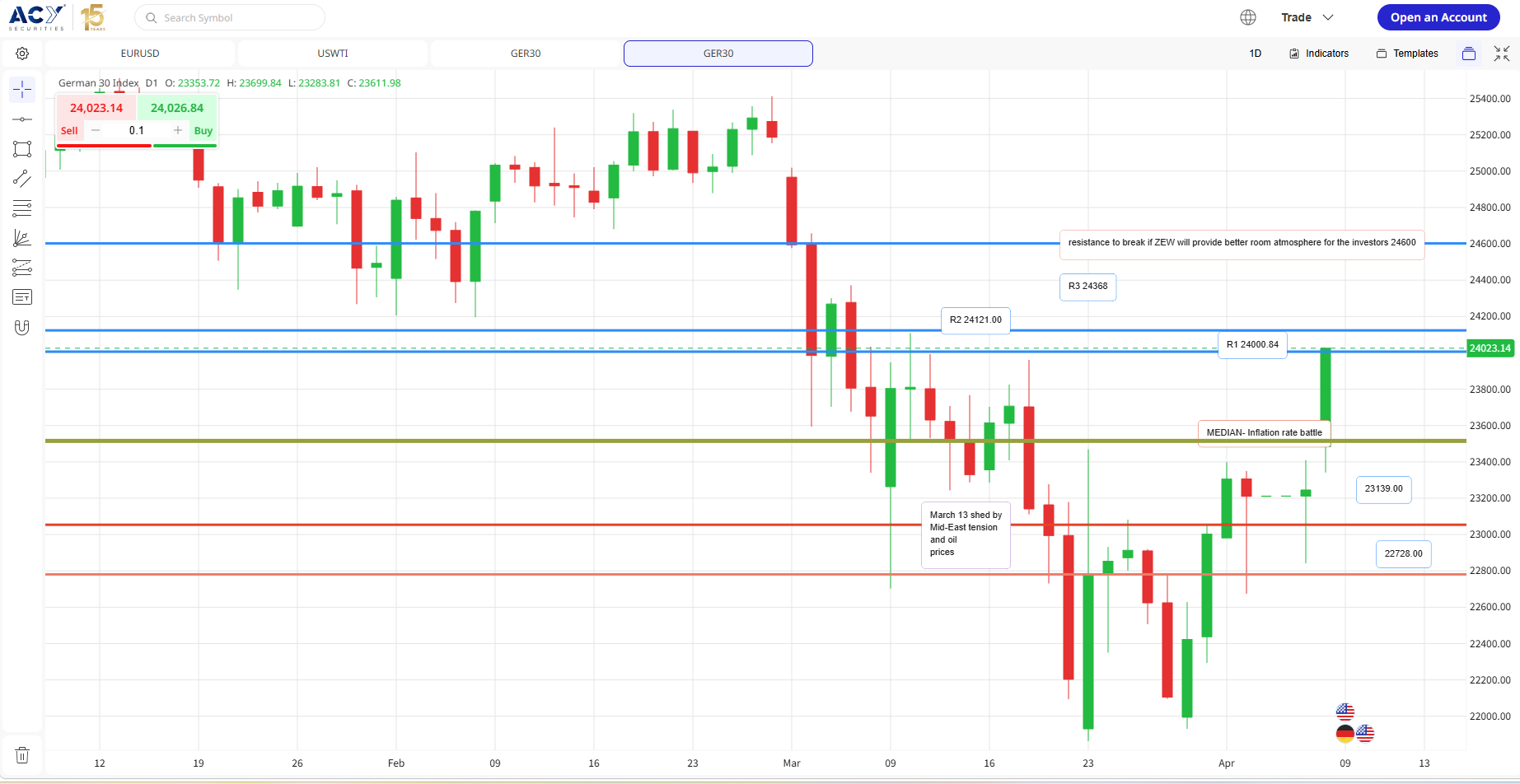
Consolidation: The DAX is currently in a period of sideways consolidation. This occurs when the market is waiting for a fundamental catalyst like a resolution to the energy crisis to decide if the trend will continue downward (a Bearish Trend) or start a new recovery (a Bullish Trend).
The Index performed breaking the ceiling at 23,133 soared to 23963.68 nerved from the ceasefire second ultimatum.
Resistance 1 (Ceiling price) at 24000.84. If the price level where investors are not yet convinced that the Industrial Core can overcome the high energy costs.
Resistance 2 (Ceiling price) at 24121.00. A second break if Inflation will soften, represents the point where investors believe the underlying value of the companies is cheap enough to justify buying, regardless of the energy risk.
MEDIAN 23523.00 relying on OPEC Basket Price and Inflation Rate battle
Support 1 (Floor price) at 23139.00. If the Production data will decline.
Support 2 (Floor price) at 22728.00. Tolerance level if the Germany Balance of Trade will be lowered than expected forecast.
This week is huge for the German inflation rate. Friday's data will decide what happens next. Many investors are currently holding their breath to see if energy costs will crush the market or let it fly. This is massive.
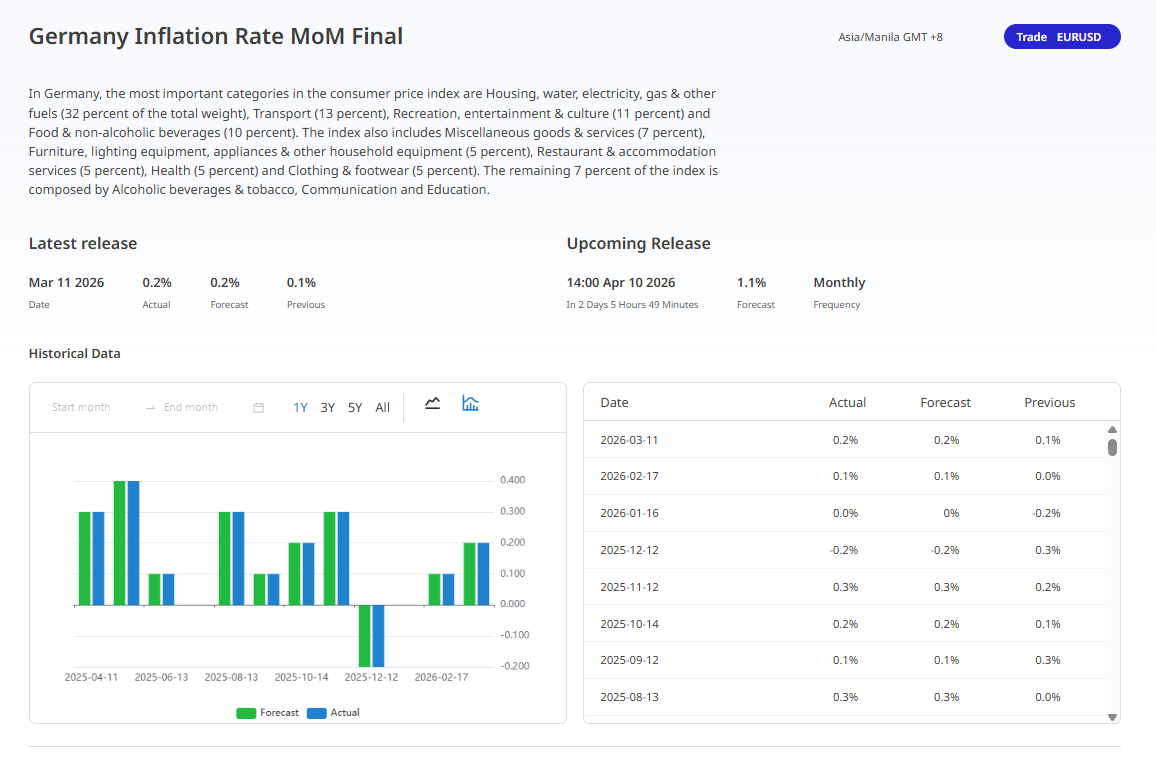
German Final Inflation Rate YoY (Year-over-Year) April 10. The Forecast: Currently projected at 2.7% (Harmonized at 2.8%). Friday’s data drop acts as the ultimate measure of cost-push inflation. A harmonized rate over 2.8 percent means the energy bear is still in control. This data will fix the sideways market action. Prices will pause. This week, the German Inflation Rate (Apr 10) will be the primary arbiter of the Energy Cost argument. A final reading above the 2.7% estimate would confirm that energy costs are still driving the bearish trend, likely keeping the DAX capped under the 23,133 resistance.
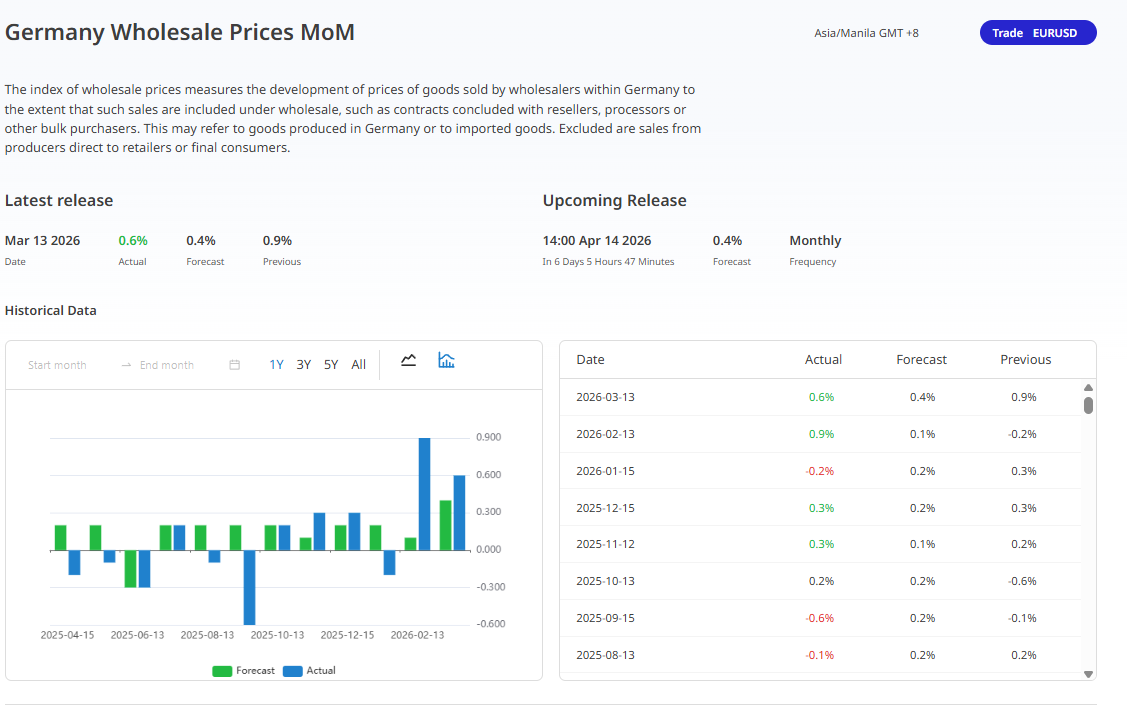
Wholesale Prices Yo(Year-over-Year) April 14. This specific date is when the newest wholesale price numbers finally drop for everyone to read. They act as a secret lead indicator for margin compression across the entire country. Because this nation relies so heavily on exporting its products, any sudden drop creates a giant red flag for everyone. Expensive energy bills might make this local goods way too costly for the global market.
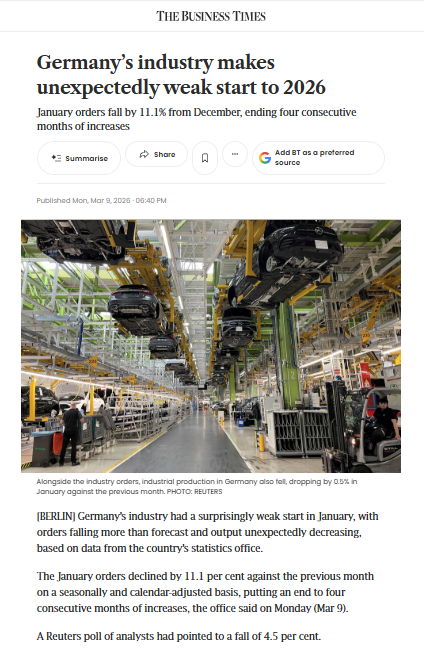
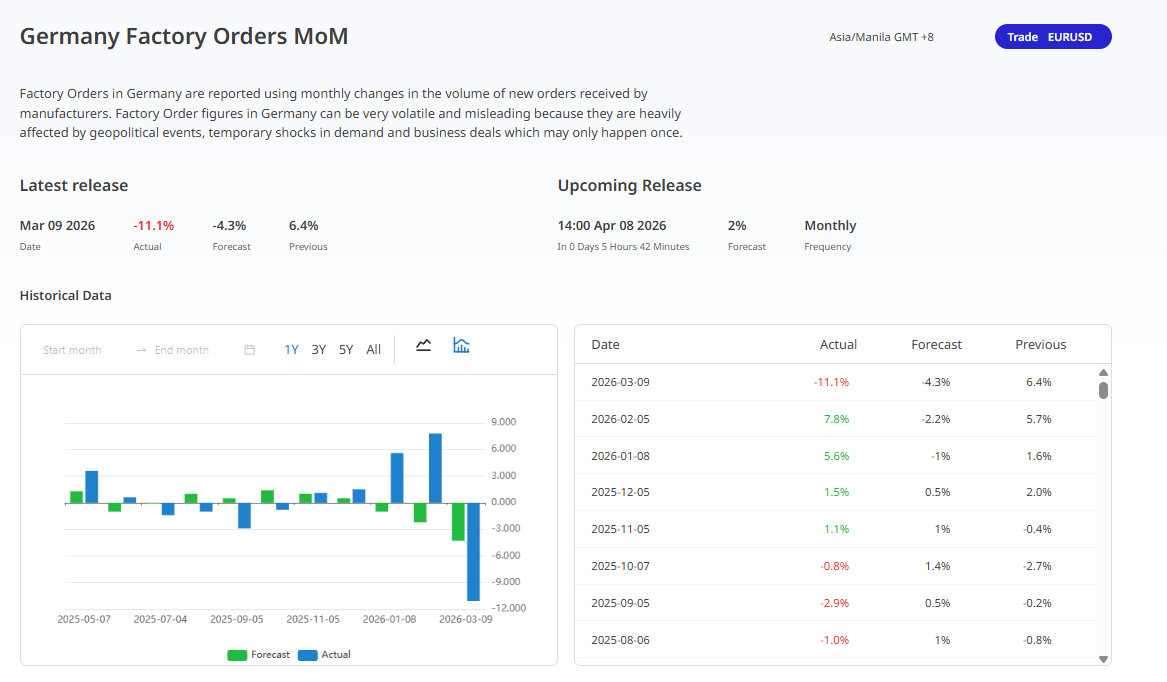
German Factory Orders MoM (Month-over-Month) A strong beat this week would be a fantastic fundamental catalyst for the whole economy.
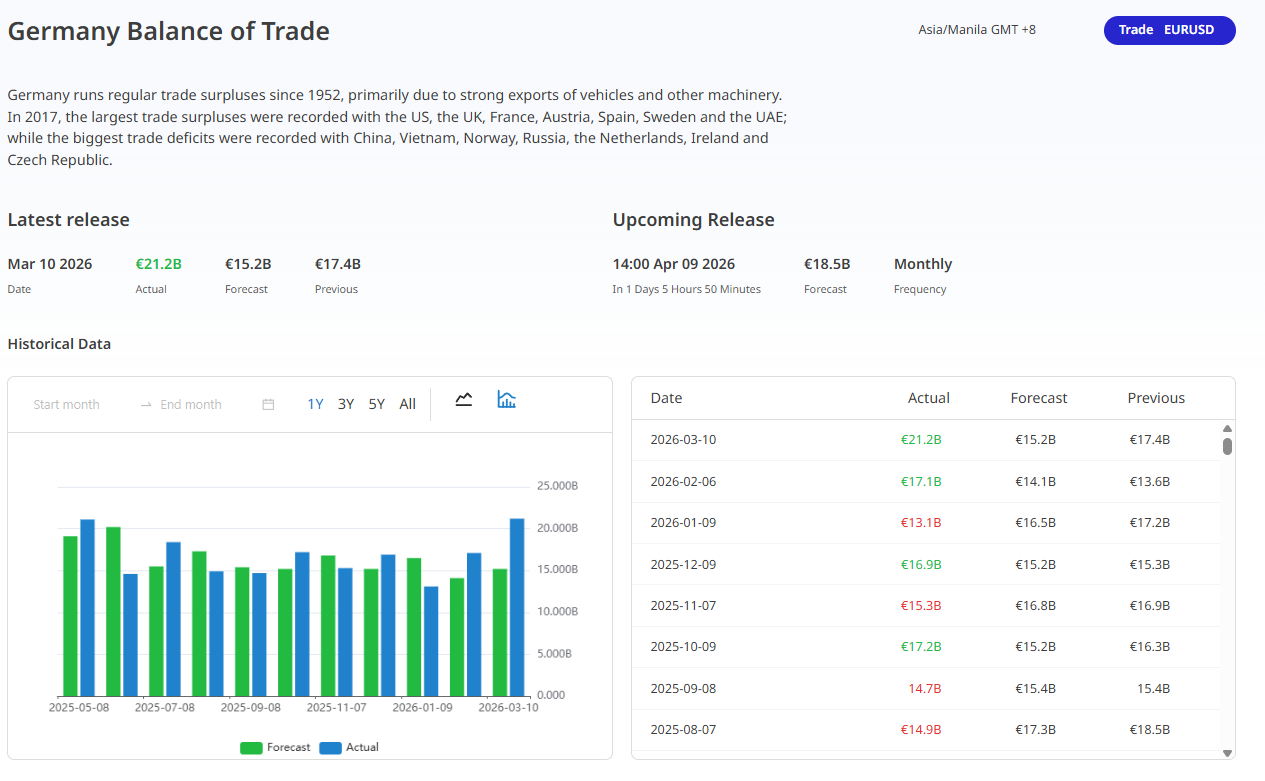
German Trade Balance & Industrial Production: With an expected €18.5 billion trade surplus, all eyes are on whether Germany can maintain its export dominance. Any drop in this figure would be a major red flag, as it indicates that high production costs may be pricing German exports out of the global market a development that would directly threaten the profitability of the DAX 40.
ZEW (Zentrum für Europäische Wirtschaftsforschung/Center for European Economic Research) Economic Sentiment- (monthly every third Tuesday). This measures the mood of institutional investors.
The Impact: If sentiment improves despite the Restrictive Monetary Stance of the ECB, it suggests that the market is starting to price in a recovery for late 2026 (Q3/Q4). Speeches from Bundesbank President Joachim Nagel. If he emphasizes fighting inflation at all costs, it reinforces the Monetary Tightening headwind and makes a breakout above 23,133 less likely this week.
Economic drivers for the index
DAX faces a fundamental dilemma, caught between the stifling effects of energy-driven inflation and the stabilizing force of government infrastructure spending. Market participants should expect continued consolidation until a clear breakout occurs either a decisive move above 24000.84 to validate a bullish trend or a breach of the 22,728 floor that highlights persistent industrial vulnerabilities.
Disclaimer: This content may have been written by a third party. ACY makes no representation or warranty and assumes no liability as to the accuracy or completeness of the information provided, nor any loss arising from any investment based on a recommendation, forecast or other information supplies by any third-party. This content is information only, and does not constitute financial, investment or other advice on which you can rely.
ACY Securities is one of Australia's fastest growing multi-asset online trading providers, offering ultra-low-cost trading, rock-solid execution, technologically superior account management and premium market analysis.

Select the categories and companies you wish to follow directly to your person rss feed.
Create Custom RSS FeedSign up and join over 5,000 professional members who receive personalized news alerts, curated professional connections, and more for free!
MAS Markets has appointed Simon Naish as Head of APAC to lead its plans across the Asia-Pacific region. Naish brings over 30 years of experience in institutional banking and FX, most recently as Country Head at ATFX Global and previously 33 years at National Australia Bank (NAB) across Asia-Pacific and global markets.
BTCUSD rejects $78,400–$82,175 support. Watch bullish follow-through toward $86,550 and a daily close below $80,268.75 for weakness.
Gold price forecast: Watch $4,175–$4,190 support for bullish confirmation toward $4,265, or a weekly support breakdown toward $3,935.
WTI crude oil price forecast: A confirmed breakout above $94.765 could open the way toward $100.305, while weekly support remains at $87.360–$90.830.
NAS100 price forecast recap: Explore the Nasdaq 100 rally to 31,401.3, with technical analysis of the breakout and key support and resistance levels.
Learn how to identify, draw and trade XAUUSD supply and demand zones using Gold market structure, price action confirmation and clear risk management.
cTrader has been named Best Trading Platform at UF Awards APAC 2026 during iFX EXPO Asia in Hong Kong.
AUD/CHF reached last week’s 0.57732 bearish target. Learn how resistance, market structure and a neckline retest shaped the original price action forecast.
Businesses eventually reach a point where basic tools are not enough basic tools.
Multi-asset trading broker AvaTrade has agreed to acquire the majority of FXCM Group’s business and brand, in a transaction that would bring a longstanding retail FX franchise into the AvaTrade Group.