just now


Liquidity Finder Ltd is incorporated in England and Wales, company number 10610740, registered address 167-169 Great Portland Street, Fifth Floor, London W1W 5PF, United Kingdom.
Published: just now
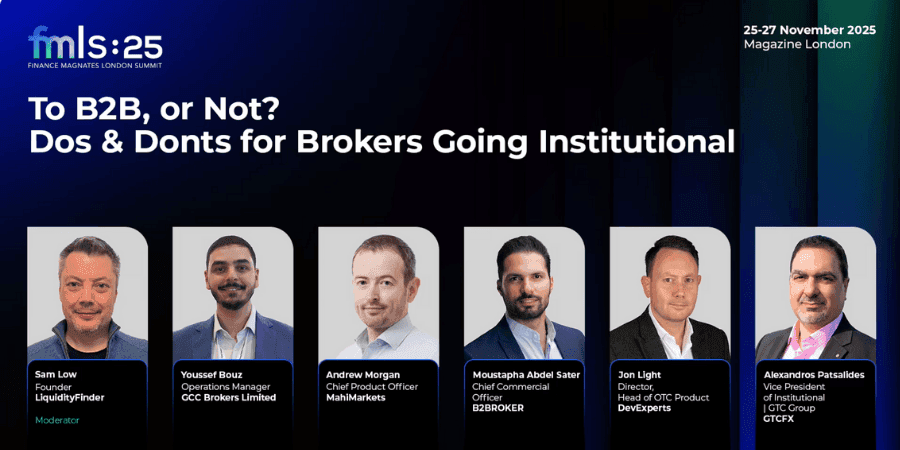
At the Finance Magnates London Summit 2025, LiquidityFinder CEO Sam Low hosted a candid discussion on whether retail brokers can still succeed by expanding into B2B liquidity — a segment that has seen explosive growth in recent years and now features dozens of new players. Despite the noise, the panel’s view was measured and remarkably consistent: the market is undeniably crowded, but far from saturated. Opportunity still exists — though only for brokers willing to specialise, invest, and treat B2B as a serious institutional business.
Joining the session were Youssef Bouz, (GCC Brokers), Andrew Morgan, (Mahi Markets), Moustapha Abdel Sater, (B2Broker), John Light, (DevExperts), Alexandros Patsalides, (GTC Group).
See the full panel video here:
Early in the discussion, there was unanimous agreement that the number of B2B providers has risen dramatically. What once was a market dominated by fewer than a dozen firms now includes more than 40 active names listed on LiquidityFinder alone.
For Youssef Bouz, the issue is less about the number of participants and more about the quality of many new entrants. He argued that too many brokers attempt to replicate what they see others doing, without the infrastructure, technology or risk framework required to serve institutional clients. This influx, he suggested, creates confusion in the market and often results in clients learning hard lessons only after suffering losses or operational failures at the hands of underprepared providers.
Alexandros Patsalides agreed, noting that many brokers underestimate how different commercial, operational and risk expectations are in the institutional world. A retail firm attempting to “go B2B” without proper capital, governance and expertise, he said, is almost certain to struggle — something he has witnessed repeatedly. According to him, the market is performing its own natural filter and will reject providers who lack the discipline or capability to operate at this level.
One of the strongest themes of the panel was that price competition is no longer a viable strategy. With spreads already thin across most major products — and especially in gold — brokers entering B2B must find ways to genuinely differentiate their offering. Alexandros, from GTC Prime, stated that differentiation is not about marginally improving a price — it is about giving clients something genuinely unavailable elsewhere.
Patsilides offered tangible examples of what GTC Prime has done to break away from the pack:
Most providers claim to offer swap-free solutions but load fees elsewhere. GTC instead bears the cost internally, creating a real differentiator for certain markets.
Where many LPs reject high-velocity or high-performance flow due to its impact on their bottom line, GTC leverages a network of Tier-1 and prime-of-prime counterparties to manage it efficiently. Patsalides portrayed this not as a risk-seeking behaviour, but as strategic positioning: serving the flow others will not take.
He revealed that GTC is preparing a new service for prop trading firms, enabling successful traders to graduate from challenges into live accounts in 2026 — a model requiring infrastructure smaller providers cannot easily replicate.
These examples reinforced his central message: brokers must find their niche — and be excellent at it.
For Andrew Morgan of Mahi Markets, this means better understanding client flow and tailoring liquidity accordingly. Rather than aggregating generic LP feeds and reselling them, he argued for applying behavioural analytics, smarter risk management, and more thoughtful pricing models that allocate liquidity based on the profile and performance of underlying clients. In his view, the industry is rife with misapplied “choice pricing” that does not reflect the risk characteristics of the flow being serviced.
GTC Prime type innovations were discussed as examples of meaningful differentiation: unique liquidity sources, smart aggregation, and ability to handle complex or volatile products. In a similar vein, some B2B providers are starting to specialise in accepting “toxic” or difficult flow, offering swap-free structures at their own expense, or providing ultra-tight spreads backed by robust depth rather than headline numbers.
While much of the conversation centred on pricing and risk, Moustapha Abdel Sater emphasised that customer experience is becoming the decisive factor in B2B selection. In his view, technology accounts for just 10% of what makes a successful institutional offering. The remaining 90% lies in the infrastructure, people, and service that surround it — especially 24/7 support, rapid incident response, operational resilience and consultative guidance.
He noted that many brokers enter B2B believing it is simply a new revenue line or an extension of their existing business. However, B2B is fundamentally a servicing business, not a marketing one, and requires deep commitment to operational excellence. Those who approach it casually will see their reputation — on both retail and institutional fronts — deteriorate quickly.
Despite the increasing sophistication of technology and liquidity distribution, John Light reminded the audience that relationships remain central. While brokers often evaluate B2B partners based on spreads, feeds or distribution channels, institutional business is still driven by trust. Firms want partners who are transparent, credible and committed, not just those who offer appealing price points. He noted that this has led to rising demand — and rising cost — for experienced institutional sales personnel, as firms compete for talent that can strengthen these long-term relationships.
The panel also highlighted several growth areas that remain underserved:
While challenge accounts are simulated, funded accounts can generate real flow — more than many assume. Both Light and Morgan noted that servicing prop firms can be complex due to the behaviour of their traders, but also represents a meaningful and expanding opportunity.
As Morgan observed, traders increasingly expect to operate around the clock, especially in crypto markets. Offering stable, resilient 24/7 liquidity — not just 24/5 — requires investment and automation, but can serve as a differentiator.
The lines between TradFi and digital assets continue to blur. Retail brokers want crypto. Crypto venues want FX and commodities. B2B providers able to deliver consistent multi-asset liquidity across both worlds will capture more demand.
The session closed with a round of final recommendations, and the advice was sobering.
🔹 Youssef Bouz urged brokers not to rush and to ensure they have the capital, technology and team required before taking on external flow.
🔹 Andrew Morgan suggested evaluating ambition and network carefully — supporting a small group of clients is vastly different from building a global infrastructure.
🔹 Moustapha Abdel Sater warned against entering B2B as a marketing decision, stressing that firms must treat it as a mission-critical operational undertaking.
🔹 Jon Light advised firms to review the business case thoroughly and prepare to hire experienced talent.
🔹 Alex Patsalides delivered the most direct message, stating that firms must know exactly why they want to enter the institutional space and be willing to commit fully. Half measures, he warned, will not survive: once in, “you have to go all in.”
Retail brokers can still succeed in B2B liquidity, but only if they approach it with purpose, infrastructure, and genuine differentiation. The market may be crowded, but specialists, innovators and service-driven providers continue to find room to grow.
In a space now defined by high expectations, instant transparency and global competition, entering B2B is less a pivot than a transformation. Those who make it will be the ones who understand what the institutional market truly demands — and deliver it with consistency.
Found this interesting? Become a member of LiquidityFinder and get daily industry news direct to your inbox — join here.
We're the largest marketplace to connect with brokers, Fintech companies & digital asset firms. Want to partner? Let's get in touch.
Select the categories and companies you wish to follow directly to your person rss feed.
Create Custom RSS FeedSign up and join over 5,000 professional members who receive personalized news alerts, curated professional connections, and more for free!
WTI crude oil price forecast: A confirmed breakout above $94.765 could open the way toward $100.305, while weekly support remains at $87.360–$90.830.
NAS100 price forecast recap: Explore the Nasdaq 100 rally to 31,401.3, with technical analysis of the breakout and key support and resistance levels.
Learn how to identify, draw and trade XAUUSD supply and demand zones using Gold market structure, price action confirmation and clear risk management.
cTrader has been named Best Trading Platform at UF Awards APAC 2026 during iFX EXPO Asia in Hong Kong.
AUD/CHF reached last week’s 0.57732 bearish target. Learn how resistance, market structure and a neckline retest shaped the original price action forecast.
Businesses eventually reach a point where basic tools are not enough basic tools.
Multi-asset trading broker AvaTrade has agreed to acquire the majority of FXCM Group’s business and brand, in a transaction that would bring a longstanding retail FX franchise into the AvaTrade Group.
LSEG and CMC Markets have signed a multi-year strategic data agreement expanding CMC's access to LSEG's real-time and delayed pricing, reference and corporate actions data, news and analytics, plus AI-ready content, to support new products, entry into new markets and the growth of CMC's institutional and B2B partnerships.
The Tel Aviv Stock Exchange is considering a bid for the Cyprus Stock Exchange, with Israeli media citing its EU licence, trading platform and clearing house. Euronext’s Athens exchange and India’s National Stock Exchange are also seen as contenders, and Cyprus aims to sign a sale agreement by the end of this year.
CME Group will launch baseball futures on 12 October, pending regulatory review, tracking CME FutureSports Performance Indexes built on Official League Data. Standard and micro contracts will start with the 2026 Postseason and the four clubs in the League Championship Series, trading around the clock.