just now

Liquidity Finder Ltd is incorporated in England and Wales, company number 10610740, registered address 167-169 Great Portland Street, Fifth Floor, London W1W 5PF, United Kingdom.
Published: just now

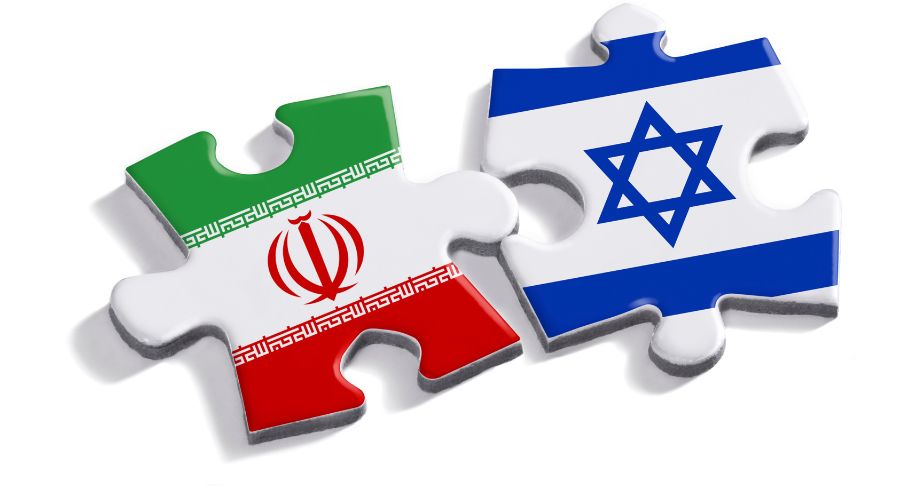
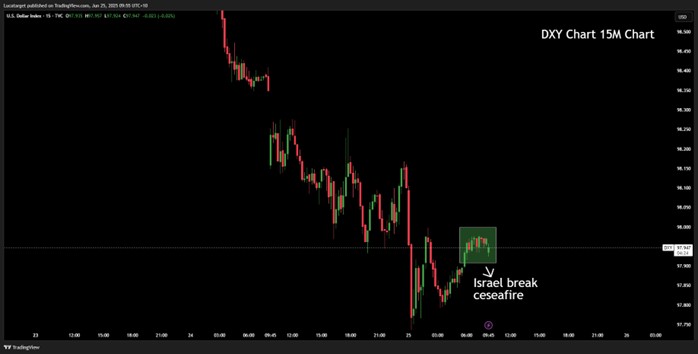
The Middle East remains on a knife’s edge after Israel launched fresh airstrikes on Iranian infrastructure in the early hours of the trading day.
This marks a clear breakdown of the temporary ceasefire agreed between Israel and Iran due to Trump last week and escalates the threat of a broader regional confrontation.
Yet, despite the severity of the development, financial markets have remained relatively calm so far. Oil prices have held steady;
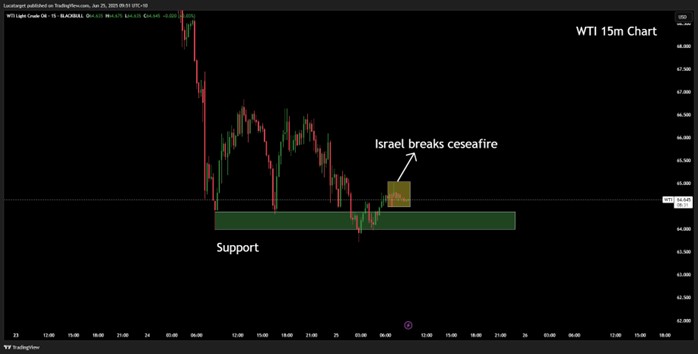
Equity markets are not showing signs of panic, and there’s only a mild uptick in risk aversion. The underlying reason seems to be the absence of an immediate Iranian response Tehran has not retaliated or issued a major threat of escalation, which is keeping traders in a holding pattern. Will Iran retaliate against Israel? What will Trump say in response?
These are the questions every trader is asking right now. The honest answer is we don’t know. And that’s precisely why the best approach at this stage is to wait, monitor, and be ready to react to any developments as they unfold.
In short, markets are bracing for potential headlines but are not fully pricing in a wider conflict at least, not yet. This creates a unique backdrop for USD traders: volatility risk is elevated, but the move hasn't materialised. That makes positioning around the dollar (DXY) more tactical than reactive for now, as investors await confirmation of whether this latest strike turns into a broader geopolitical crisis.
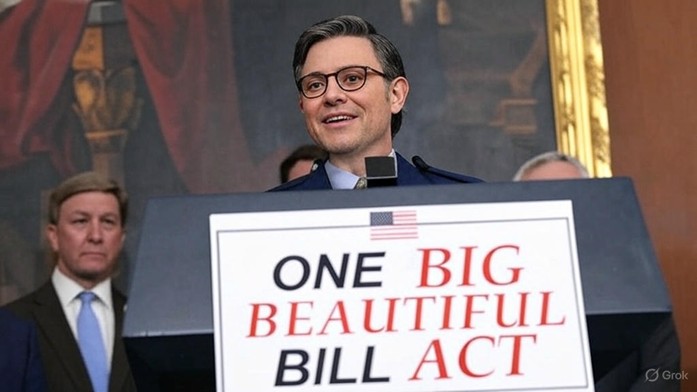
One of the biggest red flags for the dollar comes from its own domestic landscape. The newly proposed “One Big Beautiful Bill” is expected to add over $2.4 trillion to the U.S. budget deficit, further straining America's already precarious fiscal position.
Foreign central banks have slowed their purchases of U.S. Treasuries, forcing the domestic market to absorb more of the government’s debt issuance. While private foreign demand has partially offset this shift, the broader implication is clear: confidence in U.S. fiscal stewardship is waning, and the long-term cost of debt servicing is rising.
For traders, this increases the risk premium embedded in the USD and creates a more fragile foundation for long-dollar positions particularly as bond yields may rise for the wrong reasons. With the market currently leaning toward a risk-on sentiment, traders may find opportunities in positioning against the US dollar as a safe haven currency.
Strategies such as short USD/JPY (with a higher RR over 1 to 3 (3 times your risk!) So, if you risk $100 you could potently make $300, if targeting below 143.00) or long EUR/USD could prove favourable under these conditions.
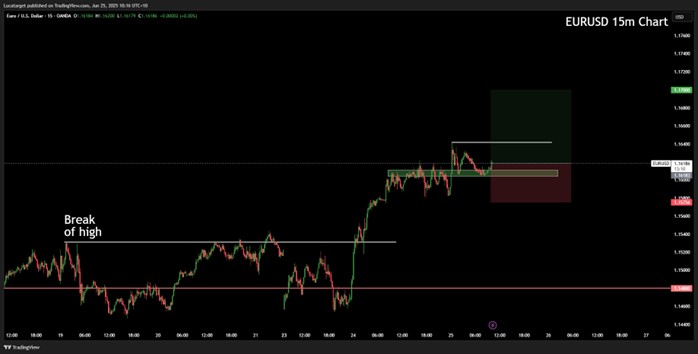
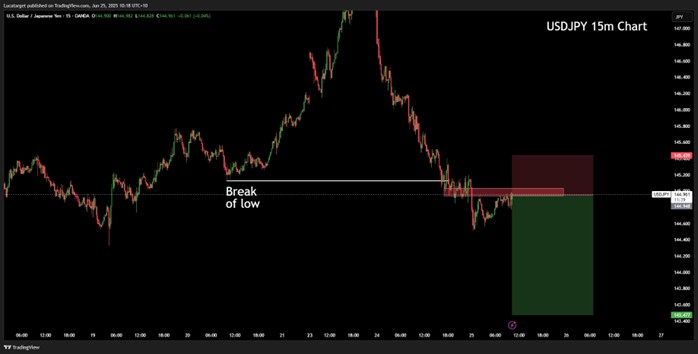
In the immediate term, the de-escalation in the Middle East (if Iran don’t retaliate Israel) is likely to make the USD bearish through classic risk-on channels.
But the medium- to long-term outlook is increasingly uncertain, shaped by an unstable political environment, an overstretched fiscal position, and weakening structural demand from global investors.
For traders navigating this evolving landscape, the dollar is no longer a one-way bet. The greenback’s response to shocks is becoming more asymmetric capable of short-term gains but vulnerable to longer-term bearish sentiment.
The risk-off narrative is alive and well, but underneath it, the foundations of the USD’s dominance are being questioned. That makes this an environment where selective positioning and macro awareness will be essential.
Q: Why hasn't the market reacted more aggressively to the renewed Israel-Iran conflict?
A: Despite Israel’s latest airstrikes, Iran has not retaliated so far. This lack of immediate escalation has kept markets relatively calm, with oil stable and equities holding ground. Traders are in a holding pattern, waiting to see whether the situation deteriorates further.
Q: Is the USD still acting like a safe haven in this environment?
A: Yes, temporarily. The USD has shown some resilience, but it’s no longer the automatic go-to during every geopolitical shock. It’s safe-haven appeal is starting to weaken beneath the surface due to concerns over fiscal stability, political interference with the Fed, and falling foreign demand for US Treasuries.
Q: What does the “One Big Beautiful Bill” mean for the USD?
A: It adds over $2.4 trillion to the US budget deficit, increasing the long-term fiscal risk associated with holding dollar assets. If confidence in Washington’s fiscal management continues to deteriorate, the dollar could come under sustained structural pressure even if yields rise
Q: What are two USD trades traders should be watching during the current Israel-Iran conflict?
A:
This content may have been written by a third party. ACY makes no representation or warranty and assumes no liability as to the accuracy or completeness of the information provided, nor any loss arising from any investment based on a recommendation, forecast or other information supplies by any third-party. This content is information only, and does not constitute financial, investment or other advice on which you can rely.
ACY Securities is one of Australia's fastest growing multi-asset online trading providers, offering ultra-low-cost trading, rock-solid execution, technologically superior account management and premium market analysis.

Select the categories and companies you wish to follow directly to your person rss feed.
Create Custom RSS FeedSign up and join over 5,000 professional members who receive personalized news alerts, curated professional connections, and more for free!
Bybit has launched Perp Options, described as the first options contracts built on TradFi perpetuals, giving traders round-the-clock access to US equity options. SpaceX and Nvidia are the first underlying assets, with USDT settlement and integration into Bybit's Unified Trading Account.
Use this trading preparation checklist to plan your session, define entry rules, manage risk, and build a disciplined trading routine in seven steps.
Your Bourse expands its crypto liquidity ecosystem with Caladan, giving brokers access to broader market coverage, institutional execution capacity and streamlined settlement.
Scope Markets, the retail brokerage part of Rostro Group, has appointed Ibrahim Hossny as Head of Research and Marketing for the Middle East and North Africa.
Hantec Prime, the institutional division of Hantec Markets, has reported trading volume up more than 300% year-to-date, alongside the addition of 42 new institutional clients since December, capping one of its strongest years of growth to date.
Learn how to refine XAUUSD support and resistance on the daily chart using candle bodies, market structure and weekly gold levels for swing trading. A slug alone cannot guarantee a top Google ranking. Keep it focused rather than adding every supporting keyword.
The week in Dubai will be focused on connecting directly with the industry and discussing how technology can help modern brokerages simplify operations, automate workflows, strengthen operational control, and scale efficiently.
Devexperts has launched a turnkey solution giving brokers in South Korea access to US equity markets, combining its DXtrade trading platform, dxFeed market data, and execution services. The offering targets South Korea's growing retail demand for US stocks, worth several billion USD monthly.
Assess why WTI crude oil surged past $105 per barrel amid Saudi pipeline disruptions, record tanker charter rates, and escalating geopolitical tensions.
Bitcoin price forecast: BTC/USD retests $78,460–$80,215 resistance. Watch bearish confirmation toward $72,480 or a bullish breakout toward $86,150.