
Jobs, Growth & Recession Fears: NFP, GDP & Unemployment in Trading
ACY Securities - Japer OsitaThe economy breathes, pulses, and beats - just like a living body. At the center of that rhythm is the labor market, and its beat shows up through Non-Farm Payrolls (NFP), GDP, and the unemployment rate. For traders, these aren’t just numbers; they’re signals that shape policy expectations, risk appetite, and price action across forex, gold, and indices.
Here’s the paradox most beginners miss: sometimes “bad” jobs news can spark a rally. To see why, you have to connect labor data to interest-rate expectations, risk-on/risk-off behavior, and the way smart money hunts liquidity around news. If you want a primer on the policy side, skim how central banks and interest rates move your trades - it’ll make today’s lesson click.

How NFP, GDP, and Unemployment Sway Market Sentiment

Non-Farm Payrolls (NFP) – The First Friday Earthquake
Every first Friday, NFP can reprice an entire month of narratives in minutes.
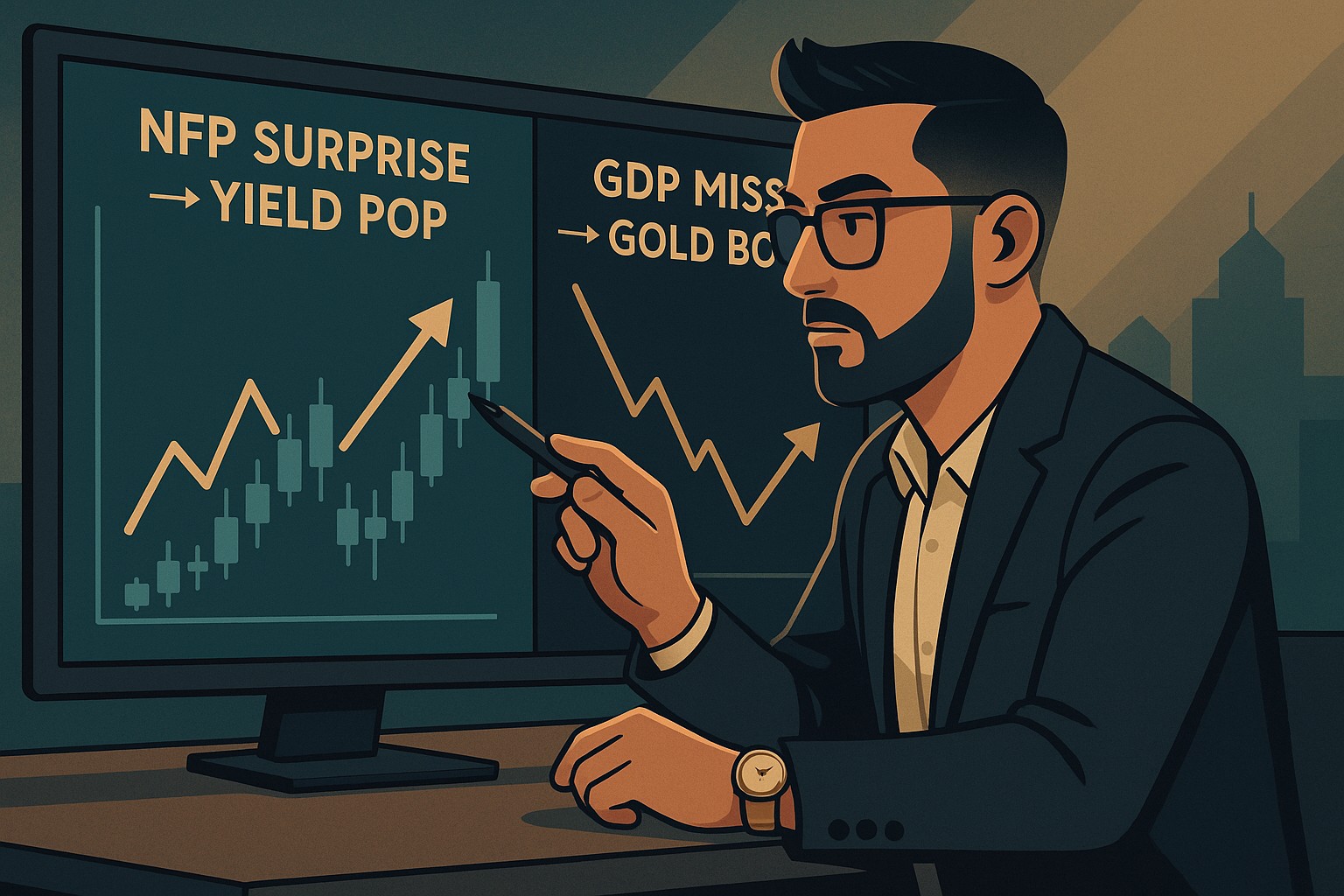
- Hot print (jobs > forecast) → stronger growth signal → often USD up, gold down, yields up.
- Cool print (jobs < forecast) → growth wobble → USD softens, risk assets and gold can bounce on easier-policy bets.
If you trade the release itself, anchor your prep with a structured plan like How to Trade NFP Using Smart Money Concepts so you’re not just reacting to the headline but executing a tested playbook.
GDP – The Growth Report Card
GDP is the semester grade for the economy.
- Stronger GDP → supports the domestic currency, lifts yields, and can pressure gold.
- Weaker GDP → raises recession worries, encourages safe-haven demand, and increases odds of policy easing.
Remember, GDP interacts with inflation. Pair this with CPI vs PPI tactics to read whether growth is happening with or without price pressure.

Unemployment – The Emotional Metric

Unemployment moves headlines because it’s visceral.
- Low unemployment gives central banks room to stay restrictive.
- Rising unemployment fuels recession fear - but can also lift stocks if it pulls forward expected rate cuts.
Zoom out: unemployment doesn’t act alone. Look at wage growth and participation. Then watch how markets actually respond on the tape.
Why “Bad News” Sometimes Means Bullish Markets

Markets are expectations engines, not morality courts.
- Good jobs → hawkish tilt. If jobs are hot and inflation sticky, markets price higher-for-longer rates - often a drag on equities and gold.
- Bad jobs → dovish tilt. Softer labor data can bring easier policy closer, lowering discount rates and supporting risk.
This is the classic “bad news = good news” regime. Whether we’re risk-on or risk-off matters a lot - review the risk-on vs risk-off guide so you can map data surprises to positioning.
The Tug-of-War Between Inflation and Jobs
Central banks juggle price stability vs employment. If inflation is cooling while jobs soften, policy can pivot dovish quickly; if both run hot, policy stays tight. The market constantly handicaps this balance - your edge is seeing which side the next report nudges. If you need a process to translate that into trade timing, see multi-timeframe confirmation with SMC so macro turns line up with clean intraday triggers.
Jobs as the Economy’s Heartbeat
Think of jobs as the heartbeat. A strong, steady pulse means the patient (economy) can handle the stress of higher rates. A weakening pulse forces the doctors (central banks) to ease the strain. Markets don’t wait for the treatment to work; they trade the anticipation. That’s why the first reaction after NFP can be violent - and why a measured post-spike confirmation often pays better than guessing the headline.

How Traders Actually React

The number is only half the story - the tape is the other half.
- Hot NFP but USD sells off? The surprise was already priced.
- Soft GDP but indices rip? Traders are front-running easier policy.
- Unemployment up but wages hot? Mixed signals; expect chop until one narrative wins.
Develop a protocol: pre-define trigger levels, note invalidations, and wait for displacement + structure shift before you commit. If you trade indices on news, study how to scalp indices at the open with SMC - the same principles help you navigate post-data volatility.

What This Means Across Markets

- Forex: USD is your macro barometer; EUR/USD and USD/JPY often express the view cleanly. When liquidity pools form around obvious highs/lows into data, understand liquidity sweeps to avoid being the liquidity.
- Gold: Thrives on recession fear and easier-policy bets; struggles when real yields and the dollar pop. If gold is your lane, pair macro with a ruleset like the complete day-trading gold guide.
- Indices: Rally on lower discount-rate expectations but can wobble if the data hints at earnings pain. Let the first reaction play out; take setups that confirm via structure.
Final Thoughts

Jobs are the heartbeat, GDP is the body’s strength, and unemployment is the stress signal. Together they set the tempo for risk appetite and policy. Your edge isn’t predicting the number; it’s positioning around expectations, then executing only when the reaction aligns with your plan. On the next NFP or GDP day, don’t just ask “What’s the print?” Ask: “What did the market expect - and what does the reaction confirm?”
FAQs
What makes NFP so important?
It’s the earliest monthly read on the labor market, directly informing rate expectations. The first Friday timing also concentrates liquidity and attention, magnifying the move - use a news-specific SMC plan rather than chasing the print.
Why do stocks rally on weak data sometimes?
Because weak data can pull forward rate cuts, lowering discount rates and boosting valuations. The context is key - use a risk-on/risk-off checklist to ensure the tape agrees.
How does GDP affect currencies?
Stronger GDP usually supports the home currency; weak GDP pressures it. But if the print simply matches what was priced, the move can fade - price in expectations first.
Should I just watch the unemployment rate?
No - consider participation and wage growth. Rising wages with stable unemployment can keep policy tight, while soft wages plus rising unemployment tilts dovish.
Start Practicing with Confidence - Risk-Free!
- Trade forex, indices, gold, and more
- Access ACY, MT4, MT5, & Copy Trading Platforms
- Practice with zero risk
It’s time to go from theory to execution - risk-free.
Create an Account. Start Your Free Demo!
Check Out My Contents:
Strategies That You Can Use
Looking for step-by-step approaches you can plug straight into the charts? Start here:
- How To Trade & Scalp Indices at the Open Using Smart Money Concepts (SMC)
- How to Trade Breakouts Effectively in Day Trading with Smart Money Concepts
- Complete Step-by-Step Guide to Day Trading Gold (XAU/USD) with Smart Money Concepts (SMC)
- The Power of Multi-Timeframe Analysis in Smart Money Concepts (SMC)
- Forex Trading Strategy for Beginners
- Mastering Candlestick Pattern Analysis with the SMC Strategy for Day Trading
- How to Use Fibonacci to Set Targets & Stops (Complete Guide)
- RSI Divergence Trading Strategy for Gold: How to Identify and Trade Trend Reversals
- Stochastics Trading Secrets: How to Time Entries in Trending Markets using Stochastics
- Gold Trading Stochastics Strategy: How to Trade Gold with 2R - 3R Targets
- RSI Hidden Divergence Explained: How to Spot Trend Continuations Like a Pro
- Moving Averages Trading Strategy Playbook
- Mastering Fibonacci Trading Psychology - Trusting the Levels, Managing the Mind
- Mastering Price Action at Key Levels - How to Spot, Trade, and Win at the Most Crucial Zones
- Mastering Retests: How to Enter with Confirmation After a Breakout
Indicators / Tools for Trading
Sharpen your edge with proven tools and frameworks:
- The Ultimate Guide to Risk Management in Trading - A Complete Compilation for 2025
- Moving Averages Trading Strategy Playbook
- How to Think Like a Price Action Trader
- Mastering Fibonacci Trading Psychology - Trusting the Levels, Managing the Mind
How To Trade News
News moves markets fast. Learn how to keep pace with SMC-based playbooks:
- Why Smart Money Concepts Work in News-Driven Markets - CPI, NFP, and More
- How to Trade NFP Using Smart Money Concepts (SMC)-A Proven Strategy for Forex Traders
- How to Trade CPI Like Smart Money - A Step-by-Step Guide Using SMC
Learn How to Trade US Indices
From NASDAQ opens to DAX trends, here’s how to approach indices like a pro:
- How to Start Trading Indices and Get into the Stock Market with Low Capital (2025 Guide)
- Best Indices to Trade for Day Traders | NASDAQ, S&P 500, DAX + Best Times to Trade Them
- How To Trade & Scalp Indices at the Open Using Smart Money Concepts (SMC)
- NAS100 - How to Trade the Nasdaq Like a Pro (Smart Money Edition)
How to Start Trading Gold
Gold remains one of the most traded assets - - here’s how to approach it with confidence:
- How to Swing Trade Gold (XAU/USD) Using Smart Money Concepts: A Simple Guide for Traders
- Complete Step-by-Step Guide to Day Trading Gold (XAU/USD) with Smart Money Concepts (SMC)
- The Ultimate Guide to Backtesting and Trading Gold (XAU/USD) Using Smart Money Concepts (SMC)
- Why Gold Remains the Ultimate Security in a Shifting World
- How to Exit & Take Profits in Trading Gold Like a Pro: Using RSI, Range Breakdowns, and MAs as Your Confluence
How to Trade Japanese Candlesticks
Candlesticks are the building blocks of price action. Master the most powerful ones:
- Mastering the Top Japanese Candlesticks: The Top 5 Candlesticks To Trade + Top SMC Candlestick Pattern
- How to Trade Candlestick Patterns with High Probability: A Complete Guide for Beginners
- The Top Japanese Candlestick Guide: What is an Engulfing Pattern and How to Trade It?
- Piercing Pattern Candlestick Explained: How to Trade It - Step-By-Step Guide
- Morning & Evening Star Candlestick Patterns - How to Trade Market Reversals with Confidence
How to Start Day Trading
Ready to go intraday? Here’s how to build consistency step by step:
- 5 Steps to Start Day Trading: A Strategic Guide for Beginners
- 8 Steps How to Start Forex Day Trading in 2025: A Beginner’s Step-by-Step Guide
- 3 Steps to Build a Trading Routine for Consistency and Discipline - Day Trading Edition
- The Ultimate Guide to Understanding Market Trends and Price Action
- Trading with Momentum: The Best Trading Session to Trade Forex, Gold and Indices
Learn how to navigate yourself in times of turmoil
Markets swing between calm and chaos. Learn to read risk-on vs risk-off like a pro:
- How to Identify Risk-On and Risk-Off Market Sentiment: A Complete Trader’s Guide
- How to Trade Risk-On and Risk-Off Sentiment - With Technical Confirmation
- The Ultimate Guide to Understanding Market Trends and Price Action
Want to learn how to trade like the Smart Money?
Step inside the playbook of institutional traders with SMC concepts explained:
- Why Smart Money Concepts Work: The Truth Behind Liquidity and Price Action
- Mastering the Market with Smart Money Concepts: 5 Strategic Approaches
- Understanding Liquidity Sweep: How Smart Money Trades Liquidity Zones in Forex, Gold, US Indices
- The SMC Playbook Series Part 1: What Moves the Markets? Key Drivers Behind Forex, Gold & Stock Indices
- The SMC Playbook Series Part 2: How to Spot Liquidity Pools in Trading-Internal vs External Liquidity Explained
- Fair Value Gaps Explained: How Smart Money Leaves Footprints in the Market
- Accumulation, Manipulation, Distribution: The Hidden Cycle That Runs Every Market
- Institutional Order Flow - Reading the Market Through the Eyes of the Big Players
- London Session Trading Secrets: How Smart Money Sets the High & Low of the Day
- Mastering the New York Session - Smart Money Concepts Guide
Master the World’s Most Popular Forex Pairs
Forex pairs aren’t created equal - - some are stable, some are volatile, others tied to commodities or sessions.
- The Top 5 All-Time Best Forex Pairs to Trade
- Top Forex Pairs Beyond the Big Five
- EUR/USD: The King of Forex
- USD/JPY: The Fast Mover
- GBP/USD: The Volatile Cable
- AUD/USD: The Commodity Currency
- USD/CAD: The Oil-Backed Pair
- GBP/JPY: How to Trade The Beast
- Asian & London Session Secrets
- Mastering the New York Session
Stop Hunting 101
If you’ve ever been stopped out right before the market reverses - - this is why:
- Stop Hunting 101: How Swing Highs and Lows Become Liquidity Traps
- Outsmarting Stop Hunts: The Psychology Behind the Trap
- How to Lessen Risk From Stop Hunts in Trading
- How Stop Hunts Trigger Revenge Trading - Breaking the Pain Cycle
- How to Accept Stop Hunts Without Losing Discipline - Shifting From Frustration to Focus
Trading Psychology
Mindset is the deciding factor between growth and blowups. Explore these essentials:
- The Mental Game of Execution - Debunking the Common Trading Psychology
- Managing Trading Losses: Why You Can Be Wrong and Still Win Big in Trading
- The Hidden Threat in Trading: How Performance Anxiety Sabotages Your Edge
- Why 90% of Retail Traders Fail Even with Profitable Trading Strategies
- Top 10 Habits Profitable Traders Follow Daily to Stay Consistent
- Top 10 Trading Rules of the Most Successful Traders
- Top 10 Ways to Prevent Emotional Trading and Stay Disciplined in the Markets
- Why Most Traders Fail - Trading Psychology & The Hidden Mental Game
- Emotional Awareness in Trading - Naming Your Triggers
- Discipline vs. Impulse in Trading - Step-by Step Guide How to Build Control
- Trading Journal & Reflection - The Trader’s Mirror
- Overcoming FOMO & Revenge Trading in Forex - Why Patience Pays
- Risk of Ruin in Trading - Respect the Math of Survival
- Identity-Based Trading: Become Your Trading System for Consistency
- Trading Psychology: Aligning Emotions with Your System
- Mastering Fear in Trading: Turn Doubt into a Protective Signal
- Mastering Greed in Trading: Turn Ambition into Controlled Growth
- Mastering Boredom in Trading: From Restless Clicking to Patient Precision
- Mastering Doubt in Trading: Building Confidence Through Backtesting and Pattern Recognition
- Mastering Impatience in Trading: Turn Patience Into Profit
- Mastering Frustration in Trading: Turning Losses Into Lessons
- Mastering Hope in Trading: Replacing Denial With Discipline
- When to Quit on Trading - Read This!
- The Math of Compounding in Trading
- Why Daily Wins Matter More Than Big Wins
- Scaling in Trading: When & How to Increase Lot Sizes
- Why Patience in Trading Fuels the Compounding Growth
- Step-by-Step Guide on How to Manage Losses for Compounding Growth
- The Daily Habits of Profitable Traders: Building Your Compounding Routine
- Trading Edge: Definition, Misconceptions & Casino Analogy
- Finding Your Edge: From Chaos to Clarity
- Proving Your Edge: Backtesting Without Bias
- Forward Testing in Trading: How to Prove Your Edge Live
- Measuring Your Edge: Metrics That Matter
- Refining Your Edge: Iteration Without Overfitting
- The EDGE Framework: Knowing When and How to Evolve as a Trader
- Scaling Your Edge: From Small Account to Consistency
Market Drivers
- Central Banks and Interest Rates: How They Move Your Trades
- Inflation & Economic Data: CPI Trading Strategy and PPI Indicator Guide
- Geopolitical Risks & Safe Havens in Trading (Gold, USD, JPY, CHF)
Risk Management
The real edge in trading isn’t strategy - it’s how you protect your capital:
- Mastering Risk Management: Stop Loss, Take Profit, and Position Sizing
- Why Risk Management Is the Only Edge That Lasts
- How Much Should You Risk per Trade? (1%, 2%, or Less?)
- The Ultimate Risk Management Plan for Prop Firm Traders - Updated 2025
- Mastering Position Sizing: Automate or Calculate Your Risk Like a Pro
- Martingale Strategy in Trading: Compounding Power or Double-Edged Sword?
- How to Add to Winners Using Cost Averaging and Martingale Principle with Price Confirmation
Suggested Learning Path
If you’re not sure where to start, follow this roadmap:
- 1. Start with Trading Psychology → Build the mindset first.
- 2. Move into Risk Management → Learn how to protect capital.
- 3. Explore Strategies & Tools → Candlesticks, Fibonacci, MAs, Indicators.
- 4. Apply to Assets → Gold, Indices, Forex sessions.
- 5. Advance to Smart Money Concepts (SMC) → Learn how institutions trade.
- 6. Specialize → Stop Hunts, News Trading, Turmoil Navigation.
This way, you’ll grow from foundation → application → mastery, instead of jumping around randomly.
Follow me for more daily market insights!
Jasper Osita - LinkedIn - FXStreet - YouTube
This content may have been written by a third party. ACY makes no representation or warranty and assumes no liability as to the accuracy or completeness of the information provided, nor any loss arising from any investment based on a recommendation, forecast or other information supplies by any third-party. This content is information only, and does not constitute financial, investment or other advice on which you can rely.
LiquidityFinder
LiquidityFinder was created to take the friction out of the process of sourcing Business to Business (B2B) liquidity; to become the central reference point for liquidity in OTC electronic markets, and the means to access them. Our mission is to provide streamlined modern solutions and share valuable insight and knowledge that benefit our users.
If you would like to contribute to our website or wish to contact us, please click here or you can email us directly at press@liquidityfinder.com.