
just now


Liquidity Finder Ltd is incorporated in England and Wales, company number 10610740, registered address 167-169 Great Portland Street, Fifth Floor, London W1W 5PF, United Kingdom.
Published: just now


The Japanese yen (JPY) continues to be at the mercy of external forces, with recent market moves largely driven by shifting policy expectations and geopolitical developments. While USD/JPY fluctuations have closely mirrored rate differentials, growing concerns over U.S. trade policies and Japan’s monetary outlook are adding layers of complexity to the currency’s trajectory.
A major structural change in Japan’s monetary policy landscape is the government’s nomination of Junko Koeda to the Bank of Japan’s (BOJ) policy board. Koeda, who has previously advocated for the normalization of Japan’s ultra-accommodative monetary policy, is expected to tilt the board in a less dovish direction.
Her prior statements reinforce this expectation:
With her expected confirmation, markets will be closely watching her first participation in the BOJ’s monetary meeting on April 30, as it could provide signals on the future path of Japanese interest rates.
JPY crosses have been under pressure as U.S. trade policy once again becomes a market-moving factor. Reports indicate that the new U.S. Treasury Secretary, Scott Bessent, is considering a 2.5% universal tariff plan—a move that, if implemented, could significantly impact global trade flows.
The immediate market reaction has been telling. The USD/JPY pair, which had dipped on earlier risk-off sentiment, quickly rebounded to the 155-156 range following the news. Given the potential for further tariff escalation, the U.S. dollar could gain broader strength against G10 currencies, exerting downward pressure on JPY. I’ve add a trade on USDJPY on my portfolio you can find out more HERE
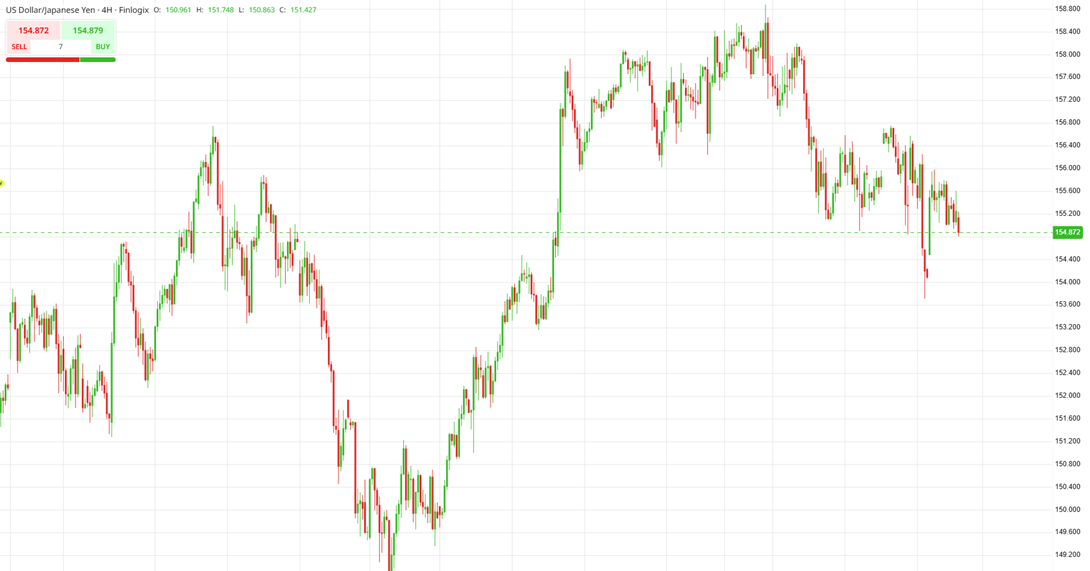
Recent Japanese inflation data has provided mixed signals. December’s services Producer Price Index (PPI) came in below expectations at 2.9% year-over-year (versus a forecasted 3.2%). However, this decline was primarily driven by volatile components such as hotel services, which remain elevated at 12% y/y.
More importantly, sectors with high labour costs continue to see price gains, aligning with Japan’s ongoing wage growth momentum. With upcoming spring labour negotiations expected to yield total pay increases of around 5%, the BOJ is unlikely to deviate from its rate hike trajectory.
Additionally, underlying inflation measures remain robust. Trimmed-mean inflation rose by 0.2 percentage points to 1.9% y/y, while weighted median inflation increased by 0.1 percentage points to 1.0% y/y. These trends suggest that inflationary pressures are becoming more entrenched, reinforcing the case for policy normalization.
Bloomberg reports indicate that Japan’s Government Pension Investment Fund (GPIF) may soon gain direct access to Japanese Government Bond (JGB) auctions. While this development is unlikely to have an immediate FX market impact, a shift in GPIF’s asset allocation could be significant in the long run.
Currently managing JPY 248 trillion ($1.6 trillion) in assets, even a minor reallocation—say, a 1% shift towards JGBs—could result in over JPY 2 trillion ($16 billion) in capital flows. While no major changes have been announced yet, markets will keep a close eye on any signals from the GPIF regarding its long-term investment strategy.
Bases on all this macro the JPY remains in a delicate balancing act between domestic monetary policy shifts and external geopolitical risks. With a potentially less dovish BOJ policy board, persistent inflation, and global trade uncertainty, Japan’s currency faces a complex path ahead.
Near-term, trade tensions could keep USD/JPY supported, but should Japan’s policy stance continue shifting towards normalization, the yen may find renewed strength in the medium term.
This content may have been written by a third party. ACY makes no representation or warranty and assumes no liability as to the accuracy or completeness of the information provided, nor any loss arising from any investment based on a recommendation, forecast or other information supplies by any third-party. This content is information only, and does not constitute financial, investment or other advice on which you can rely.
ACY Securities is one of Australia's fastest growing multi-asset online trading providers, offering ultra-low-cost trading, rock-solid execution, technologically superior account management and premium market analysis.

Select the categories and companies you wish to follow directly to your person rss feed.
Create Custom RSS FeedSign up and join over 5,000 professional members who receive personalized news alerts, curated professional connections, and more for free!
Understand trading psychology and learn how a clear strategy, risk management and a trading journal help build discipline and day trading consistency.
Ripple Prime has launched support for real-world asset perpetual swaps, giving institutional clients including Virtu exposure to more than 100 reference markets across equities, indices, ETFs, metals, energy and FX. The swaps reference Trade.xyz perpetual futures on Hyperliquid and trade and settle around the clock.
iSAM Securities Apex has integrated with Crossover Markets, connecting brokers to CROSSx, its institutional digital asset ECN, through Apex’s ultra-low-latency technology stack.
Your Bourse and 4XPORTAL highlight their existing partnership, combining client onboarding, CRM and payment solutions with liquidity, execution and risk-management infrastructure for brokers.
The partnership brings together 4XPORTAL’s brokerage technology capabilities with Your Bourse’s connectivity, liquidity aggregation, and risk-management infrastructure.
Clearstream has appointed Philippe Mueller as Head of Digital Products and Transformation for Clearstream Fund Services, succeeding Olivier Portenseigne. He will lead digital fund distribution, DLT-enabled fund processing and transfer agency innovation. He has over 25 years at Clearstream and Deutsche Börse Group.
Learn how to detach from trading outcomes by focusing on entry, exit, and risk. Build trading discipline with clear rules and a repeatable process.
CMC Markets has retired the CMC Connect name and will now present its institutional business as CMC Markets Institutional.
The SEC has approved Cboe's binary options tied to key performance indicators reported by 23 companies, covering more than 100 metrics such as iPhone revenue. The cash-settled contracts pay a fixed $1, Robinhood plans to be the first retail broker to offer them, and trading awaits clearing registration.
Gold is trading around $4,150, recovering sharply after falling to a recent low of $4,073.