just now


Liquidity Finder Ltd is incorporated in England and Wales, company number 10610740, registered address 167-169 Great Portland Street, Fifth Floor, London W1W 5PF, United Kingdom.
Published: just now

AMD, Super Micro Computer and Navitas Semiconductor are all set to report after the U.S. close on Tuesday, May 5, 2026.
Last week’s move was very bullish for the markets. So this week, investors will get a second look into the AI rally to see if actual revenue, forward guidance and demand in other AI businesses are strong enough to justify last week’s move.
AMD is the AI accelerator read, Super Micro is the AI server read, and Navitas is the speculative AI power-infrastructure read.
The market already knows AI demand is strong. The question now is whether these stocks can catch up to the expectations already priced into the rally — and if not, perhaps allow markets to cool off.
Last week’s earnings gave the AI bulls enough to work with, especially outside the usual GPU names.
Company | Result | Guidance / forward read |
| MaxLinear | Beat. Q1 revenue came in at $137.2m, up 43% YoY. | Guided Q2 revenue to $160m-$170m, well above Wall Street’s earlier $137.1m estimate. Infrastructure revenue grew 136% YoY, helped by optical data-centre demand. |
| Monolithic Power | Beat. Q1 revenue rose 26% YoY to $804.2m. | Enterprise Data revenue nearly doubled to $262.8m, helped by AI and server power-management demand. |
| Google Cloud | Strong cloud read. Google Cloud revenue rose 63% to $20bn. | Backlog nearly doubled to $460bn, showing AI services demand is moving beyond just capex headlines. |
| Microsoft Cloud | Strong cloud read. Microsoft Cloud revenue rose 29% to $54.5bn. | Commercial remaining performance obligation rose 99% to $627bn, while Azure and other cloud services grew around 40%. |
The AI story has support from cloud revenue, infrastructure chips and power-management demand, but support is not the same as surprise.
This week, AMD, SMCI and Navitas need to show whether other parts of the AI market can catch up to what traders have already priced.
The options-implied move is probably the cleanest guide for this setup.
Not because price has to stop there, but because it tells us what the market had already priced before earnings. If the report is strong enough, price can break above the upper implied range. If the update disappoints, price can break below the lower range. Either way, the implied move gives us a benchmark for whether the reaction is normal, weak or a real repricing.
These levels are based on May 5, 2026 pre-earnings pricing for the May 8, 2026 weekly options expiry.
Stock | Options-implied move | Lower range | Upper range |
| AMD | Around 8% either way | $331.70 | $389.38 |
| SMCI | Around 12.55%-12.77% either way | $23.70 | $30.50 |
| NVTS | Around ±$2.99 / 17.16% | $14.45 | $20.43 |
AMD’s implied range comes from options pricing ahead of earnings, while SMCI’s expected move has been reported around 12.5% and NVTS options pricing shows a wide earnings-week range into May 8 expiry.
The key is not to treat these levels as hard targets. They are market expectations. If earnings beat or disappoint hard enough, price can move beyond them, which is why the chart zones still matter.
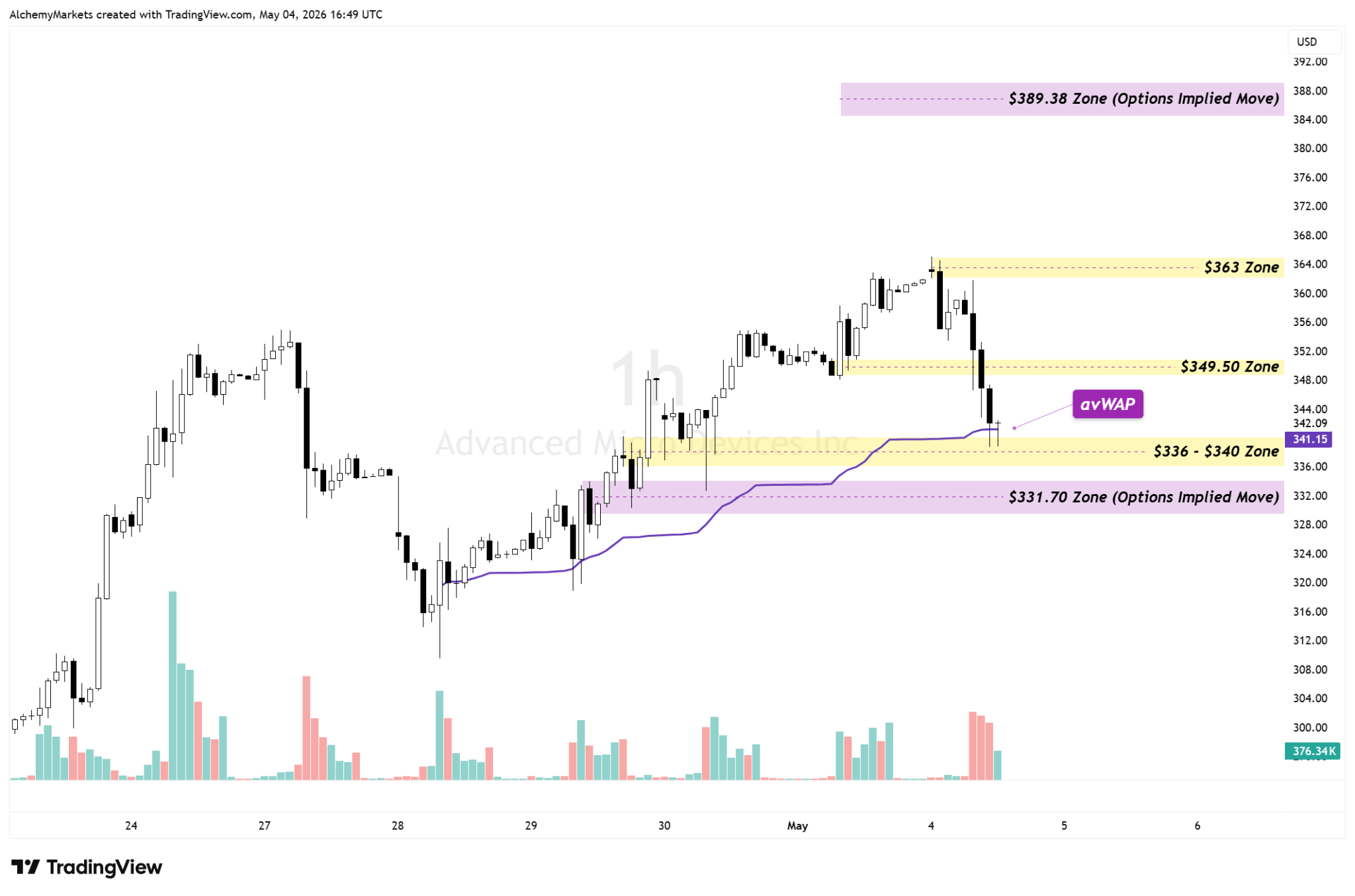
AMD is the cleanest read on whether the AI accelerator story still has room to run. The chart is now testing the $336-$340 zone, with the aVWAP sitting nearby, so that area becomes the first support reaction zone into earnings. If buyers defend it, the pullback still looks contained. If it fails, the lower options-implied range near $331.70 becomes the next stress point.
On the upside, AMD needs to reclaim $349.50 first before the chart starts to repair properly. After that, the $363 zone becomes the more important momentum level, while $389.38 marks the upper end of what the options market had priced before earnings.
AMD setup | Level / stat | Read |
| Lower options-implied range | $331.70 | Downside benchmark if earnings disappoint |
| Main support zone | $336-$340 | First chart reaction area |
| Reclaim level | $349.50 | First level needed to repair momentum |
| Momentum level | $363 | Stronger upside confirmation area |
| Upper options-implied range | $389.38 | Benchmark for a stronger-than-priced reaction |
| Short float | 2.20% | Low squeeze risk |
| Short interest | 35.65m shares | This is not really a short-squeeze setup |
AMD’s short interest is not the exciting part here. With short float at only 2.20%, this is more about guidance and whether the AI accelerator story can still justify the valuation rather than a squeeze-style setup.
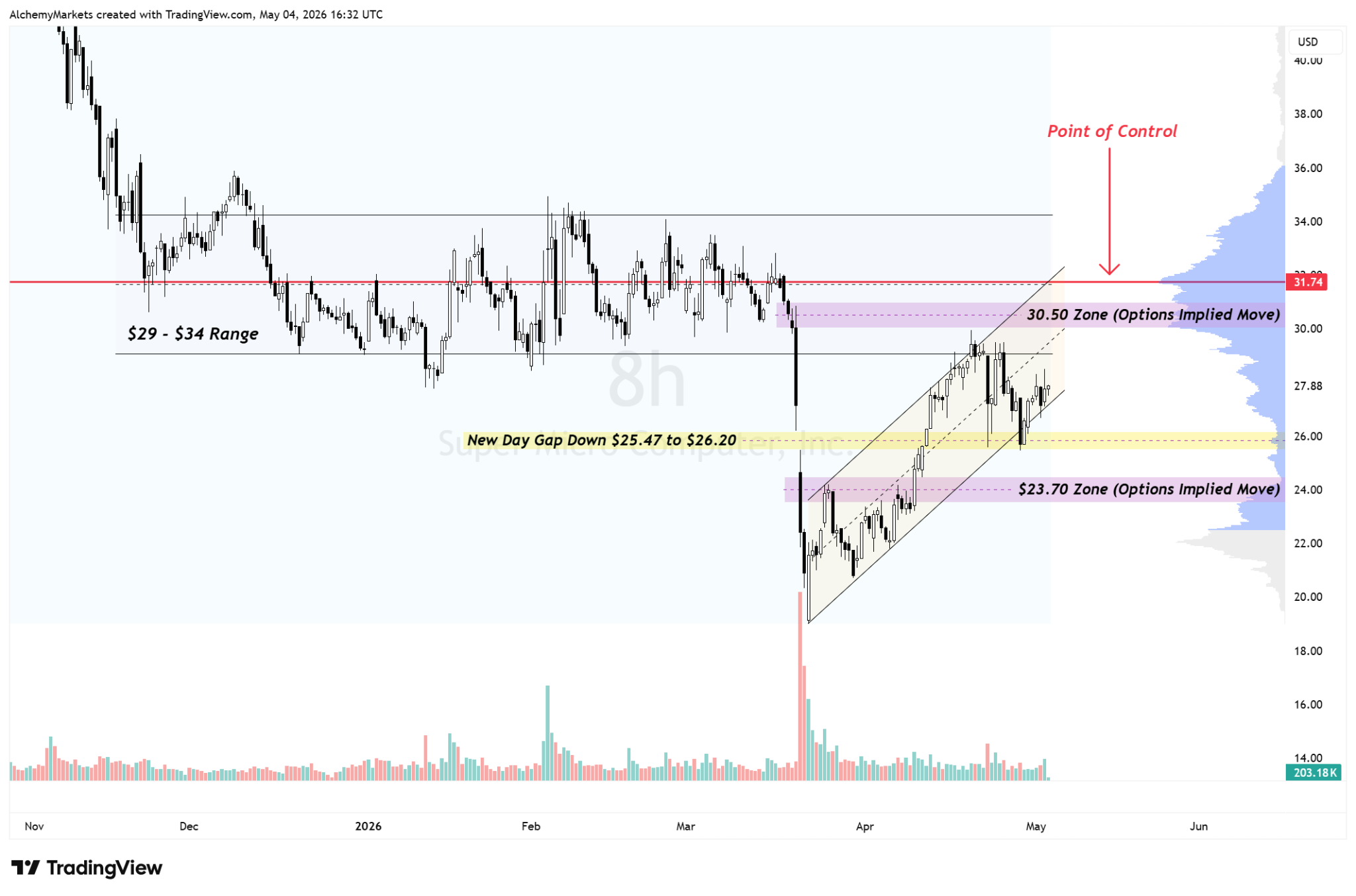
Super Micro is more interesting because the key technical level sits just above what options have already priced. The chart is still below its old $29-$34 range, while the point of control sits around $31.70-$31.74. That POC matters because it sits above the $30.50 options-implied upside range.
That makes the read very clean. A move into $30.50 would be strong, but still largely inside what the options market expected. A break above $31.70-$31.74 would be more meaningful because SMCI would be pushing beyond the implied range and trying to reclaim its old volume shelf.
SMCI setup | Level / stat | Read |
| Lower options-implied range | $23.70 | Downside benchmark if earnings disappoint |
| Gap zone | $25.47-$26.20 | First downside chart reaction area |
| Upper options-implied range | $30.50 | Upper edge of the expected move |
| POC / key resistance | $31.70-$31.74 | Stronger confirmation if reclaimed |
| Old range | $29-$34 | Range bulls need to win back |
| Short float | 16.84% | High enough to matter |
| Short interest | 86.79m shares | Potential squeeze fuel if earnings surprise |
The short-interest setup makes SMCI the more interesting squeeze candidate of the three. If earnings land well and price pushes through the POC, the move could become more than a normal post-earnings bounce. The catch is that Super Micro still needs to answer the margin question, because the market already knows AI server demand is real.
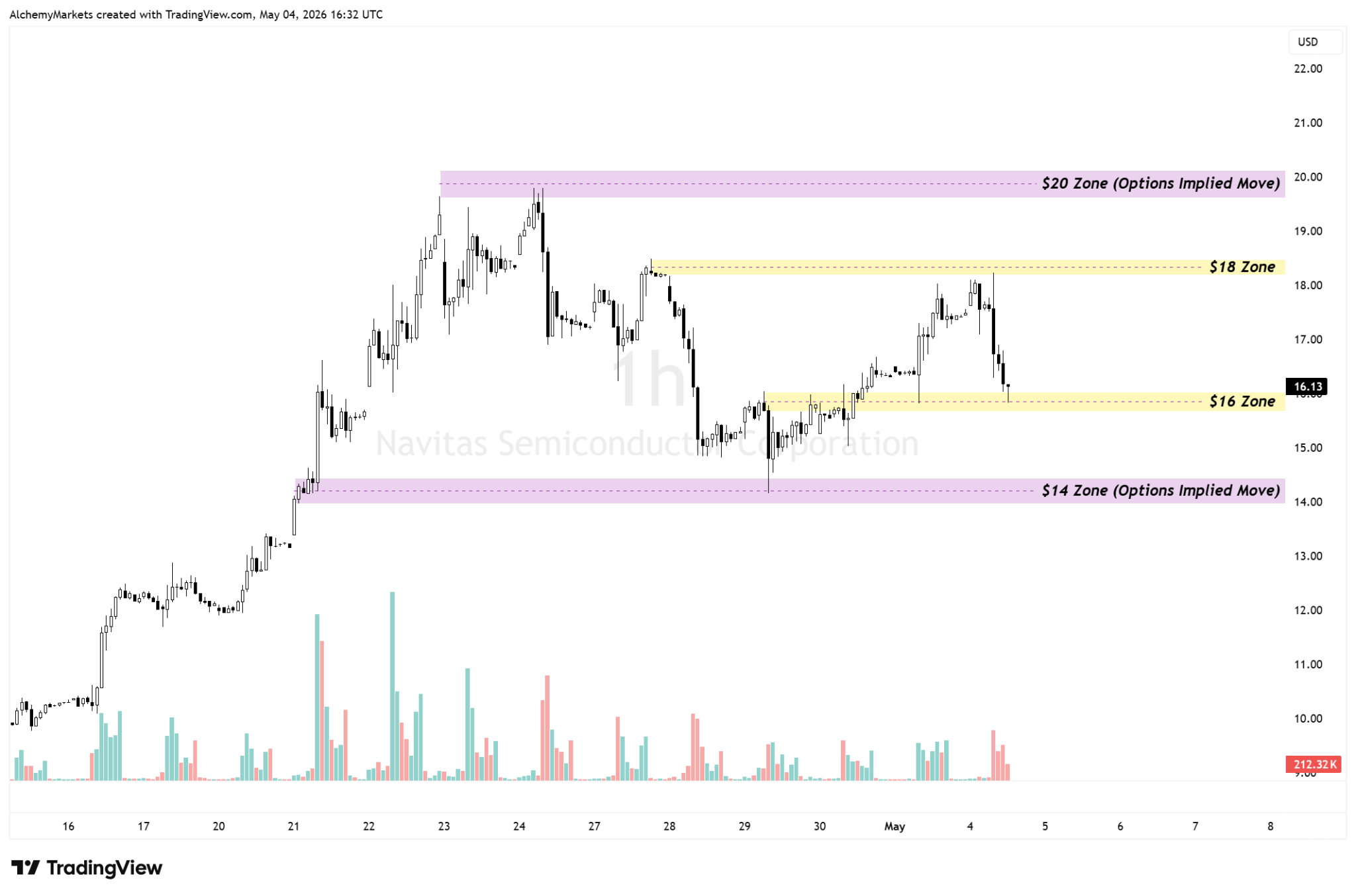
Navitas is the speculative one, and the chart is still range-based. Price is back near the $16 zone after rejecting around $18, which makes $16 the first area to watch. If it holds, the range is still alive. If it breaks, the lower options-implied range near $14.45 comes into view.
The upside is just as simple. NVTS needs to reclaim $18 before traders can talk about a stronger momentum leg. Above that, the upper options-implied range near $20.43 becomes the next benchmark.
NVTS setup | Level / stat | Read |
| Lower options-implied range | $14.45 | Downside benchmark if earnings disappoint |
| Main support zone | $16 | First chart reaction area |
| First resistance | $18 | Range level to reclaim |
| Upper options-implied range | $20.43 | Upper edge of the expected earnings-week move |
| Short float | 23.32% | Highest squeeze sensitivity of the three |
| Short interest | 48.57m shares | Can make the move violent if the update surprises |
NVTS has the most squeeze-sensitive short-interest profile, but also the least stable revenue base. That means a strong AI power-infrastructure update can squeeze hard, while a vague update can just as quickly drag the stock back into the lower end of the range.
The AI rally gets its second look after Tuesday’s U.S. close.
Last week’s earnings helped keep the AI story alive, but this week is about whether AMD, Super Micro and Navitas can back that story up with numbers and forward guidance. The options-implied ranges give us the benchmark for what the market had already priced as of May 4, 2026.
If price stays inside those ranges, the reaction may look big but still be broadly expected. If price breaks beyond them and holds, that is where the market is saying earnings were strong enough, or weak enough, to force a real repricing.
For AMD, the main test is whether price can defend $336-$340 and eventually reclaim $349.50 and $363. For SMCI, the key level is $31.70-$31.74, because it sits above the implied move and lines up with meaningful short-interest risk. For Navitas, the range is simpler: $16 support, $18 resistance and $20.43 as the upper implied range.
This week, AI earnings are the catalyst. The options market shows what was expected, the chart levels show where the reaction becomes meaningful, and short interest tells us where the move can get violent.
DISCLAIMER: For educational purposes only. Trading comes with substantial risk, leading to possible loss of your capital. Traders are advised to do their own due diligence before investing.
Alchemy Markets is a multi-asset brokerage providing retail traders with the same elite trading conditions, tools, and transparency typically reserved for institutions.

Select the categories and companies you wish to follow directly to your person rss feed.
Create Custom RSS FeedSign up and join over 5,000 professional members who receive personalized news alerts, curated professional connections, and more for free!
Multi-asset trading broker AvaTrade has agreed to acquire the majority of FXCM Group’s business and brand, in a transaction that would bring a longstanding retail FX franchise into the AvaTrade Group.
LSEG and CMC Markets have signed a multi-year strategic data agreement expanding CMC's access to LSEG's real-time and delayed pricing, reference and corporate actions data, news and analytics, plus AI-ready content, to support new products, entry into new markets and the growth of CMC's institutional and B2B partnerships.
The Tel Aviv Stock Exchange is considering a bid for the Cyprus Stock Exchange, with Israeli media citing its EU licence, trading platform and clearing house. Euronext’s Athens exchange and India’s National Stock Exchange are also seen as contenders, and Cyprus aims to sign a sale agreement by the end of this year.
CME Group will launch baseball futures on 12 October, pending regulatory review, tracking CME FutureSports Performance Indexes built on Official League Data. Standard and micro contracts will start with the 2026 Postseason and the four clubs in the League Championship Series, trading around the clock.
ESMA has published an opinion stating that MiCA-authorised crypto-asset service providers should cease services tied to non-MiCA-compliant stablecoins for EU clients across MiCA crypto-asset services. National authorities should require remediation of existing exposures within three months, by early January 2027.
Nasdaq Ventures has made a strategic investment in Amsterdam-based derivatives and crypto exchange One Trading, with both firms to explore 24/7 trading of equity futures. The undisclosed investment follows Nasdaq's US$100 million investment in Payward, the parent of Kraken, and CME Group's move to 24/7 trading.
cTrader has opened multi-platform plugins to brokers and prop firms, which can pre-install their own tools for clients or list them in cTrader Store. The plugins run across Mobile, Web, Windows and Mac, and can be built and launched independently of core-platform releases, including trading journals and calculators.
Institutional brokerage and financial infrastructure provider Clear Street has joined TradingView’s broker network, allowing its clients to trade US stocks, exchange-traded funds and options directly through the charting and analysis platform.
Learn how to improve trading psychology, manage fear and greed, avoid revenge trading, and follow your trading strategy with discipline and a trading journal.
GTC Prime has announced a strategic partnership with Centroid Solutions to manage and distribute its liquidity through CS 360 Bridge, Centroid's multi-asset connectivity and execution engine, giving brokers and institutional clients access to tailor-made pricing, low-latency execution and real-time risk management.