just now

Liquidity Finder Ltd is incorporated in England and Wales, company number 10610740, registered address 167-169 Great Portland Street, Fifth Floor, London W1W 5PF, United Kingdom.
Published: just now


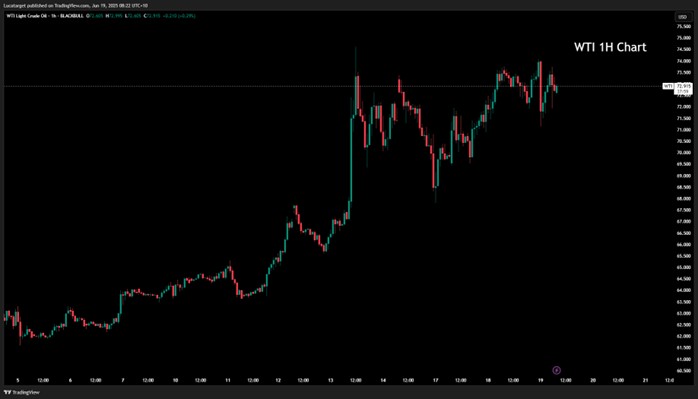
The latest developments in the Middle East are injecting fresh uncertainty into global markets, though the financial impact remains surprisingly constrained. Despite increasing speculation of direct U.S. involvement following President Trump’s call for Iran’s “unconditional surrender,” broader market reaction has been relatively muted. Crude oil has been the notable exception. Brent surged over 4% yesterday, reaching its highest level since February, largely in response to rising fears that any military engagement could jeopardize oil infrastructure in the region.
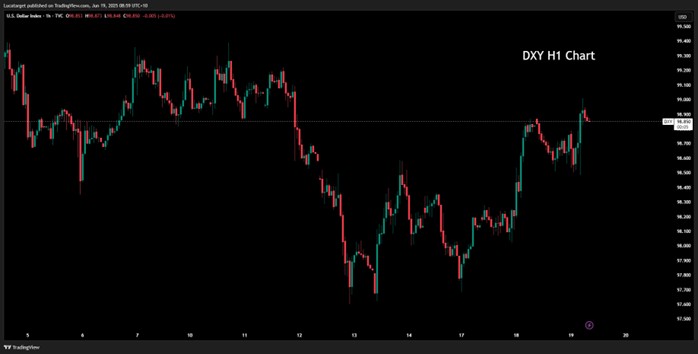
However, outside of energy markets, price action has been contained. U.S. equity indices have barely moved, the 10-year Treasury yield is up only modestly, and gold (XAU) prices remain unchanged over the past several sessions. This disconnect reflects investor scepticism that the Israel-Iran conflict will evolve into a protracted regional war that significantly disrupts global supply chains. For now, the dollar (DXY) has firmed alongside oil prices, with the Norwegian krone outperforming on its commodity linkage, while traditional low yielders like the yen and Swiss franc are under pressure.
This outperformance in the dollar, however, is unlikely to be sustained without confirmation of a broader conflict. The International Energy Agency has just released a monthly report highlighting growing global oil inventories, a sign that the market is well-positioned to absorb moderate supply disruptions. OPEC+ continues to boost output, and global oil supply is expected to grow by nearly 2 million barrels per day this year. At the same time, the IEA has revised down its demand expectations for 2025, citing a quicker-than-anticipated peak in China’s oil usage. If military escalation is avoided or proves short-lived, oil prices could correct sharply potentially dragging the dollar lower in the process.
Following its June 18 meeting, the Federal Reserve elected to maintain the federal funds rate at 4.25%–4.50%, shifting to a cautiously more balanced stance. The updated dot plot continues to reflect two rate cuts this year, but internal divisions are evident: seven of the 19 policymakers now anticipate that no cuts may be required in 2025. The Fed emphasised that while economic uncertainty has diminished, it remains vigilant amid persistent inflation and geopolitical volatility.
Chair Powell described ongoing inflationary pressures, notably from expected tariffs and elevated energy costs, as both “meaningful” and uncertain in duration at the same time, the labour market remains solid with unemployment at 4.2% though signs of slower growth are emerging Growth projections have been cut to approximately 1.4% for 2025, and inflation forecasts have been nudged higher toward 3%.
In sum, the Fed signalled a “data‑dependent” approach: maintaining a pause for now, but leaving the door open to easing later in the year potentially as soon as September if economic conditions evolve as expected.
Yet, oil-driven inflation risks and tariff uncertainty prevent the Fed from sounding overtly dovish. The threat of reciprocal tariffs beginning in July, as well as potential consumer demand drag from trade frictions, adds to the complexity of the outlook. Should the situation in the Middle East escalate, Fed officials may interpret it as a near-term inflation risk, while also recognising the potential drag on global growth and sentiment.
In short, the market is entering a phase of elevated geopolitical and monetary policy uncertainty. The dollar remains supported in the near term by rising oil prices and the lack of a clear risk-off rotation. However, should we see easing in Middle East tensions or signs of weaker U.S. growth ahead, this dollar strength could quickly unwind. What Powell signals later today will be crucial, particularly given how delicately poised the balance is between inflation concerns and evidence of economic deceleration.
Q&A: Geopolitics, the Fed, and the Market Outlook
Q: Why has oil surged despite limited broader market reaction?
A: Oil prices are highly sensitive to geopolitical risk, particularly in the Middle East. Brent crude surged over 4% as markets priced in the threat of supply disruptions if U.S. x Iran tensions escalate. However, equity and bond markets have remained stable, reflecting investor scepticism that the conflict will evolve into a broader regional war.
Q: Is the oil rally sustainable?
A: Not necessarily. While tensions remain elevated, the IEA’s latest report shows that global inventories are rising and demand growth is slowing, particularly in China. Unless there is a major disruption to supply, the oil rally may face downward pressure in the coming weeks.
Q: What did the Fed decide in its latest meeting?
A: The Fed held rates steady at 4.25%–4.50% and maintained its projection for two cuts in 2025. However, there are growing divisions within the committee, with seven members now anticipating no cuts at all this year.
Q: How did Chair Powell address current risks?
A: Powell struck a cautiously balanced tone, citing inflationary risks from tariffs and energy prices while acknowledging slowing growth and a still-resilient labour market. The Fed remains data-dependent and has left the door open to potential rate cuts later in the year.
Q: What does this mean for the U.S. dollar going forward?
A: In the near term, the dollar remains supported by higher oil prices and ongoing uncertainty. But should tensions in the Middle East de-escalate or if economic data weakens, the dollar could lose momentum especially if markets begin to price in rate cuts more aggressively.
Q: What should investors be watching next?
A: Keep an eye on developments in the Middle East, tariff implementation timelines, and U.S. inflation and labour data. These factors will heavily influence the Fed’s path and the trajectory of the U.S. dollar through the second half of 2025.
This content may have been written by a third party. ACY makes no representation or warranty and assumes no liability as to the accuracy or completeness of the information provided, nor any loss arising from any investment based on a recommendation, forecast or other information supplies by any third-party. This content is information only, and does not constitute financial, investment or other advice on which you can rely.
ACY Securities is one of Australia's fastest growing multi-asset online trading providers, offering ultra-low-cost trading, rock-solid execution, technologically superior account management and premium market analysis.

Select the categories and companies you wish to follow directly to your person rss feed.
Create Custom RSS FeedSign up and join over 5,000 professional members who receive personalized news alerts, curated professional connections, and more for free!
The AI trade has always been a supply chain story. For the past two years, the narrative has been simple: insatiable demand for compute infrastructure, constrained supply at every choke point, and the companies that own the bottlenecks collect the toll. NVIDIA on GPUs. ASML on lithography. Samsung, SK Hynix, and Micron on memory. The entire semiconductor complex has traded on scarcity, and scarcity has delivered historic margins.
Interactive Brokers reported customer equity of USD 964.7 billion at the end of the third quarter, up 27% year on year, as customer accounts increased 35% to 5.58 million.
Crypto exchange BingX has secured a Markets in Crypto-Assets Regulation (MiCA) licence for its European arm from Austria's Financial Market Authority (FMA).
CXM Group has agreed to acquire TD Markets (Pty) Ltd, a Johannesburg-headquartered broker authorised by South Africa’s FSCA. TD Markets keeps its brand, team and licence, and Amar Ramith stays as CEO. Financial terms were not disclosed. The deal gives CXM a regulated base in South Africa. Clients need take no action.
Global equities under pressure: Hotter than expected US inflation and rising yields weighed on stocks, particularly technology and semiconductor shares.
Understand trading psychology and learn how a clear strategy, risk management and a trading journal help build discipline and day trading consistency.
Ripple Prime has launched support for real-world asset perpetual swaps, giving institutional clients including Virtu exposure to more than 100 reference markets across equities, indices, ETFs, metals, energy and FX. The swaps reference Trade.xyz perpetual futures on Hyperliquid and trade and settle around the clock.
iSAM Securities Apex has integrated with Crossover Markets, connecting brokers to CROSSx, its institutional digital asset ECN, through Apex’s ultra-low-latency technology stack.
Your Bourse and 4XPORTAL highlight their existing partnership, combining client onboarding, CRM and payment solutions with liquidity, execution and risk-management infrastructure for brokers.
The partnership brings together 4XPORTAL’s brokerage technology capabilities with Your Bourse’s connectivity, liquidity aggregation, and risk-management infrastructure.