just now

Liquidity Finder Ltd is incorporated in England and Wales, company number 10610740, registered address 167-169 Great Portland Street, Fifth Floor, London W1W 5PF, United Kingdom.
Published: just now


The global economy is once again navigating uncertain waters, with key developments shaping the outlook for currencies and economic stability. Among these shifts, the Reserve Bank of Australia’s (RBA) evolving stance on monetary policy and its implications for the Australian dollar (AUD) take centre stage. Meanwhile, China's renewed commitment to economic stimulus and escalating U.S.-China trade tensions add layers of complexity. In this blog, we explore how these factors intersect and their potential consequences for global markets.
The Reserve Bank of Australia has maintained its benchmark interest rate at 4.35% throughout 2024, yet recent developments suggest a significant shift may be on the horizon. Following its latest policy meeting, the RBA expressed growing confidence that inflationary pressures are easing. This view is supported by softer-than-expected economic data, including a slowdown in wage growth and a weaker GDP report for Q3.
Governor Michele Bullock emphasized that the battle against inflation isn’t over but acknowledged the building evidence of cooling price pressures. Notably, she suggested that the RBA does not require several quarters of declining inflation to justify rate cuts—a remark that has markets speculating about potential reductions as early as February or April next year.
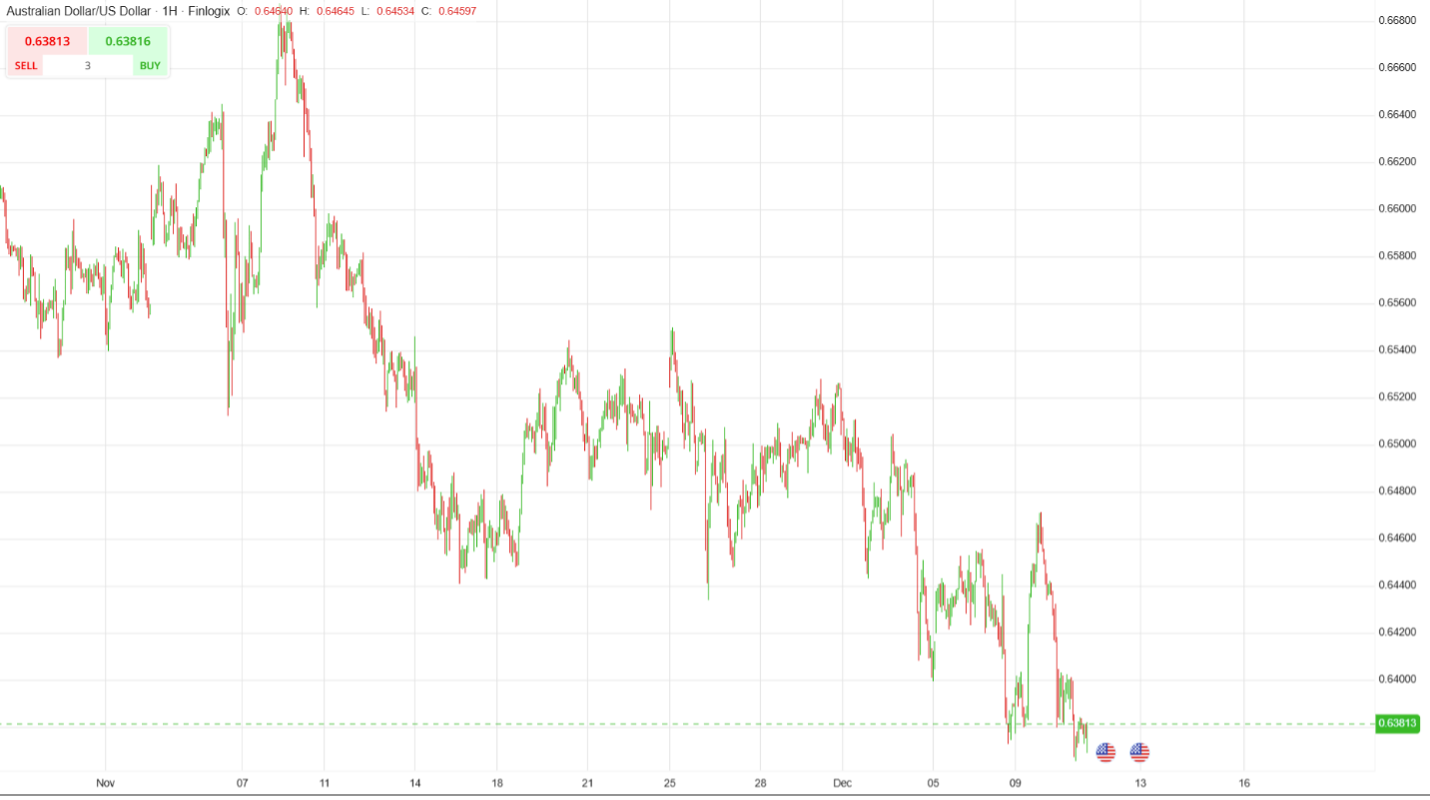
For the AUD, this dovish shift has brought immediate repercussions. After a brief rally, the currency fell back below the 0.6400 mark against the U.S. dollar. While the prospect of lower interest rates could offer some relief to borrowers, it poses downside risks for the AUD, especially when coupled with global uncertainties.
China’s Politburo has unveiled plans for a more aggressive economic stimulus strategy to bolster growth amid increasing external pressures. With President Donald Trump set to reintroduce higher tariffs on Chinese imports during his second term, Beijing is pre-emptively seeking to stabilize its economy. Key measures include shifting to 'moderately loose' monetary policy, adopting proactive fiscal measures, and targeting greater domestic demand.
One of the most closely watched signals from China is the annual Central Economic Work Conference (CEWC), where policymakers are expected to provide further details on the scope of their fiscal and monetary plans. Early indications suggest that next year’s budget deficit could expand to between 3% and 4% of GDP, up from 3% this year.
While these steps aim to cushion the economy, their effectiveness remains uncertain. Long-term yields on Chinese government bonds have fallen below Japanese equivalents for the first time, suggesting scepticism about the structural challenges that lie ahead. A potential weakening of the renminbi may also emerge as a tool to counteract U.S. trade measures, adding to the volatility in global markets.
Trade relations between the U.S. and China have taken a sharp turn as Donald Trump reasserts his hardline stance. Plans to impose a 10% tariff on all Chinese imports early in his term could escalate into a broader trade war, with tariffs potentially reaching as high as 60%. These measures threaten to disrupt global trade flows and amplify risks for export-driven economies.
For Australia, heavily reliant on China as a trade partner, the fallout could be significant. Commodity-driven currencies like the AUD and South African rand (ZAR) may feel the strain, even as China's stimulus efforts attempt to counteract these headwinds.
The interplay of these dynamics creates a mixed outlook for commodity-linked currencies. On one hand, China’s stimulus could support demand for raw materials, providing some relief to economies like Australia’s. On the other, the looming spectre of U.S.-China trade disruption introduces new uncertainties, limiting the scope for sustained gains.
The Australian dollar's recent performance underscores these tensions. Despite temporary rallies fuelled by China's announcements, the currency faces persistent pressure from the dual challenges of an RBA rate cut and global trade instability.
For investors and policymakers, these developments highlight the importance of adaptability. Markets are entering a period of heightened sensitivity to policy announcements, economic data, and geopolitical events.
The current environment underscores the interconnected nature of global economies and the delicate balance policymakers must strike. As the RBA signals a dovish shift, China steps up its stimulus efforts, and U.S.-China trade tensions intensify, the implications for currencies like the AUD are profound. Staying informed and responsive to these shifts will be critical for navigating the road ahead.
While challenges abound, opportunities often arise in periods of transformation. For Australia, China, and beyond, 2025 may yet hold the promise of recalibrated growth and renewed economic momentum.
This content may have been written by a third party. ACY makes no representation or warranty and assumes no liability as to the accuracy or completeness of the information provided, nor any loss arising from any investment based on a recommendation, forecast or other information supplies by any third-party. This content is information only, and does not constitute financial, investment or other advice on which you can rely.
Why Is Forex Trading So Difficult?
How To Master MT4 & MT5 - Tips And Tricks For Traders
The Importance Of Fundamental Analysis In Forex Trading
Forex Leverage Explained: Mastering Forex Leverage In Trading & Controlling Margin
The Importance Of Liquidity In Forex: A Beginner's Guide
Close All Metatrader Script: Maximise Your Trading Efficiency And Reduce Stress
Best Currency Pairs To Trade In 2024
Forex Trading Hours: Finding The Best Times To Trade FX
MetaTrader Expert Advisor - The Benefits Of Algorithmic Trading And Forex EAs
ACY Securities is one of Australia's fastest growing multi-asset online trading providers, offering ultra-low-cost trading, rock-solid execution, technologically superior account management and premium market analysis.

Select the categories and companies you wish to follow directly to your person rss feed.
Create Custom RSS FeedSign up and join over 5,000 professional members who receive personalized news alerts, curated professional connections, and more for free!
CMC Markets has retired the CMC Connect name and will now present its institutional business as CMC Markets Institutional.
The SEC has approved Cboe's binary options tied to key performance indicators reported by 23 companies, covering more than 100 metrics such as iPhone revenue. The cash-settled contracts pay a fixed $1, Robinhood plans to be the first retail broker to offer them, and trading awaits clearing registration.
Gold is trading around $4,150, recovering sharply after falling to a recent low of $4,073.

Global semiconductor and technology stocks sold off sharply on Thursday, with South Korea’s SK Hynix plunging over 10% and Samsung Electronics falling more than 8%.
Learn gold market structure to identify bullish, bearish and ranging XAUUSD trends using higher highs, higher lows, lower highs and lower lows, support and resistance.
Axi has launched an MCP integration connecting eligible MT5 accounts to Claude, allowing clients to access live market data, track positions, execute trades and update risk parameters through the AI assistant developed by Anthropic. Available to eligible Axi clients with an active MT5 account. Setup runs via Claude.ai.
Movantis has selected Integral to extend its FX liquidity offering for institutional clients including banks, payment networks and digital asset operators, adding an institutional trading platform, direct-to-client API trading and API connectivity into a third-party multi-dealer venue, supporting regional expansion.
Running a venue around the clock is the easy part. Pricing risk when the market underneath it is shut is not. Lars Holst, CEO of GCEX explains how to manage risk in 24/7 markets.
ATFX has released its Q4 2026 Trader Magazine, offering a closer look at the macroeconomic and market forces that could shape trading conditions in the final quarter of the year.
LSEG has announced a collaboration with NVIDIA that lets financial institutions analyse years of LSEG Tick History data in seconds using NVIDIA cuDF on GPUs, without creating another full copy of the dataset. Tick History holds 110 trillion rows across 100 million instruments and more than 580 venues and contributors.