just now


Liquidity Finder Ltd is incorporated in England and Wales, company number 10610740, registered address 167-169 Great Portland Street, Fifth Floor, London W1W 5PF, United Kingdom.
Published: just now

Markets just got another sharp turn in the tape.
Iran has reportedly just sent a fresh proposal for negotiations with the U.S. through Pakistani mediators, oil eased on the news, and earnings are still doing enough to keep buyers engaged. That combination has pushed the S&P 500 back toward the 7,300 area, or close enough that traders now have to treat it as a live level. After the move into 7,265, the gap is not that wide anymore.
That does not mean 7,300 has to print exactly.
It means the market is already close enough for the bigger question to take over: does this good-news wave still have enough fuel to squeeze a little further, or is it setting up the sort of peak that gets followed by a mid-year shakeout?
In this piece, we’re looking at three things now shaping the next move:
The cleaner warning sign is not the S&P 500 itself. It is SOX/SPX.
SOX is the semiconductor index. Comparing it with the S&P 500 shows whether chip stocks are still outperforming the broader market.
For an AI-led rally, that ratio tells you whether the market’s strongest theme is still doing the heavy lifting.
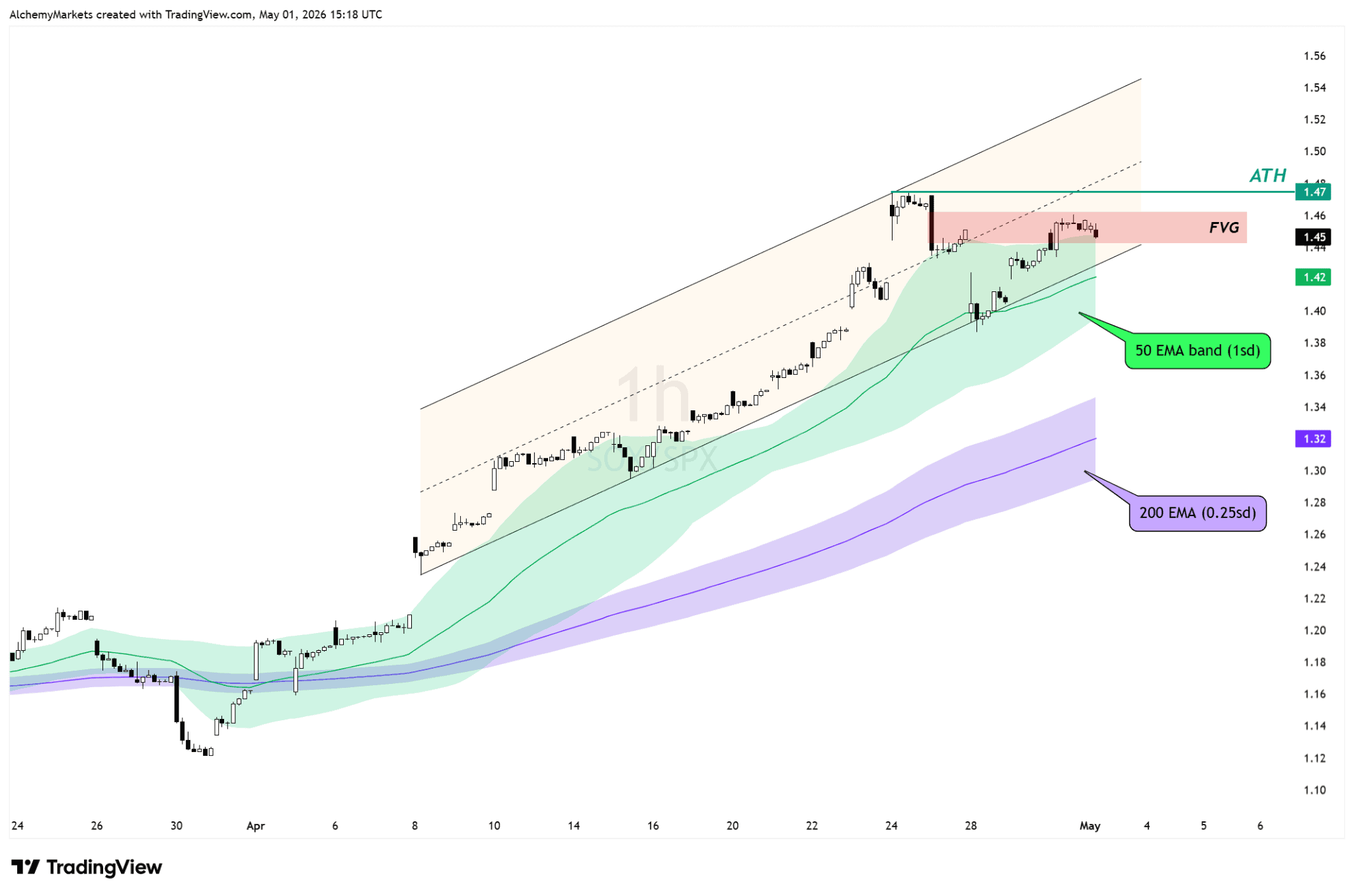
Right now, SOX/SPX is sitting in a potential rejection zone.
The ratio is pressing into the 1.45 to 1.46 area, where the fair value gap sits. However, a more interesting level would be the midline of the rising channel, which is near 1.47.
If semiconductors are stalling here or grinds higher, the index can still squeeze a little higher on earnings and improving Iran headlines.
However, if a breakdown begins, S&P 500 should begin to weaken as it is currently sustained by AI earning headlines.
The S&P 500 chart is now less about whether the rebound worked and more about how far this squeeze can still go.
https://twitter.com/Mr_Derivatives/status/2044896693750222913
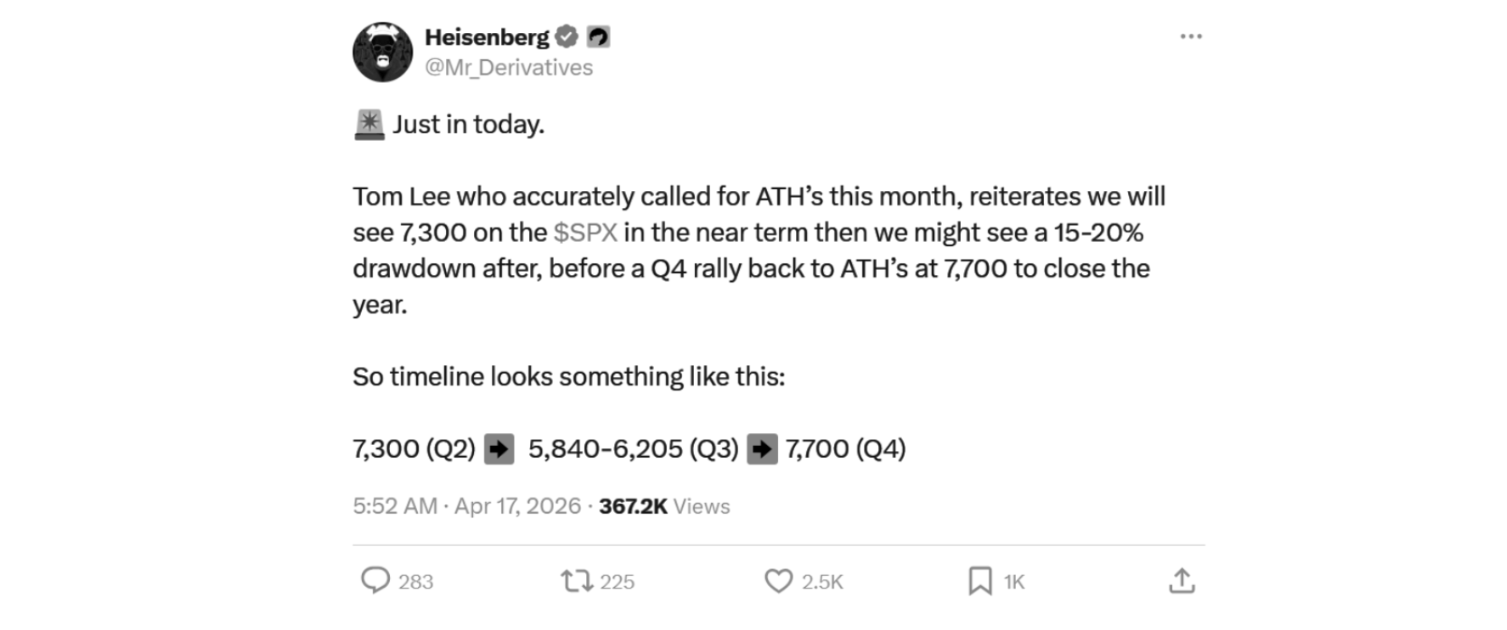
One projection making the rounds recently comes from Tom Lee of Fundstrat. Lee has argued that the S&P 500 can still push toward 7,300, helped by resilient earnings, easing inflation pressure and a market that has not fully chased the rally yet.
Separately, he has also said an S&P 500 move above 7,700 this year is “very probable,” after markets moved past early-year risks around Iran, private credit and Fed uncertainty.
That fits the current setup, but not as a straight-line melt-up story.
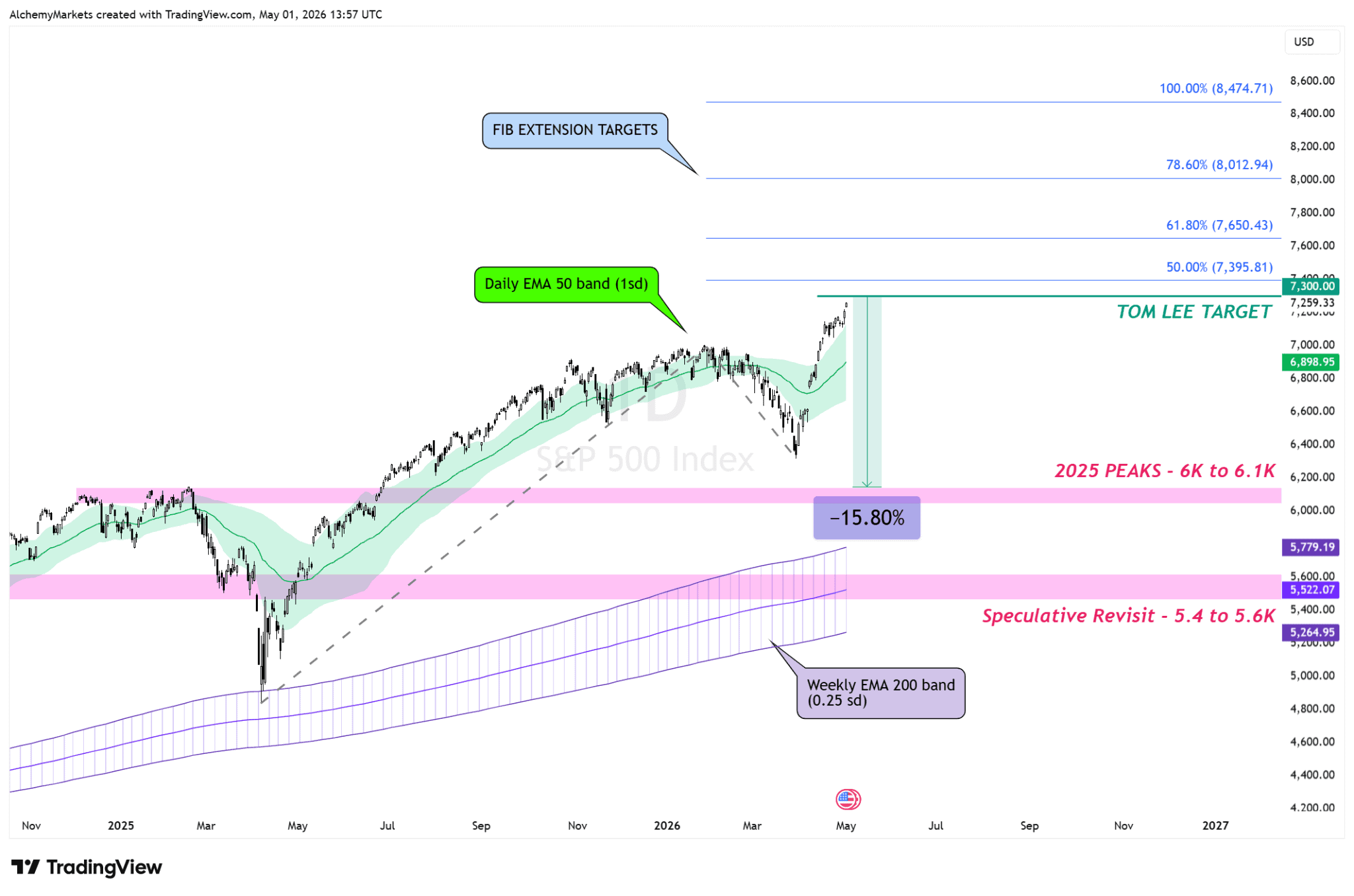
The S&P 500 has already traded into 7,265, so 7,300 does not need some heroic final leg. It only needs the current good-news wave to last a little longer.
Our read is that 7,300 is the interesting zone, not because it has to stop the market exactly, but because the risk-reward starts to change once price gets there.
If semiconductors regain momentum and SOX/SPX pushes through its own resistance, the S&P 500 can still stretch beyond 7,300. In that case, the next upside references sit around 7,395 to 7,400, then 7,650 if momentum keeps running.
But those higher levels only matter if leadership holds underneath the surface.
If chip leadership keeps stalling while the S&P 500 pushes into 7,300, the move starts to look less like a fresh breakout and more like the final squeeze before correction risk takes over.
Take a look at this Midterm Election year seasonality chart from Artemis from February 2026 - it’s the typical price movement of S&P 500 during midterm election years.
Surprisingly, the path lines up extremely well with Tom Lee’s projections. May typically is a weaker month for the S&P leading into June, where the price then recovers and makes a new ATH into December.
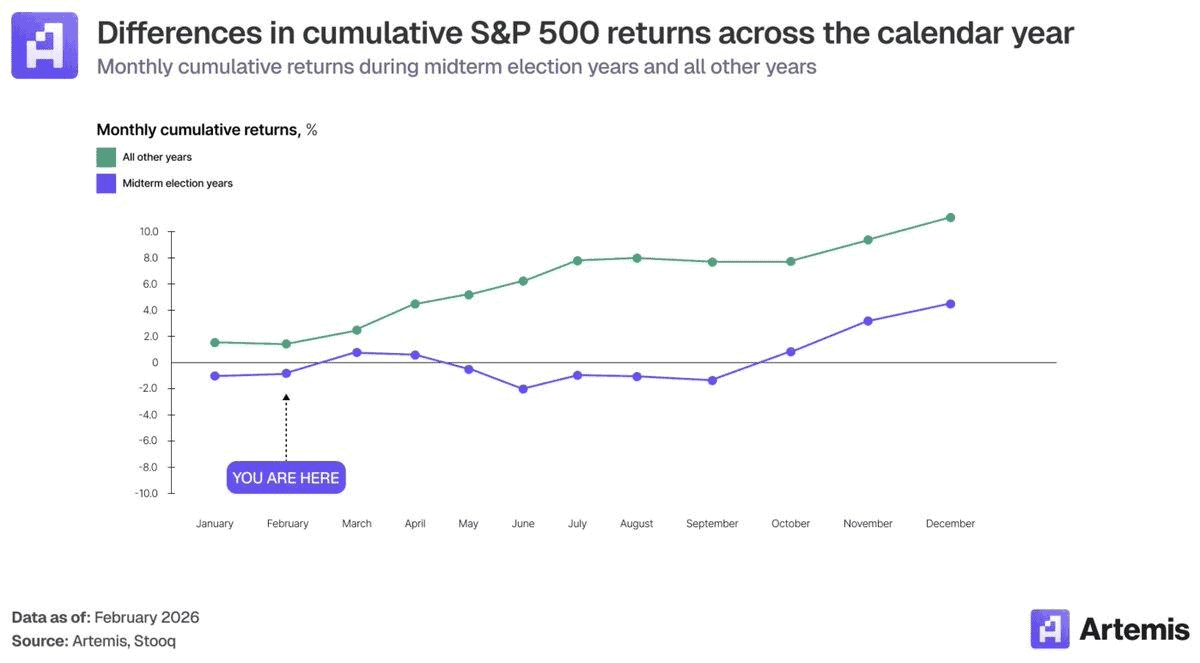
Although this is not a forecast, it is based on historical averages. So if the path ensues, we could see the following happen:
The year end targets could be near $7,700 as Tom Lee projected, but if not, Fib Extension levels could be good targets as well. Only time will tell if this typical mid-term pathing will rhyme true again in 2026.
Iran coming back to the table, softer oil and firm earnings have been enough to put S&P 7,300 back in play. But the more important read is underneath the headline index.
SOX/SPX is already in a potential rejection zone. If chip leadership pushes through it, the S&P 500 can still squeeze higher and 7,300 becomes easier to reach.
If chip leadership keeps stalling there, the index may still get close enough to test that area, but the move starts to look more like the last push of the leg than the start of a fresh one.
DISCLAIMER: For educational purposes only. Trading comes with substantial risk, leading to possible loss of your capital. Traders are advised to do their own due diligence before investing.
Alchemy Markets is a multi-asset brokerage providing retail traders with the same elite trading conditions, tools, and transparency typically reserved for institutions.

Select the categories and companies you wish to follow directly to your person rss feed.
Create Custom RSS FeedSign up and join over 5,000 professional members who receive personalized news alerts, curated professional connections, and more for free!
Why did gold keep falling after reaching $3,880? See how a failed 4-hour retest confirmed weakness in XAUUSD and why $3,400 is the next weekly support to watch.
Reality television personality Aaron Chalmers and finfluencer Jason Agbodza have been fined after pleading guilty to illegally promoting an unauthorised foreign exchange trading scheme on social media.
UK retail sales rose a stronger-than-expected 0.7% in October, giving sterling some support, while a deepening tech sell-off pushed the dollar lower overnight against all major currencies. Thanim Islam, Head of FX Analysis at Equals, says the dollar remains in charge as the week ends, with the Fed expected to raise rates more than both the Bank of England and the ECB.
Nvidia beats expectations, reporting $115.8bn in revenue and raising its long-term growth outlook, but the stock still struggled to sustain its gains. AI remains fundamentally strong, but investor expectations are becoming more demanding, particularly around capex and profitability. Wall Street suffered a major sell-off, with the S&P 500 entering a six-session losing streak as rate concerns intensified.
iSAM Securities reviews the ris of weekend gold trading
Webull Corporation reported record third quarter 2026 revenue of $218.7 million, up 39% year-on-year, with customer assets reaching $32.4 billion and options contracts volume up 79%. Net income attributable to the company was $31.2 million, while margin debit balances passed $1 billion for the first time.
Anthropic, the company behind the Claude family of AI models, begins trading on the Nasdaq today under the ticker ANT. It priced its shares at $83 last night, above its marketed range of $70 to $78, and raised about $81.3 billion. That makes it the largest initial public offering on record, ahead of the roughly $75 billion SpaceX raised in June. This note covers what investors need to know: the terms, the business, how the company is governed, and what to watch.
Nvidia's first results without Jensen Huang answered the question that has hung over the AI trade since October. Revenue of $115.8 billion beat consensus by about $7 billion, fourth-quarter guidance of $130 billion came in roughly $5 billion above expectations, and the company raised its outlook for next fiscal year to around 75% growth. All of this assumes no data-centre sales to China.
Marex has entered the football financing market through a partnership with specialist sports investment and advisory firm Pinto Capital, targeting clubs in the Premier League and EFL Championship.
Around 110,000 UK retail investors have secured $300 million worth of Anthropic shares in its record-breaking $81 billion IPO. The heavily oversubscribed offer, coordinated by RetailBook, saw smaller investors prioritised, with 63% of applicants receiving their full allocation.