just now

Liquidity Finder Ltd is incorporated in England and Wales, company number 10610740, registered address 167-169 Great Portland Street, Fifth Floor, London W1W 5PF, United Kingdom.
Published: just now
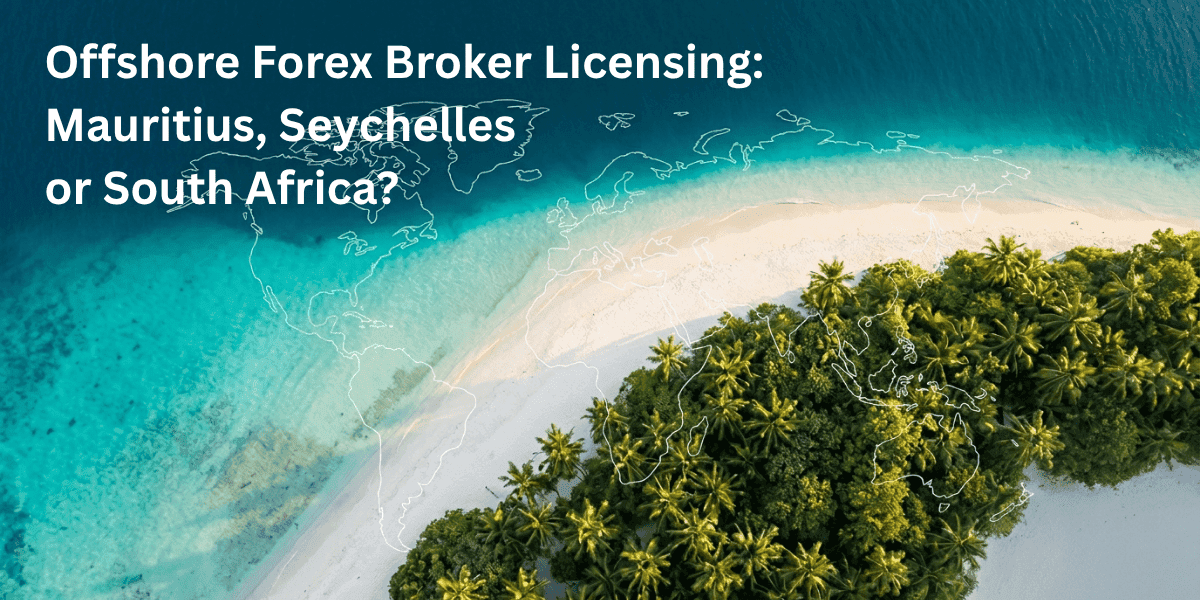
With so many jurisdictions to choose from, the process for brokers exploring offshore licensing for the first time can be overwhelming. Many of our clients ask us for guidance in selecting the best offshore jurisdiction for FX & CFD licensing. Based on our years of experience, we have narrowed down the choices to 3 distinct regions: Mauritius, Seychelles, and South Africa. Costs, reputation, banking, and license approval timelines all play a role in helping us narrow the choice down to these 3 jurisdictions which we'll highlight in today's article.
A forex broker license in Mauritius is the ideal jurisdiction for startup brokers. The budget required to obtain a forex license in Mauritius makes it quite attractive to new brokers. Only $33,000 in capital is needed to get started which happens to be one of the lowest requirements around the globe. A local presence in Mauritius is required, however, the monthly fees are quite competitive, especially compared to EU licenses or Australia. For brokers looking to cut down costs further, there is even an option to outsource some of the required roles during the initial phase of approval, a subject our team can discuss in more detail.
Mauritius also has excellent banking options. It's worth highlighting that local banks offer direct IBAN numbers for incoming wires. On the surface this doesn't appear like much of a benefit until one discovers that the majority of offshore banks require secondary or intermediary wire instructions. Offshore bank wire instructions are confusing to clients, often resulting in wires being misdirected or rejected. Brokers with a license in Mauritius avoid this complication altogether by having wire instructions that clients around the globe are more familiar with.
The only hurdle that startup brokers may face in Mauritius is meeting the local dealing requirements. In some cases, license applicants may need to rely on 3rd parties to get the license approved. Fortunately, our team has the network and experience to assist in this regard which is why we still believe Mauritius is the ideal offshore license for new CFD / FX brokers.
Our experience has shown that a forex license in Seychelles carries a higher reputation than similar offshore jurisdictions. One reason could be the difficulty in obtaining a license. The Seychelles FSA prefers applicants holding existing regulation, preferably in Europe, Asia, or Oceania making the process more difficult for startup brokers. While not impossible to obtain approval, we direct startup FX brokers to jurisdictions like Mauritius or South Africa for this reason.
If your broker is regulated elsewhere, then Seychelles is a definite consideration, just note this license does come with higher costs. While still low compared to Europe, capital was recently bumped to $100,000 which can be a bit more of a punch for newer brokers. Similar to Mauritius, a local presence with staff must be maintained in Seychelles which results in a larger budget for this jurisdiction.
Finally, the trade-off in reputation is a longer approval period, where one can expect to receive the license within 7 to 9 months. Those looking to get to market more quickly may wish to consider an acquisition. Our team routinely has a variety of licenses on sale so it is worth checking in to see if there is a license in Seychelles available for purchase.
While not technically considered offshore, South Africa can be viewed as somewhere in the middle: not reputable enough to rank with European licensing but also not an island. Despite the article title, a forex broker license in South Africa makes our list as it meets the criteria many seek in an offshore jurisdiction: low costs, easy to acquire, and simple to maintain.
The main attraction of a South Africa forex license is the ability to undergo an acquisition in a very competitive timeframe. Ownership can be taken in a matter of weeks which no other jurisdiction can offer. This is a major benefit for brokers looking to enter the market as a regulated entity from day one. Additional benefits are no paid up capital requirements, relatively low maintenance fees, and the ability to add crypto permissions under the same entity. Finally, South Africa is not technically considered offshore, so it can be an excellent complement to a Mauritius or Seychelles license.
Our team at Atomiq Consulting have the necessary industry experience and knowledge to guide your team through all aspects of a forex broker license application. To learn more about any of the jurisdictions above, feel free to contact us to learn more. (You can message me direct via LiquidityFinder using the link on my name below).
About the Author
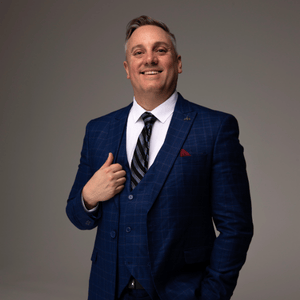
Jonathan Baumgart
CEO and Founder, Atomiq Consulting
Jonathan Baumgart is the CEO and founder of Atomiq Consulting. Since 2014, Atomiq Consulting has been offering consultation services to forex brokers, crypto exchanges and prop firms with a focus on licensing, corporate set ups, payments and technology solutions. He is also an independent director in FDCTech, a publicly traded company in the United States.
Found this interesting? Become a member of LiquidityFinder and get daily industry news direct to your inbox — join here.
We're the largest marketplace to connect with brokers, Fintech companies & digital asset firms. Want to partner? Let's get in touch.

Select the categories and companies you wish to follow directly to your person rss feed.
Create Custom RSS FeedSign up and join over 5,000 professional members who receive personalized news alerts, curated professional connections, and more for free!
The AI trade has always been a supply chain story. For the past two years, the narrative has been simple: insatiable demand for compute infrastructure, constrained supply at every choke point, and the companies that own the bottlenecks collect the toll. NVIDIA on GPUs. ASML on lithography. Samsung, SK Hynix, and Micron on memory. The entire semiconductor complex has traded on scarcity, and scarcity has delivered historic margins.
Interactive Brokers reported customer equity of USD 964.7 billion at the end of the third quarter, up 27% year on year, as customer accounts increased 35% to 5.58 million.
Crypto exchange BingX has secured a Markets in Crypto-Assets Regulation (MiCA) licence for its European arm from Austria's Financial Market Authority (FMA).
CXM Group has agreed to acquire TD Markets (Pty) Ltd, a Johannesburg-headquartered broker authorised by South Africa’s FSCA. TD Markets keeps its brand, team and licence, and Amar Ramith stays as CEO. Financial terms were not disclosed. The deal gives CXM a regulated base in South Africa. Clients need take no action.
Global equities under pressure: Hotter than expected US inflation and rising yields weighed on stocks, particularly technology and semiconductor shares.
Understand trading psychology and learn how a clear strategy, risk management and a trading journal help build discipline and day trading consistency.
Ripple Prime has launched support for real-world asset perpetual swaps, giving institutional clients including Virtu exposure to more than 100 reference markets across equities, indices, ETFs, metals, energy and FX. The swaps reference Trade.xyz perpetual futures on Hyperliquid and trade and settle around the clock.
iSAM Securities Apex has integrated with Crossover Markets, connecting brokers to CROSSx, its institutional digital asset ECN, through Apex’s ultra-low-latency technology stack.
Your Bourse and 4XPORTAL highlight their existing partnership, combining client onboarding, CRM and payment solutions with liquidity, execution and risk-management infrastructure for brokers.
The partnership brings together 4XPORTAL’s brokerage technology capabilities with Your Bourse’s connectivity, liquidity aggregation, and risk-management infrastructure.