just now

Liquidity Finder Ltd is incorporated in England and Wales, company number 10610740, registered address 167-169 Great Portland Street, Fifth Floor, London W1W 5PF, United Kingdom.
Published: just now
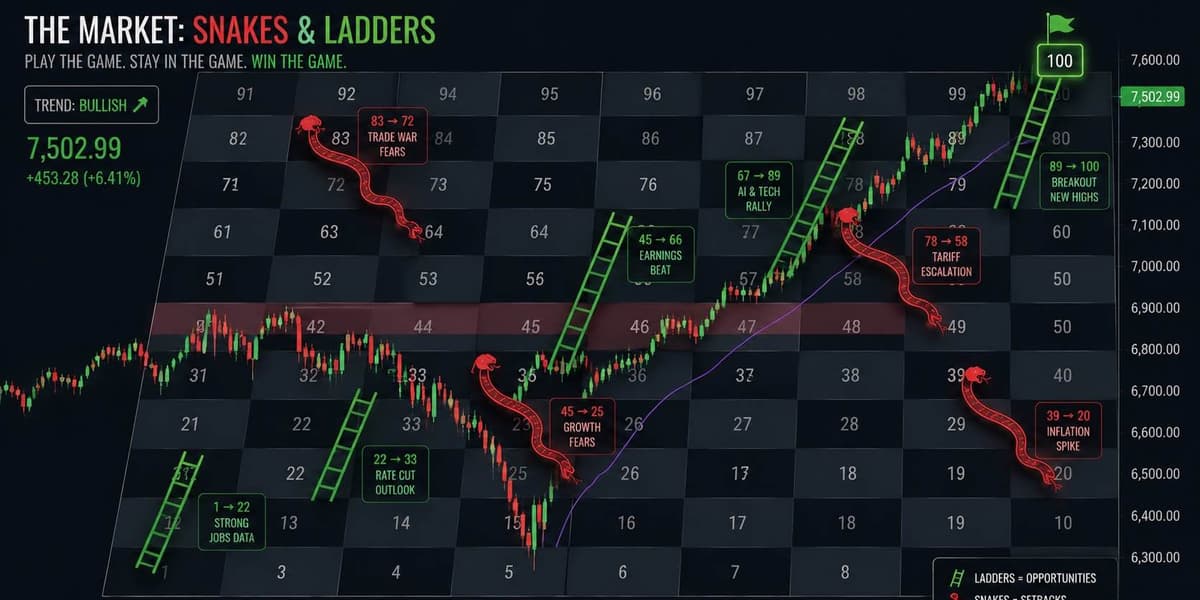
The S&P 500 continues pushing toward fresh all-time highs, driven largely by strong momentum in AI and mega-cap technology stocks. Momentum remains impressive, earnings expectations are holding up, and investors are still leaning bullish.
But while the trend remains constructive, the market is entering a phase where investors should start paying closer attention to what could trigger a correction.
A pullback does not necessarily mean the bull trend is over. In fact, even a move lower toward the 7,000 region could still fit within a healthy longer-term uptrend. The key is understanding why a correction could happen and what signals matter most right now.
The single biggest variable currently influencing equities is bond yields.
Higher yields alone are not automatically bearish for stocks. The reason yields rise matters far more than the move itself.
If yields are climbing because economic growth is improving, equities can usually absorb it. Stronger growth supports corporate earnings and keeps investor confidence elevated.
The dangerous scenario is when yields rise because inflation starts re-accelerating.
That creates a much more difficult environment for risk assets.
Several catalysts could reignite inflation fears:
When inflation fears rise, markets begin pricing in a “higher for longer” Fed stance.
That creates the following chain reaction:
Inflation fears rise
→ Fed stays tighter for longer
→ Bond yields move higher
→ Financial conditions tighten
→ Valuation multiples compress
→ Equities correct
This is especially important now because valuations across major technology names are already elevated.
On the surface, index performance still appears strong.
Underneath, however, leadership remains relatively narrow.
AI-related companies and mega-cap technology stocks continue carrying a significant portion of the rally. That means if leadership begins fading while yields continue rising, downside pressure could accelerate quickly.
The main warning signs investors should monitor daily include:
The most dangerous setup for equities would likely be:
Inflation-driven yield increases while economic growth quality weakens.
Historically, that type of environment tends to pressure risk assets the most.
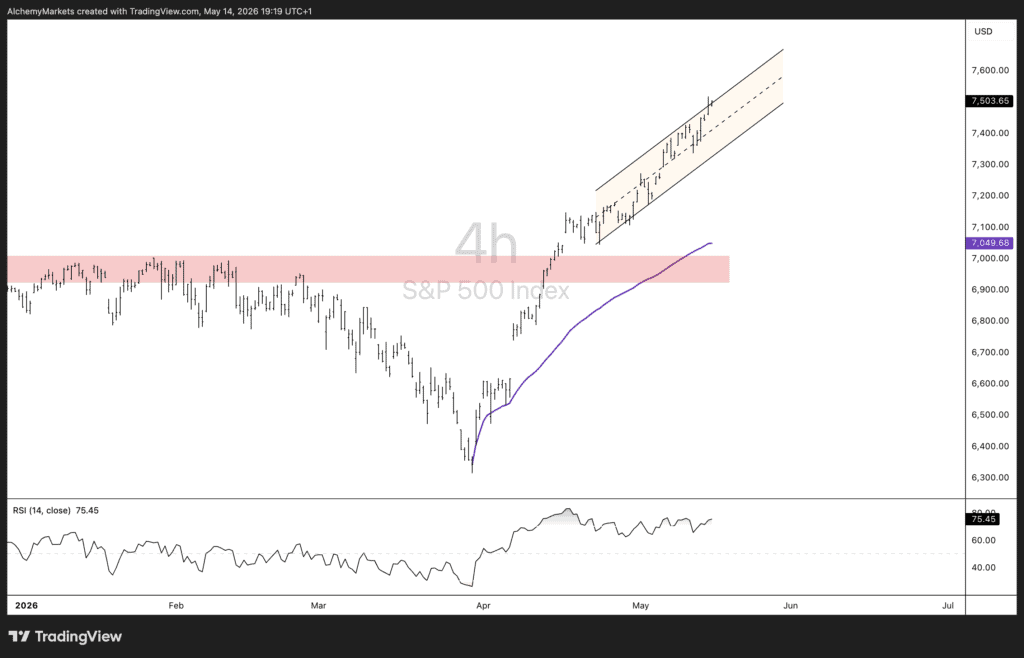
From a technical perspective, the S&P 500 is also beginning to look stretched in the near term.
The index has been grinding higher inside a steep rising channel, but momentum indicators are starting to show signs of exhaustion.
Most notably, RSI is showing bearish divergence. Price continues making higher highs while momentum is failing to confirm with stronger highs of its own. That type of divergence often signals that upside momentum is slowing.
The market also appears increasingly extended above key moving averages, leaving room for mean reversion if macro pressures intensify.
A correction from current levels could potentially pull the S&P 500 back toward the 7,000 area, particularly if:
Importantly, even a correction toward 7,000 would still likely represent a healthy structural trend in the bigger picture rather than the start of a full bear market.
Bull markets rarely move in straight lines.
Corrections are normal and often necessary to reset positioning, cool sentiment, and rebuild healthier market structure.
The broader uptrend in the S&P 500 remains intact for now, but the margin for error is narrowing as inflation risks and yields become increasingly important.
As long as growth remains stable and inflation does not reaccelerate aggressively, equities may continue climbing higher over time.
But if inflation-driven yields continue rising while leadership narrows further, volatility and downside risk could increase materially in the weeks ahead.
Alchemy Markets is a multi-asset brokerage providing retail traders with the same elite trading conditions, tools, and transparency typically reserved for institutions.

Select the categories and companies you wish to follow directly to your person rss feed.
Create Custom RSS Feed
just now
Sign up and join over 5,000 professional members who receive personalized news alerts, curated professional connections, and more for free!
Multi-asset trading broker AvaTrade has agreed to acquire the majority of FXCM Group’s business and brand, in a transaction that would bring a longstanding retail FX franchise into the AvaTrade Group.
LSEG and CMC Markets have signed a multi-year strategic data agreement expanding CMC's access to LSEG's real-time and delayed pricing, reference and corporate actions data, news and analytics, plus AI-ready content, to support new products, entry into new markets and the growth of CMC's institutional and B2B partnerships.
The Tel Aviv Stock Exchange is considering a bid for the Cyprus Stock Exchange, with Israeli media citing its EU licence, trading platform and clearing house. Euronext’s Athens exchange and India’s National Stock Exchange are also seen as contenders, and Cyprus aims to sign a sale agreement by the end of this year.
CME Group will launch baseball futures on 12 October, pending regulatory review, tracking CME FutureSports Performance Indexes built on Official League Data. Standard and micro contracts will start with the 2026 Postseason and the four clubs in the League Championship Series, trading around the clock.
ESMA has published an opinion stating that MiCA-authorised crypto-asset service providers should cease services tied to non-MiCA-compliant stablecoins for EU clients across MiCA crypto-asset services. National authorities should require remediation of existing exposures within three months, by early January 2027.
Nasdaq Ventures has made a strategic investment in Amsterdam-based derivatives and crypto exchange One Trading, with both firms to explore 24/7 trading of equity futures. The undisclosed investment follows Nasdaq's US$100 million investment in Payward, the parent of Kraken, and CME Group's move to 24/7 trading.
cTrader has opened multi-platform plugins to brokers and prop firms, which can pre-install their own tools for clients or list them in cTrader Store. The plugins run across Mobile, Web, Windows and Mac, and can be built and launched independently of core-platform releases, including trading journals and calculators.
Institutional brokerage and financial infrastructure provider Clear Street has joined TradingView’s broker network, allowing its clients to trade US stocks, exchange-traded funds and options directly through the charting and analysis platform.
Learn how to improve trading psychology, manage fear and greed, avoid revenge trading, and follow your trading strategy with discipline and a trading journal.
GTC Prime has announced a strategic partnership with Centroid Solutions to manage and distribute its liquidity through CS 360 Bridge, Centroid's multi-asset connectivity and execution engine, giving brokers and institutional clients access to tailor-made pricing, low-latency execution and real-time risk management.