just now


Liquidity Finder Ltd is incorporated in England and Wales, company number 10610740, registered address 167-169 Great Portland Street, Fifth Floor, London W1W 5PF, United Kingdom.
Published: just now

Silver has quietly become one of the most exciting stories in financial markets this month. After years of consolidation and subdued sentiment, the metal has finally broken higher — and not just by a little. The move is supported by a compelling mix of fundamental strength and a textbook technical breakout that’s catching traders’ attention everywhere.
So, what’s driving this surge?
At the heart of silver’s rally lies a simple equation: demand is growing faster than supply. According to industry analysts, the global silver market has been in deficit for several consecutive years. Industrial demand — particularly from solar panels, electric vehicles, and electronics manufacturing — continues to expand rapidly, while mine production has failed to keep pace.
On top of that, investors are rediscovering silver’s appeal as a safe-haven asset. With uncertainty surrounding global growth and shifting central bank policies, silver is benefiting from its dual role — both as an industrial metal and a store of value. As markets anticipate further interest rate cuts in the U.S., the opportunity cost of holding precious metals is falling, further fuelling the rally.
In short, silver is finding support from all angles: tighter supply, resilient industrial use, and a macro backdrop favoring hard assets.
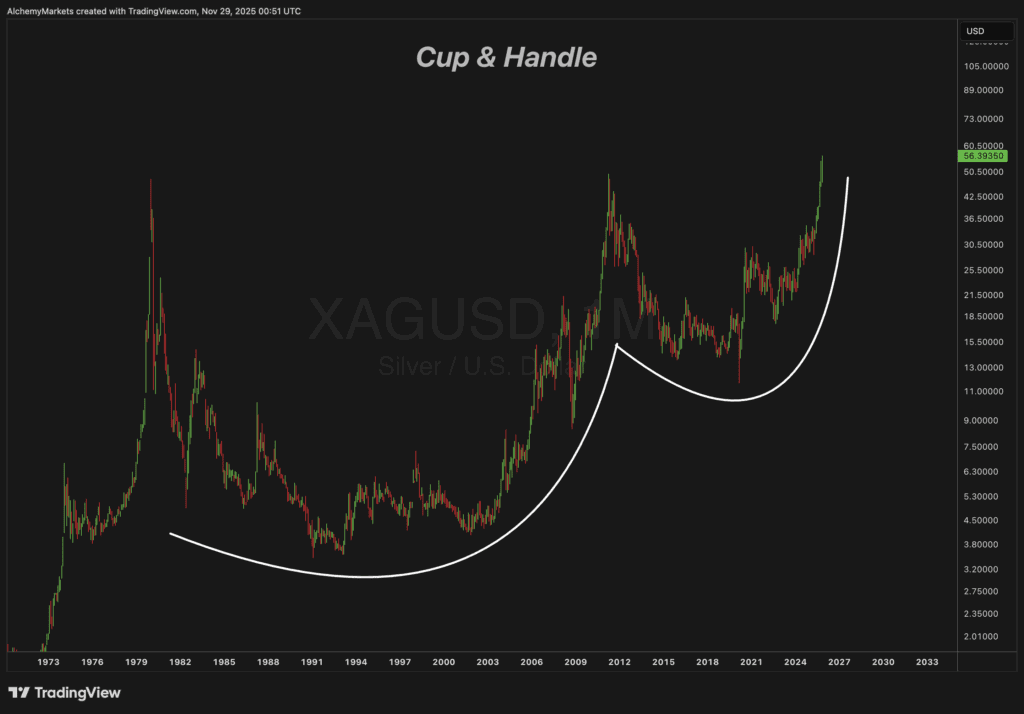
If you glance at silver’s long-term chart, you’ll notice something remarkable — the formation of a massive Cup and Handle pattern, one that has been developing for decades. The pattern, which typically signals a long-term bullish reversal, has now finally broken to the upside.
In technical terms, the “cup” represents a long, rounded bottom — silver’s recovery from the deep declines of the 1980s and 1990s — while the “handle” captures the recent consolidation since 2011. Now that prices have broken above that handle resistance, chart watchers interpret it as a confirmation of a powerful, long-term uptrend.
This breakout isn’t just another short-term rally. It suggests that silver could be entering a multi-year bullish phase, potentially targeting significantly higher price levels. And when fundamentals and technicals align this neatly, it tends to grab the attention of both institutional investors and retail traders alike.
While silver’s breakout is stealing the spotlight, this week’s economic calendar could determine whether the momentum continues — not just for metals, but for risk assets in general.
We’re now in the final stretch before the December 10th Federal Reserve policy meeting, and markets are almost fully pricing in another 25-basis-point rate cut — the third in a row.
That expectation has been shaped by a combination of factors: a mixed labor market, softer inflation readings, and cautious remarks from Fed officials. This week’s data is unlikely to change that narrative. The ISM Manufacturing Index is expected to remain in contraction territory, while the ISM Services Index should move closer to neutral — consistent with signs of cooling activity across regional surveys.
Meanwhile, inflation pressures continue to fade. The upcoming core PCE deflator, the Fed’s preferred inflation gauge, is expected to confirm that price growth remains subdued. With tariffs showing “more bark than bite” and energy costs easing, the Fed has room to act preemptively if the labor market softens further.
That brings us to the ADP Employment Report, which could be crucial. Economists expect flat growth in private-sector jobs, though the risk — based on recent weekly figures — is that we might actually see a small decline. If that happens, it would strengthen the argument for not just one, but possibly two more rate cuts in 2026.
For silver, this is good news. Lower rates generally weaken the dollar and reduce yields, both of which tend to push investors toward precious metals.
Across the Atlantic, attention turns to Tuesday’s release of the Eurozone CPI. Inflation has been behaving — neither too hot nor too cold — hovering right around the European Central Bank’s 2% target. While a stronger euro and lower producer prices are applying downward pressure, domestic inflation, particularly in services, remains sticky.
That stability means the ECB is unlikely to make any sudden moves. For now, policymakers can afford to keep rates steady, giving markets a breather after a volatile year. In a broader sense, this balance supports global risk sentiment — but it also reinforces the narrative that monetary easing, rather than tightening, will define the coming year.
And once again, that’s music to the ears of precious-metal bulls.
When you connect the dots, it’s easy to see how this week’s developments could influence silver’s trajectory. If the U.S. data confirms a slowdown and inflation stays muted, it cements expectations of a friendlier Fed. A softer policy stance typically leads to a weaker dollar and lower real yields — both strong tailwinds for metals.
At the same time, if Eurozone inflation holds steady and the ECB remains on hold, global liquidity conditions could stay loose, supporting demand for both commodities and risk assets.
In other words, this week’s data could end up reinforcing the perfect storm already brewing in silver: bullish fundamentals, supportive central banks, and a powerful long-term technical setup.
Of course, no rally comes without risks. A sudden hawkish shift from central banks, a rebound in the U.S. dollar, or a sharp decline in industrial activity could all temper enthusiasm for silver. Likewise, if this breakout turns out to be premature — lacking volume or follow-through — the metal could fall back into its prior trading range.
Still, for now, the trend looks convincing. Momentum is on silver’s side.
Silver is finally having its moment. Years of quiet accumulation, followed by a textbook technical breakout, have positioned it as one of the most intriguing assets heading into 2026. With supply tight, industrial demand robust, and monetary policy easing globally, the backdrop couldn’t be more supportive.
As we head into a data-heavy week, investors should keep an eye on U.S. employment and inflation readings, as well as Eurozone CPI. These reports won’t just shape central bank decisions — they could determine whether silver’s next leg higher is sustained or simply paused for breath.
Either way, the message from both the charts and the macro is clear: silver’s story isn’t over, it may just be beginning.
Alchemy Markets is a multi-asset brokerage providing retail traders with the same elite trading conditions, tools, and transparency typically reserved for institutions.

Select the categories and companies you wish to follow directly to your person rss feed.
Create Custom RSS FeedSign up and join over 5,000 professional members who receive personalized news alerts, curated professional connections, and more for free!
ESMA has published an opinion stating that MiCA-authorised crypto-asset service providers should cease services tied to non-MiCA-compliant stablecoins for EU clients across MiCA crypto-asset services. National authorities should require remediation of existing exposures within three months, by early January 2027.
Nasdaq Ventures has made a strategic investment in Amsterdam-based derivatives and crypto exchange One Trading, with both firms to explore 24/7 trading of equity futures. The undisclosed investment follows Nasdaq's US$100 million investment in Payward, the parent of Kraken, and CME Group's move to 24/7 trading.
cTrader has opened multi-platform plugins to brokers and prop firms, which can pre-install their own tools for clients or list them in cTrader Store. The plugins run across Mobile, Web, Windows and Mac, and can be built and launched independently of core-platform releases, including trading journals and calculators.
Institutional brokerage and financial infrastructure provider Clear Street has joined TradingView’s broker network, allowing its clients to trade US stocks, exchange-traded funds and options directly through the charting and analysis platform.
Learn how to improve trading psychology, manage fear and greed, avoid revenge trading, and follow your trading strategy with discipline and a trading journal.
GTC Prime has announced a strategic partnership with Centroid Solutions to manage and distribute its liquidity through CS 360 Bridge, Centroid's multi-asset connectivity and execution engine, giving brokers and institutional clients access to tailor-made pricing, low-latency execution and real-time risk management.
CMC Markets Founder and CEO, Lord Peter Cruddas, discusses the structural evolution of the Group, the accelerating opportunity across B2B and institutional markets, major global partnerships including Revolut, Westpac, and ASB, and his outlook for the remainder of the financial year ahead.
Clear Street has announced an exclusive partnership with Seawolf Capital to bring market commentary from Danny Moses, Vincent Daniel and Porter Collins to its clients and the wider investing community, including live market calls, digital content and events. New programming will sit alongside Seawolf's podcast.
Yields are surging. But is inflation really the reason? This week’s BitDelta Pro Weekly Outlook looks beyond the headline explanation to examine what is actually driving the move in rates, and what that could mean across equities, credit and commodities. We also explore the growing importance of balance-sheet quality, the signals emerging from the AI infrastructure cycle, and what oil and gold may be telling markets about the current macro regime. Read the full Weekly Outlook. BitDelta Securities Financial Services LLC, regulated by the Capital Market Authority under Category 5 (Introduction Only), acts solely as an introducer and does not provide trading, execution, dealing, advisory, portfolio management, or custody services. All trading, execution, and investment-related services are provided by BitDelta Limited, Mauritius, a licensed Investment Dealer. All trading and investments involve risk. The value of investments may fluctuate, and you may receive less than your initial investment.
Devexperts has appointed Rainer Fuchsluger as Global Group Chief Executive Officer, effective immediately. His career spans LSEG, Wolters Kluwer, SS&C and Thomson Reuters, and he follows Ben Hurley, who was CEO for two years. His mandate covers international growth, cloud computing and AI across the portfolio.