just now


Liquidity Finder Ltd is incorporated in England and Wales, company number 10610740, registered address 167-169 Great Portland Street, Fifth Floor, London W1W 5PF, United Kingdom.
Published: just now
Over the past two weeks, markets have aggressively shifted back toward a more hawkish central bank outlook.
The catalyst has been straightforward:
Only a few weeks ago, markets were confidently pricing multiple rate cuts for later this year. Now, expectations have shifted materially higher, with cuts being pushed further into the future and some traders even reopening the discussion around additional tightening risks.
But the key question heading into this week is whether markets are reacting to the right inflation driver — or potentially overestimating the persistence of this latest energy shock.
The current market narrative assumes that higher oil prices automatically translate into broader inflation pressure and therefore force central banks to remain restrictive for longer.
That logic makes sense on the surface.
However, this environment still looks materially different from the 2022 energy crisis.
Back then, the inflation shock was not driven by crude oil alone. Europe experienced a full-spectrum energy crisis as:
That broader energy transmission mechanism created persistent inflation pressure across nearly every sector of the economy.
This time, however, the picture is more contained.
While crude oil prices have moved sharply higher due to geopolitical tensions, natural gas prices remain relatively stable compared with the extreme levels seen in 2022.
That distinction matters enormously for central banks.
Policymakers are not simply reacting to oil prices in isolation. What they care about is whether higher energy prices begin feeding into:
So far, that transmission effect still appears limited.
At the same time, several underlying economic indicators continue pointing toward slower growth conditions beneath the headline data.
The US labour market still appears resilient at first glance, but internally the picture is becoming less convincing.
Several softer trends continue developing:
This creates an important divergence in market expectations.
Right now:
focuses on:
suggests:
That tension will likely define market direction over the next several months.
The Bank of England is facing many of the same concerns.
Markets have aggressively repriced UK rate expectations higher because Britain remains highly sensitive to energy shocks.
But again, the current backdrop differs significantly from 2022.
Natural gas prices have not experienced the same type of parabolic move that previously triggered the broader UK inflation spiral.
That weakens the argument for the Bank of England needing to tighten aggressively again.
If inflation expectations remain relatively anchored while growth continues slowing, markets may eventually need to reverse some of this hawkish repricing.
The biggest macro question now is whether this latest oil surge becomes:
or
That distinction will likely determine:
If inflation expectations remain contained, central banks may tolerate temporarily elevated oil prices without tightening further.
But if energy prices remain elevated long enough to impact consumer behaviour and inflation psychology again, markets may ultimately be correct to expect a more hawkish policy path.
Markets are expecting another strong headline inflation print.
The primary drivers are expected to be:
However, the broader view remains that this inflation acceleration may still prove temporary if underlying demand conditions continue weakening.
The critical market focus will be whether inflation broadens beyond energy-related categories.
Retail sales may appear stronger at the headline level primarily because gasoline prices mechanically boost nominal spending figures.
However, underlying discretionary demand may remain softer.
Potential areas of weakness:
Markets will watch closely for signs that consumers are beginning to pull back under higher financing costs and slower income growth.
Industrial production is expected to rebound modestly, helped by continued strength in manufacturing activity and stabilization within supply chains.
The ISM manufacturing data has recently shown signs of resilience, though broader industrial momentum still remains mixed.
One of the most important developments this week is political and symbolic.
Jerome Powell enters his final days as Federal Reserve Chair before Kevin Warsh officially takes over on Friday, May 15.
Markets will be closely monitoring:
Any signal that the incoming leadership may tolerate higher inflation or prioritize growth stabilization differently could materially impact yields, equities, and the dollar.
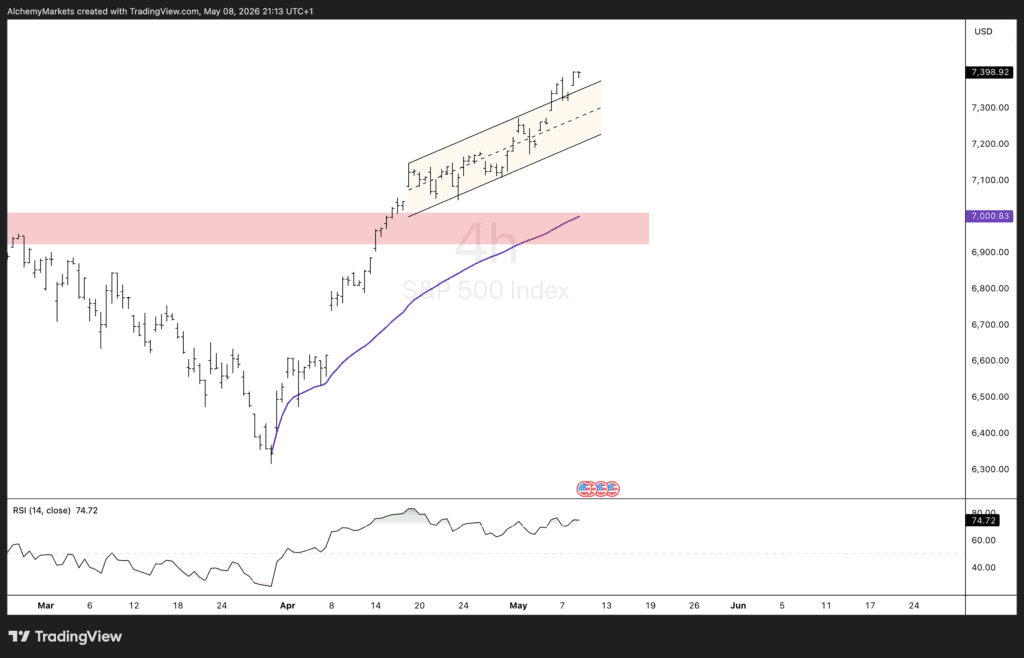
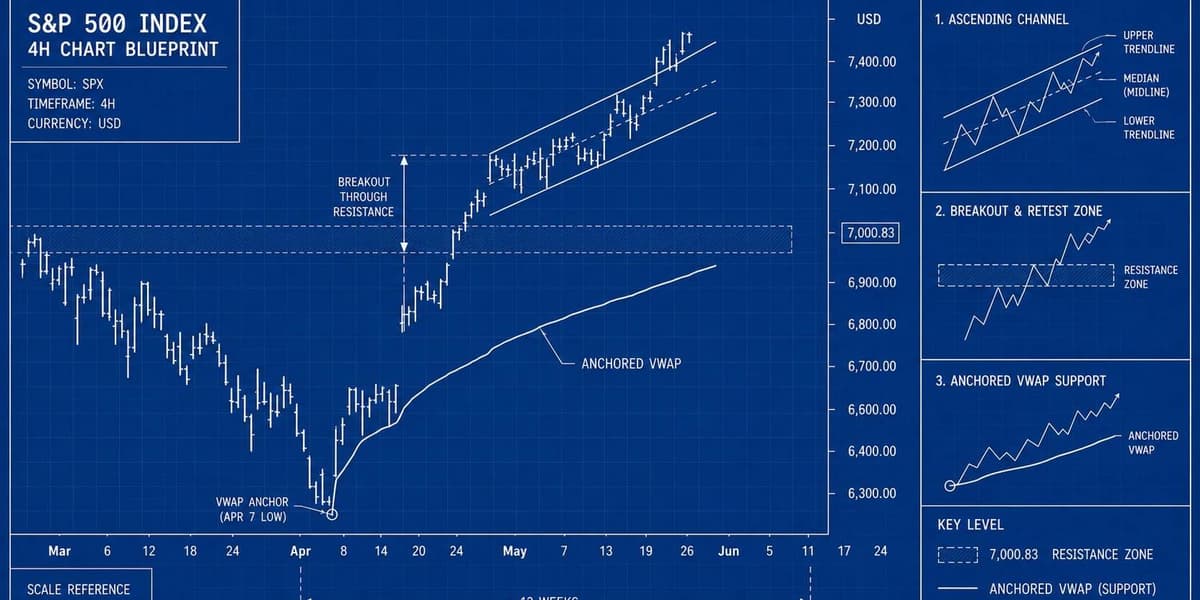
The SPX continues trading inside a strong ascending channel structure on the 4-hour timeframe, with momentum remaining firmly bullish despite increasingly overbought conditions.
The index has now broken significantly above prior resistance and continues respecting higher lows while riding above anchored VWAP support.
RSI remains elevated near overbought territory, reflecting strong momentum but also increasing sensitivity to any macro disappointment.
The bullish case remains structurally intact as long as:
Under this scenario, markets may conclude:
Technically, the chart structure still favours continuation higher.
The ascending channel remains intact, and buyers continue stepping in at shallow pullbacks.
If momentum persists:
A softer inflation interpretation this week could act as another catalyst for upside continuation.
The bearish risk emerges if markets begin believing this oil shock is evolving into a broader inflation regime shift.
That would likely require:
Under that scenario:
Technically, the market is already extended.
RSI is elevated, positioning is increasingly crowded, and price is trading near the upper boundary of the channel.
If a correction develops, the first major downside area becomes:
This zone aligns closely with:
The anchored VWAP currently acts as a critical institutional support area.
A clean hold there would likely preserve the broader bullish trend structure.
However, if price loses both:
then a deeper corrective phase could begin as momentum positioning unwinds.
Markets are entering a critical macro phase where the debate is no longer simply about inflation.
The real debate is whether:
That distinction will drive:
For now, SPX remains technically bullish — but increasingly sensitive to macro data surprises and inflation expectations.
This week’s inflation data and central bank communication may determine whether the rally extends further or finally enters a corrective phase.
Alchemy Markets is a multi-asset brokerage providing retail traders with the same elite trading conditions, tools, and transparency typically reserved for institutions.

Select the categories and companies you wish to follow directly to your person rss feed.
Create Custom RSS Feed
just now
Sign up and join over 5,000 professional members who receive personalized news alerts, curated professional connections, and more for free!
Multi-asset trading broker AvaTrade has agreed to acquire the majority of FXCM Group’s business and brand, in a transaction that would bring a longstanding retail FX franchise into the AvaTrade Group.
LSEG and CMC Markets have signed a multi-year strategic data agreement expanding CMC's access to LSEG's real-time and delayed pricing, reference and corporate actions data, news and analytics, plus AI-ready content, to support new products, entry into new markets and the growth of CMC's institutional and B2B partnerships.
The Tel Aviv Stock Exchange is considering a bid for the Cyprus Stock Exchange, with Israeli media citing its EU licence, trading platform and clearing house. Euronext’s Athens exchange and India’s National Stock Exchange are also seen as contenders, and Cyprus aims to sign a sale agreement by the end of this year.
CME Group will launch baseball futures on 12 October, pending regulatory review, tracking CME FutureSports Performance Indexes built on Official League Data. Standard and micro contracts will start with the 2026 Postseason and the four clubs in the League Championship Series, trading around the clock.
ESMA has published an opinion stating that MiCA-authorised crypto-asset service providers should cease services tied to non-MiCA-compliant stablecoins for EU clients across MiCA crypto-asset services. National authorities should require remediation of existing exposures within three months, by early January 2027.
Nasdaq Ventures has made a strategic investment in Amsterdam-based derivatives and crypto exchange One Trading, with both firms to explore 24/7 trading of equity futures. The undisclosed investment follows Nasdaq's US$100 million investment in Payward, the parent of Kraken, and CME Group's move to 24/7 trading.
cTrader has opened multi-platform plugins to brokers and prop firms, which can pre-install their own tools for clients or list them in cTrader Store. The plugins run across Mobile, Web, Windows and Mac, and can be built and launched independently of core-platform releases, including trading journals and calculators.
Institutional brokerage and financial infrastructure provider Clear Street has joined TradingView’s broker network, allowing its clients to trade US stocks, exchange-traded funds and options directly through the charting and analysis platform.
Learn how to improve trading psychology, manage fear and greed, avoid revenge trading, and follow your trading strategy with discipline and a trading journal.
GTC Prime has announced a strategic partnership with Centroid Solutions to manage and distribute its liquidity through CS 360 Bridge, Centroid's multi-asset connectivity and execution engine, giving brokers and institutional clients access to tailor-made pricing, low-latency execution and real-time risk management.