just now


Liquidity Finder Ltd is incorporated in England and Wales, company number 10610740, registered address 167-169 Great Portland Street, Fifth Floor, London W1W 5PF, United Kingdom.
Published: just now


In October, the Japanese yen saw a significant weakening against both the U.S. dollar and the euro. This decline is largely attributable to the Bank of Japan’s (BoJ) continued accommodative monetary policy. After implementing some adjustments in July—including reducing Japanese Government Bond (JGB) purchases and raising the interest rate on excess reserves slightly—the BoJ chose to keep its stance unchanged in October. These adjustments were designed to keep short-term interest rates low and stable. However, Japan’s relatively low rates, especially in comparison to the U.S., have added downward pressure on the yen, making it less attractive to investors seeking higher returns.
USDJPY Chart H4
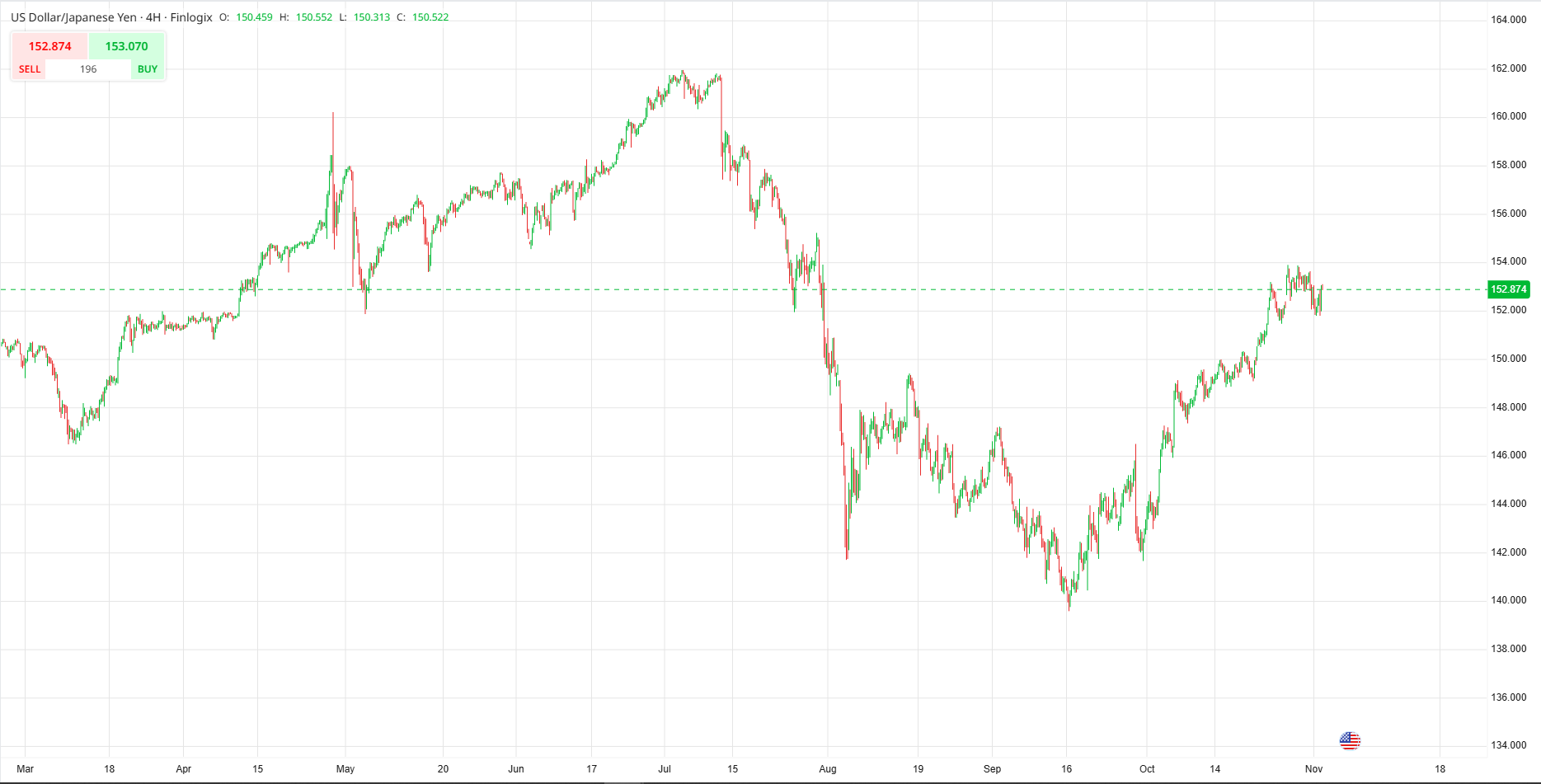
The U.S. economy’s strong performance has further widened this gap. Over recent months, the U.S. has released consistently positive economic data, from strong job numbers and robust retail sales to persistent inflationary pressures. These indicators have supported higher U.S. yields, driving investors to the dollar over the yen and intensifying yen weakness. Additionally, speculation around potential U.S. political shifts—particularly regarding a possible Trump re-election—has led to expectations of stronger U.S. trade policies. Many market participants believe that a Trump administration could introduce more aggressive trade stances, which would likely strengthen the dollar further against other currencies, including the yen.
US10Y Bonds
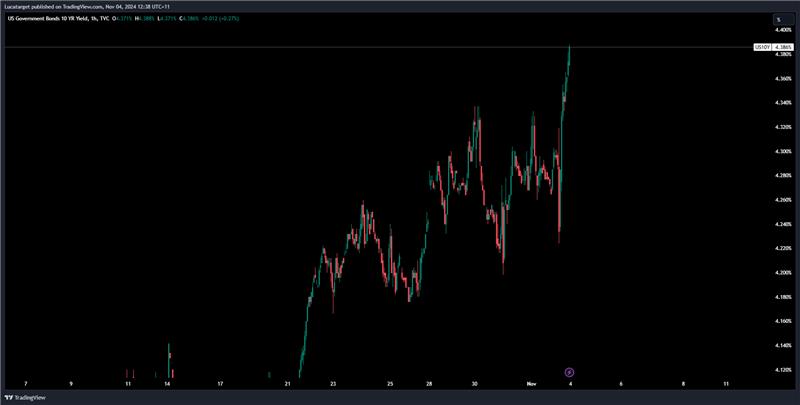
On Japan’s side, the BoJ has recently hinted at a more “hawkish” stance. While the central bank has not made concrete rate hikes, it has signalled a readiness to tighten monetary policy if Japan’s economy meets its growth and inflation targets. Currently, I’m expecting the BoJ might raise rates by late 2025, though there is a chance this could happen sooner if inflation and economic growth remain stable.
Japan’s Political Landscape and Its Influence on Economic Policy
Japan’s political environment has also influenced its economic outlook. Following a recent election, the ruling coalition led by Prime Minister Ishiba lost its majority in the lower house of Japan’s parliament. This shift has created uncertainty around the government’s ability to pass key economic policies without forming new alliances. To secure the necessary support, the coalition may consider expanding its base by forming a partnership with the Democratic Party for the People (DPP).
If an alliance with the DPP is formalized, it could lead to new economic initiatives, such as increasing tax-free income thresholds for part-time workers, which would benefit consumer spending. While these policy shifts may provide some support to Japan’s economy, they are unlikely to directly alter the BoJ’s monetary strategy in the near term. However, by smoothing the legislative path for economic reform, a coalition with the DPP could indirectly support earlier rate adjustments if Japan’s economic indicators continue to improve.
Interest Rate and Yield Outlook
In October, Japan’s 10-year JGB yield climbed to 0.95%, reflecting both global bond market trends and domestic currency depreciation. This rise in yields indicates that investor sentiment is increasingly factoring in future rate hikes by the BoJ. The BoJ’s cautious shift toward a more hawkish stance stems partly from easing inflationary pressures, alongside the persistent strength of the U.S. economy, which keeps international bond markets buoyant.
Japan’s labour market has also shown promising signs, with moderate wage growth seen as an important step toward achieving stable inflation. The BoJ regards sustained wage increases as a critical factor for reaching its 2% inflation target, as higher wages boost consumer spending and economic resilience. If Japan’s labour market continues to strengthen, it could accelerate the BoJ’s timeline for rate hikes, especially if inflation trends remain favourable.
Additionally, there is speculation that the U.S. dollar might stabilize or even weaken if the U.S. economy achieves a "soft landing," in which inflation cools without causing a major downturn. Should this scenario unfold, demand for the dollar could decrease, potentially reducing the downward pressure on the yen. A more stable yen would ease inflationary risks in Japan, allowing the BoJ more flexibility in timing any potential rate hikes.
In summary, while Japan’s domestic monetary policy remains largely supportive of economic growth, external factors like U.S. economic strength, evolving trade expectations, and Japan’s political landscape are increasing the likelihood of a shift in the BoJ’s policy stance. Should inflation and economic growth remain steady, the BoJ might consider rate adjustments earlier than the market currently anticipates. This scenario would mark a notable pivot from Japan’s traditionally ultra-loose monetary policy, driven by a confluence of internal resilience and external pressures.
This content may have been written by a third party. ACY makes no representation or warranty and assumes no liability as to the accuracy or completeness of the information provided, nor any loss arising from any investment based on a recommendation, forecast or other information supplies by any third-party. This content is information only, and does not constitute financial, investment or other advice on which you can rely.
Why Is Forex Trading So Difficult?
How To Master MT4 & MT5 - Tips And Tricks For Traders
The Importance Of Fundamental Analysis In Forex Trading
Forex Leverage Explained: Mastering Forex Leverage In Trading & Controlling Margin
The Importance Of Liquidity In Forex: A Beginner's Guide
Close All Metatrader Script: Maximise Your Trading Efficiency And Reduce Stress
Best Currency Pairs To Trade In 2024
Forex Trading Hours: Finding The Best Times To Trade FX
MetaTrader Expert Advisor - The Benefits Of Algorithmic Trading And Forex EAs
ACY Securities is one of Australia's fastest growing multi-asset online trading providers, offering ultra-low-cost trading, rock-solid execution, technologically superior account management and premium market analysis.

Select the categories and companies you wish to follow directly to your person rss feed.
Create Custom RSS FeedSign up and join over 5,000 professional members who receive personalized news alerts, curated professional connections, and more for free!
Multi-asset trading broker AvaTrade has agreed to acquire the majority of FXCM Group’s business and brand, in a transaction that would bring a longstanding retail FX franchise into the AvaTrade Group.
LSEG and CMC Markets have signed a multi-year strategic data agreement expanding CMC's access to LSEG's real-time and delayed pricing, reference and corporate actions data, news and analytics, plus AI-ready content, to support new products, entry into new markets and the growth of CMC's institutional and B2B partnerships.
The Tel Aviv Stock Exchange is considering a bid for the Cyprus Stock Exchange, with Israeli media citing its EU licence, trading platform and clearing house. Euronext’s Athens exchange and India’s National Stock Exchange are also seen as contenders, and Cyprus aims to sign a sale agreement by the end of this year.
CME Group will launch baseball futures on 12 October, pending regulatory review, tracking CME FutureSports Performance Indexes built on Official League Data. Standard and micro contracts will start with the 2026 Postseason and the four clubs in the League Championship Series, trading around the clock.
ESMA has published an opinion stating that MiCA-authorised crypto-asset service providers should cease services tied to non-MiCA-compliant stablecoins for EU clients across MiCA crypto-asset services. National authorities should require remediation of existing exposures within three months, by early January 2027.
Nasdaq Ventures has made a strategic investment in Amsterdam-based derivatives and crypto exchange One Trading, with both firms to explore 24/7 trading of equity futures. The undisclosed investment follows Nasdaq's US$100 million investment in Payward, the parent of Kraken, and CME Group's move to 24/7 trading.
cTrader has opened multi-platform plugins to brokers and prop firms, which can pre-install their own tools for clients or list them in cTrader Store. The plugins run across Mobile, Web, Windows and Mac, and can be built and launched independently of core-platform releases, including trading journals and calculators.
Institutional brokerage and financial infrastructure provider Clear Street has joined TradingView’s broker network, allowing its clients to trade US stocks, exchange-traded funds and options directly through the charting and analysis platform.
Learn how to improve trading psychology, manage fear and greed, avoid revenge trading, and follow your trading strategy with discipline and a trading journal.
GTC Prime has announced a strategic partnership with Centroid Solutions to manage and distribute its liquidity through CS 360 Bridge, Centroid's multi-asset connectivity and execution engine, giving brokers and institutional clients access to tailor-made pricing, low-latency execution and real-time risk management.