just now


Liquidity Finder Ltd is incorporated in England and Wales, company number 10610740, registered address 167-169 Great Portland Street, Fifth Floor, London W1W 5PF, United Kingdom.
Published: just now

A trading journal is not a notebook. It is the operating system behind consistent performance. When done properly, journaling turns random outcomes into measurable feedback loops that expose strengths, weaknesses, and system flaws long before they become account-threatening problems.
This guide compiles the entire Trading Journal series into one structured framework, showing how raw trade data evolves into performance insight, system refinement, and long-term edge development.

Most traders believe improvement comes from more screen time, better entries, or refined indicators. In reality, improvement comes from structured feedback.
As explained in Trading Journal Tracking: Why Data Comes First, journaling replaces emotional memory with objective evidence. Without it, traders rely on selective recall and hindsight bias.
Trading without a journal is similar to training without a stopwatch. Effort may be present, but direction is missing.
Trading Journal Tracking: Why Data Comes First
Before metrics, there must be structure. Tracking is the base layer of every effective journal.
This stage focuses on recording objective trade information such as date, time, session, instrument, setup type, risk, R-multiple outcome, and market context. At this level, the goal is accuracy, not judgment.
Clean data ensures that future analysis reflects reality rather than interpretation.
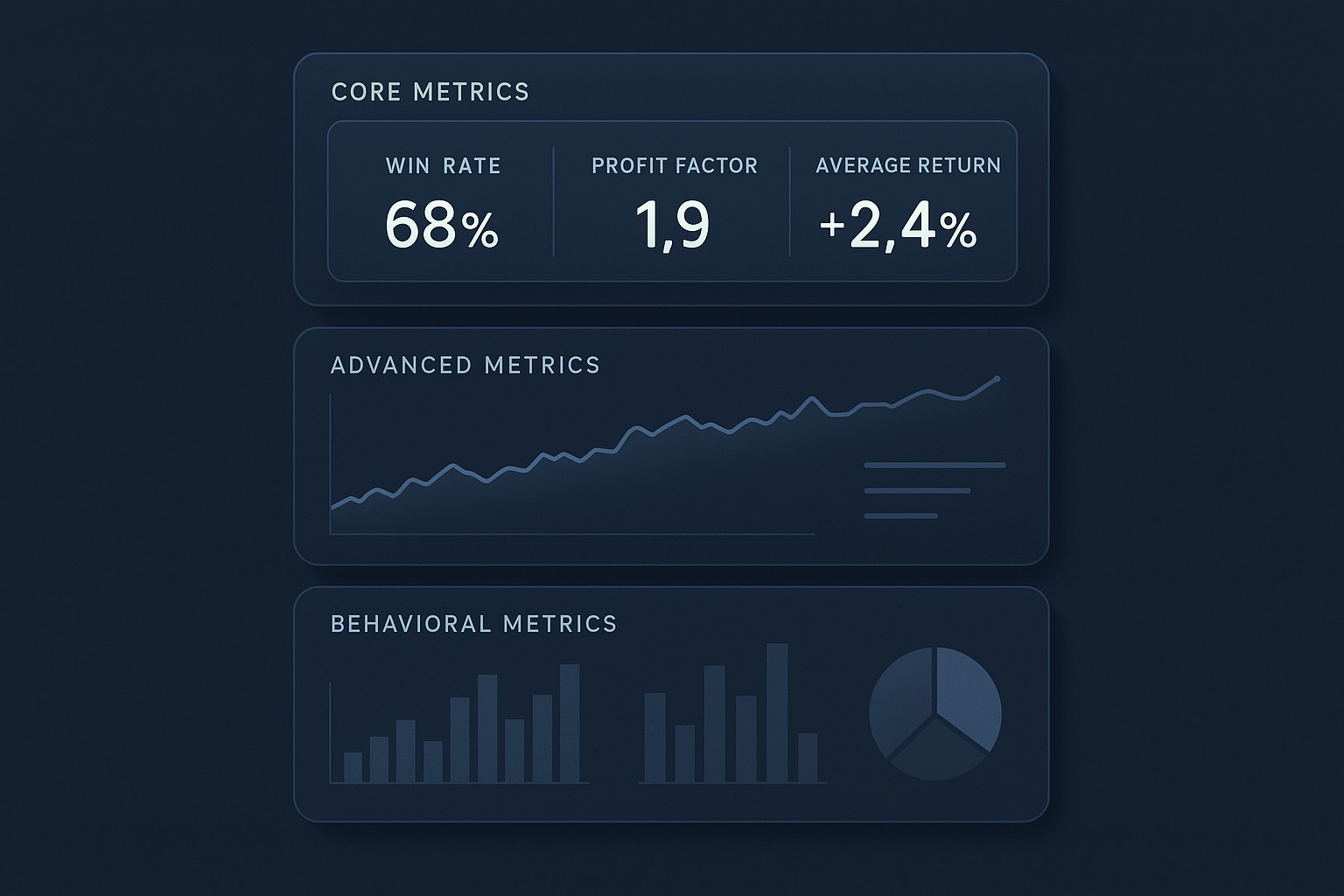
Trading Journal Core Metrics: The Non-Negotiables
Once trades are logged consistently, core metrics transform raw data into performance signals.
Core metrics answer essential questions:
Expectancy, rule adherence, and outcome classification matter far more than win rate alone. Without these metrics, traders misjudge both progress and edge.
Trading Journal Advanced Metrics: Going Beyond Win Rate
Advanced metrics separate surface-level journaling from professional evaluation.
Metrics such as profit factor, drawdown behavior, recovery speed, and equity curve structure reveal how stable and scalable a system truly is. Two traders may earn similar returns, but their risk profiles and sustainability can be vastly different.
Advanced metrics expose those differences clearly.
Trading Journal Behavior Metrics: The Psychology Layer
Markets do not change as often as trader behavior does.
Behavior metrics track emotional state, confidence levels, hesitation, impulsivity, and recurring psychological triggers. Over time, patterns emerge between emotional conditions and performance breakdowns.
This layer turns the journal into a self-awareness tool rather than just a performance log.
Trading Journal System Metrics: Measuring the Strategy
Not every losing streak is an execution problem.
System metrics evaluate the strategy itself by grading setup quality, confirmation strength, market condition alignment, and rule relevance. This allows traders to separate personal execution errors from structural weaknesses in the system.
Without this layer, traders often blame themselves for problems rooted in strategy design.
Trading Journal Trade Review Templates: Structured Reflection
Unstructured reviews lead to emotional storytelling rather than improvement.
Trade review templates enforce consistency by evaluating:
Root-cause analysis ensures that each trade produces a clear lesson, not vague conclusions.
Trading Journal Monthly Review Framework: Seeing the Bigger Picture
Daily and weekly results contain noise. Monthly reviews reveal signal.
Monthly analysis focuses on expectancy trends, drawdown behavior, rule adherence, and correlations between behavior and system performance. This timeframe allows traders to assess whether improvement is real or temporary.
Patterns become visible only when enough data is reviewed together.
Trading Journal Quarterly Review and System Evolution
Quarterly reviews shift the trader’s role from executor to system architect.
This process evaluates what should be kept, refined, removed, or cautiously added. It prevents constant rule tinkering while allowing intelligent adaptation to market changes.
This is where a trading edge evolves deliberately rather than accidentally.

A trading journal does not guarantee profitability. It guarantees clarity.
Clarity about what works.
Clarity about what fails.
Clarity about whether losses are acceptable or avoidable.
Traders who journal properly stop guessing and start managing performance with intent. Over time, this discipline compounds into consistency and confidence.
Expectancy. It determines whether a system is profitable over time regardless of short-term outcomes.
Yes. Emotional patterns often appear before execution errors and risk violations.
They are not required immediately, but adopting them early accelerates professional thinking.
Individual trade reviews, weekly pattern checks, monthly performance reviews, and quarterly system evaluations.
It’s time to go from theory to execution!
Create an Account. Start Your Live Trading Now!
Looking for step-by-step approaches you can plug straight into the charts? Start here:
Sharpen your edge with proven tools and frameworks:
News moves markets fast. Learn how to keep pace with SMC-based playbooks:
From NASDAQ opens to DAX trends, here’s how to approach indices like a pro:
Gold remains one of the most traded assets - here’s how to approach it with confidence:
Candlesticks are the building blocks of price action. Master the most powerful ones:
Ready to go intraday? Here’s how to build consistency step by step:
Markets swing between calm and chaos. Learn to read risk-on vs risk-off like a pro:
Step inside the playbook of institutional traders with SMC concepts explained:
Forex pairs aren’t created equal - some are stable, some are volatile, others tied to commodities or sessions.
If you’ve ever been stopped out right before the market reverses - this is why:
Mindset is the deciding factor between growth and blowups. Explore these essentials:
The real edge in trading isn’t strategy - it’s how you protect your capital:
If you’re not sure where to start, follow this roadmap:
This way, you’ll grow from foundation → application → mastery, instead of jumping around randomly.
Follow me for more daily market insights!
Jasper Osita - LinkedIn - FXStreet - YouTube
This content may have been written by a third party. ACY makes no representation or warranty and assumes no liability as to the accuracy or completeness of the information provided, nor any loss arising from any investment based on a recommendation, forecast or other information supplies by any third-party. This content is information only, and does not constitute financial, investment or other advice on which you can rely.
ACY Securities is one of Australia's fastest growing multi-asset online trading providers, offering ultra-low-cost trading, rock-solid execution, technologically superior account management and premium market analysis.

Select the categories and companies you wish to follow directly to your person rss feed.
Create Custom RSS FeedSign up and join over 5,000 professional members who receive personalized news alerts, curated professional connections, and more for free!
BTCUSD rejects $78,400–$82,175 support. Watch bullish follow-through toward $86,550 and a daily close below $80,268.75 for weakness.
Gold price forecast: Watch $4,175–$4,190 support for bullish confirmation toward $4,265, or a weekly support breakdown toward $3,935.
WTI crude oil price forecast: A confirmed breakout above $94.765 could open the way toward $100.305, while weekly support remains at $87.360–$90.830.
NAS100 price forecast recap: Explore the Nasdaq 100 rally to 31,401.3, with technical analysis of the breakout and key support and resistance levels.
Learn how to identify, draw and trade XAUUSD supply and demand zones using Gold market structure, price action confirmation and clear risk management.
cTrader has been named Best Trading Platform at UF Awards APAC 2026 during iFX EXPO Asia in Hong Kong.
AUD/CHF reached last week’s 0.57732 bearish target. Learn how resistance, market structure and a neckline retest shaped the original price action forecast.
Businesses eventually reach a point where basic tools are not enough basic tools.
Multi-asset trading broker AvaTrade has agreed to acquire the majority of FXCM Group’s business and brand, in a transaction that would bring a longstanding retail FX franchise into the AvaTrade Group.
LSEG and CMC Markets have signed a multi-year strategic data agreement expanding CMC's access to LSEG's real-time and delayed pricing, reference and corporate actions data, news and analytics, plus AI-ready content, to support new products, entry into new markets and the growth of CMC's institutional and B2B partnerships.