
just now


Liquidity Finder Ltd is incorporated in England and Wales, company number 10610740, registered address 167-169 Great Portland Street, Fifth Floor, London W1W 5PF, United Kingdom.
Published: just now

The U.S. Dollar Index (DXY) is hovering around a pivotal resistance level near 100.000, and it’s happening in one of the most uncertain macro environments in years.
The U.S. government shutdown has disrupted the collection and release of key economic data — including payrolls, CPI, and GDP revisions. With these reports delayed, the Federal Reserve will face its December meeting without the crucial insights that normally guide its decisions.
This creates a “blind spot” in policy-making. Without fresh inflation or employment numbers, policymakers are effectively flying blind, which makes a December rate cut extremely unlikely. The Fed tends to avoid acting without sufficient data, especially after the FOMC minutes showed members leaning against premature easing.
In other words, the near-term story is “delay, not cancellation.” Markets may still expect rate cuts by mid-2026, but the first move now looks postponed.
When central banks lack data, they rely more heavily on anecdotal evidence like the Beige Book — qualitative reports from businesses across the U.S. economy. While useful, these are not market movers.
The practical outcome?
The Fed will likely keep its policy rate unchanged in December, waiting for clarity. This “wait-and-see” stance supports the U.S. dollar in the short term, as rate differentials remain favorable relative to other major economies.
With CPI, jobs, and GDP data off the table, traders are forced to react to secondary indicators — ADP employment, ISM PMIs, and credit spreads. This reduces trend clarity but increases intraday volatility.
Risk assets — particularly high-duration tech stocks — tend to struggle in this type of environment. Without definitive macro signals, markets trade on narratives and sentiment, not hard data.
Expect choppy, range-bound price action across equities, while the dollar remains supported by cautious Fed rhetoric.
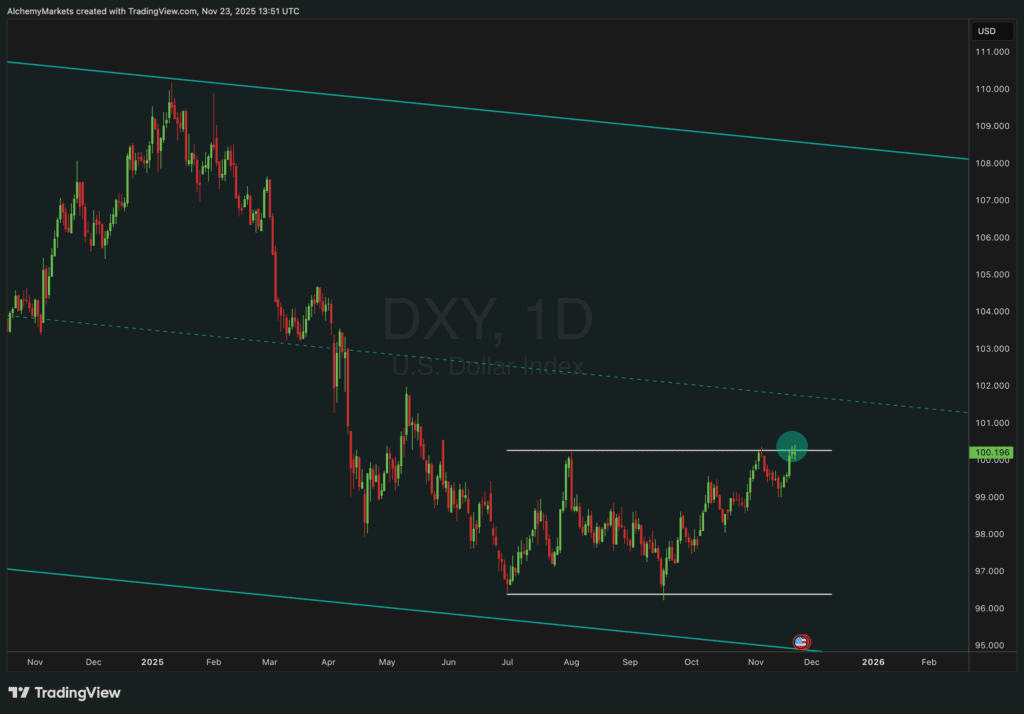
The DXY daily chart (see below) reveals a clean technical setup. After months of range-bound movement between 96.000 and 100.000, the index now sits precisely at the upper boundary — a key inflection point.
The recent rally has brought DXY right into overhead resistance, where sellers previously dominated in August and October. The reaction here will determine whether the current rally evolves into a trend reversal or another failed breakout.
If the dollar breaks and holds above 100.000, it would confirm renewed momentum, likely targeting 102.00–103.00 — aligning with the next descending trendline in the broader channel.
This scenario would suggest that markets are pricing in “higher-for-longer” U.S. rates, especially if global growth data weakens relative to the U.S.
Conversely, if DXY fails to clear resistance, expect a swift rejection toward 98.00, and possibly the lower boundary near 96.000.
A rejection here would align with renewed risk-on sentiment — potentially driven by dovish rhetoric from the Fed or an easing of U.S. financial conditions.
A stable or stronger dollar typically coincides with elevated real yields. That dynamic pressures gold and emerging market currencies, while benefiting sectors like defensive equities (utilities, healthcare).
Across the Atlantic, the UK faces its own macro crossroads. The government’s £30bn annual fiscal gap forces Chancellor Rachel Reeves to choose between tax hikes or higher borrowing.
Markets expect a combination of both, effectively tightening financial conditions.
For sterling, this means short-term support from fiscal credibility but longer-term headwinds if growth slows.
Gilts could rally if issuance expectations fall, but UK domestic equities — particularly retailers and housebuilders — may underperform if tax increases reduce disposable income.
The DXY (U.S. Dollar Index) measures the dollar’s value against a basket of major currencies. It’s a key barometer of global financial conditions.
It marks a major resistance level, previously rejected multiple times. A break above would signal a potential trend reversal.
Rate hikes or delayed cuts support the dollar by maintaining higher yields relative to other currencies.
Volatility rises as traders rely on incomplete information, and the Fed becomes more cautious with policy changes.
Fiscal credibility in the UK can stabilize GBP and influence cross-asset flows, especially into gilts.
Relative value and range-trading setups tend to outperform, as clear directional trends remain elusive.
The U.S. Dollar Index (DXY) is at a make-or-break level around 100.000, coinciding with one of the most uncertain macro backdrops in recent memory.
Whether it breaks higher toward 102.00 or rejects back to 98.00, the move will set the tone for global markets into year-end.
With the Fed flying blind and data delayed, the dollar’s resilience may persist — at least until hard numbers return.
For now, traders should respect the range, monitor positioning closely, and prepare for volatility spikes as narratives shift faster than fundamentals.
Alchemy Markets is a multi-asset brokerage providing retail traders with the same elite trading conditions, tools, and transparency typically reserved for institutions.

Select the categories and companies you wish to follow directly to your person rss feed.
Create Custom RSS FeedSign up and join over 5,000 professional members who receive personalized news alerts, curated professional connections, and more for free!
Theorem has integrated Symbiotic’s Liquid Lane RFQ network, letting holders of tokenised real-world assets trade against on-chain pool liquidity and market-maker quotes. The integration is live on Ethereum, with Midas’s yield-bearing mHYPER fund as the first supported asset. Holders can trade for the USDC stablecoin.
US equities were volatile with technology selloff erasing much of the earlier rebound.
FM Summit London 2026 returns to Old Billingsgate on 24 November for its 15th edition, with LMAX Group, Plus500 and oneZero among confirmed exhibitors. The one-day event adds Business Connect meetings and roundtables, and opens with a networking evening at The Folly on 23 November.
Finance Magnates Summit London returns to Old Billingsgate on 24 November 2026 for its 15th edition. The one-day event brings together brokers, liquidity providers, institutional firms, trading technology vendors, payments businesses and digital asset firms.
iSAM Securities Apex has integrated with Match-Prime, giving brokers access to liquidity across more than 2,000 instruments, with tailored pricing and up to 10 levels of market depth.
propfunding.com's free-entry instant funding changes the order of prop funding. Start trading first. Its free-entry instant funding model offers two qualification attempts without an upfront activation fee.
US stocks closed higher on Wednesday, with the Nasdaq gaining 1%, the S&P 500 rising 0.6%, and the Dow advancing 0.7%, as renewed enthusiasm for AI-related stocks lifted market sentiment.
SpaceX went public in June as a rocket company. On October 20 it reported as something else entirely: an AI infrastructure business, financed by a satellite broadband network, with a launch division attached. Rockets generated 12% of third quarter revenue and lost money. The AI segment generated 52% of revenue and consumed 84% of capital expenditure. Starlink generated 85% of operating profit.
Standard Chartered has signed definitive agreements to acquire 100% of Zodia Custody UK Limited, folding its regulated digital asset custody business into Securities Services. Zodia Solutions will be set up under SC Ventures with bank investors including Northern Trust, NAB Ventures, Emirates NBD and Investcorp.
Bybit Fintech FZE has secured a Virtual Asset Service Provider licence from Dubai’s Virtual Assets Regulatory Authority for Exchange Services, covering spot trading. Bybit’s Peter Loo said the firm hopes to add derivatives, subject to regulatory approvals. Its international Dubai headquarters opened in 2022.