

just now


Liquidity Finder Ltd is incorporated in England and Wales, company number 10610740, registered address 167-169 Great Portland Street, Fifth Floor, London W1W 5PF, United Kingdom.
Published: just now


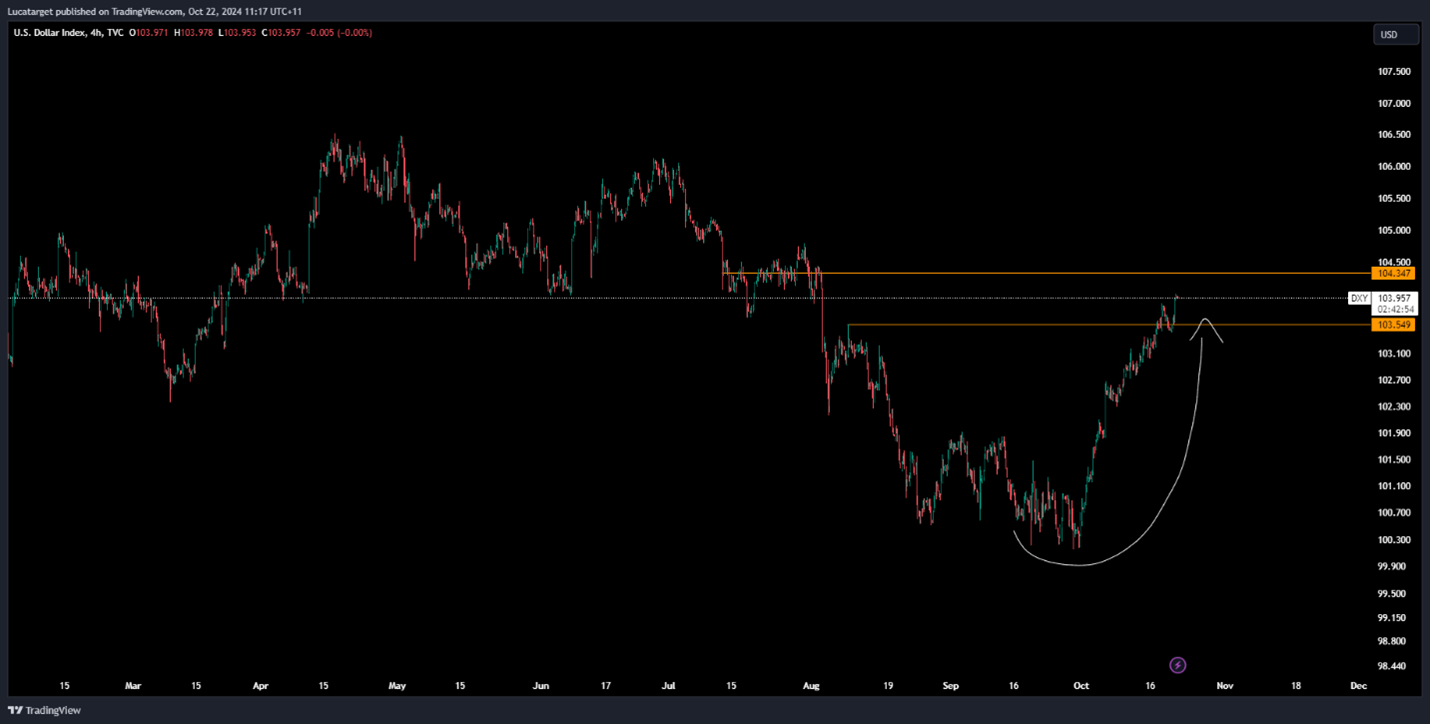
The U.S. dollar has been on a notable upward trend in the lead-up to the November 5th presidential election, registering its third consecutive week of gains. The Dollar Index, which measures the greenback’s strength against a basket of major currencies, has achieved its longest winning streak since the 1970s, climbing for fourteen consecutive trading days. This strong performance highlights the dollar’s resilience in the face of political and economic uncertainty. Over the past few weeks, the dollar has appreciated by 3.5%, showing particularly pronounced strength against currencies like the New Zealand Dollar (NZD) and the Japanese Yen (JPY), which have fallen 4.3% and 4.2% against the dollar, respectively.
DXY Chart H4
Trump’s Re-election Momentum Fuels Dollar Rally
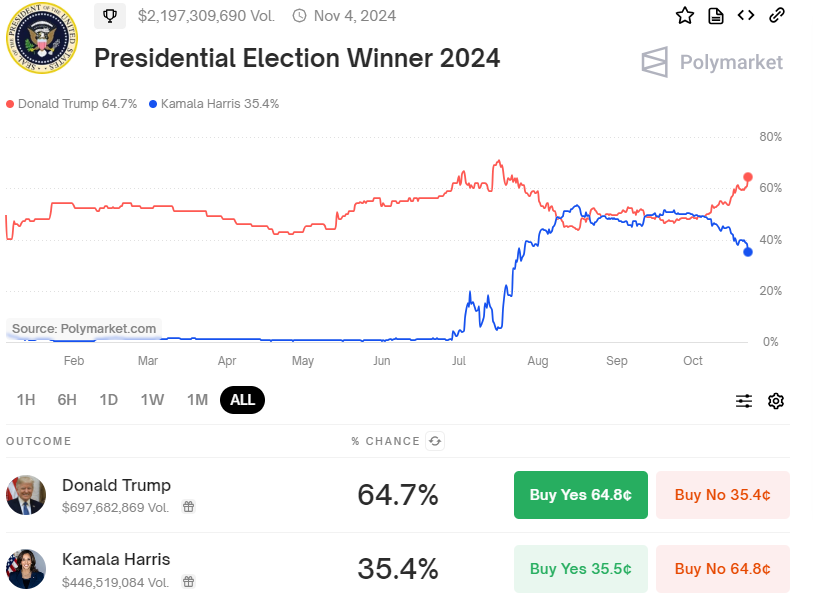
A significant factor driving the dollar’s surge is the growing market perception that Donald Trump may secure a second term in office. This sentiment has been bolstered by recent betting market data from platforms like PolyMarket, where Trump’s re-election odds have climbed past 60%. This shift in market expectations stems from his improving performance in key battleground states and the narrowing gap in opinion polls between Trump and his opponent, Kamala Harris. Despite Harris still leading in national polls, the electoral college dynamics indicate a tightening race, creating uncertainty that is reflected in currency markets.
PolyMarket Election
The USD’s rise reflects a "Trump risk premium" as investors begin to factor in the potential impact of a second Trump presidency. Historically, Trump’s policies on trade, deregulation, and economic nationalism have introduced volatility into global markets. Under his administration, policies such as tariffs on Chinese goods and a renegotiation of NAFTA (replaced by the USMCA) disrupted global supply chains and currency flows. This risk premium suggests that markets anticipate renewed volatility in global trade relations, should Trump win re-election. I’ve made a video discussing a bit more in-depth about trump winning and what could happen on the market if he actually wins, you can find this video here:
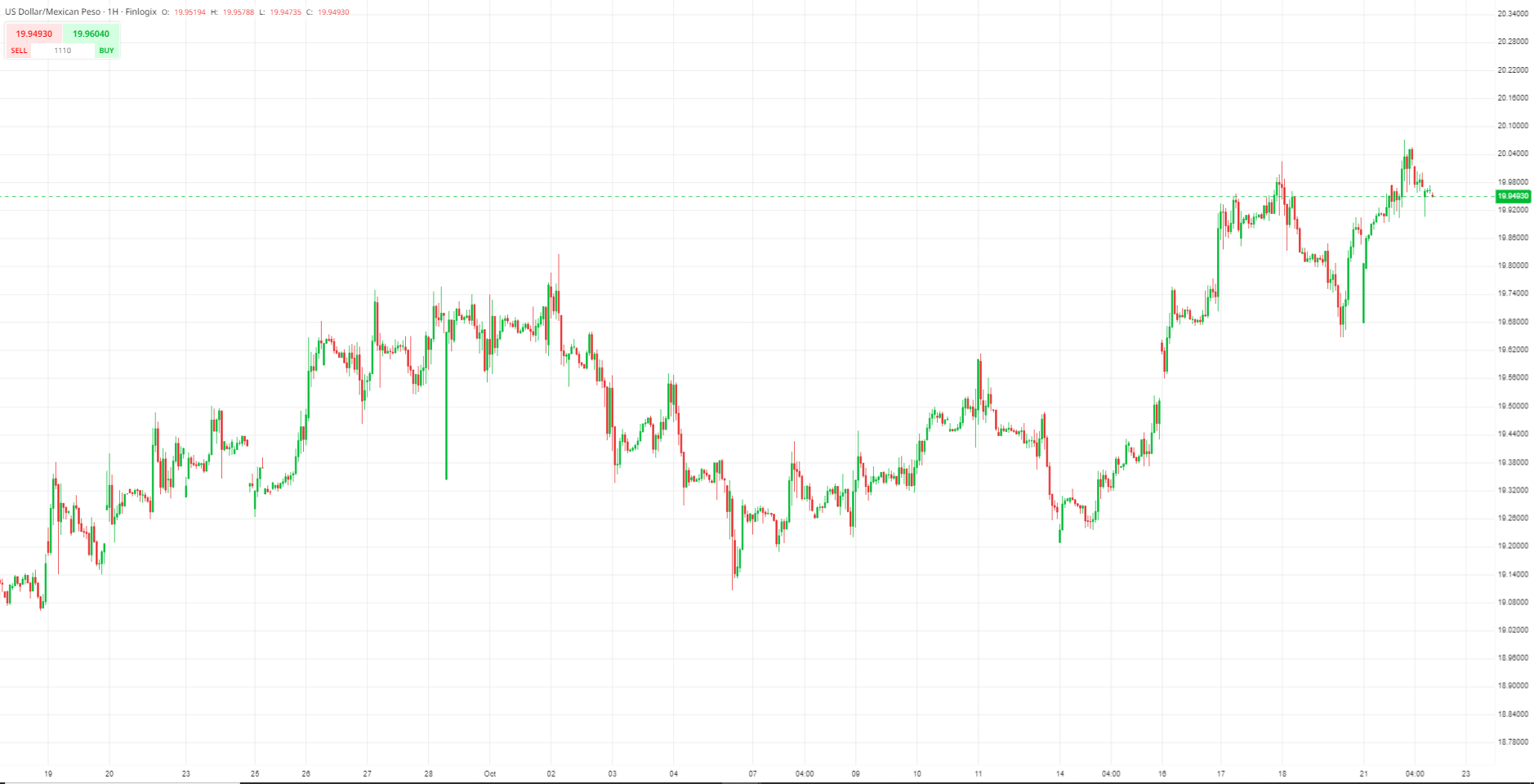
The USD/MXN pair, a barometer of U.S.-Mexico trade relations, has already climbed to the 20.00-level. The Mexican Peso’s sensitivity to U.S. political shifts reflects concerns about potential changes in trade policies or tariffs that could emerge under another Trump administration. The dollar’s strength in this context may be seen as a hedge against policy uncertainty, which could otherwise weaken emerging market currencies like the MXN.
USDMXM H1 Chart
Diverging Monetary Policies Support the Dollar’s Ascent
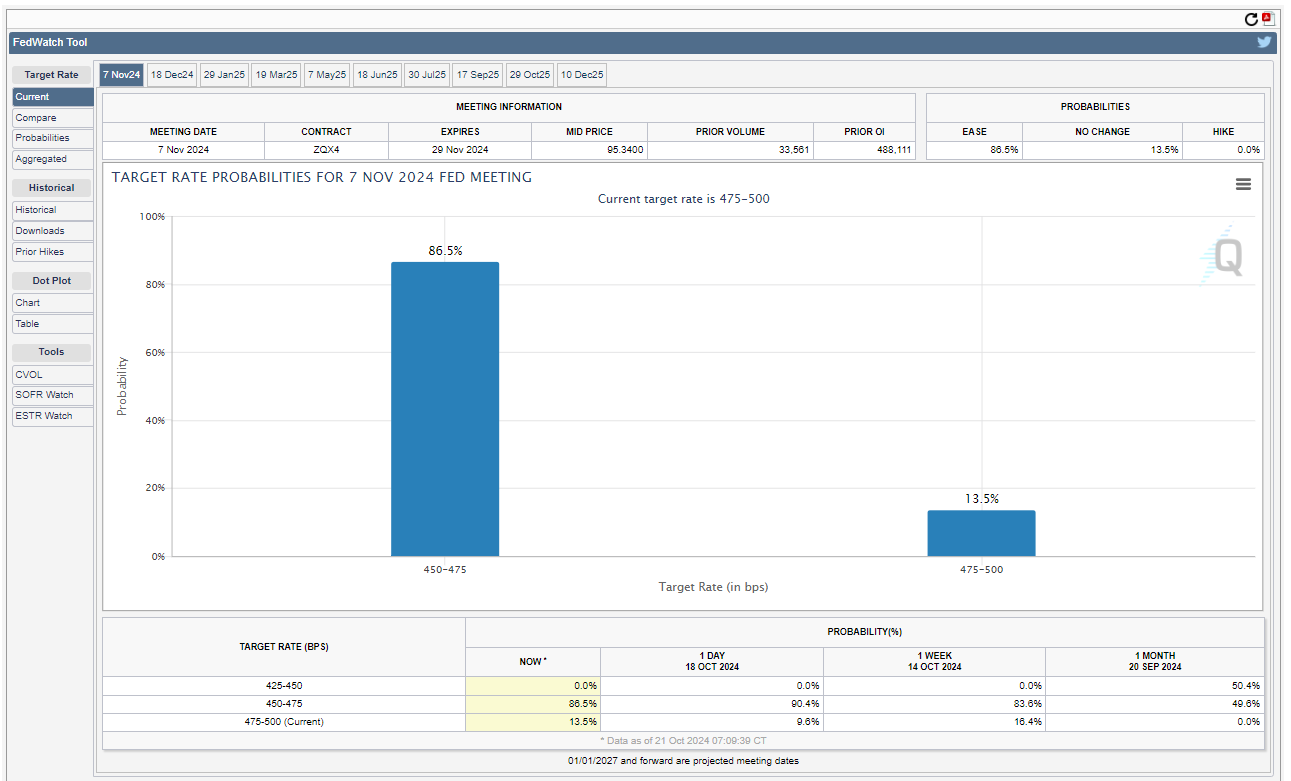
In addition to election-related factors, the U.S. dollar’s strength can also be attributed to a growing divergence in monetary policy between the Federal Reserve and other major central banks. While the Fed has signalled a potential slowdown in the pace of its interest rate cuts, delivering a modest 25 basis points (bps) reduction at its next meeting (07/11/2024), other central banks have pursued more aggressive easing measures.
CME FEDWatch
For instance, the Reserve Bank of New Zealand (RBNZ) recently implemented a significant 50bps cut and is expected to make further cuts as inflation in New Zealand has slowed faster than anticipated. Similarly, the Bank of Canada (BoC) is widely expected to follow with additional rate cuts, reflecting concerns about weakened economic growth. In contrast, resilient inflation and stronger-than-expected economic data in the U.S. have limited the Fed’s ability to continue aggressive rate cuts, which has further boosted the dollar. You can find out more about RBNZ on this blog I’ve posted: https://acy.com.au/en/market-news/market-analysis/analysis-of-the-new-zealand-dollars-after-a-50bp-from-rbnz-l-s-132614/
Should Trump win the election, market participants anticipate that the Fed might even pause its rate-cutting cycle altogether. Trump’s administration has consistently pressured the Fed for lower rates, but a Trump victory might strengthen the market’s belief in the U.S. economy's relative strength, supporting the dollar.
Global Inflation Dynamics and Impact on Central Banks
Inflation trends across major economies have also contributed to the divergence in monetary policy. In economies like New Zealand, the UK, and Canada, inflation has decelerated more rapidly than expected. This has given their respective central banks the flexibility to lower interest rates without stoking fears of overheating their economies. However, the U.S. has experienced more persistent inflation, which limits the Fed’s capacity for rate cuts. If inflation remains relatively strong, the Fed might hold off on further easing, providing additional support to the dollar.
As the November election approaches, the dollar’s trajectory will be closely tied to political developments and shifts in market sentiment regarding the election outcome. Traders and investors will be watching polling data, particularly in swing states, to assess the likelihood of a Trump victory. Additionally, any further signs of economic strength in the U.S. could reinforce the dollar’s upward momentum. However, should Trump’s opponent Kamala Harris regain her lead in the polls, the market may adjust its expectations, potentially reducing the Trump risk premium and dampening the dollar’s rally.
Central bank actions will also play a crucial role in the dollar’s future. Any unexpected rate cuts by the Fed or more aggressive easing from other central banks could alter the dollar’s current path. Inflation dynamics, trade tensions, and geopolitical risks will continue to be key drivers in the months ahead.
This content may have been written by a third party. ACY makes no representation or warranty and assumes no liability as to the accuracy or completeness of the information provided, nor any loss arising from any investment based on a recommendation, forecast or other information supplies by any third-party. This content is information only, and does not constitute financial, investment or other advice on which you can rely.
Why Is Forex Trading So Difficult?
How To Master MT4 & MT5 - Tips And Tricks For Traders
The Importance Of Fundamental Analysis In Forex Trading
Forex Leverage Explained: Mastering Forex Leverage In Trading & Controlling Margin
The Importance Of Liquidity In Forex: A Beginner's Guide
Close All Metatrader Script: Maximise Your Trading Efficiency And Reduce Stress
Best Currency Pairs To Trade In 2024
Forex Trading Hours: Finding The Best Times To Trade FX
MetaTrader Expert Advisor - The Benefits Of Algorithmic Trading And Forex EAs
ACY Securities is one of Australia's fastest growing multi-asset online trading providers, offering ultra-low-cost trading, rock-solid execution, technologically superior account management and premium market analysis.

Select the categories and companies you wish to follow directly to your person rss feed.
Create Custom RSS FeedSign up and join over 5,000 professional members who receive personalized news alerts, curated professional connections, and more for free!
Theorem has integrated Symbiotic’s Liquid Lane RFQ network, letting holders of tokenised real-world assets trade against on-chain pool liquidity and market-maker quotes. The integration is live on Ethereum, with Midas’s yield-bearing mHYPER fund as the first supported asset. Holders can trade for the USDC stablecoin.
US equities were volatile with technology selloff erasing much of the earlier rebound.
FM Summit London 2026 returns to Old Billingsgate on 24 November for its 15th edition, with LMAX Group, Plus500 and oneZero among confirmed exhibitors. The one-day event adds Business Connect meetings and roundtables, and opens with a networking evening at The Folly on 23 November.
Finance Magnates Summit London returns to Old Billingsgate on 24 November 2026 for its 15th edition. The one-day event brings together brokers, liquidity providers, institutional firms, trading technology vendors, payments businesses and digital asset firms.
iSAM Securities Apex has integrated with Match-Prime, giving brokers access to liquidity across more than 2,000 instruments, with tailored pricing and up to 10 levels of market depth.
propfunding.com's free-entry instant funding changes the order of prop funding. Start trading first. Its free-entry instant funding model offers two qualification attempts without an upfront activation fee.
US stocks closed higher on Wednesday, with the Nasdaq gaining 1%, the S&P 500 rising 0.6%, and the Dow advancing 0.7%, as renewed enthusiasm for AI-related stocks lifted market sentiment.
SpaceX went public in June as a rocket company. On October 20 it reported as something else entirely: an AI infrastructure business, financed by a satellite broadband network, with a launch division attached. Rockets generated 12% of third quarter revenue and lost money. The AI segment generated 52% of revenue and consumed 84% of capital expenditure. Starlink generated 85% of operating profit.
Standard Chartered has signed definitive agreements to acquire 100% of Zodia Custody UK Limited, folding its regulated digital asset custody business into Securities Services. Zodia Solutions will be set up under SC Ventures with bank investors including Northern Trust, NAB Ventures, Emirates NBD and Investcorp.
Bybit Fintech FZE has secured a Virtual Asset Service Provider licence from Dubai’s Virtual Assets Regulatory Authority for Exchange Services, covering spot trading. Bybit’s Peter Loo said the firm hopes to add derivatives, subject to regulatory approvals. Its international Dubai headquarters opened in 2022.