

just now


Liquidity Finder Ltd is incorporated in England and Wales, company number 10610740, registered address 167-169 Great Portland Street, Fifth Floor, London W1W 5PF, United Kingdom.
Published: just now
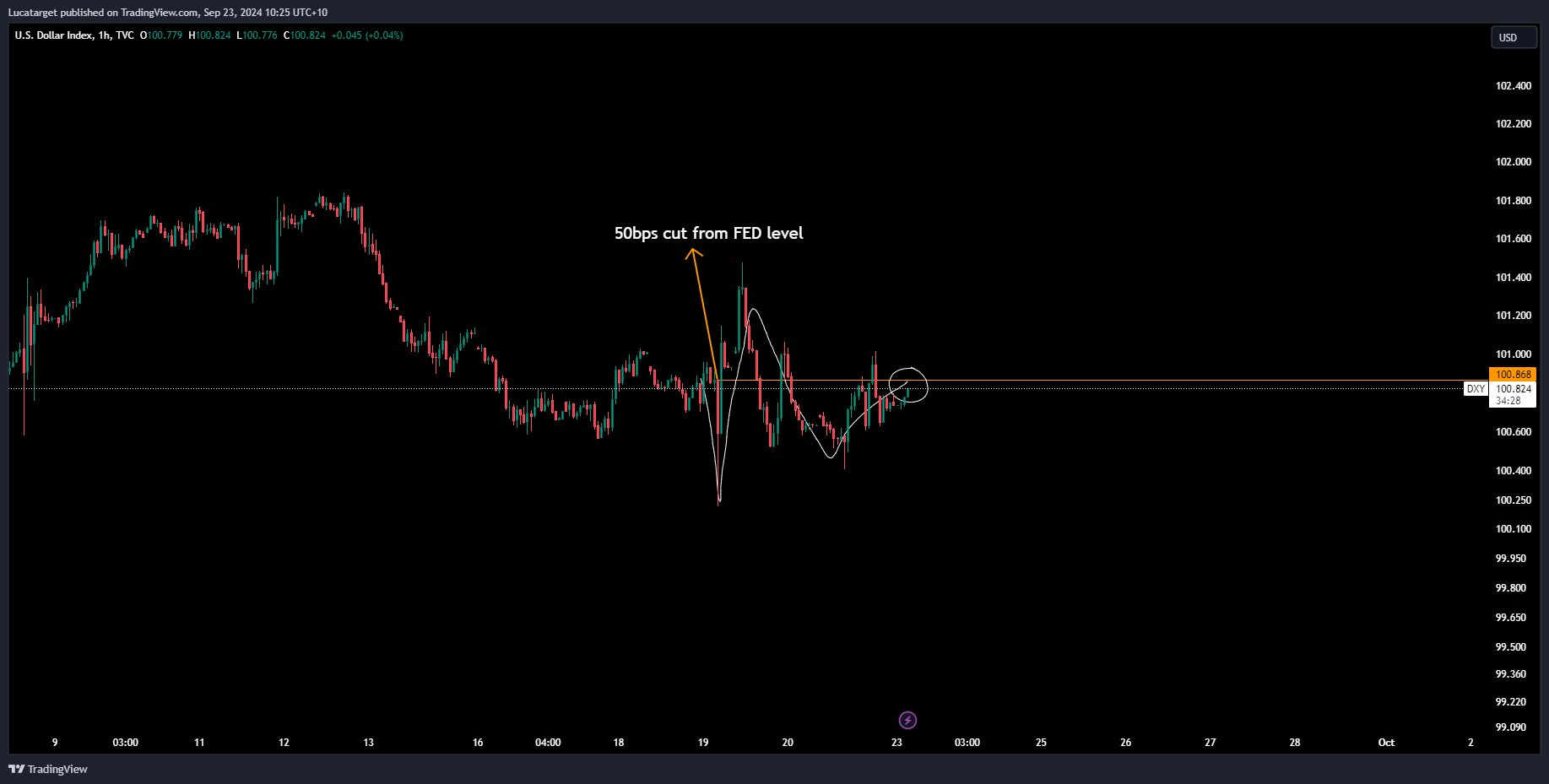
As we start another week on the market, the US dollar has demonstrated unexpected resilience, bouncing back from earlier losses. On the DXY index, which tracks the dollar's performance against a basket of other major currencies, the greenback has almost returned to its pre-rate cut levels. The Federal Reserve's recent decision to reduce interest rates by 50 basis points (bp) surprised many in the market even myself as I was expecting a 25bp cut! Most of the market had largely anticipated a more modest cut of 25 bp, but the larger-than-expected move indicated that market participants had already priced in such aggressive action. Initially, short-term US Treasury yields declined, reflecting the dovish shift, but quickly reversed as the market began to digest the broader implications of the Fed's easing cycle. As we move forward, the key question remains: how will the dollar fare in the wake of this policy change, and what historical patterns can guide expectations?
DXY On Same Levels as FED Cut 50bp
Historically, the relationship between Fed rate cuts and the dollar's performance has been far from straightforward. While some periods have seen the dollar strengthen in response to lower interest rates, others have witnessed it weaken, or even remain relatively stable. For instance, in 1995, the US dollar appreciated after the Federal Reserve's rate cut, largely because the policy shift was perceived as pre-emptive, helping to stave off a recession. This appreciation was bolstered by simultaneous rate reductions by other major central banks, particularly the German Bundesbank. The easing of monetary conditions in Europe created a relatively favourable environment for the US dollar, allowing it to maintain its strength during this period.
Conversely, the rate cut cycle in 2001 offers a different narrative. Although the dollar initially strengthened as global demand for US assets remained robust, the broader economic downturn that followed the collapse of the dot-com bubble dampened the dollar’s momentum. The recession, though mild, limited the dollar's gains, as the market sentiment shifted from optimism to caution.
A similar pattern emerged in 2007, on the cusp of the global financial crisis (GFC). During this time, the Federal Reserve's slower response to the unfolding crisis, relative to other central banks like the European Central Bank (ECB), contributed to significant dollar weakness. The Fed’s more cautious approach heightened concerns about the US economy's fragility, further weighing on the dollar.
A key determinant of the dollar's direction following rate cuts is the policy actions of other central banks. If the Fed moves more decisively than its global counterparts, the dollar may retain a level of stability, even in an economic downturn. In the current scenario, the economic outlook suggests that the US may experience a period of protracted slowdown, with further rate cuts likely in the coming months. Meanwhile, the European Central Bank, known for its more conservative stance on monetary easing, may be slower to reduce rates. This divergence could result in a narrowing interest rate differential between the US and Europe, potentially exerting downward pressure on the dollar. However, given the overall cautious tone of global monetary policy, a sharp sell-off in the dollar seems unlikely in the immediate future.
While historical patterns offer some clues, the complexity of predicting the dollar's movement after a rate cut lies in the multitude of factors at play. Economic conditions, central bank policies, and even geopolitical tensions all contribute to shaping the dollar's path. For example, if global risk sentiment deteriorates, the dollar could strengthen as investors flock to safe-haven assets, even in a low-rate environment. Conversely, should the US economy underperform more severely than expected, the dollar may weaken as investor confidence fades.
Ultimately, the dollar’s performance in the wake of Fed rate cuts cannot be predicted with absolute certainty. While historical precedents provide valuable insights, each economic cycle brings its own set of variables and uncertainties. In the current context, the interplay between US monetary policy, global economic conditions, and central bank strategies will be critical in determining the dollar's direction in the coming months. Investors and analysts alike will need to keep a close eye on these developments to navigate the evolving financial landscape.
This content may have been written by a third party. ACY makes no representation or warranty and assumes no liability as to the accuracy or completeness of the information provided, nor any loss arising from any investment based on a recommendation, forecast or other information supplies by any third-party. This content is information only, and does not constitute financial, investment or other advice on which you can rely.
Why Is Forex Trading So Difficult?
How To Master MT4 & MT5 - Tips And Tricks For Traders
The Importance Of Fundamental Analysis In Forex Trading
Forex Leverage Explained: Mastering Forex Leverage In Trading & Controlling Margin
The Importance Of Liquidity In Forex: A Beginner's Guide
Close All Metatrader Script: Maximise Your Trading Efficiency And Reduce Stress
Best Currency Pairs To Trade In 2024
Forex Trading Hours: Finding The Best Times To Trade FX
MetaTrader Expert Advisor - The Benefits Of Algorithmic Trading And Forex EAs
ACY Securities is one of Australia's fastest growing multi-asset online trading providers, offering ultra-low-cost trading, rock-solid execution, technologically superior account management and premium market analysis.

Select the categories and companies you wish to follow directly to your person rss feed.
Create Custom RSS FeedSign up and join over 5,000 professional members who receive personalized news alerts, curated professional connections, and more for free!
Theorem has integrated Symbiotic’s Liquid Lane RFQ network, letting holders of tokenised real-world assets trade against on-chain pool liquidity and market-maker quotes. The integration is live on Ethereum, with Midas’s yield-bearing mHYPER fund as the first supported asset. Holders can trade for the USDC stablecoin.
US equities were volatile with technology selloff erasing much of the earlier rebound.
FM Summit London 2026 returns to Old Billingsgate on 24 November for its 15th edition, with LMAX Group, Plus500 and oneZero among confirmed exhibitors. The one-day event adds Business Connect meetings and roundtables, and opens with a networking evening at The Folly on 23 November.
Finance Magnates Summit London returns to Old Billingsgate on 24 November 2026 for its 15th edition. The one-day event brings together brokers, liquidity providers, institutional firms, trading technology vendors, payments businesses and digital asset firms.
iSAM Securities Apex has integrated with Match-Prime, giving brokers access to liquidity across more than 2,000 instruments, with tailored pricing and up to 10 levels of market depth.
propfunding.com's free-entry instant funding changes the order of prop funding. Start trading first. Its free-entry instant funding model offers two qualification attempts without an upfront activation fee.
US stocks closed higher on Wednesday, with the Nasdaq gaining 1%, the S&P 500 rising 0.6%, and the Dow advancing 0.7%, as renewed enthusiasm for AI-related stocks lifted market sentiment.
SpaceX went public in June as a rocket company. On October 20 it reported as something else entirely: an AI infrastructure business, financed by a satellite broadband network, with a launch division attached. Rockets generated 12% of third quarter revenue and lost money. The AI segment generated 52% of revenue and consumed 84% of capital expenditure. Starlink generated 85% of operating profit.
Standard Chartered has signed definitive agreements to acquire 100% of Zodia Custody UK Limited, folding its regulated digital asset custody business into Securities Services. Zodia Solutions will be set up under SC Ventures with bank investors including Northern Trust, NAB Ventures, Emirates NBD and Investcorp.
Bybit Fintech FZE has secured a Virtual Asset Service Provider licence from Dubai’s Virtual Assets Regulatory Authority for Exchange Services, covering spot trading. Bybit’s Peter Loo said the firm hopes to add derivatives, subject to regulatory approvals. Its international Dubai headquarters opened in 2022.