
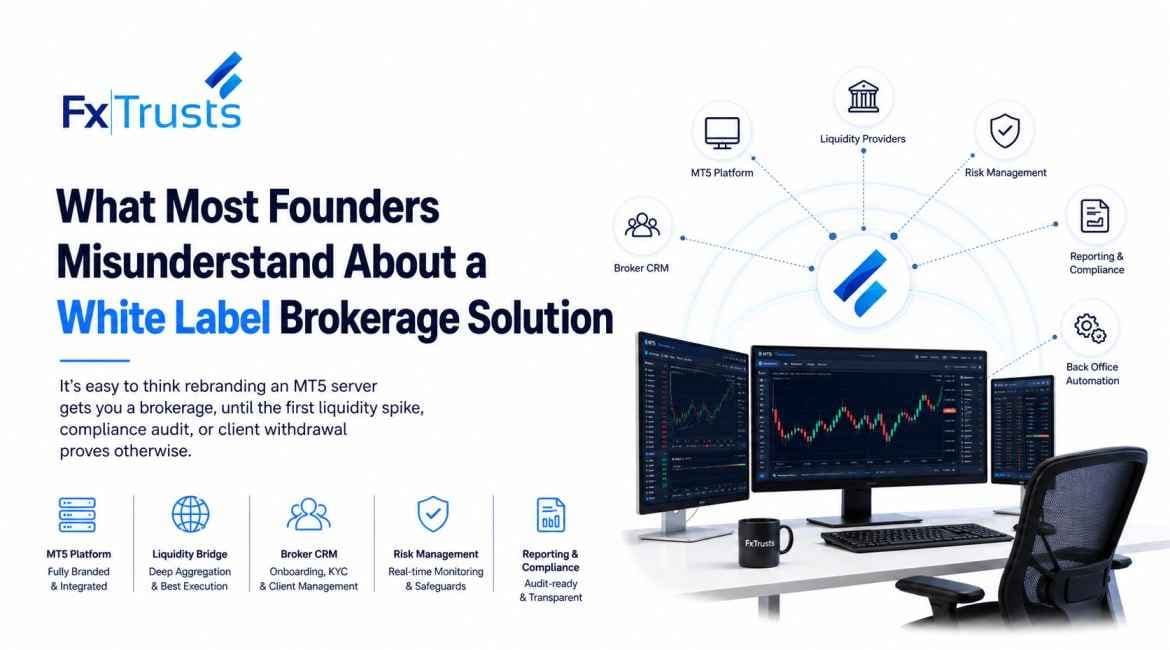
It’s easy to think rebranding an MT5 server gets you a brokerage, until the first liquidity spike, compliance audit, or client withdrawal proves otherwise.
Introduction:
I’ve sat across the table from too many sharp founders who launched what they believed was a clean white label brokerage solution, only to watch operations unravel six months later. The platform looked perfect in the demo—clean MT5 terminals, your logo on the login screen—but the back-end friction, delayed reports, and rigid workflows started costing real money and trust.
The misconception is common: many treat a white label brokerage solution as little more than a turnkey MT5 skin. In reality, it’s the entire operational nervous system of your business. Get the infrastructure layer wrong, and you’ll spend the next year patching holes instead of growing accounts. Those who treat it as serious infrastructure from day one move faster, sleep better, and scale without constant firefighting.
1. The Real-World Pain Most Brokers Discover Too Late
Picture this. A prop firm founder signs with a provider promising quick MT5 white label access. They launch, onboard their first few hundred traders, and everything feels smooth. Then volume picks up. Spreads widen unpredictably during news events. Withdrawals take days instead of hours because the back-office queue is manual. Risk alerts come late, and suddenly a few accounts blow past acceptable exposure before anyone notices.
The founder calls the provider and hears the familiar refrain: “That’s outside the base package.” What started as a cost-saving move becomes an expensive lesson in fragmented systems. I’ve seen this pattern repeatedly—especially with prop firms scaling retail-style models or FinTech startups entering brokerage space. The trading terminal works, but the business doesn’t.
The hidden cost isn’t always the monthly fee. It’s the hours your team wastes on manual reconciliations, the clients you lose to better execution elsewhere, and the regulatory headaches that surface when your data trails don’t line up cleanly.
Introduction:
I’ve sat across the table from too many sharp founders who launched what they believed was a clean white label brokerage solution, only to watch operations unravel six months later. The platform looked perfect in the demo—clean MT5 terminals, your logo on the login screen—but the back-end friction, delayed reports, and rigid workflows started costing real money and trust.
The misconception is common: many treat a white label brokerage solution as little more than a turnkey MT5 skin. In reality, it’s the entire operational nervous system of your business. Get the infrastructure layer wrong, and you’ll spend the next year patching holes instead of growing accounts. Those who treat it as serious infrastructure from day one move faster, sleep better, and scale without constant firefighting.
1. The Real-World Pain Most Brokers Discover Too Late
Picture this. A prop firm founder signs with a provider promising quick MT5 white label access. They launch, onboard their first few hundred traders, and everything feels smooth. Then volume picks up. Spreads widen unpredictably during news events. Withdrawals take days instead of hours because the back-office queue is manual. Risk alerts come late, and suddenly a few accounts blow past acceptable exposure before anyone notices.
The founder calls the provider and hears the familiar refrain: “That’s outside the base package.” What started as a cost-saving move becomes an expensive lesson in fragmented systems. I’ve seen this pattern repeatedly—especially with prop firms scaling retail-style models or FinTech startups entering brokerage space. The trading terminal works, but the business doesn’t.
The hidden cost isn’t always the monthly fee. It’s the hours your team wastes on manual reconciliations, the clients you lose to better execution elsewhere, and the regulatory headaches that surface when your data trails don’t line up cleanly.
What a White Label Brokerage Solution Actually Is
At its core, a solid white label brokerage solution gives you a fully branded MetaTrader 5 environment without buying a direct license from MetaQuotes. You operate under the provider’s master server while presenting everything to clients as your own. But the best setups go far beyond the terminal.
2. What a White Label Brokerage Solution Actually Is
At its core, a solid white label brokerage solution gives you a fully branded MetaTrader 5 environment without buying a direct license from MetaQuotes. You operate under the provider’s master server while presenting everything to clients as your own. But the best setups go far beyond the terminal.
You get the MT5 server (manager access included), client terminals (desktop, web, mobile), and the ability to configure symbols, leverage, and account types. More importantly, it connects to a liquidity bridge that aggregates feeds from multiple providers, ensuring competitive pricing and reliable execution even in volatile conditions.
Then come the operational layers most founders undervalue upfront: a broker CRM and back office for client management, KYC/AML workflows, payment processing, and reporting. Risk management tools that monitor exposure in real time. Automation for onboarding, bonus application, and margin calls. These aren’t nice-to-haves—they determine whether your operation feels professional or patched together.
3. Thinking Like an Operator: The Infrastructure Layer
Smart operators evaluate white label brokerage solutions the way they’d assess their own data center or banking relationships—through the lens of scalability and control. Can the system handle 10x volume without performance degradation? How quickly can you add new symbols or liquidity providers? What does data ownership and export look like if you ever want to migrate?
Liquidity connectivity is often the make-or-break piece. A thin bridge to a single provider might look cheap until a major pair gaps and your clients can’t exit positions cleanly. Integrated bridges that pull from tier-1 sources and offer deep aggregation change the game. Similarly, reporting needs to serve both you and regulators without custom development every quarter.
Automation matters more than people admit. Modern setups handle straight-through processing for deposits, instant account verification where possible, and rule-based risk controls. The difference between a brokerage that feels instant and one that feels clunky often comes down to how well the CRM, trading server, and liquidity layer talk to each other.
4. Business Impact: Speed, Risk, and Sustainable Growth
A well-integrated white label brokerage solution dramatically shortens your time to revenue. Instead of building or integrating separate systems over 9–12 months, you can be live and accepting clients in weeks. That speed matters in a competitive market where first-mover advantage with a niche audience (certain regions, prop models, or asset classes) can make the difference.
Client experience improves when everything works seamlessly—fast logins, reliable quotes, quick funding and withdrawals. Traders notice execution quality and support responsiveness more than they notice marketing promises. On the risk side, real-time tools help you maintain healthy A-book/B-book balance or prop firm payout ratios without nasty surprises.
Compliance workflows become manageable rather than overwhelming. Good systems generate the reports you actually need for audits instead of generic exports that require manual cleanup. Over time, this operational maturity supports expansion—whether adding more instruments, entering new jurisdictions, or layering on copy trading and other features.
Infrastructure providers such as FXTrusts are usually evaluated not only for the platform layer, but also for how CRM, liquidity bridge, and back-office workflows fit together.
"What to Evaluate Before Choosing a Provider"
Here’s a practical lens operators use:
Depth of integration: Does the CRM actually sync with MT5 in real time for positions, equity, and history? Or will you be copying data manually?
Liquidity flexibility: Can you connect multiple providers and switch routing rules? What’s the latency profile under load?
Back-office control: Look for configurable workflows, not rigid templates. You should own your client data and reporting logic.
Scalability proof: Ask for references at your expected volume and stress-test during onboarding.
Support realism: Who handles server updates, urgent fixes, and regulatory queries? What are the actual response SLAs?
Exit strategy: Understand data portability. No one plans to leave on day one, but smart founders build with mobility in mind.
Conclusion:
The biggest misunderstanding about a white label brokerage solution is treating it as a technology purchase instead of an operational partnership. The MT5 terminal is the visible storefront; the real business runs on everything happening behind it—the liquidity plumbing, risk controls, client data flows, and reporting backbone.
Founders who succeed treat these layers with the same seriousness they give to regulation and capital. They ask operational questions early, test under realistic conditions, and choose partners whose systems feel like extensions of their own thinking rather than black boxes.
The takeaway is simple but often expensive to learn: your white label brokerage solution doesn’t just enable trading. It defines how well you can run a brokerage. Build (or choose) the infrastructure thoughtfully, and the platform becomes an asset instead of a constraint.
What’s the biggest operational friction you’re facing right now with your current setup—or the one you’re considering? The comments are usually where the most useful war stories surface.

Search Companies, News, Members & more
Terms of ServicePrivacy PolicySecurity PolicyLegal InformationCommunity GuidelinesSitemapsCookie Settings
2026 Copyright © Liquidity Finder Ltd. All rights reserved.
Liquidity Finder Ltd is incorporated in England and Wales, company number 10610740, registered address 167-169 Great Portland Street, Fifth Floor, London W1W 5PF, United Kingdom.
What Most Founders Misunderstand About a White Label Brokerage Solution
Posted: just now
Global
Comments
Most Recent
Create Your FREE Account
Get access to latest news, updates, real-time data, brokerage and trading firm insights and customized information feeds.


This explains Trade balance data reveals economic health and drives currency volatility.

Discover why trading psychology matters more than technical analysis. Learn how to master the mental game for long-term trading success today.

This explains Trade balance data reveals economic health and drives currency volatility.


The S&P 500 just lost its channel after Broadcom's blowout disappointed and a hot jobs report killed the rate-cut hopes — here's why the market now needs perfect, not just good, and what the chart says next.


When Andy Ross left one of the most senior prime brokerage seats in the market to join prediction markets exchange Kalshi, I cheered him on. This was a maverick move to a maverick company. I sat down with Andy to find out what Kalshi is building for institutional markets, why the proxy hedge problem is costing institutions real money, and why the launch of the first CFTC-regulated perpetual futures on American soil changes the game for institutional capital efficiency.

Trading platform provider cTrader has integrated mobile attribution and marketing analytics specialist AppsFlyer into its platform, giving brokers the ability to launch and track mobile advertising campaigns for their branded cTrader apps.

Institutional liquidity and risk management provider X Securities Ltd has announced a strategic partnership with financial services group WSF Markets Ltd, designed to strengthen the infrastructure underpinning WSF's brokerage and prop trading operations.


DAK Markets, a technology-driven broker, has partnered with cTrader to support its growing global community with the award-winning trading platform.


The A-book and B-book are the two fundamental execution models every FX and CFD broker operates under - yet many brokers run one or both without fully understanding the risk implications. This guide covers how each model works, where broker revenue actually comes from, the risks of running a poorly managed B-book, and how hybrid execution models give brokers the flexibility to optimise profitability without taking on excessive exposure.


Your Bourse has added Advanced Markets to its Premium Liquidity Provider program, combining bank-grade liquidity with Your Bourse execution technology, bridge connectivity, hosting, and reporting tools in one streamlined solution for brokers.
Feed