
Search Companies, News, Members & more
Terms of ServicePrivacy PolicySecurity PolicyLegal InformationCommunity GuidelinesSitemapsCookie Settings
2026 Copyright © Liquidity Finder Ltd. All rights reserved.
Liquidity Finder Ltd is incorporated in England and Wales, company number 10610740, registered address 167-169 Great Portland Street, Fifth Floor, London W1W 5PF, United Kingdom.
Healthy Algorithmic Trading vs Structural Abuse: Where the Line Is

Published on Mar 9, 2026
Updated on Jun 20, 2026
As algorithmic and automated trading becomes more widespread, brokers and traders alike face an increasingly important question: how do we distinguish healthy algorithmic trading from behavior that exploits structural weaknesses rather than market risk?
This distinction matters—not because automation is a problem, but because not all algorithmic behavior is created equal. Long-term alignment in automated markets depends on understanding where that line exists and why it matters.
Profitability Is Not the Issue
A common misconception in the industry is that profitable algorithmic traders are inherently problematic. In reality, profitability alone is not a meaningful risk indicator.
Sustainable algorithmic strategies often exhibit:
🔹 Controlled risk exposure
🔹 Repeatable logic
🔹 Gradual scaling
🔹 Performance consistency across market conditions
These characteristics are typically associated with traders who survive longer, manage capital responsibly, and contribute stable trading volume over time.
The issue is not whether a strategy makes money. It is how that money is made.
What Healthy Algorithmic Trading Looks Like
Healthy algorithmic trading is grounded in market participation rather than market exploitation. While strategies vary widely, they tend to share several behavioral traits:
🔹 Execution that engages with available liquidity
🔹 Trade frequency aligned with strategy logic
🔹 Risk parameters that adapt to volatility rather than ignore it
🔹 Performance that remains viable across different sessions and conditions
These strategies accept that markets are imperfect and dynamic. They are designed to operate within those constraints, not to rely on fleeting inefficiencies.
Understanding Structural and Execution Abuse
Structural abuse occurs when trading strategies derive profitability primarily from non-market vulnerabilities rather than price movement or risk-taking.
Examples include:
🔹 Latency arbitrage that exploits delayed pricing
🔹 Quote manipulation or order sequencing designed to bypass execution logic
🔹 Strategies dependent on infrastructure asymmetries rather than market behavior
Such approaches are typically fragile. They rely on conditions that disappear as infrastructure improves, routing changes, or execution logic is adjusted. While they may generate short-term gains, they rarely scale sustainably and often introduce instability into the broader trading environment.
Why This Distinction Matters for Everyone
From a broker’s perspective, distinguishing between healthy trading behavior and structural abuse is essential for maintaining:
🔹 Execution integrity
🔹 Stable liquidity relationships
🔹 Predictable risk profiles
From a trader’s perspective, the distinction offers reassurance. Strategies built on real market interaction are not penalized simply for being profitable. Instead, evaluation focuses on behavior, consistency, and sustainability.
This approach aligns incentives rather than placing them in conflict.
Behavior Over Outcomes
In execution-first environments, behavior becomes the primary evaluation metric. This includes:
🔹 How a strategy enters and exits liquidity
🔹 How it responds to volatility
🔹 How it scales as capital increases
When behavior is market-aligned, profitability is a natural and welcome outcome. When behavior depends on exploiting structural gaps, profitability is inherently unstable.
As automated trading becomes more common, this behavioral lens becomes increasingly important.
Automation Raises Responsibility on Both Sides
Automation amplifies everything. Well-designed strategies scale efficiently. Poorly designed ones fail faster. The same applies to execution environments.
For traders, this means designing systems that remain robust when conditions change. For brokers, it means creating environments that reward genuine market participation while protecting against structural exploitation.
Neither objective contradicts the other. In fact, both are necessary for sustainable growth in automated markets.
A Foundation for Long-Term Participation
Healthy algorithmic trading is not about speed, secrecy, or exploiting edge cases. It is about repeatability, discipline, and alignment with market mechanics.
As this series has explored, clarity around execution, infrastructure, and behavior is essential in the age of automation. Drawing a clear line between sustainable trading and structural abuse is not restrictive—it is what allows serious traders to operate with confidence over the long term.
See also:
Part 1: Building the Right Trading Environment in the Age of Algorithmic & AI Trading
Part 2: Different Traders, Different Trading Environments
Part 3: STP an an Environmnet, Not a Feature
Part 4: Execution, Infrastructure, and What Actually Matters to Algo Traders
Author
 | Youssef Bouz is Operations Manager at GCC Brokers, focusing on execution quality, infrastructure, and long-term broker–trader alignment for professional and algorithmic traders. |
Share this article

Comments
Most Recent
Find The Right Partners for
Your Trading Business
Sign up and join over 5,000 professional members who receive personalized news alerts, curated professional connections, and more for free!
Outsourced dealing desks have grown as the cost of hiring experienced dealers has risen. Alex Hristov of Broktinger sets out what brokers hand over, what stays in-house, and the monitoring tools his team built for their own desk, which other brokers can also benefit from.

Risk and dealing analytics provider BrokerPilot helps multi-asset brokers spot toxic flow before it eats into their P&L. Chief Revenue Officer Sergey Berezhnoy talks to Sam Low about catching toxic patterns across MT4, MT5 and cTrader, why new brokers get targeted from day one, and where AI fits into the dealing room without replacing the human dealer.
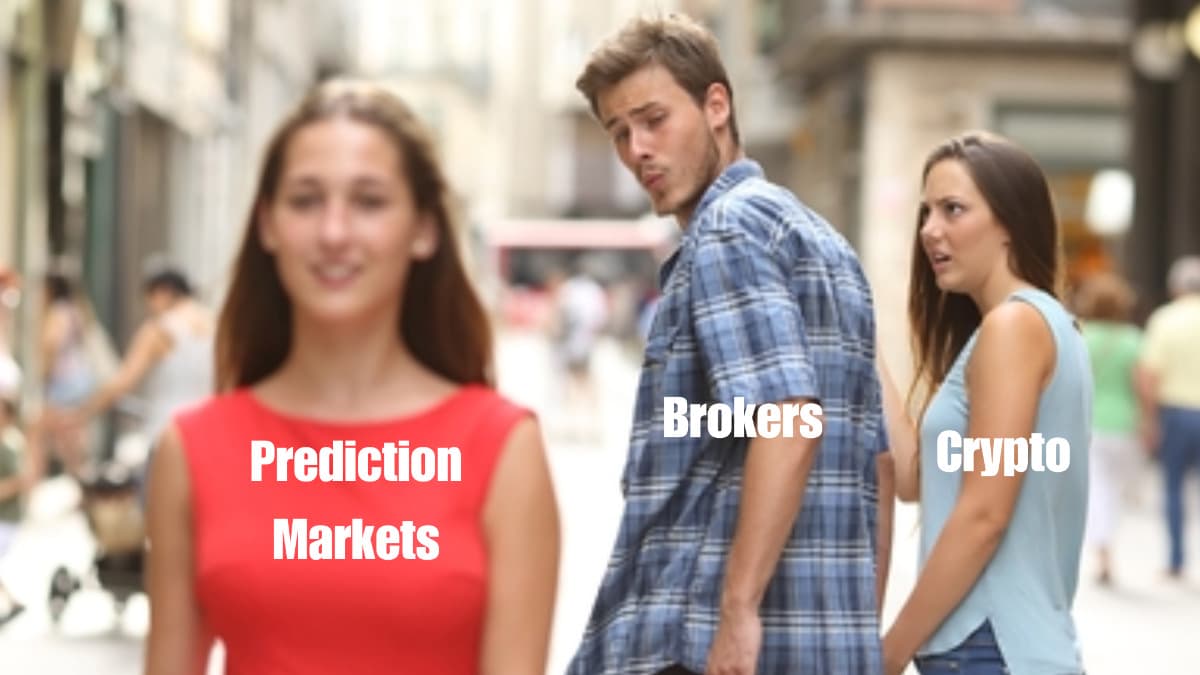
The Lowdown - newsletter. Something significant is happening in financial markets right now. Prediction markets are the new shiny object, and they are definitely now an institutional asset class. In the same way that brokers scrambled to add crypto to their offering a few years ago, the smartest operators in our space are already asking how they access prediction markets.
n in-depth review of TMGM (TradeMax Global Markets), the ASIC-regulated ECN broker offering raw spreads from 0.0 pips, MT4 and MT5, copy trading via HUBx and ZuluTrade, and 24/7 multilingual support across four regulated jurisdictions. Find out if TMGM belongs on your shortlist.
LiquidityFinder's Sam Low sits down with Nathan Sage, founder and CEO of Sage Capital Management, to trace his journey from FX fund manager to running a Bitcoin fund doing $1BN a day in 2016 — and how that experience of pain built one of the most connected prime brokerages in the digital assets market today.
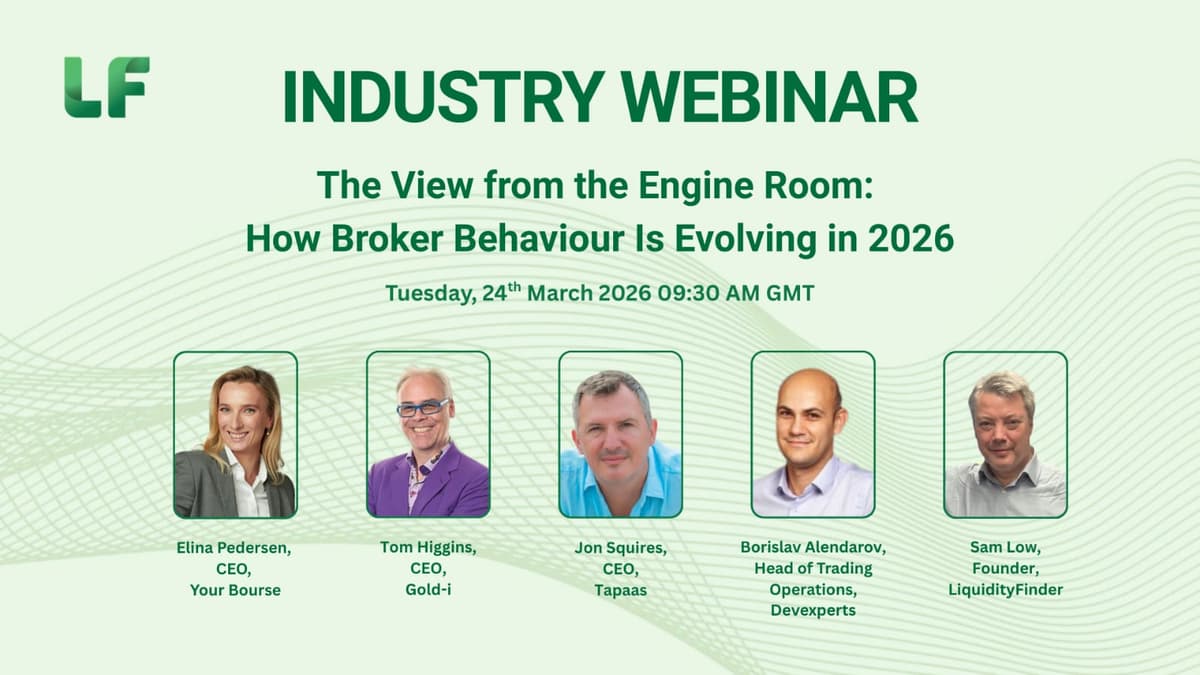
Gold at record highs, oil as a meme stock, and crypto exchanges eyeing your clients. Watch our expert panel - Gold-i, Your Bourse, Tapaas and Devexperts - discuss broker risk management, , AI trading and the MetaTrader debate.

Over a long tapas lunch in Shoreditch, London, Sam Low sits down with Peter Brooks and Jess Reed from ADMISI eFX, the dedicated electronic FX desk operating inside one of the world's largest agricultural commodities companies. What emerges is a compelling case for why this largely unknown operation deserves serious attention from brokers, payments firms, corporate treasuries, and digital asset companies alike.
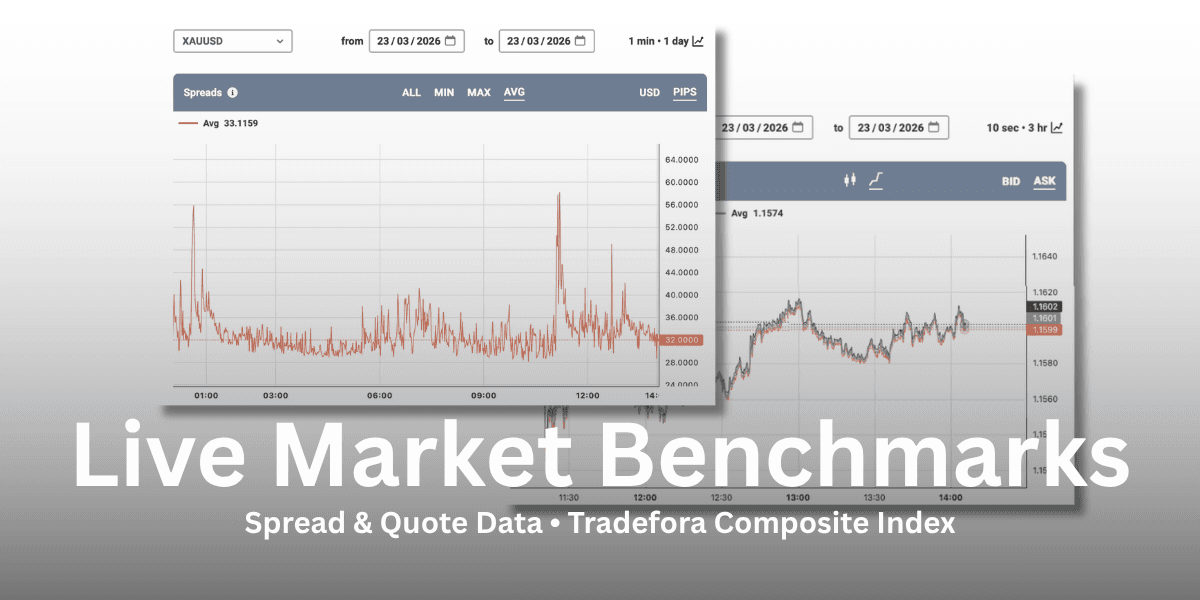
Explore live spread and quote benchmarks powered by the Tradefora Composite Index (TCI), an independent dataset aggregated from multiple FX and CFD brokers. View average, minimum and maximum spreads by instrument and timeframe, plus composite bid/ask quote data updated continuously at millisecond precision.
Create Your FREE Account
Get access to latest news, updates, real-time data, brokerage and trading firm insights and customized information feeds.


Theorem has integrated Symbiotic’s Liquid Lane RFQ network, letting holders of tokenised real-world assets trade against on-chain pool liquidity and market-maker quotes. The integration is live on Ethereum, with Midas’s yield-bearing mHYPER fund as the first supported asset. Holders can trade for the USDC stablecoin.


US equities were volatile with technology selloff erasing much of the earlier rebound.

FM Summit London 2026 returns to Old Billingsgate on 24 November for its 15th edition, with LMAX Group, Plus500 and oneZero among confirmed exhibitors. The one-day event adds Business Connect meetings and roundtables, and opens with a networking evening at The Folly on 23 November.

Finance Magnates Summit London returns to Old Billingsgate on 24 November 2026 for its 15th edition. The one-day event brings together brokers, liquidity providers, institutional firms, trading technology vendors, payments businesses and digital asset firms.


iSAM Securities Apex has integrated with Match-Prime, giving brokers access to liquidity across more than 2,000 instruments, with tailored pricing and up to 10 levels of market depth.

propfunding.com's free-entry instant funding changes the order of prop funding. Start trading first. Its free-entry instant funding model offers two qualification attempts without an upfront activation fee.

US stocks closed higher on Wednesday, with the Nasdaq gaining 1%, the S&P 500 rising 0.6%, and the Dow advancing 0.7%, as renewed enthusiasm for AI-related stocks lifted market sentiment.


SpaceX went public in June as a rocket company. On October 20 it reported as something else entirely: an AI infrastructure business, financed by a satellite broadband network, with a launch division attached. Rockets generated 12% of third quarter revenue and lost money. The AI segment generated 52% of revenue and consumed 84% of capital expenditure. Starlink generated 85% of operating profit.

Standard Chartered has signed definitive agreements to acquire 100% of Zodia Custody UK Limited, folding its regulated digital asset custody business into Securities Services. Zodia Solutions will be set up under SC Ventures with bank investors including Northern Trust, NAB Ventures, Emirates NBD and Investcorp.

Bybit Fintech FZE has secured a Virtual Asset Service Provider licence from Dubai’s Virtual Assets Regulatory Authority for Exchange Services, covering spot trading. Bybit’s Peter Loo said the firm hopes to add derivatives, subject to regulatory approvals. Its international Dubai headquarters opened in 2022.
Feed