
Search Companies, News, Members & more
Terms of ServicePrivacy PolicySecurity PolicyLegal InformationCommunity GuidelinesSitemapsCookie Settings
2026 Copyright © Liquidity Finder Ltd. All rights reserved.
Liquidity Finder Ltd is incorporated in England and Wales, company number 10610740, registered address 167-169 Great Portland Street, Fifth Floor, London W1W 5PF, United Kingdom.
edgeful Review for Futures & Prop Firm Traders: 150+ Reports and a Daily Process

Published on Oct 4, 2026
Updated on Oct 13, 2026
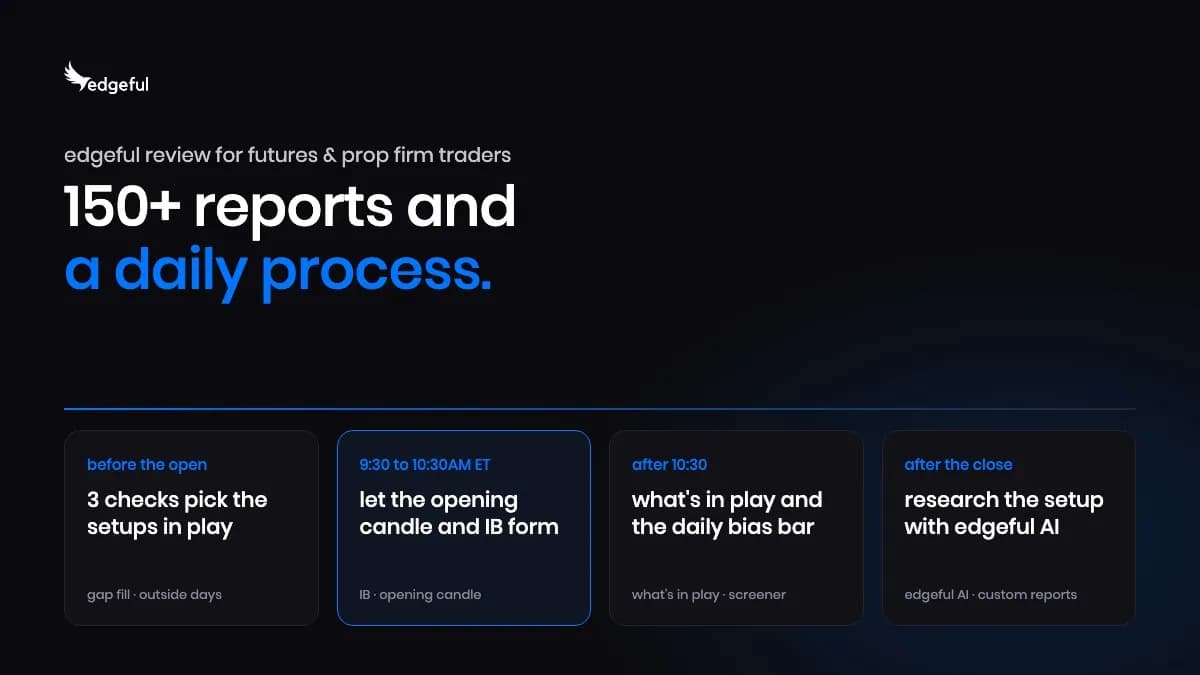
What edgeful actually is:
edgeful is a library of 150+ reports built on historical price data. Each report answers one question about one setup: how often a gap fills, how often the initial balance breaks on only one side, or how far price moves past the opening range before it turns.
The reports are day trading statistics in the most literal sense. Pick a ticker, a session (NY, London, Asian, the full Globex day, or a custom window), and a date range, and the report shows how often the setup happened and how it ended. The default lookback is 6 months, and the platform recommends it for most decisions, because older data covers market environments that may not look like the current one.
Futures come first (NQ, ES, YM, RTY, GC, CL and more), with stocks, ETFs, forex, and crypto also covered. Most reports have subreports that split the same data a different way: by weekday, by size, by spike (how far price moves against the trade before it turns), and by retracement. The IB and ORB reports also have a "by levels" subreport for extension targets.
Every report page also has a detail table with the individual days behind the percentages, so a trader can check any number against their own charts.
Before the open: the 3 context checks
A daily process on edgeful starts with 3 context checks. Each one points to a different report:
• Is price inside or outside yesterday's range? Inside puts the inside bars report in play. Outside above or below puts the outside days report in play.
• Is price above or below yesterday's close? Either way, there is a gap, and the gap fill report is in play.
• Is price above or below the midnight open? That points to the ICT opening retracement report.
When all 3 point in the same direction, the setups line up, and edgeful teaches that combination as its "ultimate reversal setup."
The gap fill report shows why the subreports matter. Over the 6 months from March 25 to September 24, 2026, in the NY session, NQ gaps smaller than 0.4% of price filled all the way 52 of 56 times (92.9%). Gaps of 0.4% or bigger filled 20 of 75 times (26.7%). Both groups count as gaps in the standard report, and the by-size subreport is what splits them.
The target on a gap fill is the fill level itself, the previous session's close, and the report can be set to half gaps for traders who take partial fills. For a longer walkthrough of how traders build futures trading strategies around gaps, edgeful's own guide on trading gap fills covers the setup step by step.
The first hour: let the data build
The process edgeful teaches does not trade the open. The first hour of the NY session (9:30 to 10:30AM ET) is when the opening candle and the initial balance form, and several of the most used reports depend on how that hour finishes.
.webp)
edgeful's initial balance breakout report, NQ, NY session, March 30 to September 29, 2026.
The initial balance report is a good example. Over the last 6 months (March 27 to September 25, 2026), in the NY session, NQ broke only one side of its first-hour range on 99 of 130 days (76.2%). Both sides broke on 23 days, and neither side broke on 8. For day trading futures, that is the number to plan around: on 99 of those 130 days, once one side of the IB broke, the other side held for the rest of the session.
What's in play goes live at 9:30AM ET, when the session opens. From then on, every report shows the live values for today: the current gap and its distance to the fill level, the IB high and low, which side has broken, the opening candle's color, and the targets. Setups that are no longer in play (a gap that already filled, an IB that already broke on both sides) drop off on their own.
After 10:30: what's in play and the screener
Once the first hour closes, 2 tools do most of the work.
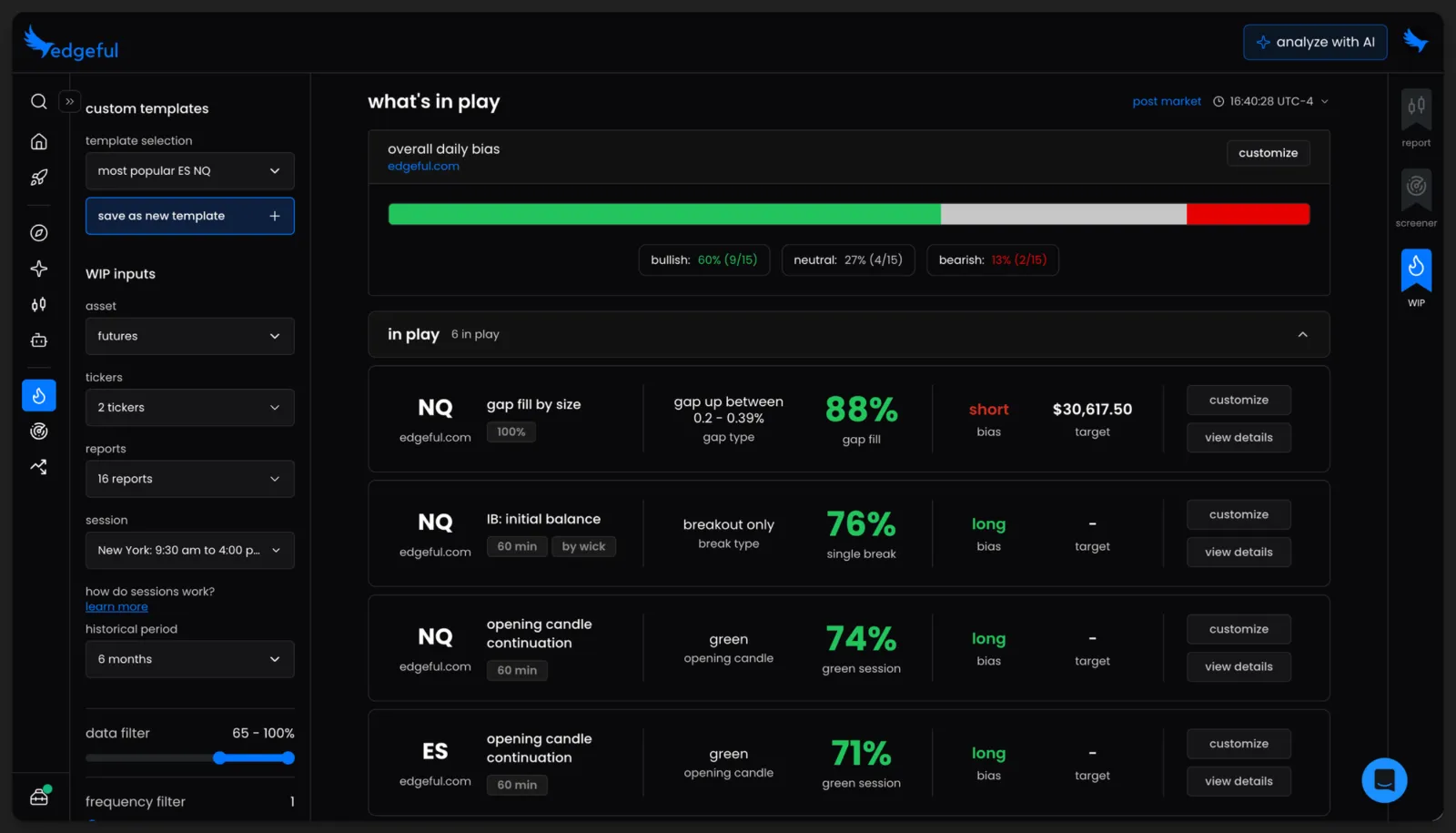
edgeful's what's in play dashboard with the overall daily bias bar, NQ and ES, September 30, 2026.
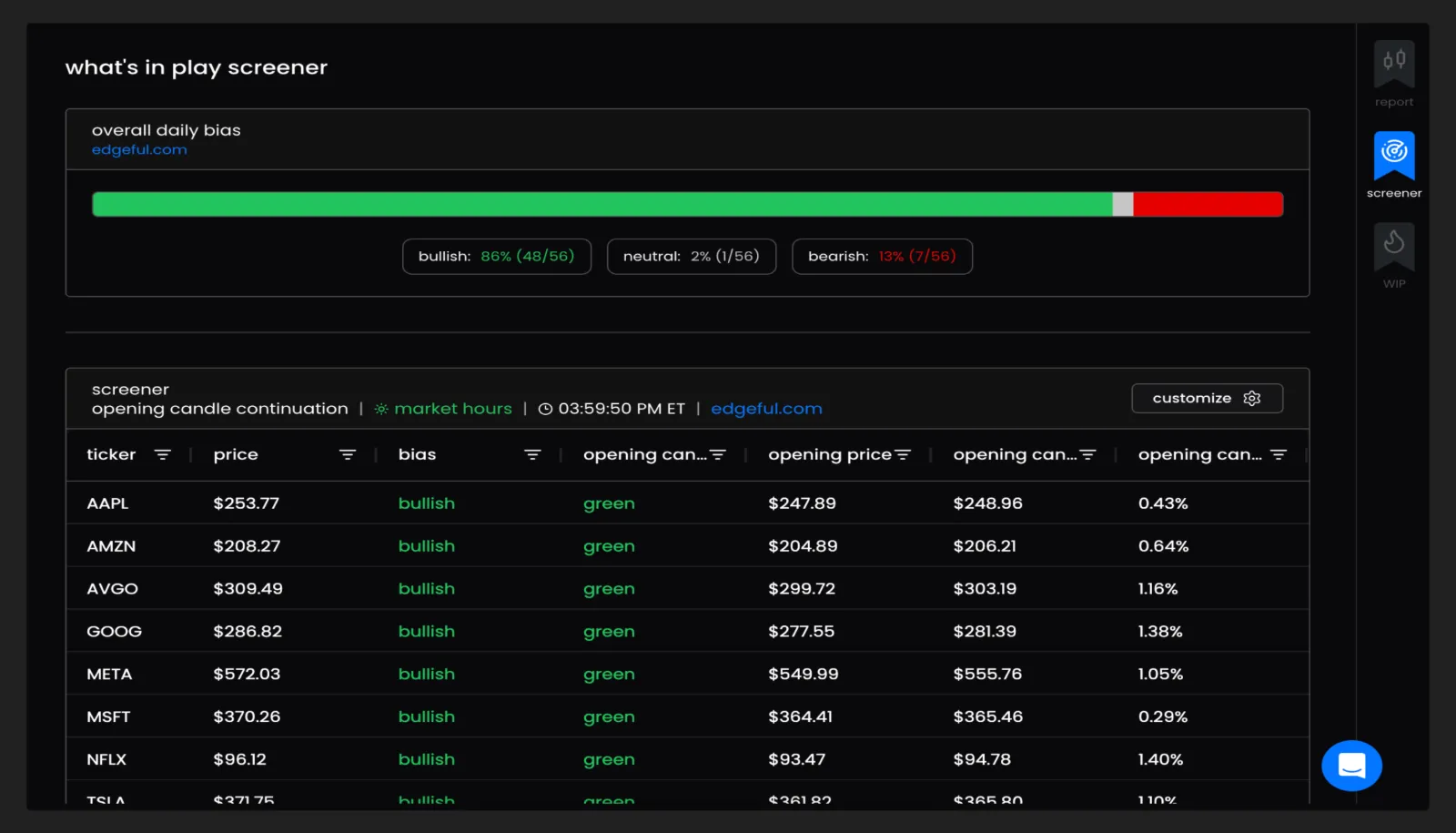
edgeful's what's in play screener with the overall daily bias bar, March 31, 2026.
The what's in play dashboard puts every report a trader follows on one page for one ticker. Each card shows the bias, the relevant level, the target, and the distance to it, with a link to the full report. Switching tickers in the watchlist bar changes every card at once.
The screener runs the same idea across many tickers. It holds up to 49 tickers and 4 reports at a time, with templates for the morning, the daily bias, and the end of the day. At the top sits the daily bias bar, which combines the bullish and bearish readings from every ticker and report into one bar. When about 65% or more of it is one color, the data favors that direction. When it is mixed, the platform's guidance is to sit out or trade smaller.
That last rule matters on a futures prop firm account, where a daily loss limit caps how much can be lost in one session. The bias bar gives the trader a rule for taking fewer trades on mixed days, set before any position is open.
On the chart: TradingView indicators
Every edgeful plan includes 50+ invite-only TradingView indicators (NinjaTrader users get 12+). They plot the report levels directly on the chart: the IB high, low, and extensions, the opening range and its midlines, the previous session's close as the gap fill level, the midnight open, session boxes for Asia, London, and New York, and more.
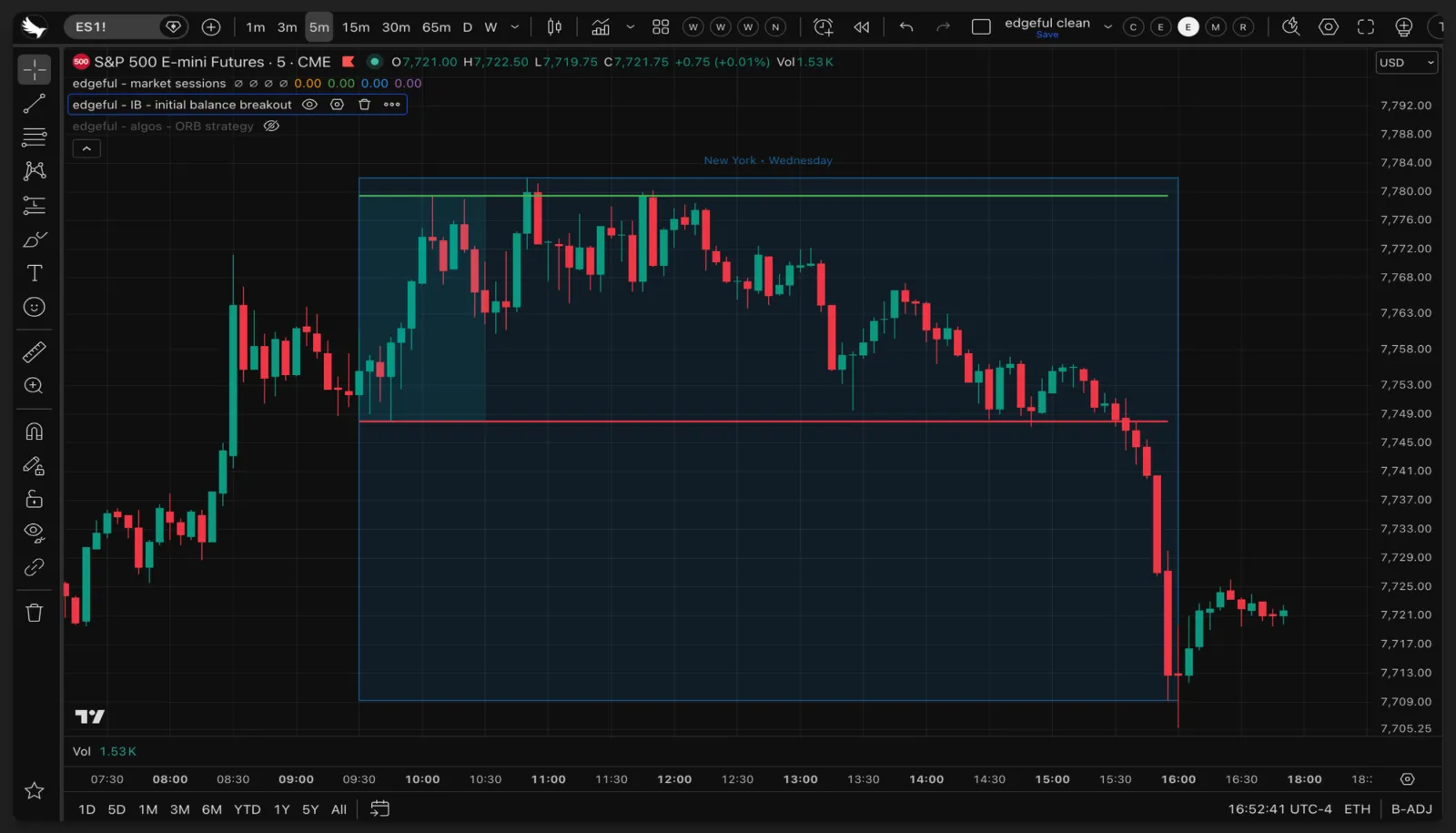
edgeful's market sessions and IB indicators on TradingView, ES 5-minute, September 30, 2026.
For traders comparing the best indicators for futures trading, the difference here is that each indicator is paired with a report, so the level on the chart comes with a number for how often price has reached it. edgeful's round-up of its top TradingView indicators for futures trading walks through 5 of them.
One practical note: edgeful and TradingView are separate. Changing the session or IB timeframe in edgeful does not change the indicator, so traders have to match the settings by hand on both sides.
After the session: edgeful AI
edgeful AI is trained on 8+ years of verified market data, and analyzes all of edgeful's 150+ reports in real time. A trader asks a question in plain language and it finds the reports it needs to answer. Questions like "look at the days the NQ gap didn't fill and find what they have in common" or "which weekday has the most double breaks on the IB" get an answer built from the raw data.
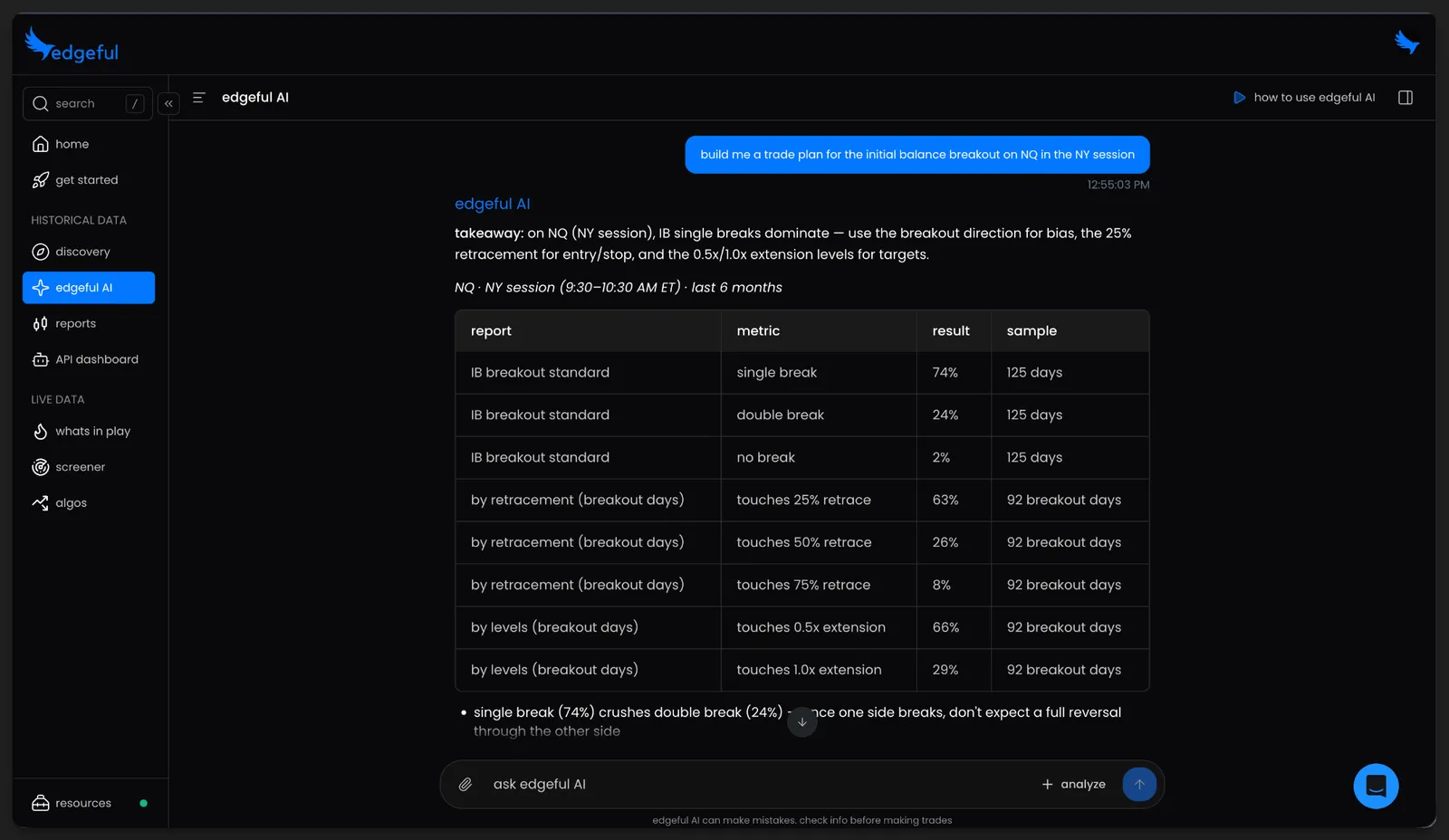
edgeful AI answering a question about the initial balance breakout on NQ in the NY session, last 6 months (September 22, 2026).
edgeful positions it as a research tool for after the session, not part of the morning prep. The morning checks happen on what's in play and the screener, and the AI handles the longer questions, like comparing every day a setup failed.
The newer part is the custom report builder, live since August 2026 inside edgeful AI. When the setup a trader wants to check isn't one of the 150+ reports, they describe it in plain words ("how often is the low of the day set between 11:00 and 11:15AM on ES"). Before saving, the builder shows the methodology, the customization options, and a sample results table, and the trader approves it or asks for fixes. The finished report can be saved and rerun later.
Automated futures trading on a prop account
The algos sit on the all access plan. edgeful has 3 foundational strategies (ORB, IB, and engulfing candles) and 7 automated algos built on them, including versions with 2 profit targets and breakeven stops. They run as TradingView strategies with every input editable, and no code is needed.
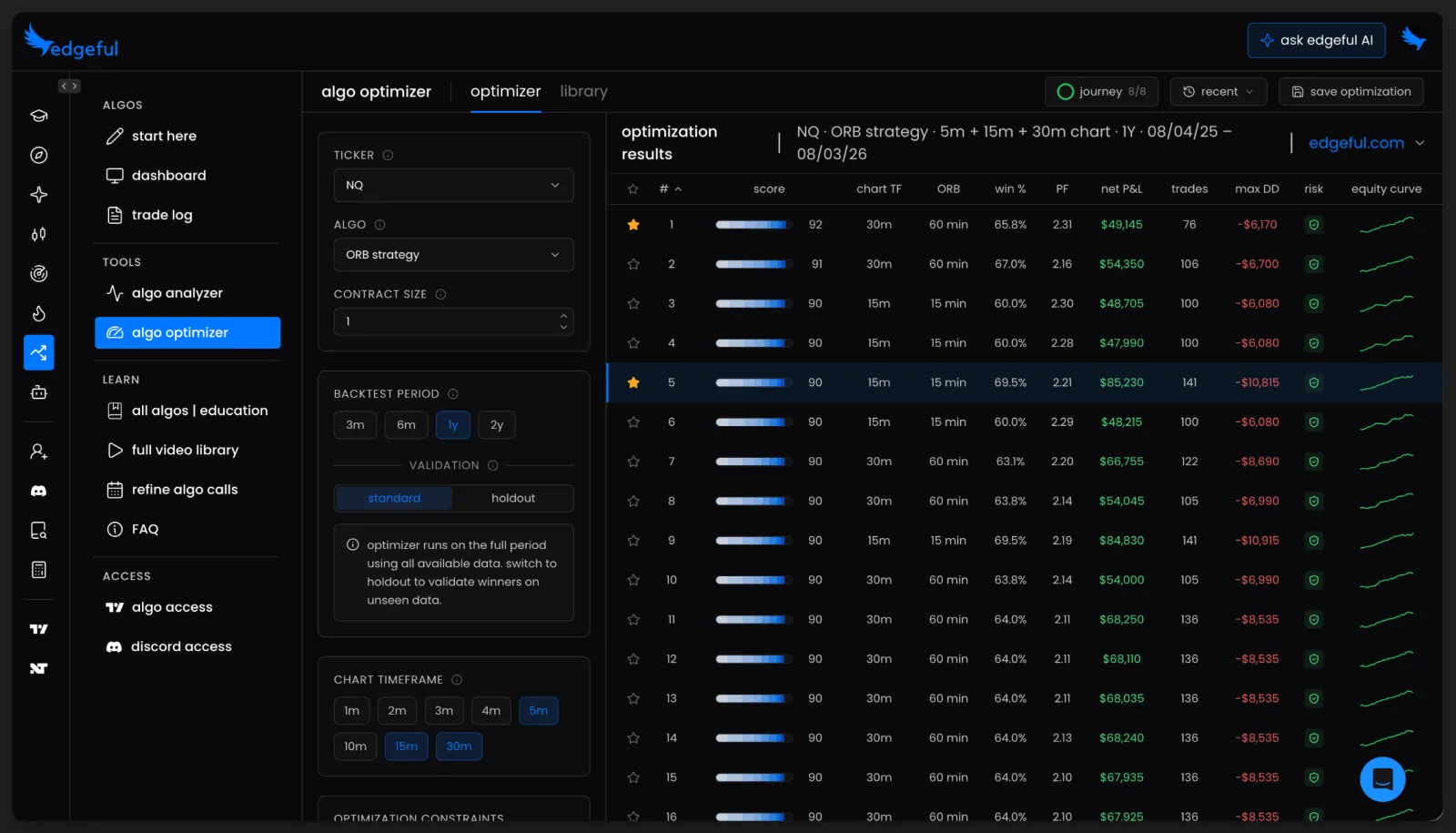
edgeful's algo optimizer ranking ORB strategy settings on NQ. Backtest results, August 4, 2025 to August 3, 2026.
3 tools support them:
• The optimizer tests parameter combinations of one algo, up to 10M of them, and can set different settings for each weekday inside one strategy. Its scoring marks results that look overfit.
• The analyzer takes a TradingView backtest export and breaks it down: equity curve, weekday results, streaks, and Monte Carlo runs on the actual trades.
• The prop firm simulator inside the analyzer runs those trades against an account's rules. Traders can enter their own account size, drawdown type, daily loss limit, and consistency rule, and see where the rules would have stopped the account.
For execution, edgeful connects to Tradovate, NinjaTrader, and ProjectX, which covers many prop firm accounts. Entries and targets can be market or limit orders, and stops always go in as market orders.
The algos execute a fully customizable strategy, built on the foundational setups covered above. egeful also provides algo templates, which are the top optimizer runs, and easy setup using the algos Chrome Extension. edgeful includes monthly algo optimization calls and a video library for further setup and assistance. The edgeful guide to automated trading strategies goes deeper on how the algos are built and tested.
Pricing
edgeful has 3 plans:
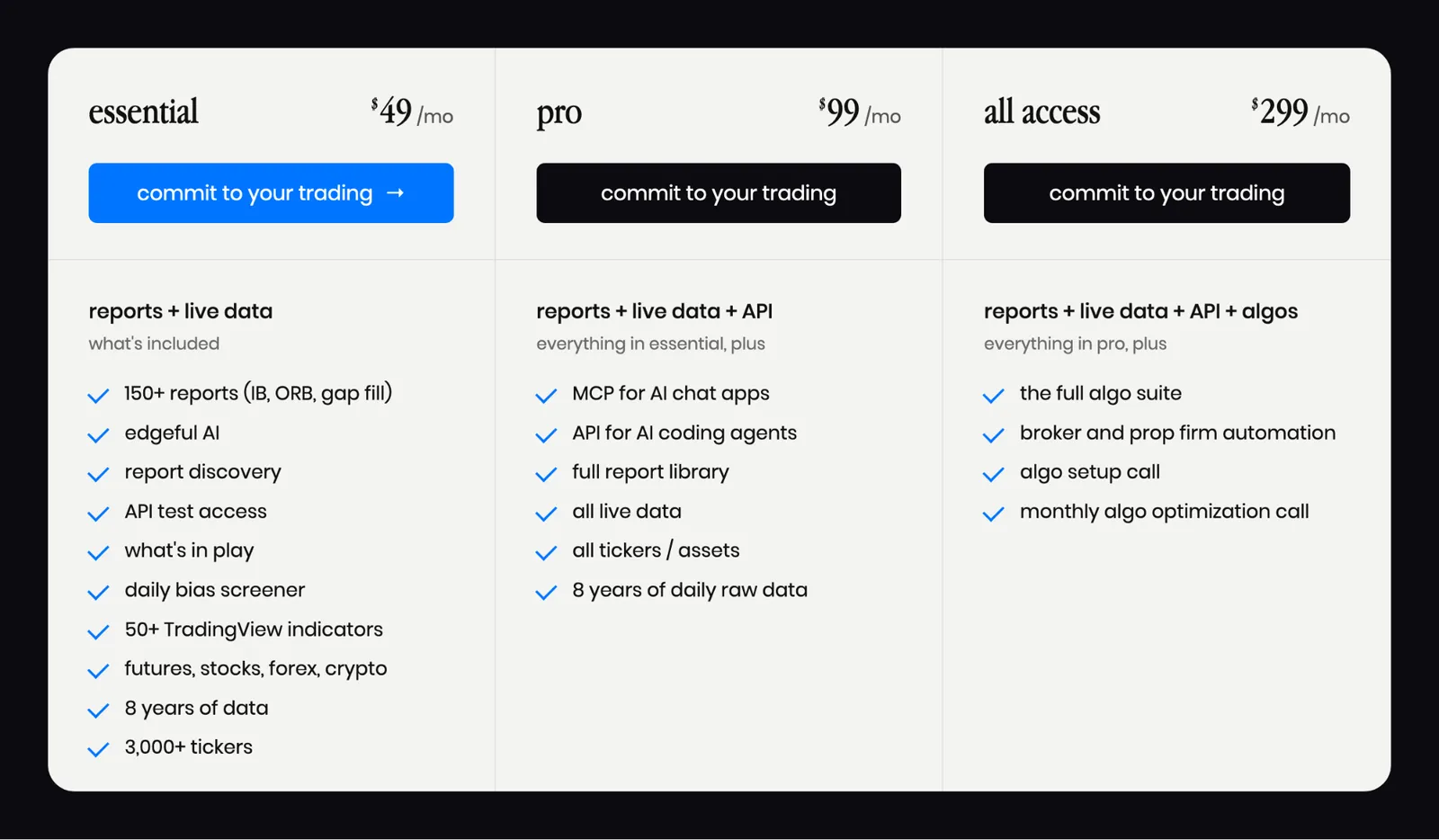
edgeful's 3 plans, from edgeful.com, September 2026.
• essential: $49 a month, or $399 a year. All 150+ reports, the what's in play dashboard, the daily bias screener, 50+ TradingView indicators, edgeful AI, and the Discord community. It also includes limited API access: 4 tickers, 3 reports, and 6 months of history.
• pro: $99 a month. Everything in essential, plus full API access: every report and ticker, live data, and 8 years of history. It is available as an in-app upgrade.
• all access: $299 a month, or $2,399 a year. Everything in pro, plus the 7 algos, the optimizer, the analyzer, and broker automation.
Pro is the plan for traders who want to work with the data outside the dashboard, and especially for traders bringing more AI into their process. The edgeful MCP connector, live since August 2026, lets AI assistants like Claude and ChatGPT pull edgeful data straight into a chat. A trader can ask their assistant about the tickers and setups they trade and get answers built from edgeful's numbers.
Who it's for
edgeful fits futures traders and prop firm traders who want set rules for which setups to take, when to take them, and when to stay out. Once the reports and a screener template are set up, the daily checks take a few minutes.
It also fits traders who already have a setup and want to check it. Between the 150+ reports and the custom report builder, most "how often does this happen" questions have an answer.
It is a weaker fit for traders who want someone else to call their trades. edgeful shows what has happened in the past and how often. It does not tell anyone what to buy or sell, and every decision stays with the trader.
FAQ
Is edgeful worth it for prop firm traders?
For a prop firm trader who wants a fixed daily process, the screener's mixed-bias rule and the analyzer's prop firm simulator are built around the limits a prop account has: a daily loss limit, a drawdown, and a consistency rule. The algos still need customization, time, and testing before they run on an account.
What markets does edgeful cover?
Futures are the main focus, including NQ, ES, YM, RTY, GC, and CL. Stocks, ETFs, forex, and crypto are covered too. Reports can be filtered by the NY, London, and Asian sessions, the full Globex day, or a custom session.
Does edgeful work with TradingView?
Yes. Every plan includes 50+ invite-only TradingView indicators that plot report levels on the chart, and the algos run as TradingView strategies. The two platforms are not linked, so session and timeframe settings have to be matched by hand.
Can edgeful algos run on a prop firm account?
Yes. The algos can execute through ProjectX, which covers many prop firm accounts, as well as Tradovate and NinjaTrader. The prop firm simulator lets traders test a backtest against their own account rules before running it live.
How far back does edgeful's data go?
The reports default to a 6-month lookback, and longer ranges are available. On the API, essential includes 6 months of history, and pro and all access include 8 years.
Share this article

Comments
Most Recent
Find The Right Partners for
Your Trading Business
Sign up and join over 5,000 professional members who receive personalized news alerts, curated professional connections, and more for free!
The Bloomberg Terminal has long been the reference standard for institutional market intelligence, but its $25,000-plus price tag puts it out of reach for most independent professionals. This article looks at seven platforms challenging that dominance in 2026, from AI-native tools like IUX24 to established names such as TradingView, Koyfin and AlphaSense, and asks how close they really come to replacing the Terminal.

LiquidityFinder's Sam Low sits down with Maria Pittashi, General Manager of Cyprus-based broker technology firm PLUGIT, to discuss its modular YOONIT platform, the Dynamic Margin tool brokers ask for by name, fixed-fee versus volume-based pricing, the hidden cost of manual KYC, and the AI features coming next.
Brent Xu left Wall Street for blockchain in Ethereum's earliest days. Now his Franklin Templeton and Galaxy Digital backed platform Dora is bringing fractionalised bond trading to retail brokers. He speaks to Sam Low.

In 2026, ready-made infrastructure is beating custom development on speed, cost and compliance. Learn when to build vs buy—and where CTOs lose time and budget.
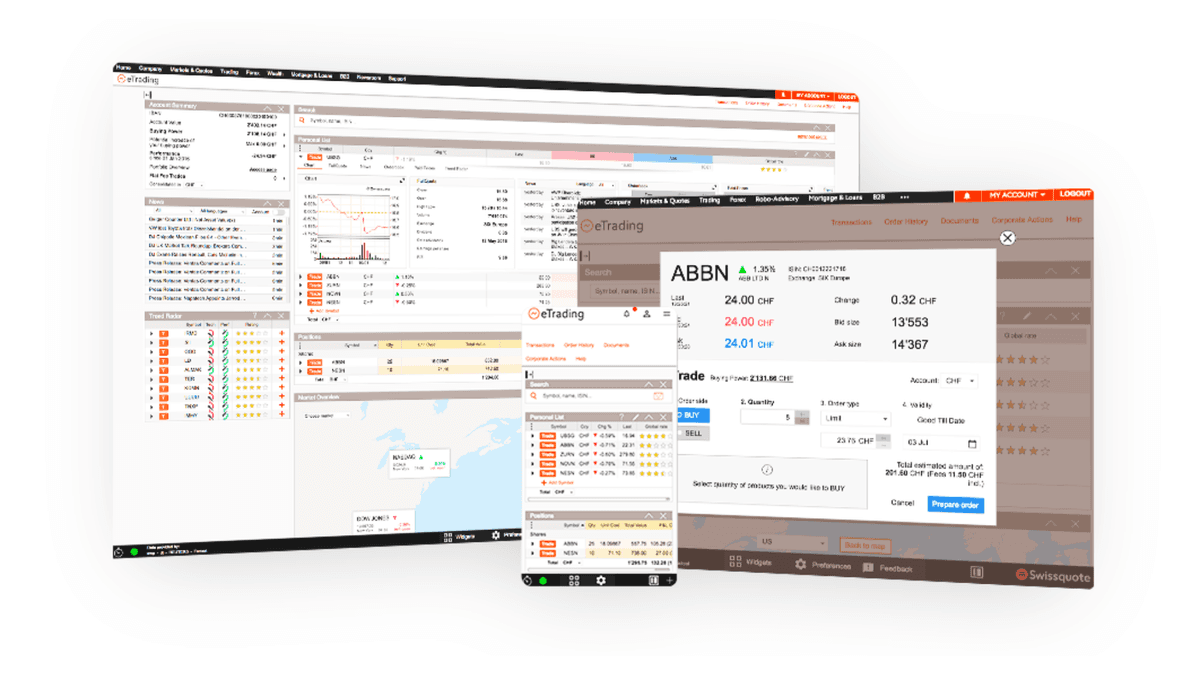
A complete comparison of MT4, MT5, cTrader, and modern proprietary trading platforms.
From machine learning-driven execution to predictive market analytics, we break down the AI tools that institutional and quantitative traders are using to gain an edge.
Artificial Intelligence (AI) has revolutionized the trading world, opening up unprecedented levels of efficiency, accuracy, and speed in financial markets. By 2025, AI will handle almost 89% of the world's trading volume—changing everything from high-frequency equity trading to decentralized crypto ecosystems. This guide explores how AI trading platforms leverage advanced algorithms, machine learning, neural networks, and real-time data analysis to automate trade, reduce human error, and execute trades at a record rate.
Gain insight into cTrader, a leading ECN trading platform. Explore its features and advantages with comparison to the established MetaTrader, helping you to choose the ideal platform for your trading needs.
Create Your FREE Account
Get access to latest news, updates, real-time data, brokerage and trading firm insights and customized information feeds.


ICM MENA has promoted Ahmed Kamal to Chief Executive Officer. Kamal joined the firm in March 2019 as Business Development Manager and most recently served as Regional Manager. He brings more than a decade of experience in financial markets, with expertise in foreign exchange, business development and team leadership.

Theorem has integrated Symbiotic’s Liquid Lane RFQ network, letting holders of tokenised real-world assets trade against on-chain pool liquidity and market-maker quotes. The integration is live on Ethereum, with Midas’s yield-bearing mHYPER fund as the first supported asset. Holders can trade for the USDC stablecoin.


US equities were volatile with technology selloff erasing much of the earlier rebound.

FM Summit London 2026 returns to Old Billingsgate on 24 November for its 15th edition, with LMAX Group, Plus500 and oneZero among confirmed exhibitors. The one-day event adds Business Connect meetings and roundtables, and opens with a networking evening at The Folly on 23 November.

Finance Magnates Summit London returns to Old Billingsgate on 24 November 2026 for its 15th edition. The one-day event brings together brokers, liquidity providers, institutional firms, trading technology vendors, payments businesses and digital asset firms.


iSAM Securities Apex has integrated with Match-Prime, giving brokers access to liquidity across more than 2,000 instruments, with tailored pricing and up to 10 levels of market depth.

propfunding.com's free-entry instant funding changes the order of prop funding. Start trading first. Its free-entry instant funding model offers two qualification attempts without an upfront activation fee.

US stocks closed higher on Wednesday, with the Nasdaq gaining 1%, the S&P 500 rising 0.6%, and the Dow advancing 0.7%, as renewed enthusiasm for AI-related stocks lifted market sentiment.


SpaceX went public in June as a rocket company. On October 20 it reported as something else entirely: an AI infrastructure business, financed by a satellite broadband network, with a launch division attached. Rockets generated 12% of third quarter revenue and lost money. The AI segment generated 52% of revenue and consumed 84% of capital expenditure. Starlink generated 85% of operating profit.
Standard Chartered has signed definitive agreements to acquire 100% of Zodia Custody UK Limited, folding its regulated digital asset custody business into Securities Services. Zodia Solutions will be set up under SC Ventures with bank investors including Northern Trust, NAB Ventures, Emirates NBD and Investcorp.
Feed