
Search Companies, News, Members & more
Terms of ServicePrivacy PolicySecurity PolicyLegal InformationCommunity GuidelinesSitemapsCookie Settings
2026 Copyright © Liquidity Finder Ltd. All rights reserved.
Liquidity Finder Ltd is incorporated in England and Wales, company number 10610740, registered address 167-169 Great Portland Street, Fifth Floor, London W1W 5PF, United Kingdom.
DORA - The Platform That Wants to Make Everyone a Bond Trader

Published on Jun 10, 2026
Updated on Jul 22, 2026
Everyone in the world can be a bond Trader. They just don't know it yet
Sam Low ( @SamLow ) speaks with Brent Xu (@BrentXu ) Founder and CEO of fixed income trading platform DORA ( @dora ), about fractionalised bond trading, the fixed income opportunity for retail brokers, and what happens when you remove middlemen out of the repo market.
Fixed income is one of the largest markets in global capital markets, and yet it remains almost entirely closed to retail traders. Minimum ticket sizes, institutional-only venues and opaque pricing have kept bond trading the preserve of banks, asset managers and a small club of professional desks. Brent Xu is about to change all of that.
Xu spent 15 years in fixed income, classically trained on a corporate bond trading desk, before becoming one of the first bond traders to leave Wall Street for the blockchain space. He followed Vitalik Buterin around the world during the launch of Ethereum, then joined Joe Lubin as one of the first 20 employees at ConsenSys. His company, DORA, applies tokenisation and algorithmic repo to the bond market, allowing retail brokers to offer fractionalised bond trading to clients with as little as five dollars in their account.
I caught up with Brent as he arrived in Cyprus ahead of iFX EXPO to talk about how the platform works, the commercial model for brokers, and the institutional capital sitting behind it.
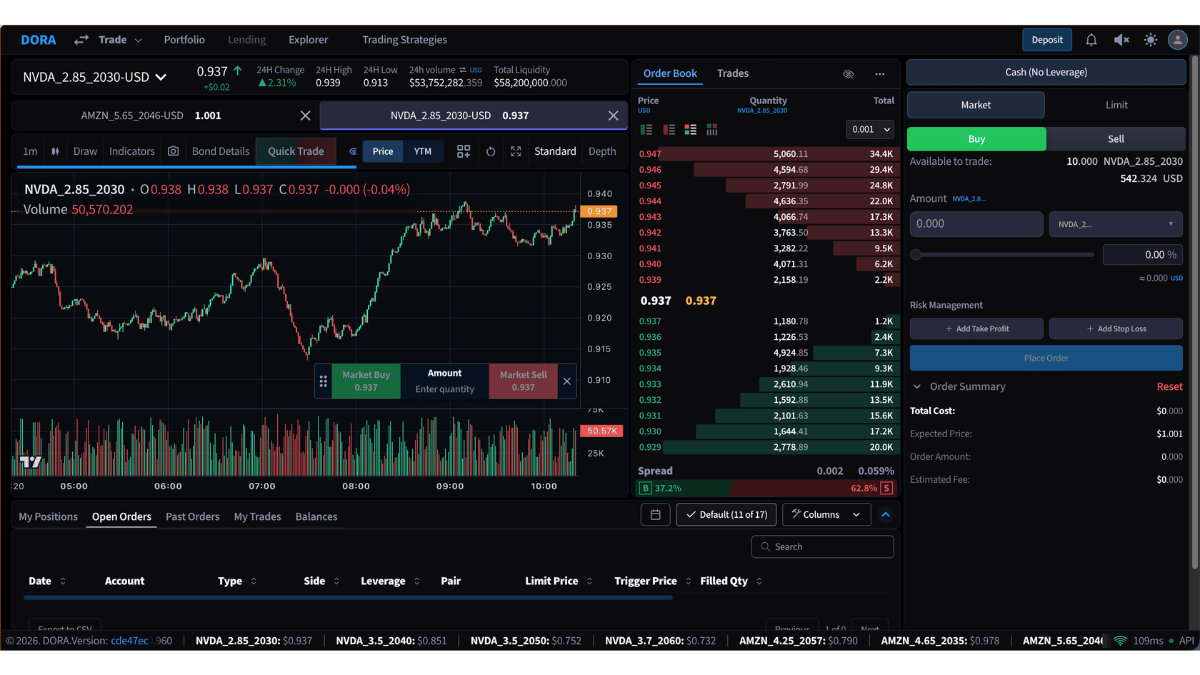
DORA Fixed Income trading platform GUI, showing pricing for an NVIDIA bond
Sam Low: Brent, we're here to talk about DORA. It's a fixed income trading platform which you're looking to offer into retail brokers.
Brent Xu: That's correct. It's called DORA, and yes, that's exactly right.
SL: This fills a gap, because retail brokers on the whole don't have fixed income capabilities at the moment, and everybody is looking for the new shiny thing to add to out-compete their competitors. People don't trade fixed income because they don't know how to, or don't have access. We get enquiries from people who want to trade fixed income and it's always a bit of a head scratcher, because it's not obvious where they can go to do it. So let me start with a practical question. I saw corporate bonds on your platform. If somebody clicks on a bond and presses the buy button, what happens in the background?
BX: Every bond that's purchased is backed by an actual bond in the real world. The way it works is that we have liquidity providers, and these liquidity providers are bondholders. Traditional bondholders, or anyone who holds bonds, put their bonds on DORA using DORA's tokenisation and pricing algorithm. The bonds are added to the platform and chopped up into small, tiny pieces.
These liquidity providers are essentially users that hold principal risk in the bond. They use the DORA algorithm to pass the economics of each bond to retail brokerages, and the brokerages act as either agents or riskless principals. They're essentially a pass-through of the economics of the bond to their retail customers. There's no internalised risk, it's a pure pass-through. Through that mechanism, the retail trader is able to hold the bond as if they're a Wall Street bond trader, but in one cent pieces.
The way we track everything is with an explorer. Every trade, every coupon payment, every piece of accrued interest, everything about the bond is recorded in our explorer, so you can always verify the authenticity of every trade and the transparency of what occurs on the system. Everything that occurs on DORA is a delivery versus payment-like mechanism. I say delivery versus payment-like because we can't do full delivery versus payment of a one cent piece of a bond yet, so for ease of use we're doing cash settlement, which makes it much easier for existing brokerage counterparts. But in the background, it's a system where the bond inventory of any bondholder can be fractionalised, tokenised and chopped up so that retail can trade it easily.
SL: Most retail brokers use one of a few platforms, the most popular being MetaTrader 5. Is there any integration to MT5, or would people have to use your front end?
BX: That's a great question. We've spoken to multiple people at MetaQuotes, and this is under discussion. So we're integrating with one of the bridge providers, and speaking to others. They've been very good and given us a lot of solid advice. And just as a note, Liquidity Finder's name has popped up multiple times in those conversations.
An MT5 integration is something we could do, and it is under discussion. However, deployment for any retail broker is very low-touch. They add a button to their site/client trading area which then pops open their branded version of the DORA trading GUI.
SL: So is the idea that most brokers would white label the platform?
BX: Correct. The easiest thing to do is to white label the platform and add our API. Our API is very flexible and gives you a one-click deployment.
SL: Are you from a fixed income trading background originally?
BX: Yes, I am. I have roughly 15 years of fixed income experience and I was classically trained on a bond trading desk in my early days. My background is somewhat unique in that I was one of the first bond traders, if not the first corporate bond trader, to leave Wall Street and join the blockchain space. My first journey in blockchain was following Vitalik Buterin around the world as he promoted Ethereum during its launch. Later, I joined Joe Lubin, the co-founder of Ethereum, as one of his first 20 employees building out ConsenSys.
Basically, I took all the maths, all the algorithms, all the tokenisation, only the best parts of blockchain, and applied it directly to the bond markets. That's why we're able to do what we do and nobody else can at the moment. We had the foresight to take the good parts of blockchain, leave the parts that aren't useful, and build a system that is fast, efficient and makes things easy for anyone who wants to trade bonds.
The Supply Side
SL: It's good to come across an example of somebody using blockchain creatively to disrupt a market. I'm a bit of a crypto sceptic in terms of Bitcoin and meme coins, where I don't see the utility. But I get the utility of stablecoins, and I get the utility here. This is a classic example of blockchain being deployed to make a market more accessible and transparent. Tell me about the other side of the platform, the supply side.
BX: What you've seen so far is primarily our retail front end. What's special about the protocol is that while the front end is geared towards retail users, who can take 10x leverage and go long a bond, or take 20x leverage and go short, the real power of the platform is the back end where the bonds are coming from.
The bonds come from institutional bond investors. Anyone who holds lots of fixed income generally just holds the bonds on their balance sheet. What we do is offer them a way to hold the bond on the balance sheet, put it in our protocol, and receive significant yield enhancement. For example, if a user is holding a bond yielding 5% to maturity, our algorithm can give them an extra 5%, so a bond that's supposed to yield 5% instead produces an aggregate 10% blended total return.
This is possible because we cut out all the middlemen, which is traditional Wall Street, and replaced them with a tokenisation engine. All the economics are passed down directly to the bondholder. That's why our returns are higher than any other system that exists on Wall Street today, and we can mathematically prove it with the block explorer.
SL: How should a retail broker price this as a service to their clients? What kind of commission is expected? What's the commercial model for them?
BX: Fabulous question. I've done some research on FX trading and talked to people who've been in the industry 20 or 25 years. Back in the day, with every million traded, the revenue per million was five or six basis points, so $500 or $600 per million. These days it sounds like it's down to five or six dollars, with half going to your bridge provider, which shows the race to the bottom in fees.
With our platform, because we're first mover, you can conceivably charge what people charged 25 years ago in retail FX, five to six basis points. And if you use the fee model of a Charles Schwab, Interactive Brokers or Robinhood, they charge on stock trades anywhere from 50 to 75 basis points depending on jurisdiction. From our perspective, a retail brokerage that integrates this product could charge in the 10 to 20 basis point range using that same logic.
What becomes really powerful is that our platform is the spot market. We're creating a parallel market to Wall Street. While Wall Street trades round lots, we trade micro lots that have more volatility, and they trade around the Wall Street price. A lot of FX brokerages like to internalise risk and run B-book or hybrid A-book and B-book models. We allow that too. They can use the DORA market as their source of liquidity and the DORA price as the index for how they manage their hybrid book. Alternatively, if a brokerage wants to produce perpetual swaps, they can use DORA for that. We're a neutral party. Our job is to allow trading at all times, and however a broker wants to use our market, they can.
SL: Is your ideal client an A-book broker to start with, to keep things simple?
BX: We've had varying experiences. Some brokers only want to do A-book and adopt the platform on that basis. Others only do B-book, and they also want to integrate because they realise that if they integrate our spot market and simply reference it, they can immediately start B-booking as well. That's one of the reasons I'm in Cyprus. A lot of these players see the value, but they need a face and a name and a handshake to get really comfortable with it.
SL: Who is already live with you?
BX: One of our early supporters is Navion FX, a UAE Trading platform. They've integrated DORA with a one-click deployment, so you can have immediate bond trading from their site. Blackbox is a Portuguese brokerage backed by a billion-dollar asset management firm, Adler Investments, and they also have a one-click deployment. There's a new company called BondTrader.io. In total, we have around 10 to 12 platforms integrated or in the process of integrating. We are speaking with GCEX for example who are very interested in what we are doing.
SL: And it sounds genuinely easy to deploy. The broker doesn't need to do much beyond an API key?
BX: Absolutely. We're here to make it as easy as possible.
But I want to touch on another piece of the puzzle. Retail is half the equation. The other half is the institutions, and it's what sits behind us. Our two biggest investors are Franklin Templeton in the US and Galaxy Digital. We also have investment from Road Capital, a VC fund backed by Stan Druckenmiller, and from Further Ventures, a tech fund backed by ADQ in Abu Dhabi. Kevin Warsh, who used to work at Druckenmiller's family office has evaluated the platform and said he sees a future where bond trading could be powered by DORA. We took that as a very positive signal.
If I show you the lending side of the platform [Brent was giving me a demo of the GUI]: this is the Amazon 30-year bond. It earns 5.44% interest, and it can earn an additional 5.56% from lending it back to us, bringing the total aggregate yield to a little over 11%. And if you don't want to lend it to us, you can be part of the actual liquidity. Say you have $11 million of a bond. Deploy that in one go and you'll splash the market and cause violent movements. Instead, you can supply your bonds into DORA as liquidity. Our analysis section forecasts the additional yield.
SL: I recently wrote a piece on the fixed income trading landscape covering MTS, Tradeweb, RateStream ( @FXSpotStream ) and Ediphy ( @Ediphy ) . How do you see DORA sitting alongside the established bond platforms?
BX: I'm pretty familiar with Tradeweb, MarketAxess, Trumid and BrokerTec. I know these guys well. At Tradeweb, I know Chris Bruner, their chief product officer, and he's a fan of ours.
What I want to stress is that with all these other bond platforms, we're completely complementary, because no bond platform has the tokenisation algorithm that we do. If one of them provides their bond API to a customer, the first thing that customer will want is a second source of liquidity, or even exit liquidity. If a platform is connected to, say, Robinhood, eToro, Revolut or Public.com, and their customers are trading, what that platform would really want is for their customers to be able to exit through someone besides them, because if they always have to quote the bid, that's more work for them. We can be an extra source of liquidity, we can be their exit. It's no problem for us.
And the other thing is, I don't think those platforms are actively going after the pure retail market. They go after semi high net worth retail. We support anyone with five dollars in their pocket. It's a different value proposition.
SL: People have presumably told you fixed income is a niche product for retail?
BX: People have told us that in the past. But I've been having conversations with a lot of brokers, and the underlying message we're sharing is that everyone in the world can be a bond trader. They just don't know it yet. Bond trading is one of the largest markets in capital markets, and yet there are only a handful of bond traders in reality, because it's geared entirely to institutions. The minimum AUM for a bond hedge fund is a yard of capital. You can't get good execution with less than that. We want to make it so you can do it whether you have $10 in your pocket or $10 million in your private account.
SL: Brent, I really appreciate your time. I think what you're doing is very exciting, and it's always good to meet somebody doing something genuinely innovative. This is definitely that.
BX: The feeling is absolutely mutual, Sam. I appreciate everything you're doing and your foresight in seeing the market you're building and hammering away at it. It shows in your product.
Brent Xu is Founder and CEO of DORA. He was speaking with Sam Low, Founder and CEO of LiquidityFinder. Brent is in Cyprus next week for the iFX Expo and for a little time after. If you would like to arrange to meet Brent in Cyprus, or contact him any time after, you can contact Brent here: @BrentXu
_________________________
SL: Worth noting a recent post on LF from @SorenHaagensen (Former COO and CEO at Trading.com): https://liquidityfinder.com/post/trade-bonds-like-fx-intraday-leveraged-and-api-driven-Ec_w5S
Retail brokers are constantly looking for new ways to differentiate, deepen client engagement, and unlock additional revenue streams. One opportunity that remains largely underutilized? Leveraged bond trading.
Imagine trading bonds with the same speed, flexibility, and leverage as FX or commodities.
Traditionally viewed as a conservative asset class reserved for the institutional desks, bonds are now being reimagined for a more dynamic, yield-seeking retail audience. By offering leveraged access to fixed income markets, while allowing the asset class to be more programmable and tradable, brokers can empower clients to:
‣ Amplify yield opportunities in a low-to-moderate rate environment
‣ Take directional views on interest rates and macro trends
‣ Diversify beyond equities and crypto with sophisticated strategies
‣ Access institutional-style trading tools previously out of reach
For brokers, the upside is equally compelling:
‣ Increased trading volume and client activity
‣ Higher client retention through expanded product offerings
‣ Attraction of more advanced, high-value traders
‣ Stronger positioning as a full-spectrum investment platform
Of course, with leverage comes responsibility. Robust risk management tools, transparent margin requirements, and clear client education are critical to ensure sustainable growth and regulatory alignment.
The retail landscape is evolving fast—and clients are becoming more sophisticated. The question is no longer if brokers should expand beyond traditional offerings, but how quickly they can do it while maintaining trust, compliance, and performance.
Is your platform ready to meet the next wave of demand in fixed income trading?
Reach out to me if you want to know more.
Brent Xu is Founder and CEO of DORA. He was speaking with Sam Low, Founder and CEO of LiquidityFinder. Brent is in Cyprus next week for the iFX Expo and for a little time after. If you would like to arrange to meet Brent in Cyprus, or contact him any time after, you can contact Brent here: @BrentXu
Found this interesting? Become a member of LiquidityFinder, join the community and join the discussion - join here.
Share this article

Comments
Most Recent
Find The Right Partners for
Your Trading Business
Sign up and join over 5,000 professional members who receive personalized news alerts, curated professional connections, and more for free!
edgeful is a trading analytics platform with 150+ reports built on historical price data, covering futures such as NQ and ES. This guide explains its daily process, screener, TradingView indicators, edgeful AI, automated algos for prop firm accounts, and three pricing plans from $49 to $299 a month.
The Bloomberg Terminal has long been the reference standard for institutional market intelligence, but its $25,000-plus price tag puts it out of reach for most independent professionals. This article looks at seven platforms challenging that dominance in 2026, from AI-native tools like IUX24 to established names such as TradingView, Koyfin and AlphaSense, and asks how close they really come to replacing the Terminal.

LiquidityFinder's Sam Low sits down with Maria Pittashi, General Manager of Cyprus-based broker technology firm PLUGIT, to discuss its modular YOONIT platform, the Dynamic Margin tool brokers ask for by name, fixed-fee versus volume-based pricing, the hidden cost of manual KYC, and the AI features coming next.

As tokenisation and digital assets move from niche curiosity to mainstream expectation, banks and financial institutions face an uncomfortable truth: their legacy core banking systems were never built for this. From order execution and pre-funding to custody, portfolio management and gas fees, Olaf Ransome explores the key infrastructure challenges FIs must navigate and asks whether to re-use, buy or build their way to a solution that actually scales.

In 2026, ready-made infrastructure is beating custom development on speed, cost and compliance. Learn when to build vs buy—and where CTOs lose time and budget.
A complete comparison of MT4, MT5, cTrader, and modern proprietary trading platforms.
Gas fees can be the most confusing part of using Ethereum and other blockchains. This guide explains what gas fees are, why they exist, how costs are calculated (including EIP-1559’s base fee and priority tip), and the key factors that drive price spikes. You’ll also learn practical ways to reduce fees using gas trackers, smarter timing, batching, and Layer 2 networks like Arbitrum, Optimism, Polygon and zkSync.
From machine learning-driven execution to predictive market analytics, we break down the AI tools that institutional and quantitative traders are using to gain an edge.
Create Your FREE Account
Get access to latest news, updates, real-time data, brokerage and trading firm insights and customized information feeds.

Multi-asset trading broker AvaTrade has agreed to acquire the majority of FXCM Group’s business and brand, in a transaction that would bring a longstanding retail FX franchise into the AvaTrade Group.

LSEG and CMC Markets have signed a multi-year strategic data agreement expanding CMC's access to LSEG's real-time and delayed pricing, reference and corporate actions data, news and analytics, plus AI-ready content, to support new products, entry into new markets and the growth of CMC's institutional and B2B partnerships.

The Tel Aviv Stock Exchange is considering a bid for the Cyprus Stock Exchange, with Israeli media citing its EU licence, trading platform and clearing house. Euronext’s Athens exchange and India’s National Stock Exchange are also seen as contenders, and Cyprus aims to sign a sale agreement by the end of this year.
CME Group will launch baseball futures on 12 October, pending regulatory review, tracking CME FutureSports Performance Indexes built on Official League Data. Standard and micro contracts will start with the 2026 Postseason and the four clubs in the League Championship Series, trading around the clock.

ESMA has published an opinion stating that MiCA-authorised crypto-asset service providers should cease services tied to non-MiCA-compliant stablecoins for EU clients across MiCA crypto-asset services. National authorities should require remediation of existing exposures within three months, by early January 2027.
Nasdaq Ventures has made a strategic investment in Amsterdam-based derivatives and crypto exchange One Trading, with both firms to explore 24/7 trading of equity futures. The undisclosed investment follows Nasdaq's US$100 million investment in Payward, the parent of Kraken, and CME Group's move to 24/7 trading.

cTrader has opened multi-platform plugins to brokers and prop firms, which can pre-install their own tools for clients or list them in cTrader Store. The plugins run across Mobile, Web, Windows and Mac, and can be built and launched independently of core-platform releases, including trading journals and calculators.
Institutional brokerage and financial infrastructure provider Clear Street has joined TradingView’s broker network, allowing its clients to trade US stocks, exchange-traded funds and options directly through the charting and analysis platform.


Learn how to improve trading psychology, manage fear and greed, avoid revenge trading, and follow your trading strategy with discipline and a trading journal.
GTC Prime has announced a strategic partnership with Centroid Solutions to manage and distribute its liquidity through CS 360 Bridge, Centroid's multi-asset connectivity and execution engine, giving brokers and institutional clients access to tailor-made pricing, low-latency execution and real-time risk management.
Feed