just now


Liquidity Finder Ltd is incorporated in England and Wales, company number 10610740, registered address 167-169 Great Portland Street, Fifth Floor, London W1W 5PF, United Kingdom.
Published: just now

This week is shaping up to be an important one for rotation trades, particularly as insider activity continues to lean heavily toward selling.
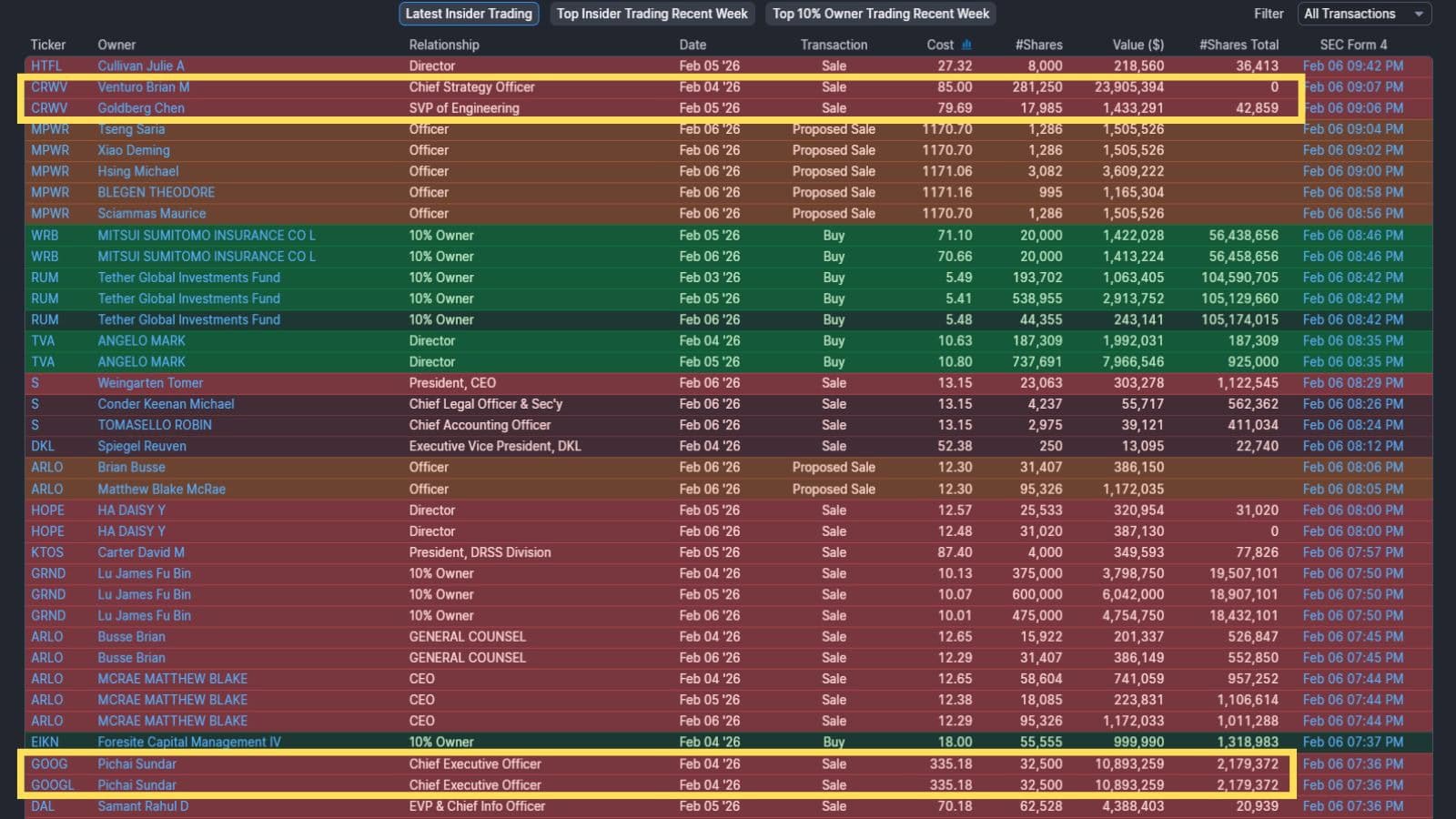
On Friday, February 6, we saw a notable wave of insider selling across multiple sectors.
Two transactions stood out. Alphabet CEO Sundar Pichai sold 32,500 shares each of GOOG and GOOGL, while CoreWeave’s Chief Strategy Officer sold over USD 23 million worth of shares, reducing his position to zero.
Source:https://finviz.com/insidertrading?tc=7
Looking across insider activity more broadly, most reported transactions last Friday were either outright sales or proposed sales. Meaningful buying was limited, with Eikon Therapeutics in biotechnology and Sonos in consumer electronics standing out as exceptions.
Our bias remains cautiously bearish for technology stocks over the next one to two sessions. The scale and concentration of insider selling is consistent with distribution behaviour, a sign that insiders are selectively protecting capital at current valuations.
CoreWeave is a high-growth AI infrastructure company focused on cloud computing for machine learning workloads. GOOG and GOOGL represent Alphabet’s two share classes, both tied to Google’s core advertising, cloud, and AI businesses.
CoreWeave is set to open lower, aligning with the heavy insider selling observed last week. Momentum indicators support this view, with a bearish Stochastic RSI cross already in place.
Using a fixed-range volume profile, we can see that price has recently tapped into a high-volume bearish zone from the prior sell-off. This suggests supply remains active at current levels.
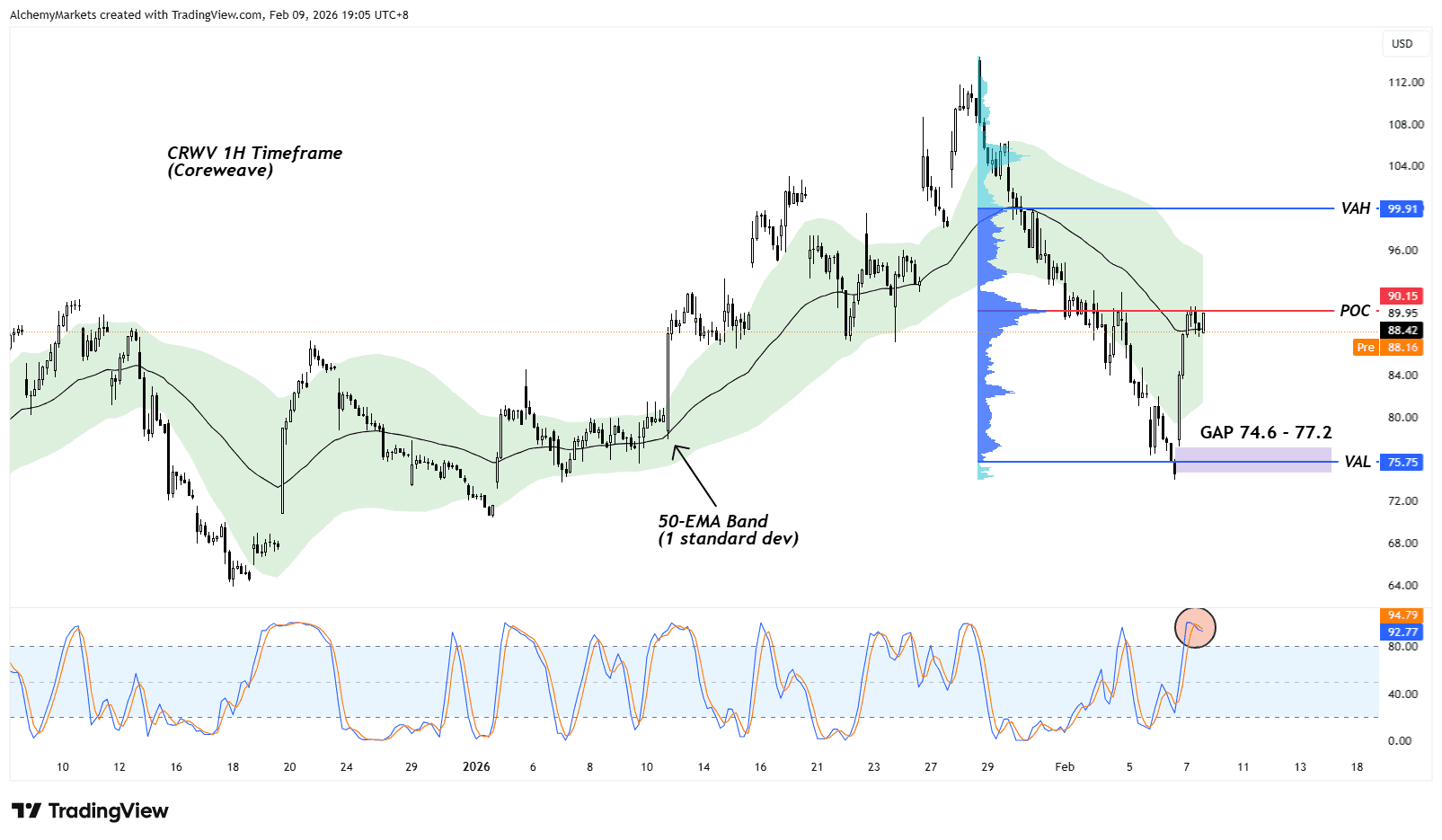
The 50-EMA band on the 1-hour timeframe continues to act as a reliable trend guide. Historically, once CRWV breaks directionally, price tends to stay within the band until a genuine reversal occurs. At present, the dominant pressure remains bearish.
If price pushes lower, a test of the gap between 74.6 and 77.2 becomes likely. But, watch for a fakeout of another probe of the point of control. Should the POC be reclaimed, a move toward the upper Bollinger Band near 96 could be another inflection point.
Alphabet is showing early signs of weakness following a rejection from the 1-hour 50-EMA Bollinger Band®. Price has accepted back into the rally’s fixed-range volume profile, signalling waning bullish momentum rather than a confirmed trend reversal.
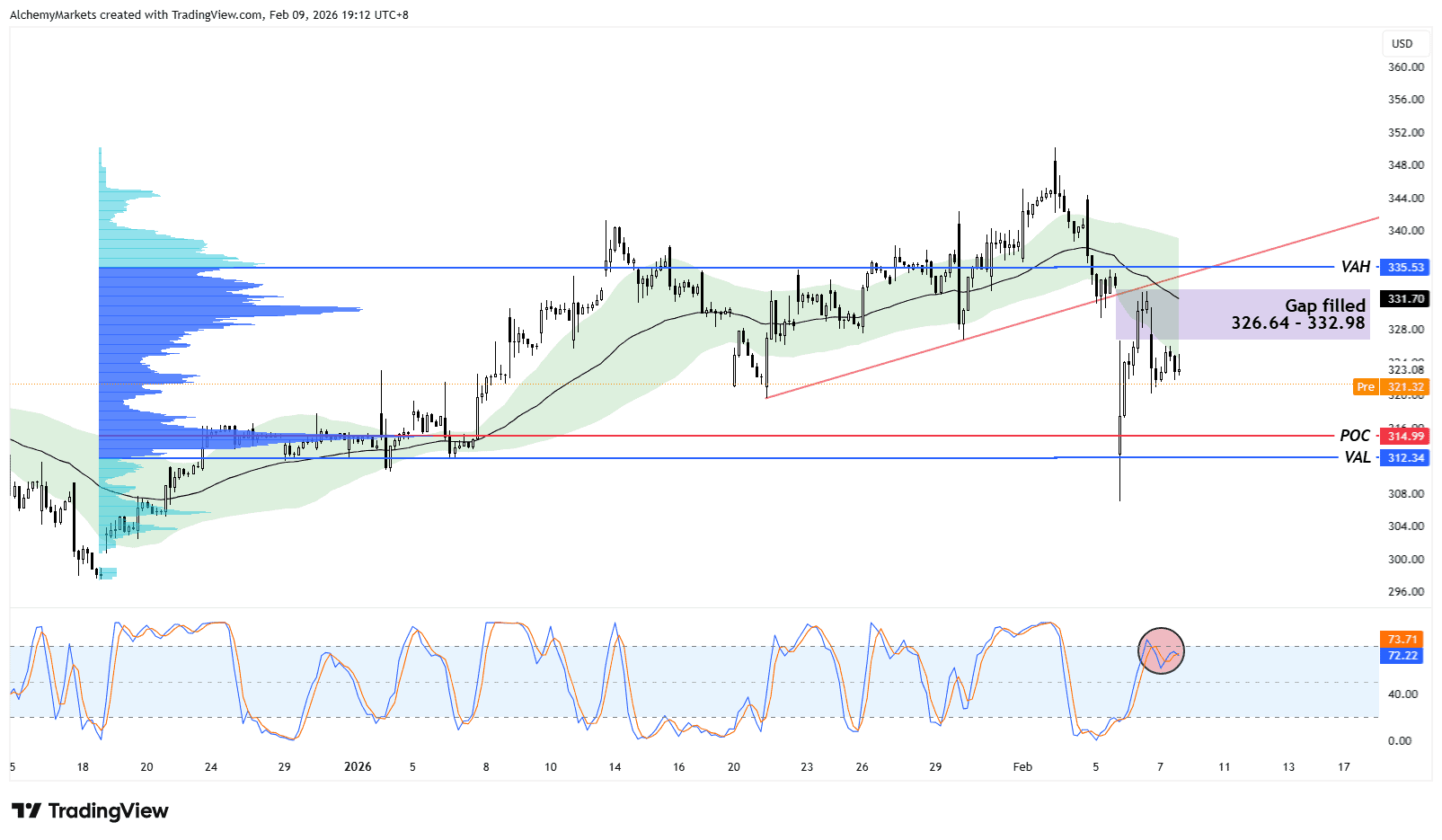
The stock is also set to open lower, reinforcing the insider-selling narrative. Stochastic RSI remains overbought and has begun to roll over.
A continued pullback could see price revisit 314.99, the rally’s point of control, followed by 312.34 at the value area low, both of which previously attracted buyers. For now, the 50-EMA band should continue to act as a suppressive force on upside attempts.
From a technical perspective, the Technology Select Sector SPDR Fund (XLK) is now testing short-term resistance.
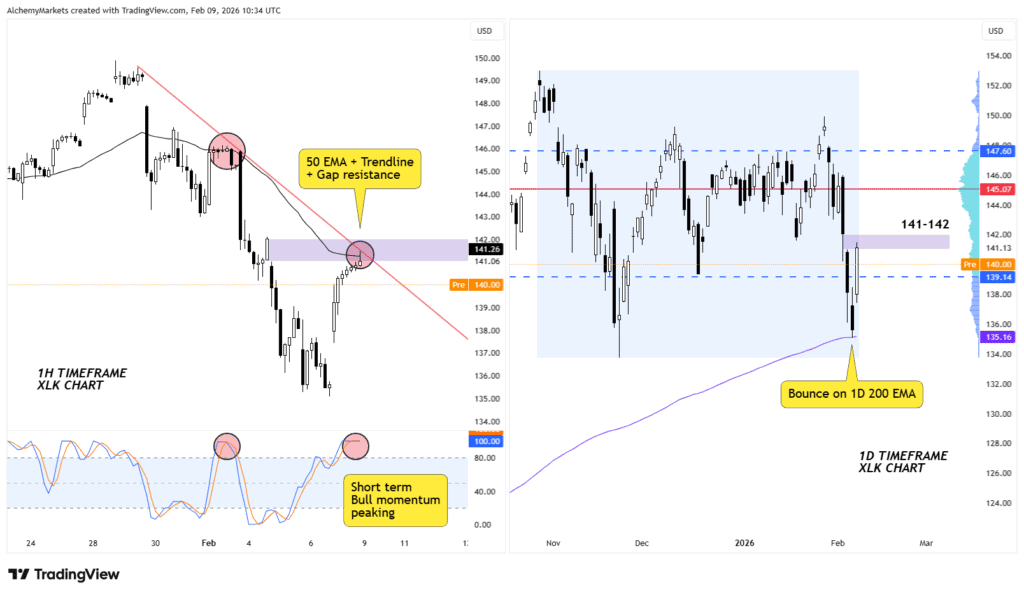
Premarket action is leaning lower, with price capped by the 50-EMA on the 1-hour chart and a minor price gap between 141 and 142 acting as overhead pressure.
However, zooming out to the daily timeframe tells a more balanced story. XLK bounced cleanly off its daily 200-EMA last Thursday, suggesting longer-term buyers are still defending key levels.
For now, this sets up a tug-of-war between short-term distribution and higher-timeframe support, with the near-term bias favouring downside follow-through before any meaningful continuation higher.
Insider activity continues to point toward late-cycle behaviour, reinforcing a rotation-driven market rather than a broad risk-off move. Technology remains vulnerable in the near term, while markets rotate to more defensive stocks and positions.
DISCLAIMER: For educational purposes only. Trading comes with substantial risk, leading to possible loss of your capital. Traders are advised to do their own due diligence before investing.
Alchemy Markets is a multi-asset brokerage providing retail traders with the same elite trading conditions, tools, and transparency typically reserved for institutions.

Select the categories and companies you wish to follow directly to your person rss feed.
Create Custom RSS FeedSign up and join over 5,000 professional members who receive personalized news alerts, curated professional connections, and more for free!
ATARIA CRM helps brokers manage a growing client base by bringing client information into one organized platform. It highlights key client statuses such as total, active, inactive, and blocked clients, making it easier for teams to track records, manage communication, automate follow-ups, personalize engagement, and use data insights to strengthen relationships, improve collaboration, save time, and support business growth.
The biggest macro events of Q3 may be behind us. Now comes the next question: what happens when the market starts separating companies rather than trading the macro narrative? Following the Fed’s 25-basis-point hike, a flattening yield curve and sharply elevated tanker rates, the investment landscape is shifting. The same forces can create very different pressures across technology, energy, financials, industrials and consumer sectors. In this week’s BitDelta Pro Weekly Outlook, we look beyond the headlines to examine where those differences may start to matter most. Read the full article for our breakdown of the rate path, the inflation signal hiding in shipping costs, and the sector dynamics taking shape. BitDelta Securities Financial Services LLC, regulated by the Capital Market Authority under Category 5 (Introduction Only), acts solely as an introducer and does not provide trading, execution, dealing, advisory, portfolio management, or custody services. All trading, execution, and investment-related services are provided by BitDelta Limited, Mauritius, a licensed Investment Dealer. All trading and investments involve risk. The value of investments may fluctuate, and you may receive less than your initial investment.
An analysis of how Federal Reserve policy, geopolitical risks in the Persian Gulf, and shifting global yields drive the US Dollar (DXY) near the 100.3 level, alongside market scenarios and technical outlooks.
audcad-price-forecast-support-retest-bullish-breakout
Gold holds weekly support as XAUUSD breaks above its daily EMA. Explore key support and resistance levels and the next bullish confirmation.
Detailed market analysis and technical outlook for WTI Crude Oil prices near $100 per barrel for the week of September 21 to 25, 2026, combining macroeconomic drivers, EIA inventory data, and key chart indicators.
Learn how to convert custom Gold (XAUUSD) price action tutorials into MetaTrader 5 AI prompts using external AI, analyze live charts, audit risk, and auto-generate MQL5 code.
MarketsVox has introduced 24/7 trading on Gold, Silver, WTI and Brent crude CFDs, giving clients round-the-clock access to key commodity markets. The launch is part of the broker's 2026 roadmap, alongside Client Area and Partner Area updates. CEO Joe Roeder says clients "should not have to wait for a trading session to open."
DXtrade, Devexperts' flagship multi-asset trading platform, has become one of only two platforms approved by Indonesia's Bappebti. The approval authorises DXtrade for licensing by commodity futures and derivatives brokers in Indonesia, and is expected to support future applications to OJK, including for digital asset services.
Exchange FZE (GCEX) has appointed Alya Marrakchi as Managing Director, following approval from Dubai's Virtual Assets Regulatory Authority (VARA). Marrakchi joined GCEX in June 2025, building institutional relationships across the UAE and GCC. Her promotion follows Mohammed A. Mulla's appointment as a GCEX Dubai board member.