
just now


Liquidity Finder Ltd is incorporated in England and Wales, company number 10610740, registered address 167-169 Great Portland Street, Fifth Floor, London W1W 5PF, United Kingdom.
Published: just now

This week’s CPI report came in modestly softer than expected. Headline inflation printed 0.2% month-over-month versus 0.3% expected, while year-over-year slowed to 2.4%. Core inflation held at 0.3% MoM and 2.5% YoY.
At first glance, the market response made sense. Yields softened, duration assets caught a bid, and equities pushed higher. The narrative was straightforward: inflation is easing, rate-cut probabilities tick higher, and financial conditions loosen slightly.
But that interpretation only captures the first-order effect.
Core inflation at 0.3% monthly still annualizes to roughly 3.6%. That is not consistent with a clean return to target. This was not a regime shift in inflation dynamics — it was incremental cooling within a still-sticky core trend.
What this CPI print accomplished was subtle:
What it did not do was materially alter forward earnings expectations.
That distinction matters. Liquidity can fuel tactical extensions. Sustainable rallies require earnings reinforcement.
The post-CPI move appears more positioning-driven than fundamentally driven. If the market leaned cautious into the print, a softer read forces mechanical adjustment: duration short covering, systematic fund re-leveraging, and incremental equity exposure.
But beyond positioning, the more important question is whether this data changes the earnings trajectory.
Does slightly cooler inflation:
The answer, at least for now, is that the effects are marginal rather than transformative.
This keeps the rally dependent on liquidity dynamics rather than upward revisions in growth expectations. And rallies driven primarily by liquidity tend to weaken over successive impulses unless fundamentals re-accelerate.
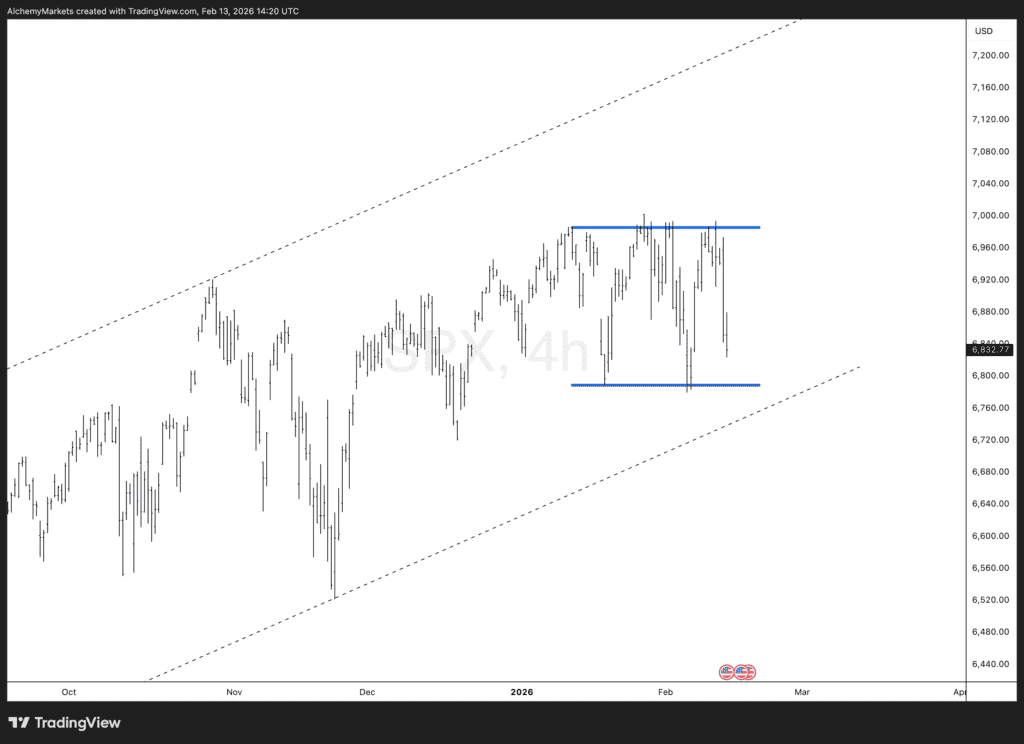
The SPX remains in a constructive technical posture, but price action has shifted from expansion to compression.
The index is consolidating near range highs within a broader rising channel. Higher lows remain intact, but upside progress has slowed as resistance caps immediate momentum. Volatility has compressed and momentum indicators have cooled — classic characteristics of digestion rather than distribution.
This is not bearish structure. It is a pause.
Markets tend to move in sequences: impulse, consolidation, impulse. We are currently in the consolidation phase. A decisive breakout above range resistance would likely trigger another leg higher as systematic flows and momentum strategies re-engage.
However, the durability of that next impulse is the real issue.
Each successive breakout has required expanding liquidity, improving breadth, and stable or rising earnings expectations. At present:
That means the market may well produce another upside break. But the internal strength behind it will be scrutinized more closely than prior legs.
The question is no longer whether SPX can make new highs. It is whether the market has enough internal momentum for another sustained expansion, or whether upside velocity begins to fade without fresh macro or earnings catalysts.
Sideways action near highs is healthy. But repeated breakouts without reinforcement eventually lose torque.
Three events stand out as relevant to this framework.
Building permits offer forward-looking insight into housing and construction activity. With inflation cooling slightly, this release will help determine whether demand is stabilizing or softening.
If permits strengthen, it supports the interpretation that CPI cooling reflects supply normalization rather than demand erosion. That would reinforce the soft-landing narrative and support rate-sensitive segments of the market.
If permits weaken, the inflation moderation could instead be interpreted as slowing demand. That would increase the risk that earnings expectations face pressure in coming weeks.
Housing is one of the clearest transmission channels from rates into the real economy. This data point carries more signal than the headline often suggests.
The Reserve Bank of New Zealand decision will not directly drive U.S. equities, but it does contribute to the global liquidity backdrop.
A dovish tone would reinforce global easing expectations and potentially keep downward pressure on global yields. A hawkish stance, by contrast, could temper enthusiasm around the timing and breadth of global rate cuts.
In a market sensitive to policy trajectory, even incremental shifts in global central bank tone can influence risk appetite.
Consumer sentiment closes the week and may prove decisive in shaping positioning.
Confidence is a proxy for future spending behavior. Strong sentiment would reinforce the soft-landing narrative and support discretionary demand assumptions. Weak sentiment, especially alongside cooling inflation, risks shifting the narrative toward demand deceleration.
That distinction is critical. Inflation cooling due to supply improvement is constructive. Inflation cooling due to weakening demand carries very different earnings implications.
The CPI report modestly reduced inflation risk but did not signal structural disinflation. SPX remains technically constructive but range-bound. The setup allows for another breakout attempt, particularly if housing and sentiment data confirm economic resilience.
However, sustainability will depend on whether:
Liquidity can power the next move. But without reinforcement from growth and revisions, each successive impulse becomes harder to extend.
The market may attempt another leg higher.
The real debate is whether it still has the internal strength to sustain it.
Alchemy Markets is a multi-asset brokerage providing retail traders with the same elite trading conditions, tools, and transparency typically reserved for institutions.

Select the categories and companies you wish to follow directly to your person rss feed.
Create Custom RSS FeedSign up and join over 5,000 professional members who receive personalized news alerts, curated professional connections, and more for free!
Theorem has integrated Symbiotic’s Liquid Lane RFQ network, letting holders of tokenised real-world assets trade against on-chain pool liquidity and market-maker quotes. The integration is live on Ethereum, with Midas’s yield-bearing mHYPER fund as the first supported asset. Holders can trade for the USDC stablecoin.
US equities were volatile with technology selloff erasing much of the earlier rebound.
FM Summit London 2026 returns to Old Billingsgate on 24 November for its 15th edition, with LMAX Group, Plus500 and oneZero among confirmed exhibitors. The one-day event adds Business Connect meetings and roundtables, and opens with a networking evening at The Folly on 23 November.
Finance Magnates Summit London returns to Old Billingsgate on 24 November 2026 for its 15th edition. The one-day event brings together brokers, liquidity providers, institutional firms, trading technology vendors, payments businesses and digital asset firms.
iSAM Securities Apex has integrated with Match-Prime, giving brokers access to liquidity across more than 2,000 instruments, with tailored pricing and up to 10 levels of market depth.
propfunding.com's free-entry instant funding changes the order of prop funding. Start trading first. Its free-entry instant funding model offers two qualification attempts without an upfront activation fee.
US stocks closed higher on Wednesday, with the Nasdaq gaining 1%, the S&P 500 rising 0.6%, and the Dow advancing 0.7%, as renewed enthusiasm for AI-related stocks lifted market sentiment.
SpaceX went public in June as a rocket company. On October 20 it reported as something else entirely: an AI infrastructure business, financed by a satellite broadband network, with a launch division attached. Rockets generated 12% of third quarter revenue and lost money. The AI segment generated 52% of revenue and consumed 84% of capital expenditure. Starlink generated 85% of operating profit.
Standard Chartered has signed definitive agreements to acquire 100% of Zodia Custody UK Limited, folding its regulated digital asset custody business into Securities Services. Zodia Solutions will be set up under SC Ventures with bank investors including Northern Trust, NAB Ventures, Emirates NBD and Investcorp.
Bybit Fintech FZE has secured a Virtual Asset Service Provider licence from Dubai’s Virtual Assets Regulatory Authority for Exchange Services, covering spot trading. Bybit’s Peter Loo said the firm hopes to add derivatives, subject to regulatory approvals. Its international Dubai headquarters opened in 2022.