just now


Liquidity Finder Ltd is incorporated in England and Wales, company number 10610740, registered address 167-169 Great Portland Street, Fifth Floor, London W1W 5PF, United Kingdom.
Published: just now


If you’ve ever sat there after a CPI release, watching gold spike when you expected it to dump or dump when you expected it to rally, you’re not alone. We’ve all been there. The number hits the screen, and the knee-jerk logic kicks in: inflation is higher than expected, so gold should go up, right? Not necessarily.
Trading gold (XAUUSD) based on CPI is one of those setups that seems straightforward… until it isn’t. Because here’s the thing most new traders don’t realise: the number itself isn’t the market mover it’s the interpretation of that number in context.
And when you start to factor in things like market sentiment, the broader risk appetite, and what traders think central banks might do next, suddenly that CPI figure becomes just one piece of a much bigger puzzle.
In this article, we’re going to unpack exactly how CPI and gold interact not just in theory, but in real, everyday trading scenarios. We’ll also explore why sometimes a hotter CPI print strengthens the currency and doesn’t help gold at all. And most importantly, I’ll show you how to start making sense of this data in the moment, so you can begin trading it with more clarity and confidence.
Let’s start with the old-school narrative. Gold is often described as an inflation hedge. The logic is simple: when the cost of goods goes up, the value of paper money drops, and people rush to gold to protect their wealth.
That’s true in a general sense, and it’s backed by history. During the 1970s inflation crisis in the U.S., for example, gold prices absolutely exploded. But we’re not living in the 1970s anymore. We’re in a world of central banks, algorithms, macro speculation, and lightning-fast liquidity shifts.
So today, while gold can behave as an inflation hedge, that behaviour isn’t automatic. It depends heavily on the market’s mood and especially on how risk-on or risk-off traders are feeling when that CPI number hits.
CPI, or the Consumer Price Index, is one of the most-watched economic indicators in the world. It measures how prices are changing for consumers. But it’s not just the number that matters it’s how that number compares to expectations.
Here’s where most traders mess up: they assume a high CPI is always “bad” and a low CPI is always “good.” But that’s way too simplistic.
Imagine this: CPI comes in above expectations. Traders immediately think, “Oh no, inflation is still a problem.” But what happens next depends entirely on what the market believes the central bank response will be.
If CPI is hot and traders think the Fed will now be forced to raise rates, the market might buy the dollar (DXY) because higher rates tend to support the currency. And if the dollar goes up? Gold usually goes down.
But in a different scenario, a hot CPI could cause fear. If inflation is spiralling out of control and the central bank is seen as behind the curve, the market might move into risk-off mode. That means selling stocks, avoiding risky currencies, and moving into safe havens which includes gold.
So, the key takeaway here is: CPI isn’t bullish or bearish for gold on its own. What matters is how that number plays into the market’s view of risk and policy. If inflation triggers fear, gold rallies. If inflation triggers faith in rate hikes and a strong central bank, gold can fall.
This is the part that doesn’t get talked about enough in trading education but it’s crucial.
Markets, at their core, are driven by risk appetite. When traders are in a risk-on mood, they feel confident. They want to invest in growth, tech stocks, emerging markets, crypto. They’re not looking for safety they’re chasing yield.
But in a risk-off mood, everything changes. Suddenly safety becomes the priority. That’s when money moves into traditional havens U.S. bonds, the Japanese yen, and yes, gold.
And what creates these mood swings? CPI is just one trigger. Others include geopolitical tensions, central bank decisions, unexpected crises, and even market technical.
So, when you see CPI rise or fall, the real question you need to ask is: How will this number affect risk sentiment?
If CPI falls sharply and the market thinks inflation is under control, traders might start pricing in easier monetary policy which could boost stocks and hurt gold in the short term, as money flows back into risk assets.
But if CPI drops and traders see it as a sign of economic weakness maybe the economy is slowing too fast, or there are deflation risks that can spark a risk-off mood. Suddenly gold looks attractive again, even though inflation is lower.
This is why gold often performs best when there’s confusion or fear. It’s not about high or low CPI it’s about how uncomfortable the market feels with the result.
Let’s talk about a few moments where this dynamic played out in real time.
In early 2024, U.S. CPI came in well above forecasts. Traders were already worried about sticky inflation, and this report only confirmed that fear. But instead of dumping gold, the market bought it heavily. Why? Because this wasn’t just about inflation it was about the idea that the Fed might lose control, and inflation expectations could become unanchored. That’s a classic risk-off trigger.
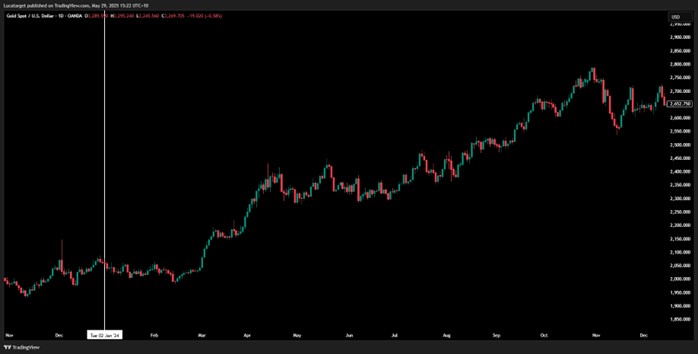
Fast forward to March 2025. CPI came in softer than expected. On the surface, that looks like a “bad” signal for gold. But what happened? Gold rallied. Why? Because the market interpreted the drop in CPI as a green light for the Fed to pause its tightening and a possible pivot toward easing. That meant a weaker dollar, lower yields and a better environment for gold.
In both cases, gold didn’t just react to the CPI number it reacted to the interpretation of that number within the broader market narrative.
This is where the rubber meets the road. It’s one thing to understand this intellectually, but how do you use it in your trading?
Here’s the approach that works for me and has helped me avoid a lot of the “CPI trap” mistakes over the years.
Before any major CPI release, I look at three things:
Then I match that up with gold’s behaviour. Is it trading near a key technical level? Is positioning stretched? Are there signs that traders are about to shift into safety?
Putting all of that together gives me a much clearer read not just on what gold might do, but why it might do it.
If there’s one thing I hope you take away from this, it’s that trading gold isn’t about being right on the CPI number. It’s about understanding how the market feels about that number and what it plans to do next.
In this environment, where volatility can spike on a single headline, and where central banks are constantly trying to manage expectations, your real edge comes from your ability to read the mood.
Gold is still the same asset it’s always been a store of value, a haven, a hedge against chaos. But in the world, we’re trading in now, it’s also a mirror. It reflects fear, doubt, uncertainty, and sometimes even greed.
So, the next time CPI hits, don’t just look at the number. Step back, read the room, and ask yourself: Is the market scared, or is it confident? Are we moving into risk, or running from it?
Because that’s when gold shows its true colours.
This content may have been written by a third party. ACY makes no representation or warranty and assumes no liability as to the accuracy or completeness of the information provided, nor any loss arising from any investment based on a recommendation, forecast or other information supplies by any third-party. This content is information only, and does not constitute financial, investment or other advice on which you can rely.
ACY Securities is one of Australia's fastest growing multi-asset online trading providers, offering ultra-low-cost trading, rock-solid execution, technologically superior account management and premium market analysis.

Select the categories and companies you wish to follow directly to your person rss feed.
Create Custom RSS FeedSign up and join over 5,000 professional members who receive personalized news alerts, curated professional connections, and more for free!
Bybit has launched Perp Options, described as the first options contracts built on TradFi perpetuals, giving traders round-the-clock access to US equity options. SpaceX and Nvidia are the first underlying assets, with USDT settlement and integration into Bybit's Unified Trading Account.
Use this trading preparation checklist to plan your session, define entry rules, manage risk, and build a disciplined trading routine in seven steps.
Your Bourse expands its crypto liquidity ecosystem with Caladan, giving brokers access to broader market coverage, institutional execution capacity and streamlined settlement.
Scope Markets, the retail brokerage part of Rostro Group, has appointed Ibrahim Hossny as Head of Research and Marketing for the Middle East and North Africa.
Hantec Prime, the institutional division of Hantec Markets, has reported trading volume up more than 300% year-to-date, alongside the addition of 42 new institutional clients since December, capping one of its strongest years of growth to date.
Learn how to refine XAUUSD support and resistance on the daily chart using candle bodies, market structure and weekly gold levels for swing trading. A slug alone cannot guarantee a top Google ranking. Keep it focused rather than adding every supporting keyword.
The week in Dubai will be focused on connecting directly with the industry and discussing how technology can help modern brokerages simplify operations, automate workflows, strengthen operational control, and scale efficiently.
Devexperts has launched a turnkey solution giving brokers in South Korea access to US equity markets, combining its DXtrade trading platform, dxFeed market data, and execution services. The offering targets South Korea's growing retail demand for US stocks, worth several billion USD monthly.
Assess why WTI crude oil surged past $105 per barrel amid Saudi pipeline disruptions, record tanker charter rates, and escalating geopolitical tensions.
Bitcoin price forecast: BTC/USD retests $78,460–$80,215 resistance. Watch bearish confirmation toward $72,480 or a bullish breakout toward $86,150.