
just now

Liquidity Finder Ltd is incorporated in England and Wales, company number 10610740, registered address 167-169 Great Portland Street, Fifth Floor, London W1W 5PF, United Kingdom.
Published: just now
Every trader eventually faces the question: “How fast should I trade?”
Some crave the thrill of intraday volatility, watching candles dance minute by minute. Others prefer the calm pace of multi-day swings, where structure speaks louder than noise. Between these two extremes lies a rhythm that balances both - and that’s where swing trading thrives.

Swing trading isn’t just another strategy. It’s a tempo - the space between speed and stillness, where timing meets patience and clarity replaces chaos. If you’re new and want cleaner reads with less noise, start by learning how to read the higher timeframes with multi-timeframe analysis; it’s the backbone of swing decisions.
Swing trading is the art of capturing the market’s natural rhythm - those meaningful “swings” that occur as price expands, corrects, and trends again. While scalpers hunt for seconds and day traders fight for hourly moves, swing traders wait for the market to breathe. They enter when momentum is confirmed and exit when it fades.
The average trade lasts a few days to a few weeks, depending on volatility. But more importantly, swing traders focus on context - they study the daily narrative of price rather than chasing every candle. It’s less about being fast and more about being aligned. When you’re ready to define risk and targets clearly, revisit the essentials of risk management, stops, and position sizing to protect those swings.

It’s easy to pit one style against the other, but both have strengths. The best traders understand how each serves a different personality and lifestyle.
| Aspect | Day Trading | Swing Trading |
|---|---|---|
| Time Commitment | Requires full attention during market hours; ideal if you can monitor screens 4–8 hours and follow a tight day-trading routine. | Flexible - analyze once or twice daily, set alerts, manage around your schedule. |
| Trade Duration | Seconds to hours; flat by session close. | 2 days to 2 weeks; riding trend legs, not intraday noise. |
| Volatility Exposure | Intraday whipsaws; minimal overnight risk. | Overnight/weekend gaps; benefits from larger, cleaner moves. |
| Stress Level | Fast, mentally intense; rapid decisions. | Slower, deliberate; patience replaces urgency. |
| Reward Potential | Smaller moves, higher frequency - compounding small edges. | Fewer trades, higher R multiples (1:3+) if trends extend. |
| Ideal Trader Type | Action-oriented, thrives on quick cycles and intraday playbooks like a structured indices open strategy. | Strategic, patient, values work–life balance and higher-TF confluence. |
Both paths lead to growth - they simply train different muscles. Day trading sharpens execution and adaptability. Swing trading builds perspective, emotional control, and rhythm. Many traders evolve through both: they learn speed from intraday playbooks, then deepen conviction with higher-timeframe reads.
Jobs, families, studies - life doesn’t always allow 8 hours of screen time. Swing trading respects that reality. You can analyze after work, set alerts, place orders, and then step back. It’s a realistic bridge between markets and life, especially if you’re still building consistency. For clearer decision-making under pressure, pair your plan with a simple mental framework like the ideas in How to Think Like a Price Action Trader.
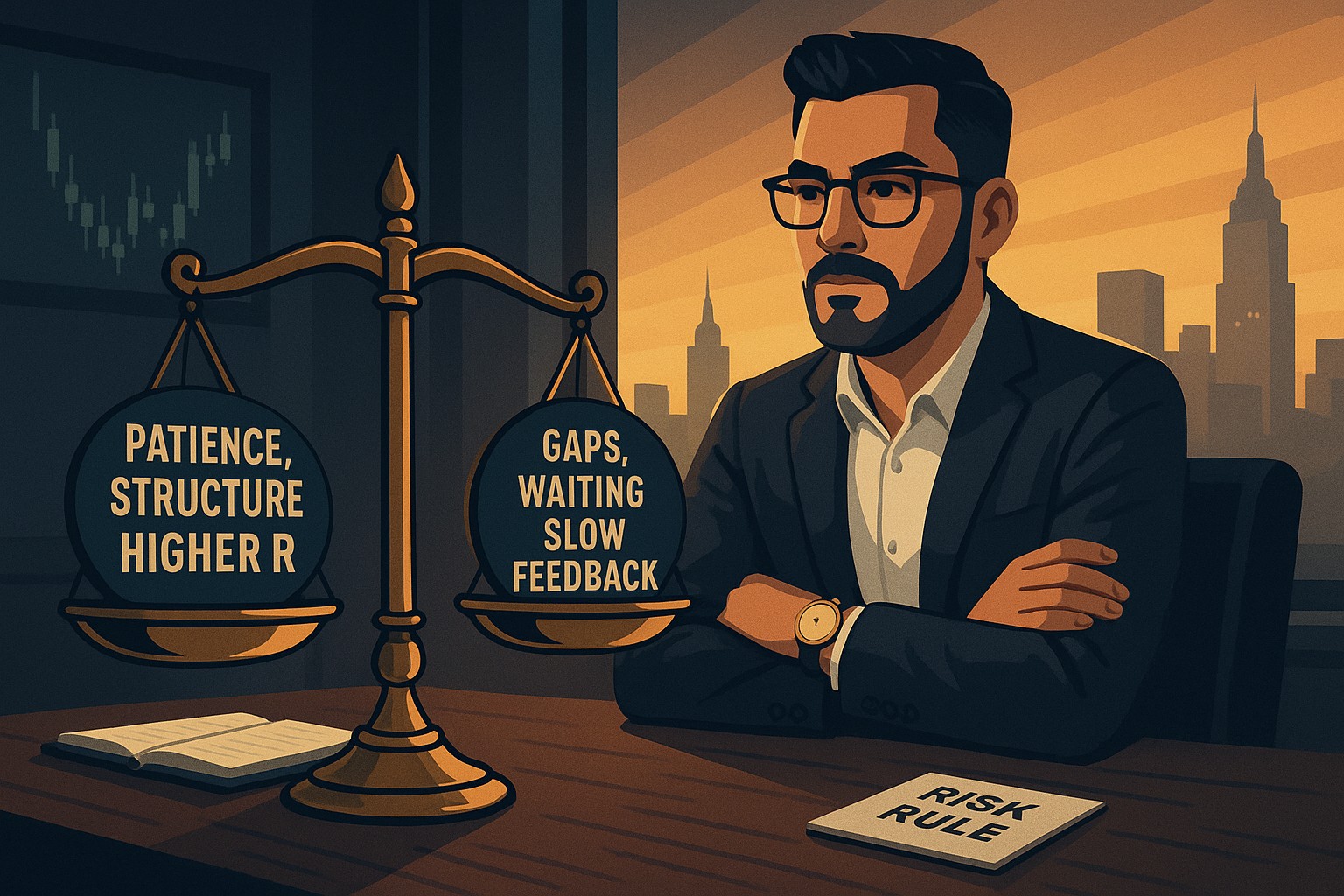
Swing trading rewards calm thinkers - but punishes those who confuse slowness with safety. Patience only pays when paired with precision and risk discipline (bookmark Why Risk Management Is the Only Edge That Lasts).

Day trading drains decision energy; you win or lose quickly and immediately re-engage. Swing trading builds mental recovery into the cadence: analyze → plan → execute → step away. That breathing room clarifies cause-and-effect and reduces impulsive tinkering. If you’re coming from intraday, this slower cadence often improves your win quality and emotional control.
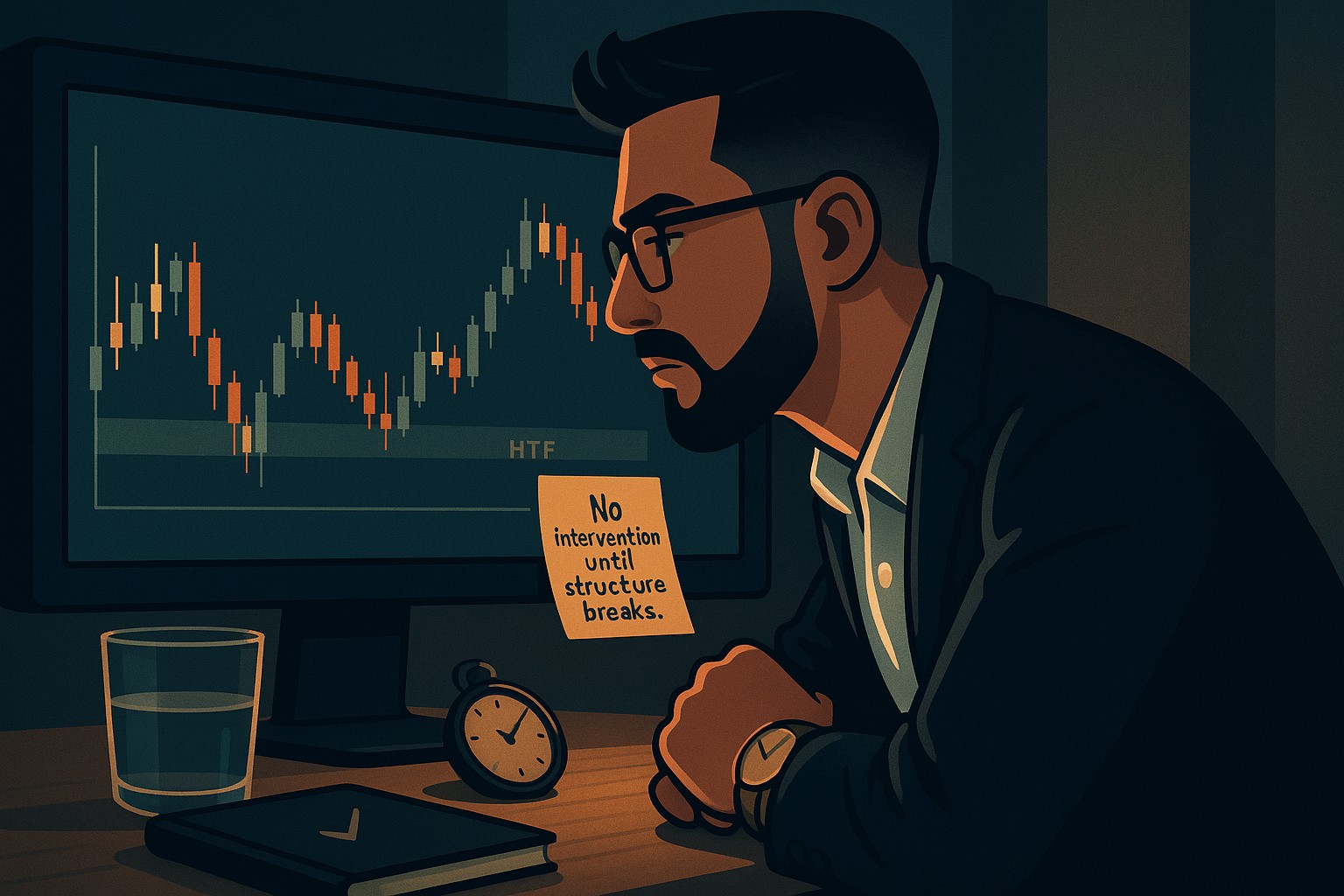
The challenge isn’t the setup - it’s the stillness. Swing traders learn to hold conviction, tolerate uncertainty, and manage themselves when price goes sideways for days. If psychology is your bottleneck, start with The Mental Game of Execution and add one rule you’ll follow after entry (e.g., “no intervention until HTF structure breaks”).

Scalpers sprint; day traders run mid-distance; swing traders are marathoners. They pace, read terrain, and conserve energy for decisive moves. The market, like a marathon, rewards endurance over excitement - especially when your plan and position sizing method make finishing strong the default.
Swing trading is not slower - it’s smarter. It teaches you how to think, not just react; how to hold conviction, not just clicks. It rewards those who combine structure with serenity, and it builds habits that extend beyond markets: patience, preparation, and peace of mind. When you learn to trust time instead of fighting it, you stop chasing trades and start catching meaning - that’s when trading evolves from a hustle into a rhythm.
It’s time to go from theory to execution - risk-free.
Create an Account. Start Your Free Demo!
Looking for step-by-step approaches you can plug straight into the charts? Start here:
Sharpen your edge with proven tools and frameworks:
News moves markets fast. Learn how to keep pace with SMC-based playbooks:
From NASDAQ opens to DAX trends, here’s how to approach indices like a pro:
Gold remains one of the most traded assets - - here’s how to approach it with confidence:
Candlesticks are the building blocks of price action. Master the most powerful ones:
Ready to go intraday? Here’s how to build consistency step by step:
Markets swing between calm and chaos. Learn to read risk-on vs risk-off like a pro:
Step inside the playbook of institutional traders with SMC concepts explained:
Forex pairs aren’t created equal - - some are stable, some are volatile, others tied to commodities or sessions.
If you’ve ever been stopped out right before the market reverses - - this is why:
Mindset is the deciding factor between growth and blowups. Explore these essentials:
The real edge in trading isn’t strategy - it’s how you protect your capital:
If you’re not sure where to start, follow this roadmap:
This way, you’ll grow from foundation → application → mastery, instead of jumping around randomly.
Follow me for more daily market insights!
Jasper Osita - LinkedIn - FXStreet - YouTube
This content may have been written by a third party. ACY makes no representation or warranty and assumes no liability as to the accuracy or completeness of the information provided, nor any loss arising from any investment based on a recommendation, forecast or other information supplies by any third-party. This content is information only, and does not constitute financial, investment or other advice on which you can rely.
ACY Securities is one of Australia's fastest growing multi-asset online trading providers, offering ultra-low-cost trading, rock-solid execution, technologically superior account management and premium market analysis.

Select the categories and companies you wish to follow directly to your person rss feed.
Create Custom RSS FeedSign up and join over 5,000 professional members who receive personalized news alerts, curated professional connections, and more for free!
Theorem has integrated Symbiotic’s Liquid Lane RFQ network, letting holders of tokenised real-world assets trade against on-chain pool liquidity and market-maker quotes. The integration is live on Ethereum, with Midas’s yield-bearing mHYPER fund as the first supported asset. Holders can trade for the USDC stablecoin.
US equities were volatile with technology selloff erasing much of the earlier rebound.
FM Summit London 2026 returns to Old Billingsgate on 24 November for its 15th edition, with LMAX Group, Plus500 and oneZero among confirmed exhibitors. The one-day event adds Business Connect meetings and roundtables, and opens with a networking evening at The Folly on 23 November.
Finance Magnates Summit London returns to Old Billingsgate on 24 November 2026 for its 15th edition. The one-day event brings together brokers, liquidity providers, institutional firms, trading technology vendors, payments businesses and digital asset firms.
iSAM Securities Apex has integrated with Match-Prime, giving brokers access to liquidity across more than 2,000 instruments, with tailored pricing and up to 10 levels of market depth.
propfunding.com's free-entry instant funding changes the order of prop funding. Start trading first. Its free-entry instant funding model offers two qualification attempts without an upfront activation fee.
US stocks closed higher on Wednesday, with the Nasdaq gaining 1%, the S&P 500 rising 0.6%, and the Dow advancing 0.7%, as renewed enthusiasm for AI-related stocks lifted market sentiment.
SpaceX went public in June as a rocket company. On October 20 it reported as something else entirely: an AI infrastructure business, financed by a satellite broadband network, with a launch division attached. Rockets generated 12% of third quarter revenue and lost money. The AI segment generated 52% of revenue and consumed 84% of capital expenditure. Starlink generated 85% of operating profit.
Standard Chartered has signed definitive agreements to acquire 100% of Zodia Custody UK Limited, folding its regulated digital asset custody business into Securities Services. Zodia Solutions will be set up under SC Ventures with bank investors including Northern Trust, NAB Ventures, Emirates NBD and Investcorp.
Bybit Fintech FZE has secured a Virtual Asset Service Provider licence from Dubai’s Virtual Assets Regulatory Authority for Exchange Services, covering spot trading. Bybit’s Peter Loo said the firm hopes to add derivatives, subject to regulatory approvals. Its international Dubai headquarters opened in 2022.