just now

Liquidity Finder Ltd is incorporated in England and Wales, company number 10610740, registered address 167-169 Great Portland Street, Fifth Floor, London W1W 5PF, United Kingdom.
Published: just now
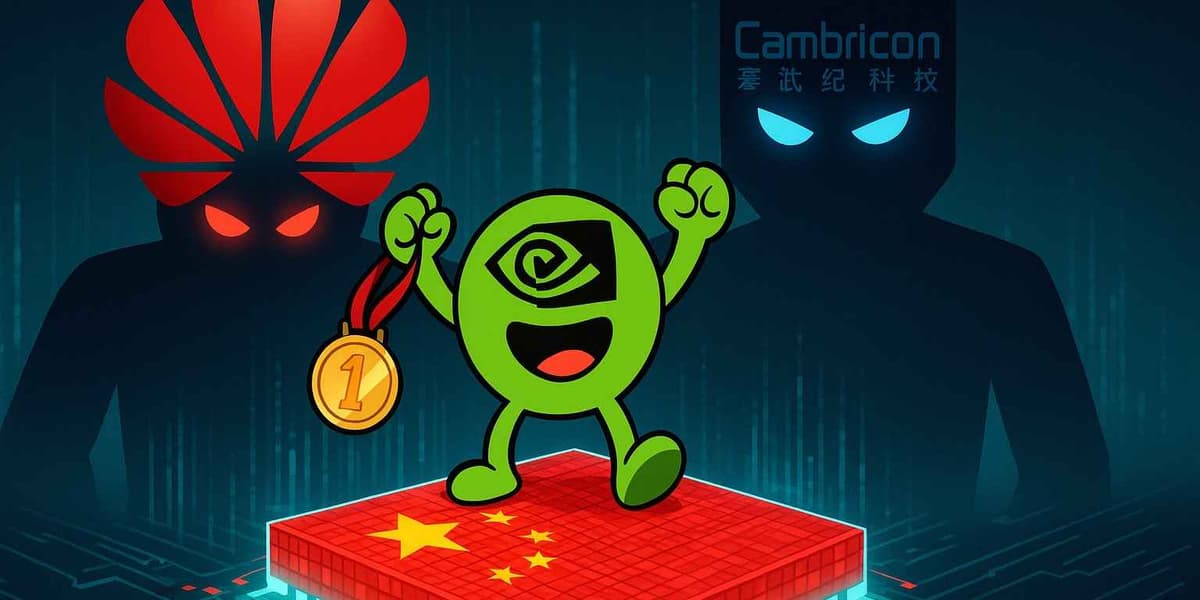
Wall Street held its breath heading into Nvidia’s Q2 release, and the chip giant didn’t disappoint on paper.
Revenue exploded to $46.7 billion, well above the ~$44 billion expected, and EPS cleared consensus with room to spare. Data-center revenue, the crown jewel of Nvidia’s AI empire, surged to nearly $28 billion. For most companies, that would be a dream quarter.
But markets don’t always reward perfection. Despite the blowout numbers, Nvidia is slipping in pre-market, trading at $178.36. Why?
Profit-taking explains some of it, but the bigger question looming over every trader’s screen is China.
Beijing has drawn a line, limiting purchases of Nvidia’s high-end H20 chips, while simultaneously nurturing homegrown challengers. Huawei’s Ascend and Cambricon might look like minnows compared to Nvidia today, but with state backing and control of critical rare earths like Neodymium, their threat could grow rapidly.
And here’s the twist: while Nvidia pulled back, the S&P 500 pushed into new all-time highs. The market is saying “yes” to AI, but not blindly “yes” to Nvidia. That divergence sets the stage for today’s tug of war.
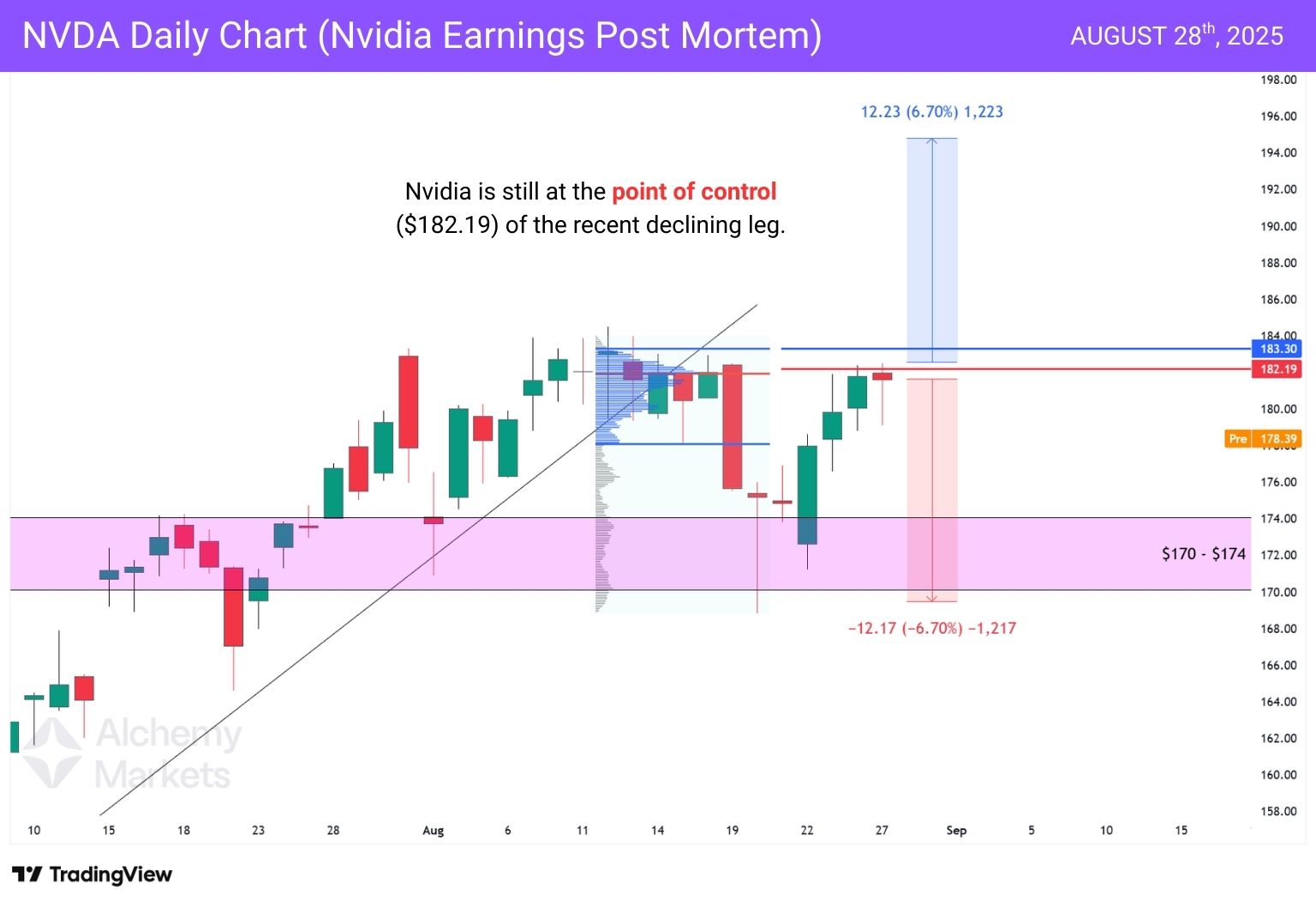
The chart tells its own story. After an ugly breakdown earlier this month, Nvidia found footing in the $170 to $174 demand zone and staged a bounce. Now it’s staring down the $182 to $183 supply shelf, a battleground where rallies have been rejected before.
This is a knife’s-edge moment. A close above $183.3 would unlock room to run into the $192 to $195 zone, completing a measured move of 6.7% as estimated by the options market.
Fail here, and Nvidia risks tumbling back toward $170, the opposite end of the 6.7% projection.
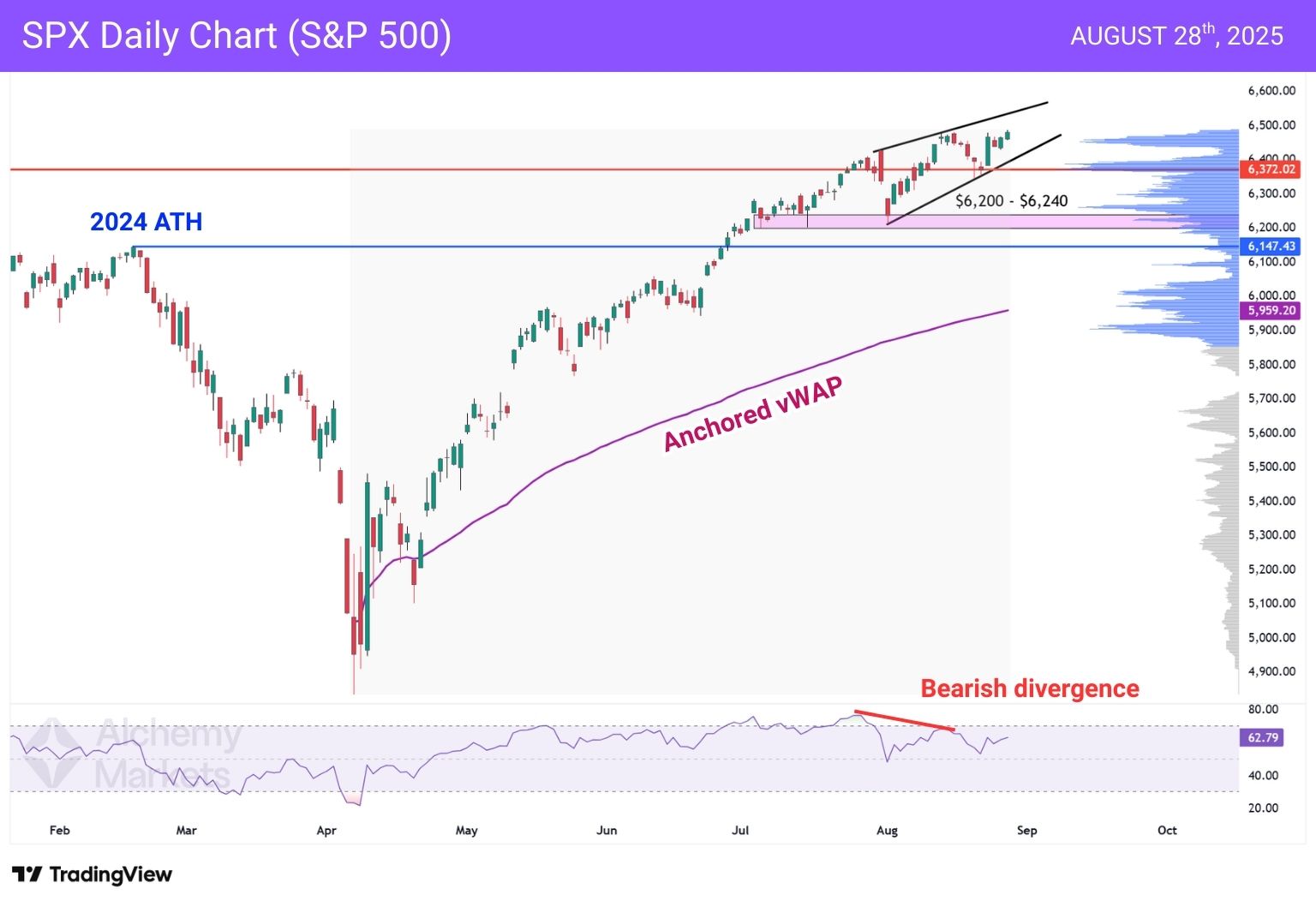
The index is playing a different game. The S&P 500 has been grinding higher inside a rising wedge, shrugging off concerns and climbing as traders rotate into broader AI exposure.
The SPX could throttle toward the $6,500s, where the wedge’s upper trendline is waiting. That zone could act as a rejection point if momentum continues to thin.
If the wedge eventually breaks lower, a move back into the $6,200–$6,240 region would not be surprising — the technical target of the rising wedge — with deeper tests toward the anchored VWAP near $5,959 still on the table in a broader correction.
Closer support sits at $6,372.02, the point of control and highest traded volume area of the 2025 rally. Beneath that, our rising wedge target of $6,200, and beyond that lies the 2024 all-time high around $6,150.
But for now, the index remains bid. Traders should be wary that new highs are coming on weaker fuel (forming a bearish RSI divergence), and this wedge will not stay tight forever.
This is where it gets interesting.
Nvidia is still the AI king, but markets are starting to treat it more like a single chapter than the whole book.
Bulls highlight the resilience: record-breaking revenue despite losing Chinese customers. Bears highlight the cracks: weak China sales, export bans biting, and state-backed rivals waiting to scale.
Meanwhile, SPX shows what the market really believes. AI is here to stay. The theme is so powerful that even Nvidia selling off couldn’t stop the index from printing a fresh record. That tells us money is flowing into the story, just not all of it into the same stock.
For traders, the playbook is simple but critical. Watch Nvidia at $183 and $170. These are the gates. A breakout, or a retest, will decide the next chapter. Until then, enjoy the drama but don’t get caught in the noise.
You may be interested in:
All Eyes on Nvidia Earnings: Will the Tech Giant Rise in Spite of China Risks?
DISCLAIMER: For educational purposes only. Trading comes with substantial risk, leading to possible loss of your capital. Traders are advised to do their own due diligence before investing.
Alchemy Markets is a multi-asset brokerage providing retail traders with the same elite trading conditions, tools, and transparency typically reserved for institutions.

Select the categories and companies you wish to follow directly to your person rss feed.
Create Custom RSS FeedSign up and join over 5,000 professional members who receive personalized news alerts, curated professional connections, and more for free!
Standard Chartered has signed definitive agreements to acquire 100% of Zodia Custody UK Limited, folding its regulated digital asset custody business into Securities Services. Zodia Solutions will be set up under SC Ventures with bank investors including Northern Trust, NAB Ventures, Emirates NBD and Investcorp.
Bybit Fintech FZE has secured a Virtual Asset Service Provider licence from Dubai’s Virtual Assets Regulatory Authority for Exchange Services, covering spot trading. Bybit’s Peter Loo said the firm hopes to add derivatives, subject to regulatory approvals. Its international Dubai headquarters opened in 2022.
ATFX Connect has released its Q4 2026 Institutional Edge, examining the geopolitical, monetary policy and fiscal pressures shaping global financial markets in the final quarter of the year.
The Nasdaq 100 is trading at 29,382. After reaching a recent high of 29,957, the index reversed sharply and has been recording a series of lower highs and lower lows.
propfunding.com's free-entry instant funding changes the order of prop funding. Start trading first. Its free-entry instant funding model offers two qualification attempts without an upfront activation fee.
FM Summit London returns to Old Billingsgate on 24 November 2026 for its 15th edition, with a curated one-day format aimed at senior executives. LMAX Group, Plus500, oneZero and MetaQuotes are among confirmed exhibitors, with Business Connect meetings, roundtables and an opening event at The Folly on 23 November.
GCEX has launched European-style, fiat-settled options on Bitcoin and Ethereum with monthly expiries for eligible professional and institutional clients. The service runs through the GCEX OTC desk, with pricing from Tier 1 liquidity providers and reporting on XplorPortal. GC Exchange Limited is authorised by the UK FCA
Wall Street closed mostly higher on Tuesday, led by a nearly 1% gain in the Dow. In Asia, South Korea’s Kospi rebounded 2.7% and Japan’s Nikkei gained 0.8%.
Brent crude is trading at $111.70. The latest price action show the recovery continuing toward $111.70, suggesting that demand has returned after the sharp correction.
FOREX.com has introduced weekend trading for US SP 500 and US Tech 100 CFDs in Japan, operated by StoneX Securities Co., Ltd., a StoneX Group Inc. subsidiary. Investors can manage positions seven days a week, including Saturday and Sunday sessions, without waiting for underlying markets to reopen on Monday.