
just now


Liquidity Finder Ltd is incorporated in England and Wales, company number 10610740, registered address 167-169 Great Portland Street, Fifth Floor, London W1W 5PF, United Kingdom.
Published: just now


Here we are! The last day of June! 50% of the whole year gone, and with that, the Forex market finds itself at a critical point.
After a volatile first half of the year, a combination of trade diplomacy, dovish central banks, and soft economic data is reshaping the global currency landscape.
The USD is under heavy down trend, the JPY is showing signs of resurgence, and commodity currencies are beginning to diverge on policy expectations.
This week ahead, the confluence of US macro softness and geopolitical trade relief may have shifted the market’s directional bias again. Risk On for the week ahead!
The US dollar (DXY) is struggling to find its footing. While a flurry of optimism emerged on news that the U.S. has clinched not one but potentially ten new trade deals including progress with China and Europe this wasn’t enough to trigger a broad-based USD rally.
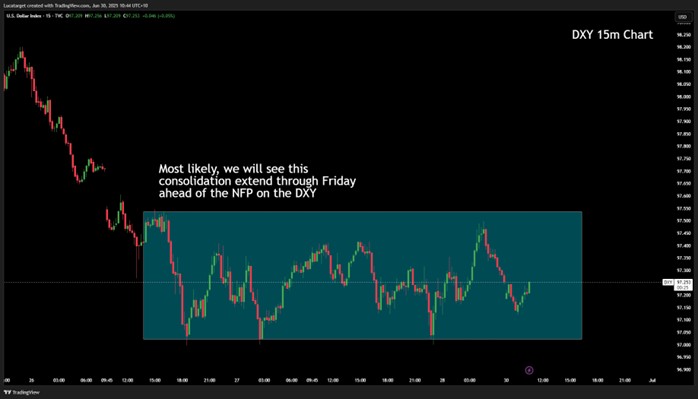
Market participants, instead of buying the news, appear to be focused on what lies ahead: a Federal Reserve that is increasingly open to easing policy, a labour market showing signs of fatigue, and consumer data that is no longer bulletproof. But no cuts are expected for the month ahead… only for Sep, Oct and Dec (all of them 25bp each bringing the rate down from 4.25-4.50 to 3.50 -3.75 at end of 2025)
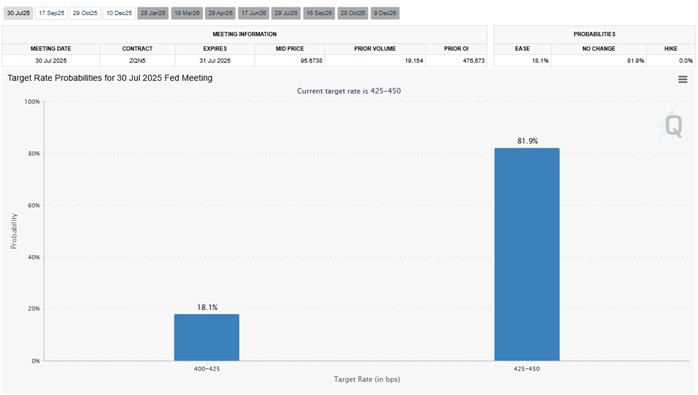
The Fed's tone has decisively softened. Officials, including Powell and Waller, have floated the possibility of rate cuts “sooner rather than later,” and market pricing reflects that.
Continued claims for unemployment are nearing 2 million levels not seen since late 2021 and the final revisions to Q1 GDP confirm that US consumer resilience is waning.
With the July PCE inflation release and the upcoming payrolls data now in focus, it won’t take much for markets to fully price in a July cut.
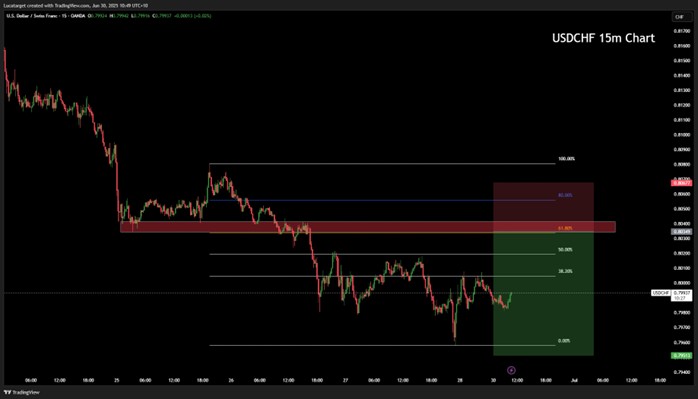
In my opinion surprise to the downside can happen. Looking to short USD/CHF, particularly if risk sentiment improves and the Fed's dovish leanings intensify. CHF is still a defensive play, but relative rate expectations and positioning favour the franc now.
Amid the broader USD weakness, the JPY is quietly staging a comeback albeit with some speed bumps.
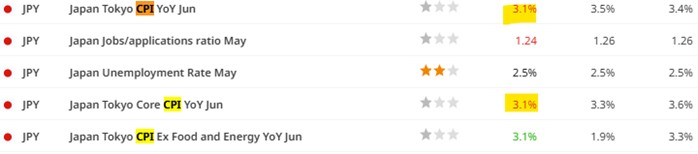
Tokyo CPI data surprised to the downside last week, reinforcing expectations that inflation in Japan may return to sub-2% levels by year-end. While this appears to lessen the urgency for BoJ rate hikes, it's not the whole story.
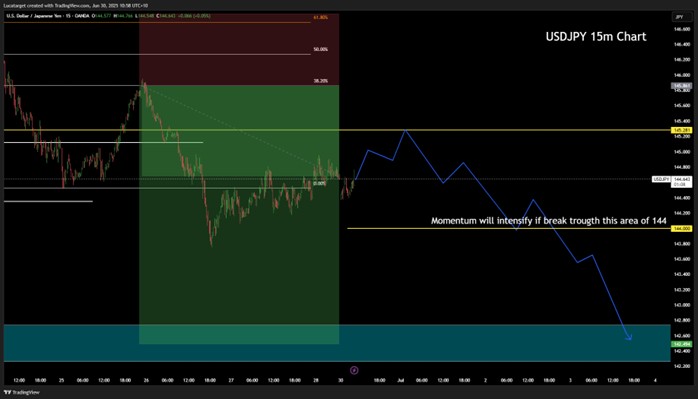
The bigger driver for USD/JPY right now is the narrowing yield differential and falling energy prices. Oil’s decline is disinflationary for Japan’s import bill, and the US-Japan rate spread is no longer offering the same carry incentive. According to some real-time fair value models, USD/JPY should be trading closer to 144 than 147, and even as low as 141 could be justified if US yields continue falling.
Based on this condition I’m looking for a tactical short USD/JPY trade makes sense from here, particularly if the US data continues to underwhelm this week. Keep stops tight above 147 but target a breakdown toward 143 in the near term.
Despite improvement in EU trade negotiations and softer peripheral yields, the euro hasn’t decisively taken the reins.
Economic sentiment in the bloc has stabilised, but inflation remains tame, and the ECB is unlikely to offer fresh surprises anytime soon.
EUR/USD has benefited from USD weakness, not Euro strength, and that trend might not last without further macro support.
However, the EUR/JPY cross is worth watching. With Japanese inflation likely to decelerate and the euro maintaining stability, this pair could start to look stretched again if USD/JPY breaks lower faster than EUR/USD.
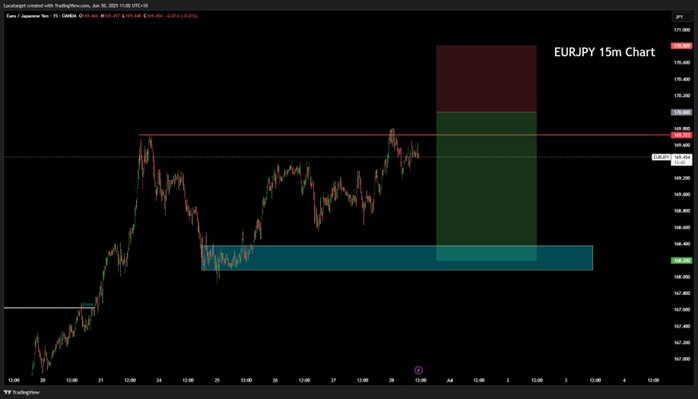
So, look for sells on EUR/JPY into rallies near 170, targeting 168.2 in the medium term. The pair is at risk of becoming fundamentally overvalued, especially if Japan’s economy outpaces EU growth in Q3.
Q1: Why is the USD under pressure right now?
A: Despite progress on trade deals and reduced tariff risks, the USD is struggling due to rising expectations of Fed rate cuts, weakening consumer and labour market data, and political uncertainty over future Fed leadership. Traders are hesitant to go long USD while rate cuts remain a real possibility.
Q2: What’s the best trade if the USD continues to weaken?
A: Shorting USD/JPY offers a strong risk-reward profile. The narrowing US-Japan rate differential, lower oil prices, and renewed JPY strength could drive the pair down toward 143. A break below 144 would signal a technical shift in momentum.
Q3: How should traders position around CAD vs AUD?
A: Go long AUD/CAD. Canada’s economy is showing signs of slowing, with retail sales and GDP underwhelming, while Australia is benefiting from stable commodities and a less dovish central bank stance. This divergence makes AUD/CAD an attractive relative value play.
Q4: Is the euro a buy right now?
A: Not against the USD but EUR/JPY could be a short opportunity. As the JPY strengthens and the euro lacks fresh macro support, the pair is looking stretched near 170. A reversal could take it back toward 168.2.
This content may have been written by a third party. ACY makes no representation or warranty and assumes no liability as to the accuracy or completeness of the information provided, nor any loss arising from any investment based on a recommendation, forecast or other information supplies by any third-party. This content is information only, and does not constitute financial, investment or other advice on which you can rely.
ACY Securities is one of Australia's fastest growing multi-asset online trading providers, offering ultra-low-cost trading, rock-solid execution, technologically superior account management and premium market analysis.

Select the categories and companies you wish to follow directly to your person rss feed.
Create Custom RSS FeedSign up and join over 5,000 professional members who receive personalized news alerts, curated professional connections, and more for free!
Bybit has launched Perp Options, described as the first options contracts built on TradFi perpetuals, giving traders round-the-clock access to US equity options. SpaceX and Nvidia are the first underlying assets, with USDT settlement and integration into Bybit's Unified Trading Account.
Use this trading preparation checklist to plan your session, define entry rules, manage risk, and build a disciplined trading routine in seven steps.
Your Bourse expands its crypto liquidity ecosystem with Caladan, giving brokers access to broader market coverage, institutional execution capacity and streamlined settlement.
Scope Markets, the retail brokerage part of Rostro Group, has appointed Ibrahim Hossny as Head of Research and Marketing for the Middle East and North Africa.
Hantec Prime, the institutional division of Hantec Markets, has reported trading volume up more than 300% year-to-date, alongside the addition of 42 new institutional clients since December, capping one of its strongest years of growth to date.
Learn how to refine XAUUSD support and resistance on the daily chart using candle bodies, market structure and weekly gold levels for swing trading. A slug alone cannot guarantee a top Google ranking. Keep it focused rather than adding every supporting keyword.
The week in Dubai will be focused on connecting directly with the industry and discussing how technology can help modern brokerages simplify operations, automate workflows, strengthen operational control, and scale efficiently.
Devexperts has launched a turnkey solution giving brokers in South Korea access to US equity markets, combining its DXtrade trading platform, dxFeed market data, and execution services. The offering targets South Korea's growing retail demand for US stocks, worth several billion USD monthly.
Assess why WTI crude oil surged past $105 per barrel amid Saudi pipeline disruptions, record tanker charter rates, and escalating geopolitical tensions.
Bitcoin price forecast: BTC/USD retests $78,460–$80,215 resistance. Watch bearish confirmation toward $72,480 or a bullish breakout toward $86,150.