
just now

Liquidity Finder Ltd is incorporated in England and Wales, company number 10610740, registered address 167-169 Great Portland Street, Fifth Floor, London W1W 5PF, United Kingdom.
Published: just now


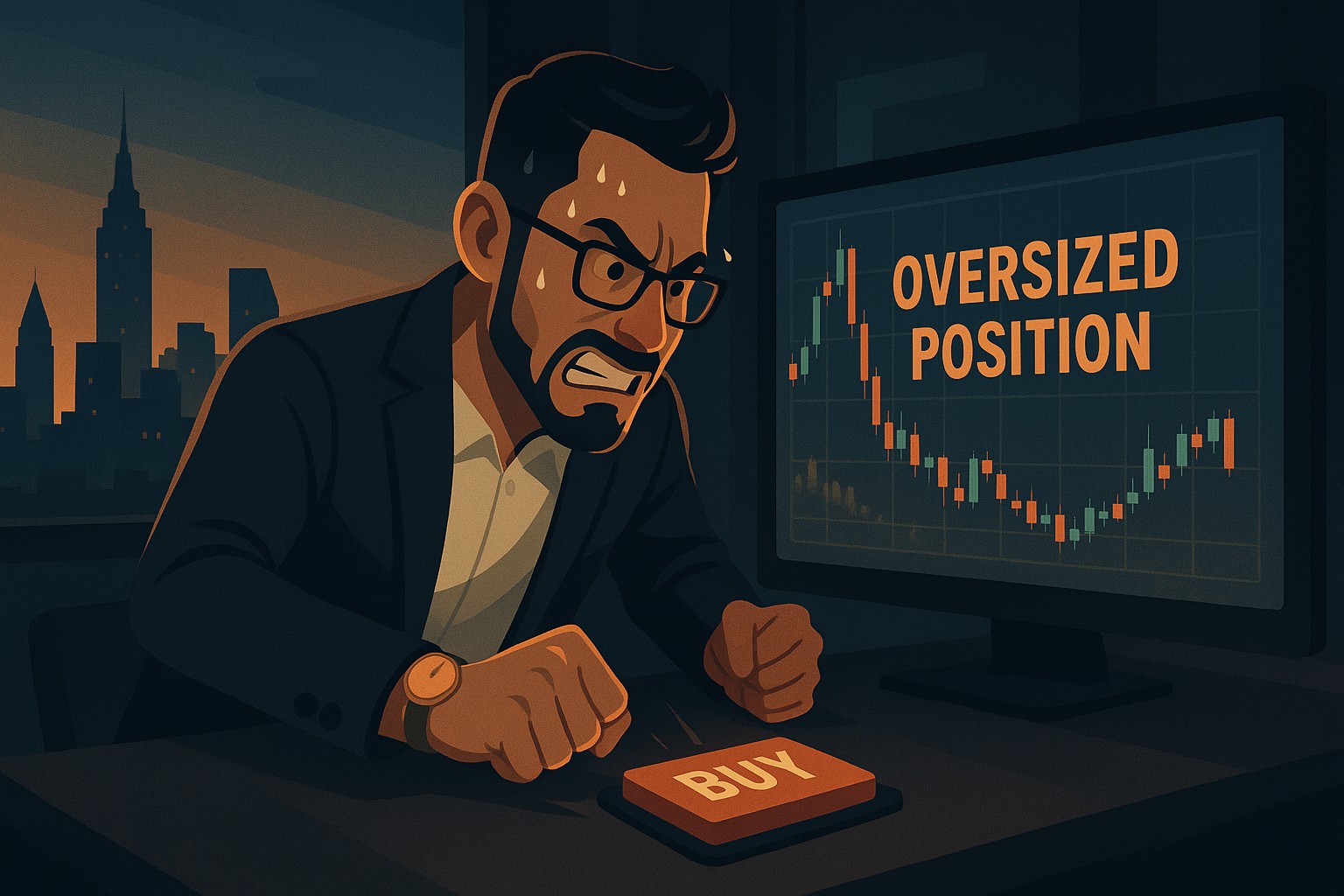
Every trader knows the feeling: the chart suddenly explodes, the candles fly, and you’re not in the move. Your heart races. Your cursor hovers over the buy button. That urgency is FOMO (fear of missing out) at work.
The problem is that FOMO makes you forget your plan. You enter late, right when the professionals are exiting. What should have been a winning day often flips into frustration.
And frustration has a twin: revenge trading. After a stop-out or a missed move, emotions take the wheel. Instead of following the plan, you press harder, increase risk, or force entries to “make it back.” But the market doesn’t reward desperation; it punishes it.
The market doesn’t punish lack of knowledge as much as it punishes lack of patience — a lesson echoed in Why Most Traders Fail – Trading Psychology & The Hidden Mental Game.
Both FOMO and revenge trading don’t appear out of thin air — they usually start with psychological blind spots and structural gaps in trading systems.
This is why frameworks like the Discipline vs. Impulse in Trading – Step-by-Step Guide are critical for traders who want to break free from emotional spirals.
Here’s the truth most traders avoid:
That’s why professional traders repeat a mantra: “Patience pays. Impulse costs.”
Think of it like fishing. Sometimes the water looks calm, but the right catch isn’t there yet. Casting early only wastes bait. Waiting for the right moment ensures you reel in something worth keeping.
For deeper guidance on building this kind of patience, revisit Top 10 Ways to Prevent Emotional Trading and Stay Disciplined.
Casinos thrive on two emotions: excitement when you’re winning and desperation when you’re losing. Both keep you playing until the house wins.
Trading without control is no different. FOMO is the excitement, revenge trading is the desperation. The only way to win is to step back, play your edge, and know when to walk away.
If you want more on how to navigate emotional traps, explore The Mental Game of Execution.
For the next 5 trading days, track every time you feel FOMO or the urge to chase back a loss. Write it down before acting. If you can walk away instead of forcing the trade, you’ve won — even without profit.
Remember: survival is the true edge. The traders who last are the ones who master patience, not the ones who catch every single move.

FOMO and revenge trading don’t destroy accounts because of the market itself — they destroy accounts because they hijack a trader’s discipline. They start small, with impatience or the fear of being left behind, but if unchecked, they snowball into emotional spirals that wipe out weeks or months of hard work.
The solution isn’t to fight the market; it’s to master yourself. Every missed trade is a reminder that you saved capital, and every avoided revenge trade is proof of discipline. In trading, survival comes first, profit comes second — and patience is the bridge between both.
For a full mindset reset, check out Managing Trading Losses: Why You Can Be Wrong and Still Win Big.
It’s time to go from theory to execution - risk-free.
Create an Account. Start Your Free Demo!
Looking for step-by-step approaches you can plug straight into the charts? Start here:
Sharpen your edge with proven tools and frameworks:
News moves markets fast. Learn how to keep pace with SMC-based playbooks:
From NASDAQ opens to DAX trends, here’s how to approach indices like a pro:
Gold remains one of the most traded assets — here’s how to approach it with confidence:
Candlesticks are the building blocks of price action. Master the most powerful ones:
Ready to go intraday? Here’s how to build consistency step by step:
Markets swing between calm and chaos. Learn to read risk-on vs risk-off like a pro:
Step inside the playbook of institutional traders with SMC concepts explained:
Forex pairs aren’t created equal — some are stable, some are volatile, others tied to commodities or sessions.
If you’ve ever been stopped out right before the market reverses — this is why:
Mindset is the deciding factor between growth and blowups. Explore these essentials:
The real edge in trading isn’t strategy — it’s how you protect your capital:
If you’re not sure where to start, follow this roadmap:
This way, you’ll grow from foundation → application → mastery, instead of jumping around randomly.
Follow me for more daily market insights!
Jasper Osita - LinkedIn - FXStreet - YouTube
This content may have been written by a third party. ACY makes no representation or warranty and assumes no liability as to the accuracy or completeness of the information provided, nor any loss arising from any investment based on a recommendation, forecast or other information supplies by any third-party. This content is information only, and does not constitute financial, investment or other advice on which you can rely.
ACY Securities is one of Australia's fastest growing multi-asset online trading providers, offering ultra-low-cost trading, rock-solid execution, technologically superior account management and premium market analysis.

Select the categories and companies you wish to follow directly to your person rss feed.
Create Custom RSS FeedSign up and join over 5,000 professional members who receive personalized news alerts, curated professional connections, and more for free!
ICM MENA has promoted Ahmed Kamal to Chief Executive Officer. Kamal joined the firm in March 2019 as Business Development Manager and most recently served as Regional Manager. He brings more than a decade of experience in financial markets, with expertise in foreign exchange, business development and team leadership.
Theorem has integrated Symbiotic’s Liquid Lane RFQ network, letting holders of tokenised real-world assets trade against on-chain pool liquidity and market-maker quotes. The integration is live on Ethereum, with Midas’s yield-bearing mHYPER fund as the first supported asset. Holders can trade for the USDC stablecoin.
US equities were volatile with technology selloff erasing much of the earlier rebound.
FM Summit London 2026 returns to Old Billingsgate on 24 November for its 15th edition, with LMAX Group, Plus500 and oneZero among confirmed exhibitors. The one-day event adds Business Connect meetings and roundtables, and opens with a networking evening at The Folly on 23 November.
Finance Magnates Summit London returns to Old Billingsgate on 24 November 2026 for its 15th edition. The one-day event brings together brokers, liquidity providers, institutional firms, trading technology vendors, payments businesses and digital asset firms.
iSAM Securities Apex has integrated with Match-Prime, giving brokers access to liquidity across more than 2,000 instruments, with tailored pricing and up to 10 levels of market depth.
propfunding.com's free-entry instant funding changes the order of prop funding. Start trading first. Its free-entry instant funding model offers two qualification attempts without an upfront activation fee.
US stocks closed higher on Wednesday, with the Nasdaq gaining 1%, the S&P 500 rising 0.6%, and the Dow advancing 0.7%, as renewed enthusiasm for AI-related stocks lifted market sentiment.
SpaceX went public in June as a rocket company. On October 20 it reported as something else entirely: an AI infrastructure business, financed by a satellite broadband network, with a launch division attached. Rockets generated 12% of third quarter revenue and lost money. The AI segment generated 52% of revenue and consumed 84% of capital expenditure. Starlink generated 85% of operating profit.
Standard Chartered has signed definitive agreements to acquire 100% of Zodia Custody UK Limited, folding its regulated digital asset custody business into Securities Services. Zodia Solutions will be set up under SC Ventures with bank investors including Northern Trust, NAB Ventures, Emirates NBD and Investcorp.