just now

Liquidity Finder Ltd is incorporated in England and Wales, company number 10610740, registered address 167-169 Great Portland Street, Fifth Floor, London W1W 5PF, United Kingdom.
Published: just now

Each year, the world’s most powerful central bankers and economists gather in the remote peaks of Jackson Hole, Wyoming. But while the setting is serene, the implications are seismic.
This year's symposium, titled “Labour Markets in Transition”, is poised to be a policy-defining moment for Fed Chair Jerome Powell—and for markets hungry for clarity on inflation, interest rates, and the future of monetary policy.
With inflation cooling modestly and growth showing signs of fatigue, investors are betting on at least one rate cut by September. But the Fed’s language has stayed cautious. And with internal politics heating up—amid debates over independence, presidential influence, and even succession—the stakes for Powell’s Jackson Hole address couldn’t be higher.
Tariffs, particularly those targeting Chinese electric vehicles and semiconductors, are once again inflating input costs. July import prices rose 0.4%, the first solid jump in months. But who’s eating that cost?
Data suggests U.S. corporations are still absorbing the blow, lacking pricing power to pass it on. This deflationary absorption may buy Powell time. However, with retail inventories declining—especially in autos—companies may soon be forced to hike prices.
Powell will likely acknowledge that inflation risks remain skewed to the upside. But whether they’re persistent enough to delay a rate cut remains to be seen.
In July, Powell said the labour market wasn’t weakening. Two days later, a shock revision to payrolls painted a different picture. Job growth slowed, and confidence surveys like ISM and U. of Michigan echo labour weakness.
While Powell may downplay payroll revisions in favour of the unemployment rate (still below 4%), sluggish wage growth contradicts the idea of a tight labour supply.
With the symposium themed around labour, expect Powell to walk a fine line: acknowledging softness without triggering panic.
Markets are fully pricing in a September cut. But Powell might hesitate to pre-commit. Why? One more jobs and inflation print is due before the September meeting.
Expect Powell to re-emphasise data dependence, possibly tempering expectations. But he’s unlikely to strongly oppose a market already banking on easing—unless the next data sets surprise to the upside.
Treasury Secretary Scott Bessent has called for a 50bps cut. Meanwhile, Trump’s appointee Stephen Miran, still awaiting confirmation, could push for even more.
The drama raises questions: Will the Fed board fracture under political pressure? Will Powell assert independence, or will this be his final Jackson Hole?
Beyond September, the path is murky. The market is split on whether we’ll see one, two, or even three more cuts in 2025. Powell might hint at gradual normalisation, especially if he sees inflation as manageable and labour cooling.
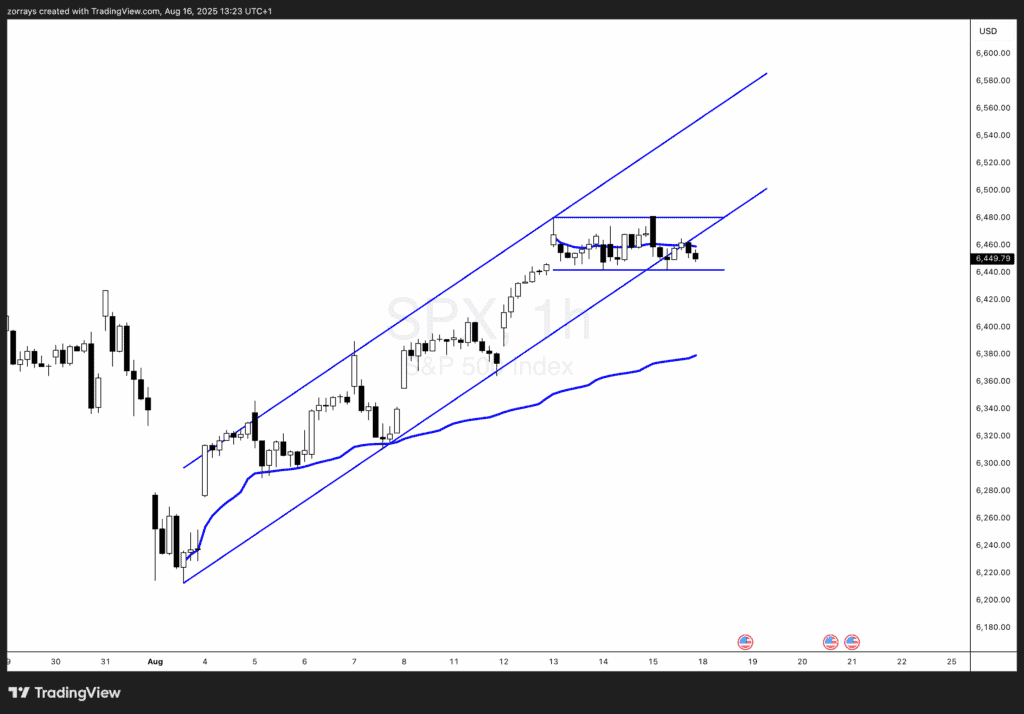
The SPX is currently trading within a well-defined ascending channel, respecting both upper and lower bounds since early August. Price recently consolidated into a parallel channel at the upper end—often a bullish flag continuation pattern.
As long as SPX remains inside this ascending channel, the outlook is mildly bullish. The pullback toward the lower parallel is viewed as healthy consolidation, not breakdown.
Momentum appears to be building for another push higher, especially if Powell delivers a market-friendly tone at Jackson Hole. However, a clean break below the lower blue horizontal support would invalidate this view and shift sentiment near-term.
The ECB and BOE are also near inflection points. A dovish Powell may give them cover to pause. BOJ, meanwhile, remains firmly dovish, offering a contrast that could weaken the yen further.
Political heat, dovish market expectations, and rising internal voices are testing the Fed’s ability to appear neutral and data-driven. Powell’s speech must reassert credibility without spooking markets.
CME FedWatch shows 80% odds of a September cut. Yet real economic indicators suggest caution. Powell could take the opportunity to level-set expectations—especially if the Fed wants to avoid pre-committing.
Watch for:
Institutions appear net long tech and cyclicals, suggesting optimism. But options flows show significant hedging. Expect volatility spikes around the speech window.
It’s an annual economic conference hosted by the Kansas City Fed, bringing together global central bankers, economists, and policymakers.
Markets closely watch Powell’s tone and forward guidance, which often sets the stage for near-term policy moves.
Yes, markets currently price in a high likelihood of a 25bps cut.
Tariffs can raise prices, impacting inflation—a key input into Fed policy. But their long-term effect depends on corporate pricing power and supply chains.
SPX is likely to break higher, especially if it stays in the current ascending channel.
Yes, especially for the ECB and BOE, which often move in sync with the Fed.
With markets pricing in cuts, inflation showing mixed signals, and labor markets wobbling, Jackson Hole 2025 may turn out to be a defining moment for U.S. monetary policy.
For now, the SPX remains in a bullish channel, suggesting optimism prevails—but all eyes are on Powell to either validate or reset expectations.
Alchemy Markets is a multi-asset brokerage providing retail traders with the same elite trading conditions, tools, and transparency typically reserved for institutions.

Select the categories and companies you wish to follow directly to your person rss feed.
Create Custom RSS FeedSign up and join over 5,000 professional members who receive personalized news alerts, curated professional connections, and more for free!
The AI trade has always been a supply chain story. For the past two years, the narrative has been simple: insatiable demand for compute infrastructure, constrained supply at every choke point, and the companies that own the bottlenecks collect the toll. NVIDIA on GPUs. ASML on lithography. Samsung, SK Hynix, and Micron on memory. The entire semiconductor complex has traded on scarcity, and scarcity has delivered historic margins.
Interactive Brokers reported customer equity of USD 964.7 billion at the end of the third quarter, up 27% year on year, as customer accounts increased 35% to 5.58 million.
Crypto exchange BingX has secured a Markets in Crypto-Assets Regulation (MiCA) licence for its European arm from Austria's Financial Market Authority (FMA).
CXM Group has agreed to acquire TD Markets (Pty) Ltd, a Johannesburg-headquartered broker authorised by South Africa’s FSCA. TD Markets keeps its brand, team and licence, and Amar Ramith stays as CEO. Financial terms were not disclosed. The deal gives CXM a regulated base in South Africa. Clients need take no action.
Global equities under pressure: Hotter than expected US inflation and rising yields weighed on stocks, particularly technology and semiconductor shares.
Understand trading psychology and learn how a clear strategy, risk management and a trading journal help build discipline and day trading consistency.
Ripple Prime has launched support for real-world asset perpetual swaps, giving institutional clients including Virtu exposure to more than 100 reference markets across equities, indices, ETFs, metals, energy and FX. The swaps reference Trade.xyz perpetual futures on Hyperliquid and trade and settle around the clock.
iSAM Securities Apex has integrated with Crossover Markets, connecting brokers to CROSSx, its institutional digital asset ECN, through Apex’s ultra-low-latency technology stack.
Your Bourse and 4XPORTAL highlight their existing partnership, combining client onboarding, CRM and payment solutions with liquidity, execution and risk-management infrastructure for brokers.
The partnership brings together 4XPORTAL’s brokerage technology capabilities with Your Bourse’s connectivity, liquidity aggregation, and risk-management infrastructure.