just now


Liquidity Finder Ltd is incorporated in England and Wales, company number 10610740, registered address 167-169 Great Portland Street, Fifth Floor, London W1W 5PF, United Kingdom.
Published: just now

For all the noise about recession fears and economic slowdown, the U.S. economy continues to hum along at a fairly steady pace. Growth hasn’t collapsed, inflation is easing (if stubbornly), and unemployment remains near historic lows. Yet sentiment has plunged to near three-year lows. Consumers feel worse, investors feel anxious, and markets are showing cracks in what’s been an impressive rally.
It’s one of those odd macro moments when the data says “we’re fine,” but everyone feels like something’s about to go wrong. The disconnect between sentiment and reality has rarely felt this wide — and it’s giving traders, businesses, and policymakers a strange sense of déjà vu.
Reality check: the economy is still expanding. Job growth has cooled but not cratered, inflation is sticky but trending down, and most sectors remain resilient. Yet consumer and business confidence surveys are turning sour.
Part of this stems from policy uncertainty — the ongoing government shutdown, fiscal tensions, and political gridlock. Another part is psychological fatigue. After two years of high prices, volatile markets, and interest-rate shocks, optimism is running on fumes.
It’s like driving a car that’s still running smoothly but hearing a faint rattle under the hood — even if it’s nothing serious, you can’t help but worry. That’s where markets are now: cautious, twitchy, but still moving forward.
In theory, next week should be a big one for U.S. data watchers. We were supposed to get CPI, retail sales, and a range of key macro indicators that would help gauge the economy’s pulse. In practice, though, the ongoing government shutdown has thrown that plan out the window. With government agencies closed, there’s simply no one around to collect, collate, or publish the official data.
That leaves investors reliant on third-party surveys, like the NFIB Small Business Optimism Index, which is expected to remain little changed. These alternative data points will become the market’s lifeline in the absence of traditional releases.
One piece of information that’s still expected is the federal budget statement — and this one might surprise. Typically, October is a heavy borrowing month for the U.S. Treasury:
But with parts of the government shut down and wages temporarily unpaid, the short-term effect could be a budget surplus. Of course, that would be more illusion than improvement — once the shutdown ends and back pay is issued, the books will swing sharply back into deficit.
It’s a reminder that the U.S. economy isn’t short on noise, but that noise doesn’t always tell the real story.
Across the Atlantic, the Bank of England remains on course to cut rates in December, assuming no major surprises from data or fiscal announcements. The central bank is deeply divided, but falling inflation and cooling wages are shifting the consensus toward easing.
Jobs Data (Tuesday): Private-sector wage growth is likely to continue edging down, staying below 4% by year-end. That’s a key signal for policymakers that inflation pressures are easing beneath the surface.
3Q GDP (Thursday): The UK economy is on track for around 0.2% growth in the third quarter, modest by any measure but steady considering recent headwinds. After a stronger first half of the year, helped by tariff frontloading and resilient spending, growth looks set to slow further into 2026 as government support fades.
The theme across both sides of the Atlantic is similar: growth holding up, inflation gradually easing, but sentiment slipping. People aren’t feeling the recovery — and that matters.
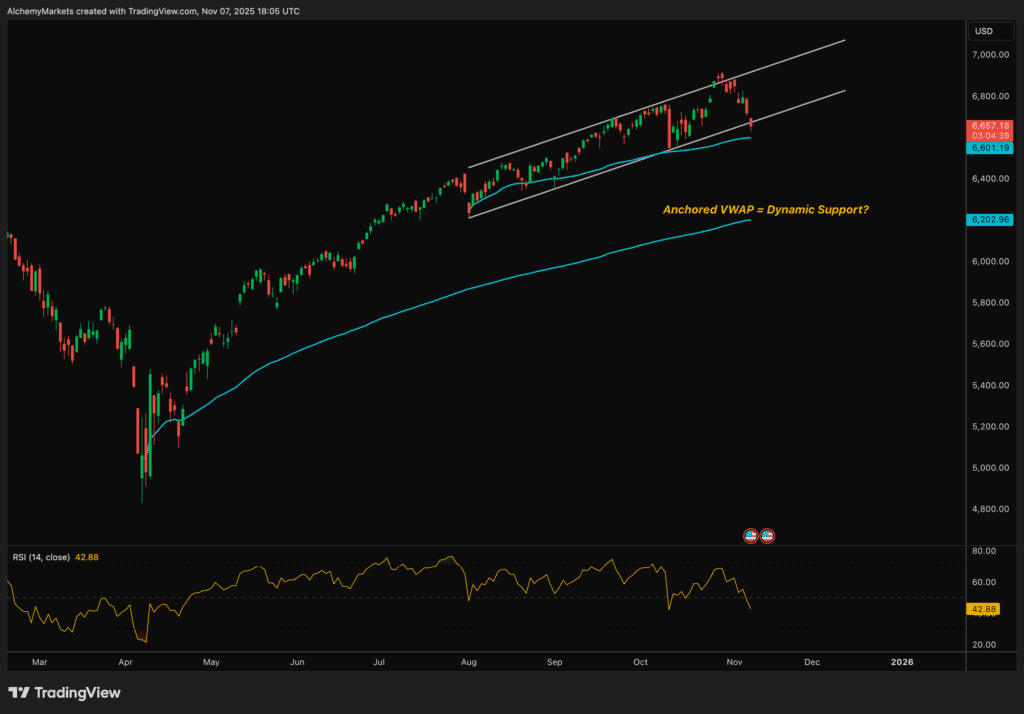
The chart above tells the story better than words can. The S&P 500 has broken below its ascending channel, a structure that’s defined the uptrend since early spring. That’s a warning shot — a sign that momentum is fading after a strong run.
Right now, the index is testing key dynamic support near 6200, which coincides with the Anchored VWAP from the March pivot. This level could prove to be a critical line in the sand for bulls. If it holds, a rebound could follow; if it breaks, the next leg lower might be underway.
Adding to the caution, the RSI has slipped into bearish territory, showing divergence between price action and momentum — lower highs in RSI even as prices hit new peaks earlier this quarter. That kind of divergence often signals exhaustion in an uptrend.
In short, the market still looks healthy from afar, but beneath the surface, it’s starting to sweat. Bulls have lost some control, and sentiment is turning defensive. The chart supports the macro story: fundamentals remain solid, but the collective mood has darkened.
This “sentiment vs. reality” gap matters because it shapes how consumers spend, how businesses invest, and how markets trade. When people feel worse than the data suggests, they often act accordingly — pulling back on spending, hiring, and risk-taking. That can turn perception into reality faster than policymakers would like.
So, are we worrying too much, or not enough? The answer probably lies somewhere in between. The economy’s still resilient, but the psychological scars from years of volatility, inflation, and political noise haven’t healed. Until confidence catches up to the data, markets may stay choppy and reactive.
For traders, this means keeping an eye on both — the hard numbers (when they finally arrive) and the soft mood that often moves prices first.
Bottom Line:
The data still says “steady.” The charts say “watch out.” And sentiment says “brace yourself.” Next week’s numbers — if they come — won’t just measure inflation or spending. They’ll test whether confidence itself can find a floor.
Alchemy Markets is a multi-asset brokerage providing retail traders with the same elite trading conditions, tools, and transparency typically reserved for institutions.

Select the categories and companies you wish to follow directly to your person rss feed.
Create Custom RSS FeedSign up and join over 5,000 professional members who receive personalized news alerts, curated professional connections, and more for free!
Multi-asset trading broker AvaTrade has agreed to acquire the majority of FXCM Group’s business and brand, in a transaction that would bring a longstanding retail FX franchise into the AvaTrade Group.
LSEG and CMC Markets have signed a multi-year strategic data agreement expanding CMC's access to LSEG's real-time and delayed pricing, reference and corporate actions data, news and analytics, plus AI-ready content, to support new products, entry into new markets and the growth of CMC's institutional and B2B partnerships.
The Tel Aviv Stock Exchange is considering a bid for the Cyprus Stock Exchange, with Israeli media citing its EU licence, trading platform and clearing house. Euronext’s Athens exchange and India’s National Stock Exchange are also seen as contenders, and Cyprus aims to sign a sale agreement by the end of this year.
CME Group will launch baseball futures on 12 October, pending regulatory review, tracking CME FutureSports Performance Indexes built on Official League Data. Standard and micro contracts will start with the 2026 Postseason and the four clubs in the League Championship Series, trading around the clock.
ESMA has published an opinion stating that MiCA-authorised crypto-asset service providers should cease services tied to non-MiCA-compliant stablecoins for EU clients across MiCA crypto-asset services. National authorities should require remediation of existing exposures within three months, by early January 2027.
Nasdaq Ventures has made a strategic investment in Amsterdam-based derivatives and crypto exchange One Trading, with both firms to explore 24/7 trading of equity futures. The undisclosed investment follows Nasdaq's US$100 million investment in Payward, the parent of Kraken, and CME Group's move to 24/7 trading.
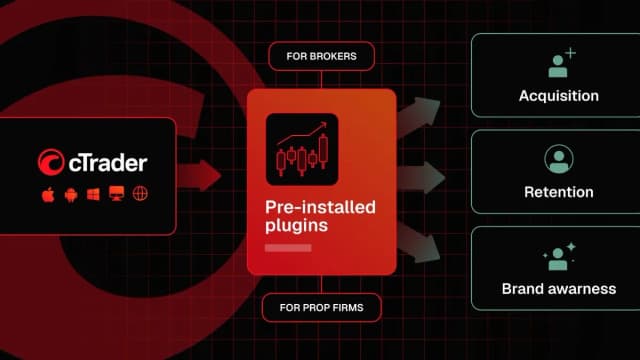
cTrader has opened multi-platform plugins to brokers and prop firms, which can pre-install their own tools for clients or list them in cTrader Store. The plugins run across Mobile, Web, Windows and Mac, and can be built and launched independently of core-platform releases, including trading journals and calculators.
Institutional brokerage and financial infrastructure provider Clear Street has joined TradingView’s broker network, allowing its clients to trade US stocks, exchange-traded funds and options directly through the charting and analysis platform.
Learn how to improve trading psychology, manage fear and greed, avoid revenge trading, and follow your trading strategy with discipline and a trading journal.
GTC Prime has announced a strategic partnership with Centroid Solutions to manage and distribute its liquidity through CS 360 Bridge, Centroid's multi-asset connectivity and execution engine, giving brokers and institutional clients access to tailor-made pricing, low-latency execution and real-time risk management.