just now


Liquidity Finder Ltd is incorporated in England and Wales, company number 10610740, registered address 167-169 Great Portland Street, Fifth Floor, London W1W 5PF, United Kingdom.
Published: just now

Over the past few weeks, I’ve been closely following the developments from the Bank of Japan, and to be honest, this is the most interesting the BoJ has been in a long time.
We’re watching a central bank slowly (and I mean very slowly) turn the wheel after decades of ultra-loose monetary policy.
And if you’re trading the Japanese yen or have exposure to Asia, what’s happening now could quietly reshape how capital flows into the region, and what USD/JPY might look like in the months ahead.
Let me break it down in simple terms.
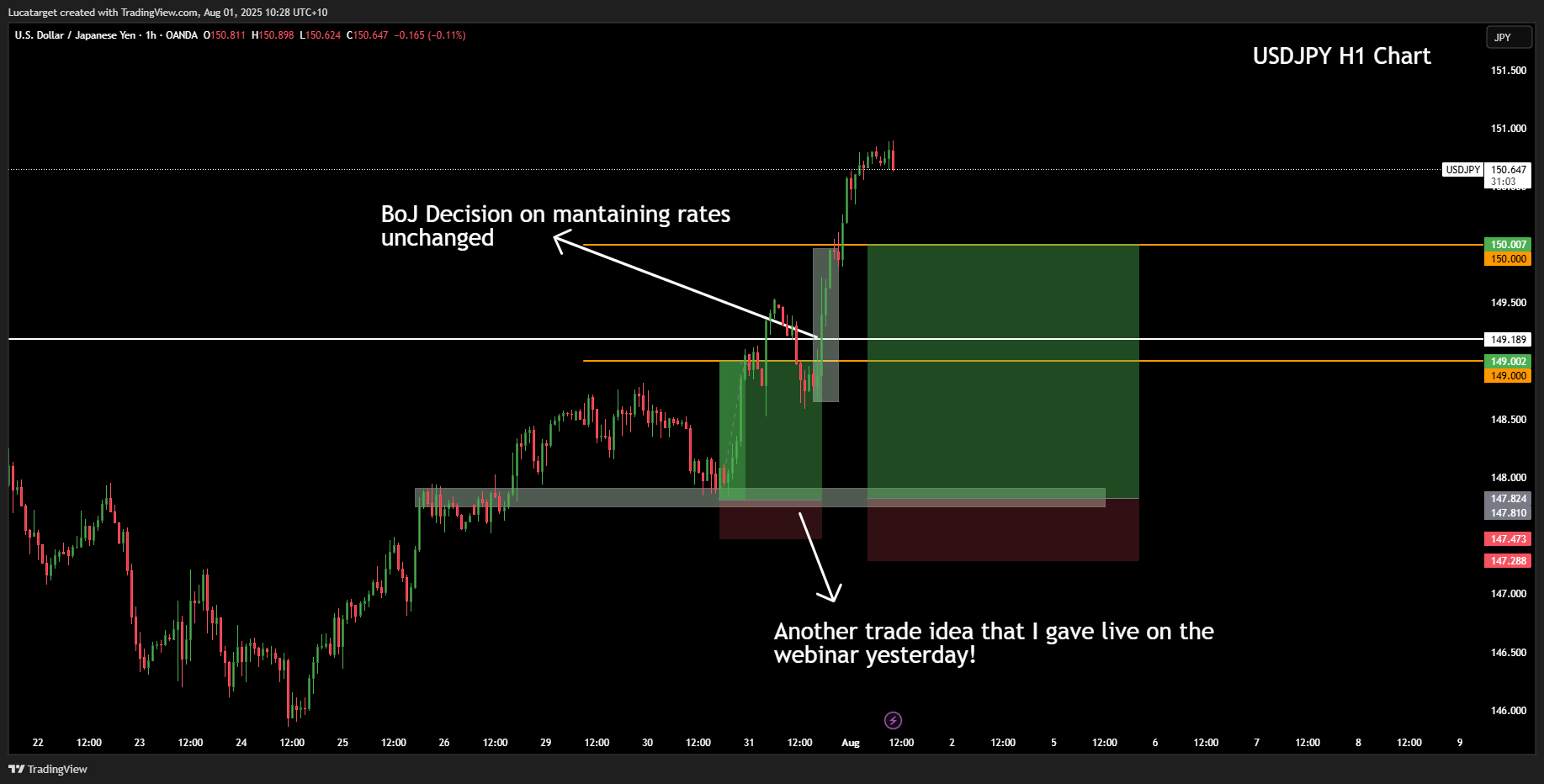
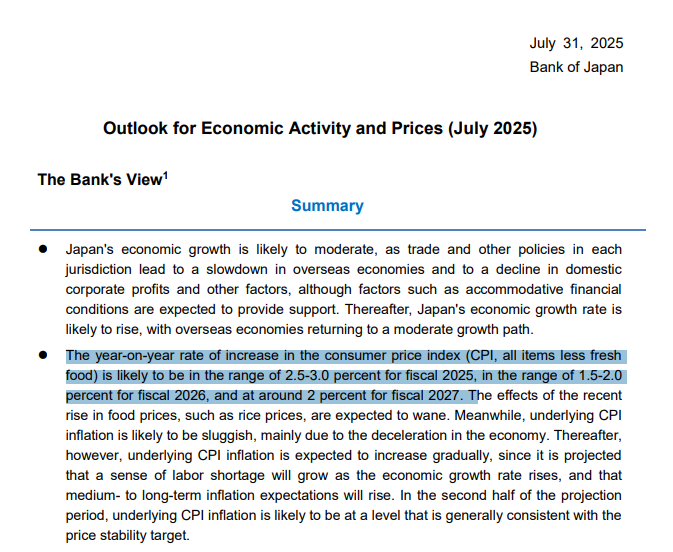
The BoJ held rates steady at 0.50% that’s no surprise. But what did raise eyebrows was the fact they bumped up their inflation forecast for 2025 to 2.7%, up from 2.2%. That’s not a small revision.
At first glance, this looked hawkish. Markets even responded with a quick push higher in the yen.
For a moment, it seemed like Japan might be finally warming up to more aggressive tightening. But then came the press conference and Governor Ueda had other ideas.
During the press conference, Ueda poured a big glass of cold water over those hawkish expectations. He was clear: the BoJ isn’t hiking just because inflation is up.
What they want to see is sustainable, wage-driven inflation not just price pressures from food or supply-side distortions.
And when it comes to the new U.S.-Japan trade deal? Ueda was cautious there too. He called the current situation “foggy” and advised against assuming that the tariff impact would be immediately clear.
That kind of language doesn’t usually come from a central bank ready to hike aggressively.
So where does that leave the yen?
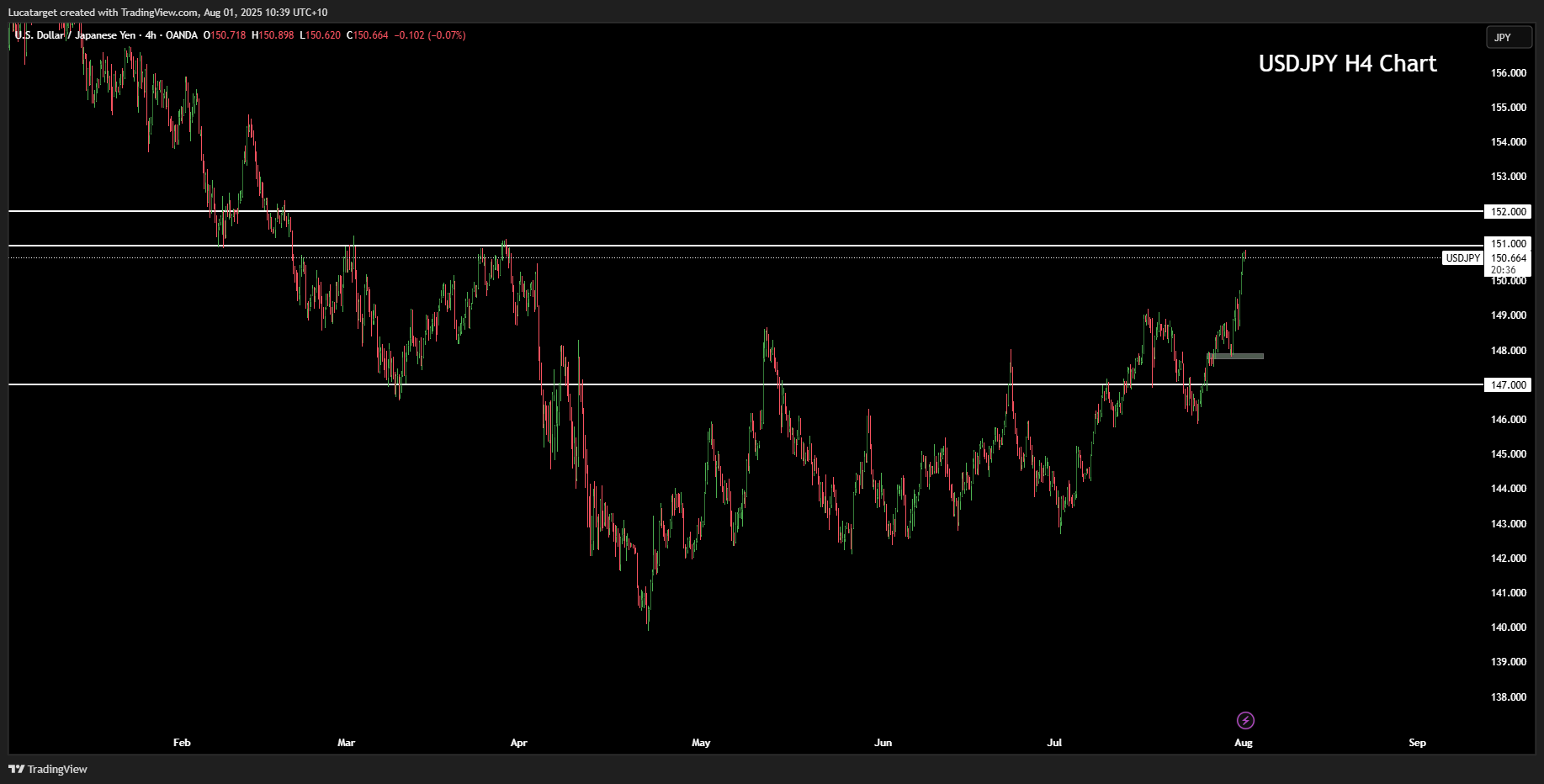
Well, USD/JPY is hovering just under 150 and to me, it feels like we’re at an inflection point. The short squeeze we saw last week was real. A lot of the long yen positions entered between 158 and 150 are now being reevaluated.
There's nearly $10 billion in futures positioning in that range, that kind of clustering can act like a gravity well either pulling us back to 152 or snapping lower toward 147.
But here’s the kicker: even with BoJ sounding slightly more upbeat about growth and inflation, Japan is still sitting on negative real yields. In a low-volatility FX environment, that just doesn’t attract foreign capital the way the U.S. or even Europe does right now.
From a positioning point of view, I’m cautious on shorting USD/JPY too aggressively here. We need to respect the technical levels 147 is a key support, while 151/152 remains heavy resistance.
But fundamentally, the story is changing. Slowly, yes, but it's changing.
If BoJ does hike this year and inflation proves sticky, the yen could see a stronger bid, especially as global equity volatility picks up. Until then, the dollar is still king but it’s no longer unchallenged.
1. What did the Bank of Japan decide in its July 2025 meeting?
The BoJ kept its short-term interest rate unchanged at 0.50% for the fourth consecutive meeting. While they revised their inflation forecast for 2025 upward to 2.7%, Governor Ueda emphasized that further rate hikes would only happen if inflation proves sustainable, not just reactive.
2. Why is the Japanese yen (JPY) still weak despite rising inflation?
Because the BoJ is still cautious. Inflation in Japan is largely supply-driven (think food and energy), not demand-led. Until wage growth and domestic consumption strengthen, the BoJ won’t rush into hiking rates keeping real yields low and the yen less attractive globally.
3. How does the U.S.xJapan trade deal affect BoJ policy?
The recent trade deal adds layers of uncertainty. Governor Ueda pointed out that the “fog” around tariffs hasn’t cleared, meaning the BoJ is hesitant to overreact without solid data on how the agreement affects real economic activity.
4. Is USD/JPY likely to break below 147 or push above 152?
Right now, USD/JPY is trading in a tight range. There's heavy positioning in the 150/152 zone, and unless we see a strong surprise from either the BoJ or the Fed, it’s likely to remain range-bound. That said, any BoJ rate hike or dovish Fed move could spark a break below 147.
5. What’s the best way to trade JPY in this environment?
I’m keeping a tactical approach respecting technicals while watching global rate differentials. Until the BoJ commits to a clear tightening path, I see better opportunities in short-term USD/JPY pullbacks and yen crosses where risk sentiment plays a bigger role.
This content may have been written by a third party. ACY makes no representation or warranty and assumes no liability as to the accuracy or completeness of the information provided, nor any loss arising from any investment based on a recommendation, forecast or other information supplies by any third-party. This content is information only, and does not constitute financial, investment or other advice on which you can rely.
ACY Securities is one of Australia's fastest growing multi-asset online trading providers, offering ultra-low-cost trading, rock-solid execution, technologically superior account management and premium market analysis.

Select the categories and companies you wish to follow directly to your person rss feed.
Create Custom RSS FeedSign up and join over 5,000 professional members who receive personalized news alerts, curated professional connections, and more for free!
Multi-asset trading broker AvaTrade has agreed to acquire the majority of FXCM Group’s business and brand, in a transaction that would bring a longstanding retail FX franchise into the AvaTrade Group.
LSEG and CMC Markets have signed a multi-year strategic data agreement expanding CMC's access to LSEG's real-time and delayed pricing, reference and corporate actions data, news and analytics, plus AI-ready content, to support new products, entry into new markets and the growth of CMC's institutional and B2B partnerships.
The Tel Aviv Stock Exchange is considering a bid for the Cyprus Stock Exchange, with Israeli media citing its EU licence, trading platform and clearing house. Euronext’s Athens exchange and India’s National Stock Exchange are also seen as contenders, and Cyprus aims to sign a sale agreement by the end of this year.
CME Group will launch baseball futures on 12 October, pending regulatory review, tracking CME FutureSports Performance Indexes built on Official League Data. Standard and micro contracts will start with the 2026 Postseason and the four clubs in the League Championship Series, trading around the clock.
ESMA has published an opinion stating that MiCA-authorised crypto-asset service providers should cease services tied to non-MiCA-compliant stablecoins for EU clients across MiCA crypto-asset services. National authorities should require remediation of existing exposures within three months, by early January 2027.
Nasdaq Ventures has made a strategic investment in Amsterdam-based derivatives and crypto exchange One Trading, with both firms to explore 24/7 trading of equity futures. The undisclosed investment follows Nasdaq's US$100 million investment in Payward, the parent of Kraken, and CME Group's move to 24/7 trading.
cTrader has opened multi-platform plugins to brokers and prop firms, which can pre-install their own tools for clients or list them in cTrader Store. The plugins run across Mobile, Web, Windows and Mac, and can be built and launched independently of core-platform releases, including trading journals and calculators.
Institutional brokerage and financial infrastructure provider Clear Street has joined TradingView’s broker network, allowing its clients to trade US stocks, exchange-traded funds and options directly through the charting and analysis platform.
Learn how to improve trading psychology, manage fear and greed, avoid revenge trading, and follow your trading strategy with discipline and a trading journal.
GTC Prime has announced a strategic partnership with Centroid Solutions to manage and distribute its liquidity through CS 360 Bridge, Centroid's multi-asset connectivity and execution engine, giving brokers and institutional clients access to tailor-made pricing, low-latency execution and real-time risk management.