
just now


Liquidity Finder Ltd is incorporated in England and Wales, company number 10610740, registered address 167-169 Great Portland Street, Fifth Floor, London W1W 5PF, United Kingdom.
Published: just now


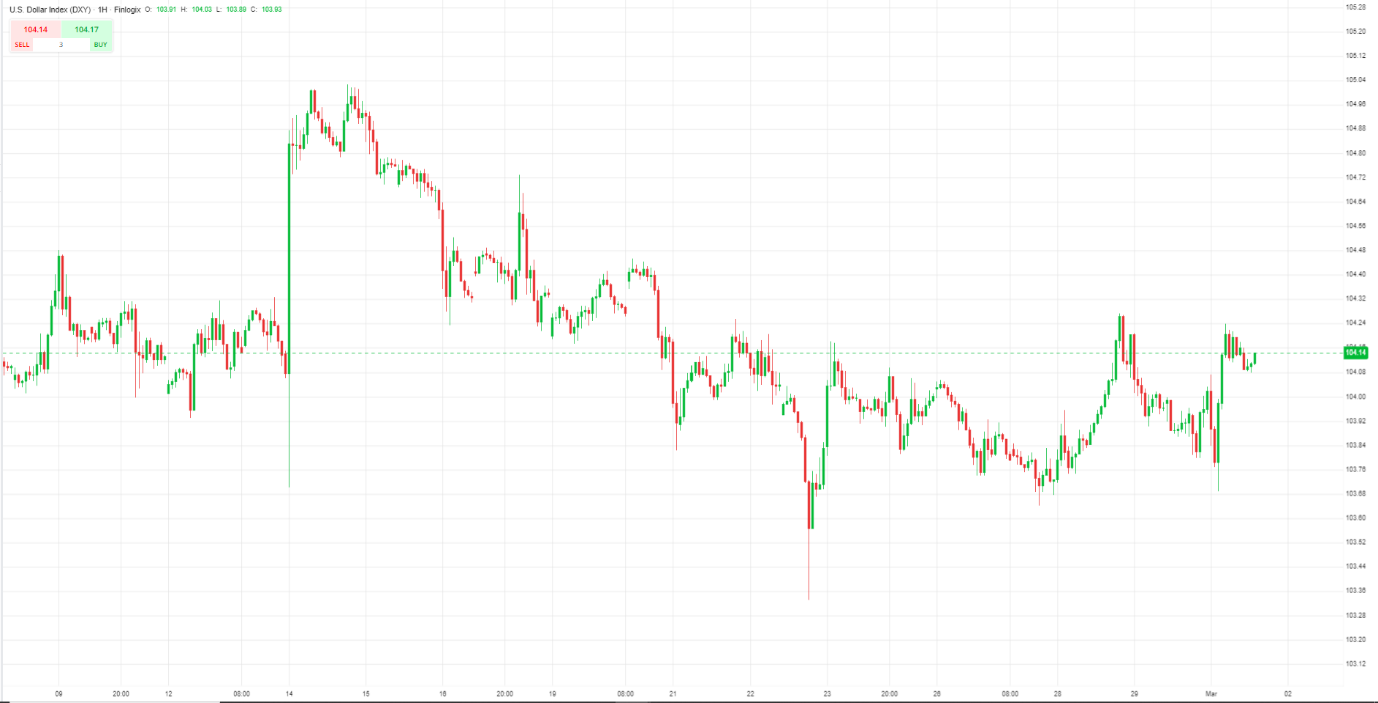
Don't count on the idea that the United States will always be exceptional. Right now, currency markets are moving very little, and there isn't much happening to make them change. As we approach the end of the month, some news stories suggest the US dollar might get weaker.
Recently, there was a Bloomberg article talking about "US exceptionalism," saying it will help the US dollar stay strong. While I agree with some points in the article, I don't agree that the US dollar will stay strong for a long time. As you all know of now, we can already say that I expect the US dollar to decrease by about 5% from now until the end of the year.
The US has indeed had impressive economic growth compared to other major countries, and the US dollar reached its highest point in September 2022. However, I don't think that peak will happen again, and I rather believe the dollar will become weaker in the medium to long term.
One thing making the US stand out is how it dealt with energy price shocks. Unlike Europe, the US, being an energy producer, didn't face significant energy price increases. This contributed to the US economy accelerating while the Eurozone and the UK experienced slower growth. However, this difference might fade as natural gas prices fall.
The resilience of the US economy also comes from substantial fiscal support, starting with Trump's tax cuts, followed by support packages for companies, and additional help for consumers. Yet, this has led to a high budget deficit, indicating that the US is borrowing growth from the future. The consequence may be weaker growth, potentially higher inflation, and a less strong US dollar. So, while the US has strengths in technology and labor market flexibility, there's a challenge ahead in dealing with unsustainable budget deficits.
USD Index H1
The New Zealand Dollar (NZD) took a plunge following the Reserve Bank of New Zealand's (RBNZ) recent actions. The rates curve, indicating interest rates across various maturities, seemed unusual compared to other major currencies. There was a risk that the RBNZ's statements might not meet market expectations for more rate hikes. Just yesterday, the market implied a 50% chance of a 25 basis points rate hike in May, but after the RBNZ decided to keep the key policy rate at 5.50%, that chance dropped close to zero.
NZDUSD H1
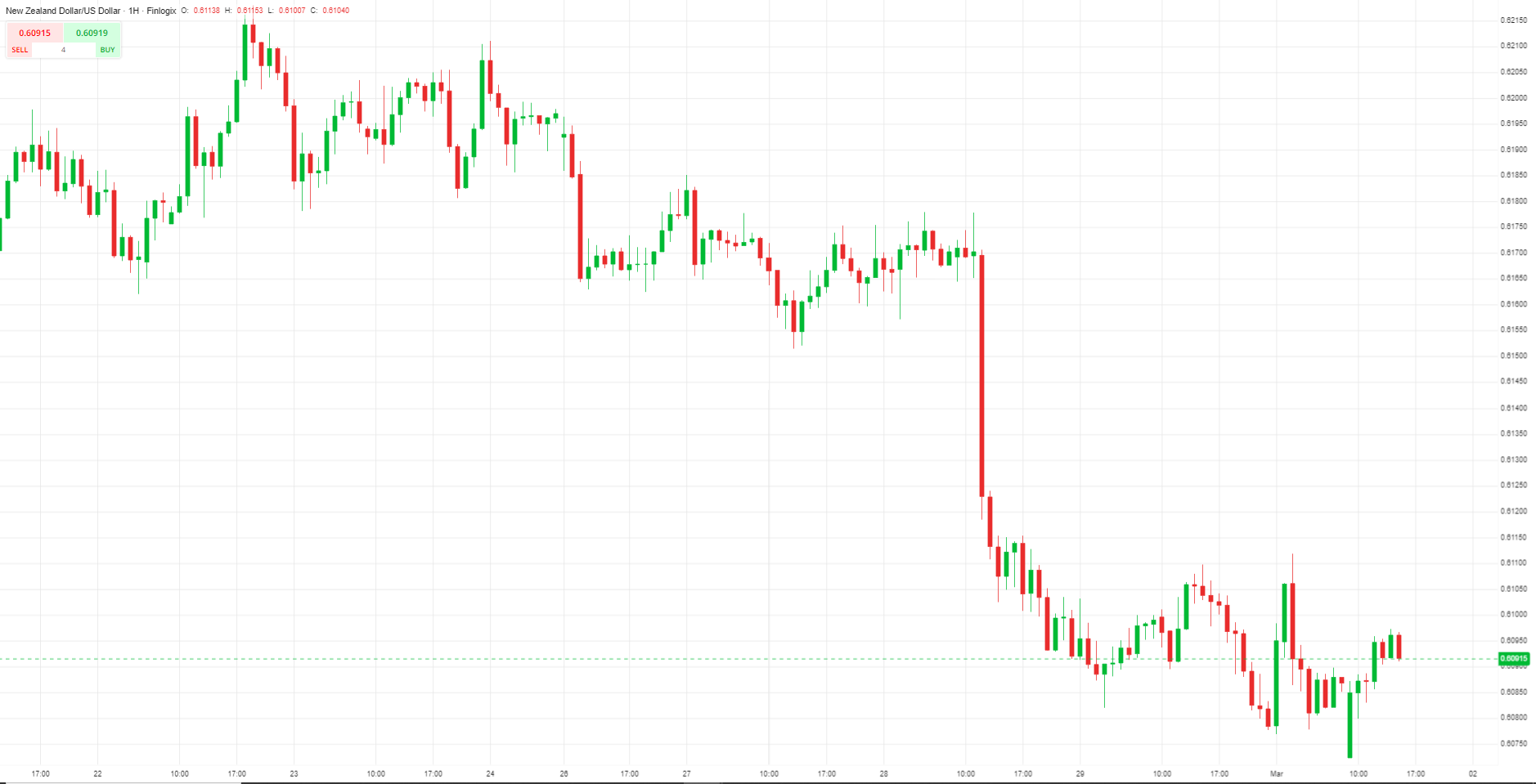
Crucially, the RBNZ acknowledged that risks to the inflation outlook had become more balanced. The updated forecasts also showed a slightly lower profile, with the peak policy rate now expected to be 5.60%, down from the previous estimate of 5.69%. The RBNZ softened its guidance on future policy by removing the conditional need to raise rates further if inflationary pressures were stronger than anticipated. However, the RBNZ remains vigilant about "heightened geopolitical and climate conditions" affecting inflation, pledging to act if needed.
The RBNZ emphasized the need for a "sustained decline in capacity pressures" to bring inflation into the 1%-3% target band. While this communication suggests a softening of the bias to tighten policy further, it doesn't completely remove that bias. The RBNZ conveyed a strong message that the current policy stance will be maintained for a sustained period.
As a response to this, the 2-year bond yield in New Zealand dropped by 16 basis points, and the NZD underperformed due to a significant repositioning in the market, anticipating a potential rate cut. Recent data showed Leveraged Funds holding the largest long NZD position since August last year. However, it's important to note that we are still a considerable distance from considering rate cuts, suggesting that a prolonged decline in the NZD from this point onward is unlikely.
Insights Inspired by MUFG: Credit to Their Analysis for Shaping the Aspects of This Text
This content may have been written by a third party. ACY makes no representation or warranty and assumes no liability as to the accuracy or completeness of the information provided, nor any loss arising from any investment based on a recommendation, forecast or other information supplied by any third-party. This content is information only, and does not constitute financial, investment or other advice on which you can rely.
ACY Securities is one of Australia's fastest growing multi-asset online trading providers, offering ultra-low-cost trading, rock-solid execution, technologically superior account management and premium market analysis.

Select the categories and companies you wish to follow directly to your person rss feed.
Create Custom RSS FeedSign up and join over 5,000 professional members who receive personalized news alerts, curated professional connections, and more for free!
24X National Exchange has filed a proposed rule change with the SEC to launch 24X Options, a general options market trading from 9:30 a.m. to 4:00 p.m. ET. The filing also covers binary KPI options on quarterly revenue, earnings per share and other metrics for 23 of the most actively traded U.S. companies.
cTrader Mobile 5.11 introduces Signals, a new app where traders can browse signals from leading providers and act on them directly in the platform.
ATFX Group has partnered with South Africa-based payment and digital asset infrastructure provider FiveWest to support institutional fund movements for ATFX Connect and add a cryptocurrency funding option for eligible retail clients. Both firms hold FSCA Over-the-Counter Derivative Provider licences.
UK inflation rose to 3.6% in October, keeping a December Bank of England rate rise likely, while the euro hit a fresh one-year low against the dollar ahead of tonight’s Fed minutes. Daily FX analysis from Equals.
GBPUSD has shifted decisively lower. After reaching 1.3228, the pair reversed and initially consolidated around the moving averages before breaking sharply below the 1.3180 area. It is now trading near 1.3169.
Nvidia shares jumped around 4% after hours after beating earnings and revenue expectations and raising its outlook for 75% year on year revenue growth through January 2028. The positive Nvidia results also lifted AI-related stocks, with CoreWeave up 8% and Nebius 10%.
Deutsche Börse Group has appointed Maximilian Weissenrieder as Head of Cash Market from 1 January 2027, succeeding Eric Leupold, who becomes CEO of Eurex. Weissenrieder has led Group M&A and Venture Investments since October 2024 and will retain those duties until a successor is named by the Group.
DEXA, the AI-powered risk management and analytics platform developed by TFB (Tools for Brokers), has connected with Match-Trader, bringing real-time trader analysis and toxic flow detection to brokers on the platform. DEXA classifies trader behaviour from as early as the third trade, with no change to execution systems.
Poland's financial markets regulator, the Polish Financial Supervision Authority (Komisja Nadzoru Finansowego, KNF), is preparing a new product intervention on contracts for difference (CFDs)
Choosing an outsourced dealing desk is much closer to hiring a head of dealing than to buying a piece of software. You are handing an external team one of the most sensitive functions in your brokerage - your exposure, your routing, your clients' trading activity - so the decision should rest on evidence of how the team actually operates, not on how good the sales presentation looks.