just now


Liquidity Finder Ltd is incorporated in England and Wales, company number 10610740, registered address 167-169 Great Portland Street, Fifth Floor, London W1W 5PF, United Kingdom.
Published: just now
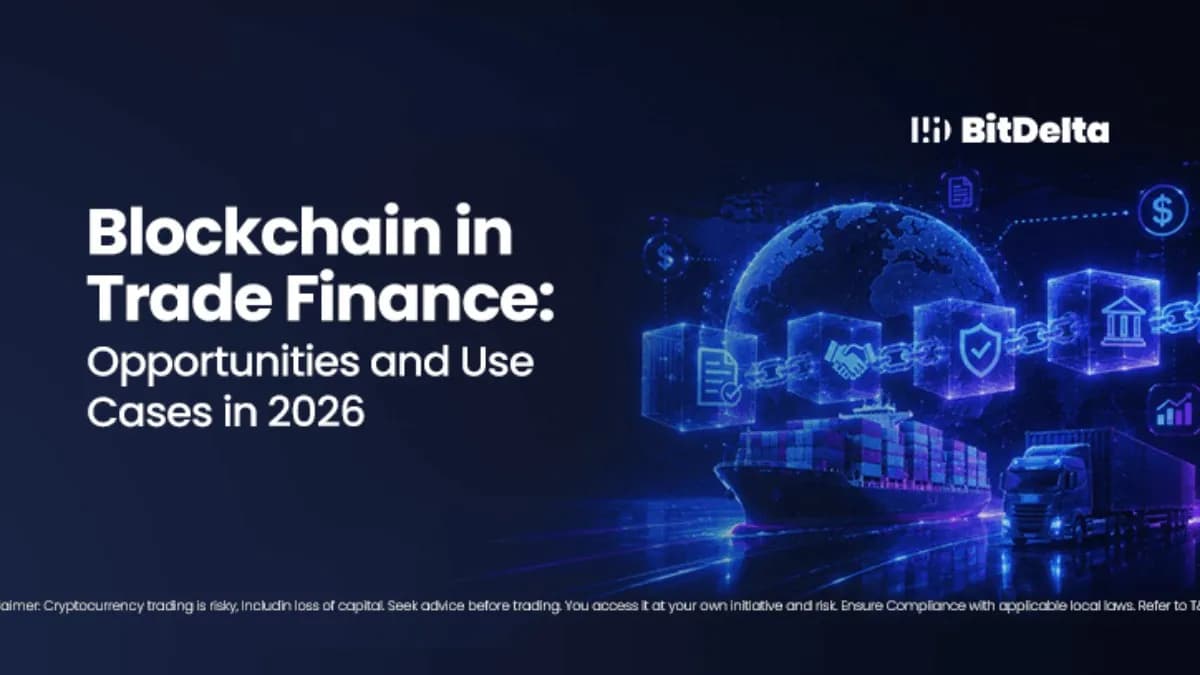
The area of trade finance has been complex since day one. Multiple parties are involved in transactions while documents have always passed between them through systems that do not interact. Exporters, importers, banks, and logistic service providers all rely on documentation to conduct business.
Here comes blockchain.
Unlike a system filled with inefficiency, blockchain technology creates a platform that allows everyone involved to record, verify and use information in real-time without the need to interact in a traditional way.
Trade finance has relied on trust in the past as well as the usage of various documents such as letters of credits, bills of lading, invoices, and more. All these transactions are checked by various companies and institutions.
What ends up happening is that the same information is being reviewed by multiple parties, creating inefficiencies.
However, blockchain presents an alternative way of doing things. Rather than everyone having their own record, everybody uses the same record. Once information is entered into the record, it is transparent and hard to tamper with, making it unnecessary to keep verifying it over and over again.
The blockchain acts as a distributed ledger system. Within trade finance, it implies that everybody involved has access to the same piece of information.
Rather than passing documents between various entities, the information gets stored on a single platform where authorised individuals can see it instantly.
Example
A business exports goods to another company. Instead of going through a lengthy process where the documents get passed around from one entity to the next to be verified, the shipment details and invoices can all be stored within the same system.
Document-related issues are among the major delays in trade finance, which blockchain can significantly reduce through its ability to update information in real time.
The process of obtaining approvals would take less time because all the information would be available immediately, thus speeding up transactions.
As all the participants get access to the same information, it becomes possible to decrease discrepancies caused by inaccurate or contradicting records.
When there are changes in shipment details or in documentation, all the parties are informed about it.
Most trade finance frauds usually involve manipulation or double funding. Blockchain provides a secure way of storing information, thus helping to minimise the number of cases when documents are changed.
Trade finance requires cooperation between multiple banks, logistics providers, companies etc. Blockchain allows for better coordination since everything is provided within a single framework.
Using blockchain, it is possible to optimize cross-border payments which takes less time compared to traditional banking.
Letter of credits, an important part of trade finance, become issued and validated using blockchain.
Items going through borders can be traced using blockchain technology. Every step of the logistics can be accounted for, resulting in a transparent record.
Businesses tend to use invoices for obtaining financing. Blockchain technologies facilitate fast verification of such documents, making the process easier for the lender.
While there are numerous advantages of integrating blockchain into trade finance, implementation is not automatic.
Firstly, laws in various countries might differ. Secondly, blockchain should be combined with already existing mechanisms, thus requiring time to achieve integration. Moreover, standardisation is needed to make sure all involved parties will operate on the same platform.
All of these factors make blockchain implementation slower than anticipated but do not prevent it from happening.
Currently, processes in trade finance move towards greater automation and digitalisation. As mentioned before, blockchain is one of such initiatives.
This does not mean it would replace existing models of financing and logistics instantly but would rather improve them with time. The more people use blockchain-based platforms, the more efficient the process will become.
The blockchain technology used in the field of trade finance not only represents an upgrade when it comes to technology. It represents a way in which broken business practices have to be fixed for quite some time now.
The technology improves the exchange of information which results in the creation of a much more efficient network.
With globalization increasing every year, it is only natural that the demand for innovative and efficient solutions grows too.
BitDelta operates within this evolving digital landscape, giving users access to markets shaped by innovation, data and global financial shifts. As systems like blockchain continue to influence how value moves across borders, having the right platform helps you stay aligned with where the market is heading, not where it has been.
Select the categories and companies you wish to follow directly to your person rss feed.
Create Custom RSS FeedSign up and join over 5,000 professional members who receive personalized news alerts, curated professional connections, and more for free!
CME Group will launch Bitcoin Cash and Uniswap futures on 19 October, pending regulatory review, expanding its crypto derivatives suite with standard and micro contracts. Executives from CME Group, Volatility Shares and Ripple Prime say the products give institutions broader, regulated tools for managing digital asset risk.
ATARIA CRM helps brokers manage a growing client base by bringing client information into one organized platform. It highlights key client statuses such as total, active, inactive, and blocked clients, making it easier for teams to track records, manage communication, automate follow-ups, personalize engagement, and use data insights to strengthen relationships, improve collaboration, save time, and support business growth.
The biggest macro events of Q3 may be behind us. Now comes the next question: what happens when the market starts separating companies rather than trading the macro narrative? Following the Fed’s 25-basis-point hike, a flattening yield curve and sharply elevated tanker rates, the investment landscape is shifting. The same forces can create very different pressures across technology, energy, financials, industrials and consumer sectors. In this week’s BitDelta Pro Weekly Outlook, we look beyond the headlines to examine where those differences may start to matter most. Read the full article for our breakdown of the rate path, the inflation signal hiding in shipping costs, and the sector dynamics taking shape. BitDelta Securities Financial Services LLC, regulated by the Capital Market Authority under Category 5 (Introduction Only), acts solely as an introducer and does not provide trading, execution, dealing, advisory, portfolio management, or custody services. All trading, execution, and investment-related services are provided by BitDelta Limited, Mauritius, a licensed Investment Dealer. All trading and investments involve risk. The value of investments may fluctuate, and you may receive less than your initial investment.
An analysis of how Federal Reserve policy, geopolitical risks in the Persian Gulf, and shifting global yields drive the US Dollar (DXY) near the 100.3 level, alongside market scenarios and technical outlooks.
audcad-price-forecast-support-retest-bullish-breakout
Gold holds weekly support as XAUUSD breaks above its daily EMA. Explore key support and resistance levels and the next bullish confirmation.
Detailed market analysis and technical outlook for WTI Crude Oil prices near $100 per barrel for the week of September 21 to 25, 2026, combining macroeconomic drivers, EIA inventory data, and key chart indicators.
Learn how to convert custom Gold (XAUUSD) price action tutorials into MetaTrader 5 AI prompts using external AI, analyze live charts, audit risk, and auto-generate MQL5 code.
MarketsVox has introduced 24/7 trading on Gold, Silver, WTI and Brent crude CFDs, giving clients round-the-clock access to key commodity markets. The launch is part of the broker's 2026 roadmap, alongside Client Area and Partner Area updates. CEO Joe Roeder says clients "should not have to wait for a trading session to open."
DXtrade, Devexperts' flagship multi-asset trading platform, has become one of only two platforms approved by Indonesia's Bappebti. The approval authorises DXtrade for licensing by commodity futures and derivatives brokers in Indonesia, and is expected to support future applications to OJK, including for digital asset services.