

just now


Liquidity Finder Ltd is incorporated in England and Wales, company number 10610740, registered address 167-169 Great Portland Street, Fifth Floor, London W1W 5PF, United Kingdom.
Published: just now


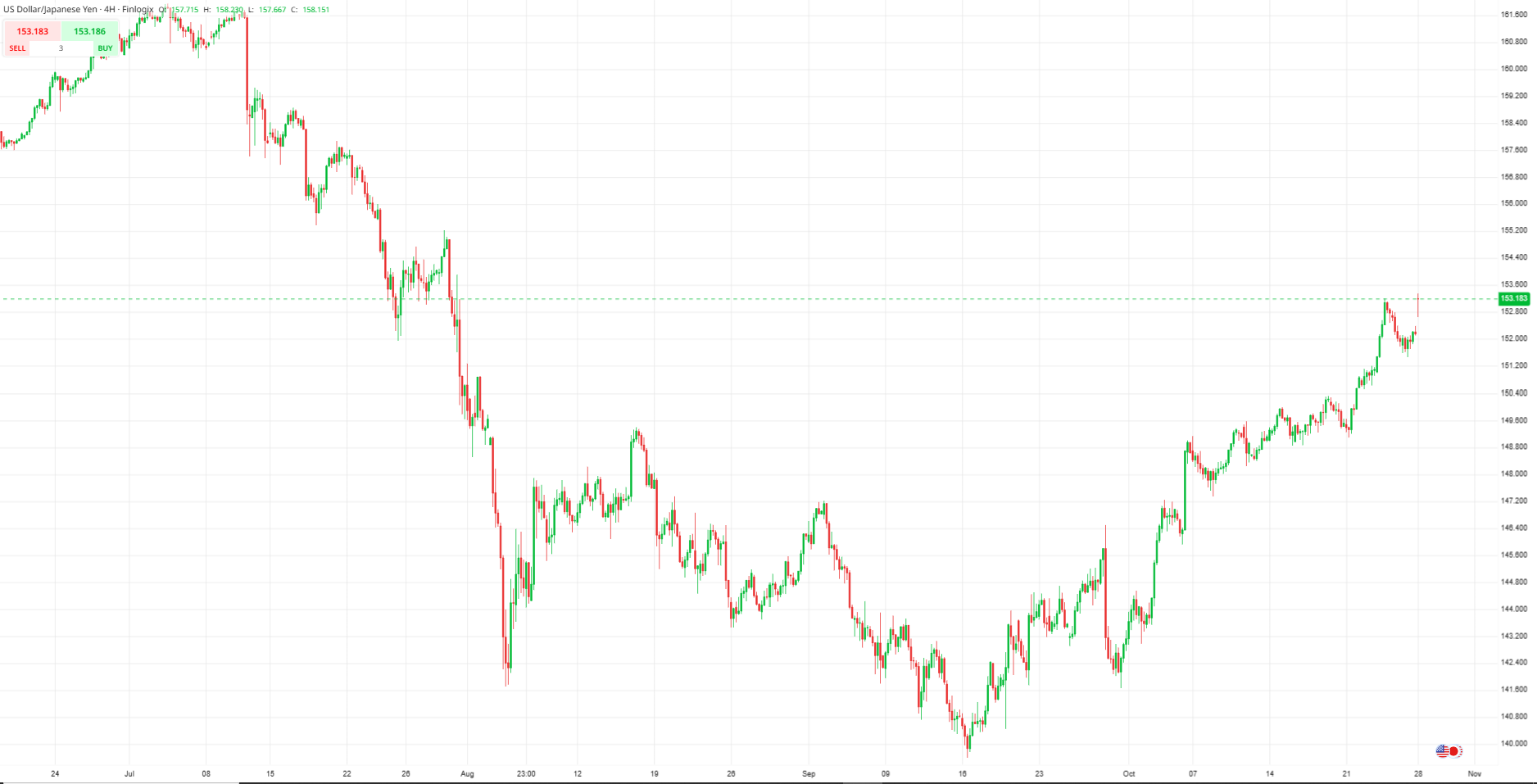
The U.S. dollar (USD) continues to build momentum against the Japanese yen (JPY), marking its fourth consecutive week of gains. This trend is driven by a combination of rising U.S. Treasury yields, evolving political landscapes in both the United States and Japan, and anticipated changes in central bank policies. Together, these factors are reshaping market dynamics, making the USD/JPY pairing a focal point for traders and investors alike.
USDJPY H4
At the forefront of this momentum is the renewed rise in U.S. Treasury yields, especially at the long end of the yield curve. The 10-year Treasury yield has again crossed the critical 4% mark, surpassing key technical levels and reinforcing confidence in the dollar’s strength. This uptick reflects optimism in the U.S. economy, which has been underscored by recent economic data showing solid growth and resilience. With higher yields making the dollar more appealing, particularly against lower-yielding currencies like the yen, USD demand has surged, drawing international capital into dollar-denominated assets.
US10Y H4
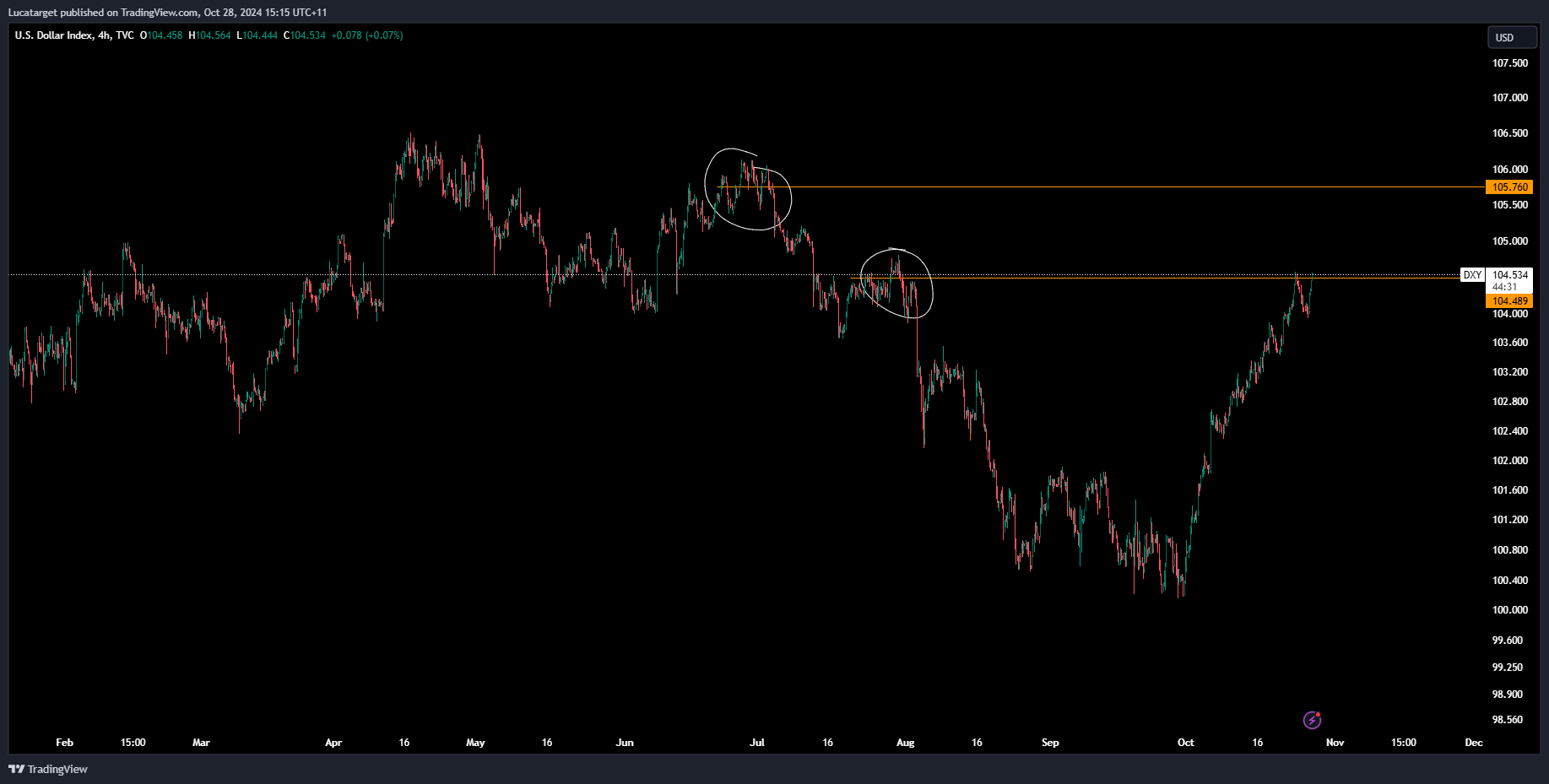
Political factors further amplify the dollar’s ascent. In the U.S., the upcoming November midterm elections could pave the way for what many analysts are calling a “Red Sweep” in Congress. With a Republican-led Congress, policies like former President Trump’s $7.5 trillion fiscal agenda could take shape, centring on extensive tax cuts aimed at stimulating the economy. This agenda is expected to promote economic expansion, potentially bolstering the dollar further as investors favour growth-oriented fiscal policies. Although such tax cuts could ease inflationary pressures to a degree, their stimulative effects may also carry inflation risks, adding complexity to the fiscal landscape that market participants will need to navigate.
Meanwhile, the yen has weakened substantially against the dollar as U.S. yields have climbed. After a brief period of yen strength in July and August, a resurgence of carry trades—where investors borrow in lower-yielding currencies to invest in higher-yielding ones—has accelerated the yen’s decline. USD/JPY reached recent highs near 153.19, marking a roughly 6-7% depreciation in the yen this month alone. This downward trend has not gone unnoticed by Japanese officials, who have expressed concern over “one-sided” currency movements, prompting speculation that Japan may intervene to support the yen. However, any intervention is likely to depend on the U.S. election results, as changes in U.S. fiscal and monetary policies could influence USD/JPY and potentially ease the pressure on Japan’s currency, reducing the necessity for intervention.
Adding to the yen’s volatility is Japan’s own political situation. Prime Minister Shigeru Ishiba’s calls for a snap election in Japan’s Lower House this weekend has introduced fresh uncertainty. If the ruling Liberal Democratic Party (LDP) and its coalition partner Komeito lose seats, they may need to form a broader coalition, potentially with the Democratic Party for the People (DPP). The DPP’s platform includes a proposed cut in the consumption tax and a shift toward more accommodative fiscal measures. Should the DPP gain influence, Japan’s economic policy could see a pivot toward increased fiscal spending, which could further impact perceptions of the yen’s stability.
The role of the Bank of Japan (BoJ) in this evolving landscape is also critical. The BoJ has thus far maintained a cautious approach, showing patience in adjusting rates amid yen strength earlier in the year. However, the yen’s steep decline since then may push the BoJ to reevaluate its stance. The upcoming BoJ policy meeting is expected to provide insights into this possibility. Some analysts anticipate that BoJ Governor Kazuo Ueda may hint at a rate hike as early as December or early next year. Such a shift would mark a significant departure from Japan’s longstanding accommodative monetary policy, potentially stabilizing the yen if implemented.
In summary, the USD/JPY pairing is at a critical juncture, influenced by a complex mix of economic trends, political developments, and anticipated central bank actions. The near-term direction for USD/JPY will largely depend on how U.S. fiscal policies shape up post-election, the outcome of Japan’s Lower House elections, and any policy signals from the BoJ. Investors and market participants should monitor these elements closely, as their interplay will likely dictate the trajectory of USD/JPY in the weeks and months ahead.
This content may have been written by a third party. ACY makes no representation or warranty and assumes no liability as to the accuracy or completeness of the information provided, nor any loss arising from any investment based on a recommendation, forecast or other information supplies by any third-party. This content is information only, and does not constitute financial, investment or other advice on which you can rely.
Why Is Forex Trading So Difficult?
How To Master MT4 & MT5 - Tips And Tricks For Traders
The Importance Of Fundamental Analysis In Forex Trading
Forex Leverage Explained: Mastering Forex Leverage In Trading & Controlling Margin
The Importance Of Liquidity In Forex: A Beginner's Guide
Close All Metatrader Script: Maximise Your Trading Efficiency And Reduce Stress
Best Currency Pairs To Trade In 2024
Forex Trading Hours: Finding The Best Times To Trade FX
MetaTrader Expert Advisor - The Benefits Of Algorithmic Trading And Forex EAs
ACY Securities is one of Australia's fastest growing multi-asset online trading providers, offering ultra-low-cost trading, rock-solid execution, technologically superior account management and premium market analysis.

Select the categories and companies you wish to follow directly to your person rss feed.
Create Custom RSS Feed
just now
Sign up and join over 5,000 professional members who receive personalized news alerts, curated professional connections, and more for free!
IG Group has cut its 2026 revenue growth outlook after weaker revenue retention in its over-the-counter derivatives business outweighed growth in customer activity, putting the economics of its revised market-making approach in focus.
CME Group has withdrawn its filing to launch a 10-Barrel WTI Crude Oil futures contract that would have traded 24 hours a day, seven days a week. The exchange said industry participants were concerned that 24/7 energy trading could create unintended consequences without further due diligence.
Multibank FX aggregation service FXSpotStream reported a record average daily volume (ADV) of USD 179.118 billion for September 2026, replacing the previous high of USD 173.6 billion set in March this year.
ASK Investment Managers has agreed to acquire SageOne Investment Managers, with Blackstone remaining majority shareholder. SageOne founder Samit Vartak becomes CIO (Equities) of the combined business, which will manage more than INR 850 billion in assets. The transaction is subject to regulatory and investor approvals.
Intercontinental Exchange launched TD34 and TD15 VLCC tanker futures and two container freight average price options, as average daily volume across its freight markets is up 33% year-to-date. The contracts extend ICE's freight complex to more than 90 contracts across over 30 routes spanning wet and container freight.
What if rising yields are not a warning sign, but a reflection of stronger demand? Our latest BitDelta Pro article takes a closer look at that question as Q4 begins, examining how the same macro forces are playing out differently across rates, equities, commodities and gold. The outlook also considers what could challenge the current thesis, and which market signals may matter most in the months ahead. Read the full article for our Q4 perspective. BitDelta Securities Financial Services LLC, regulated by the Capital Market Authority under Category 5 (Introduction Only), acts solely as an introducer and does not provide trading, execution, dealing, advisory, portfolio management, or custody services. All trading, execution, and investment-related services are provided by BitDelta Limited, Mauritius, a licensed Investment Dealer. All trading and investments involve risk. The value of investments may fluctuate, and you may receive less than your initial investment.
Sky Links Capital Group has appointed Hormoz Faryar as Managing Director to lead institutional business development and expansion across global markets. Faryar brings over 25 years of e-FX trading and institutional sales experience from senior roles at Credit Suisse, Equiti Group, ADSS and ATFX MENA.
Webull (NASDAQ:BULL) has partnered with X as a Cashtag Partner for stocks and crypto trading, linking X's social-market data and conversation tools to Webull's brokerage infrastructure. Executives from both firms say the deal connects market discussion on X directly to investing action for users.
Gold price forecast ahead of NFP: Explore XAUUSD support, resistance and the weekly 50 EMA, with bullish and bearish scenarios and key price targets.
Learn how to convert custom price action strategies into fully automated MetaTrader 5 Expert Advisors (EAs) using a simple two-step AI prompt workflow.