just now


Liquidity Finder Ltd is incorporated in England and Wales, company number 10610740, registered address 167-169 Great Portland Street, Fifth Floor, London W1W 5PF, United Kingdom.
Published: just now

Impact of Recent Tariffs on U.S. GDP
The recent implementation of substantial tariffs by President Donald Trump has introduced significant concerns regarding U.S. economic growth. We project that these tariffs could lead to a notable deceleration in GDP expansion. Specifically, the firm has adjusted its GDP growth forecast downward to 1.0% and anticipates an increase in the unemployment rate to 4.5% by the end of 2025. These projections underscore the potential for a "growth shock" that may necessitate more aggressive interest rate cuts by the Federal Reserve to mitigate the economic slowdown.
The tariffs are expected to exert upward pressure on inflation, with core Personal Consumption Expenditures (PCE) prices potentially rising by approximately 0.1 percentage point for every 1 percentage point increase in the effective tariff rate.This inflationary trend could further strain consumer spending and real disposable income, contributing to tighter financial conditions and heightened uncertainty in business investments.
Anticipation Surrounding Upcoming U.S. CPI Data Release
The Bureau of Labor Statistics is scheduled to release the Consumer Price Index (CPI) data for March 2025 on April 10. In February, the CPI increased by 2.8% year-over-year, slightly below the forecasted 2.9% . Market participants are keenly awaiting the March figures to assess the trajectory of inflation, especially in light of the recent tariff implementations.
Should the upcoming CPI data indicate a continuation of subdued inflation, it may reinforce expectations of a dovish stance from the Federal Reserve. Conversely, an uptick in inflation could prompt a reassessment of monetary policy, potentially leading to adjustments in interest rate expectations.
Reserve Bank of New Zealand's Impending Interest Rate Decision
The Reserve Bank of New Zealand (RBNZ) is poised to announce its Official Cash Rate (OCR) decision on April 9.According to a Reuters poll, economists anticipate a 25 basis point reduction, bringing the OCR down to 3.5% . This expected cut aligns with the RBNZ's ongoing efforts to stimulate economic activity amid manageable inflation levels.
However, some economists have expressed reservations regarding the necessity of further rate cuts at this juncture. For instance, Westpac's chief economist, Kelly Eckhold, suggests that additional easing may not be warranted given the current economic indicators.
Interplay Between Technical Indicators and Fundamental Factor.Technical Outlook: DXY & NZD/USD
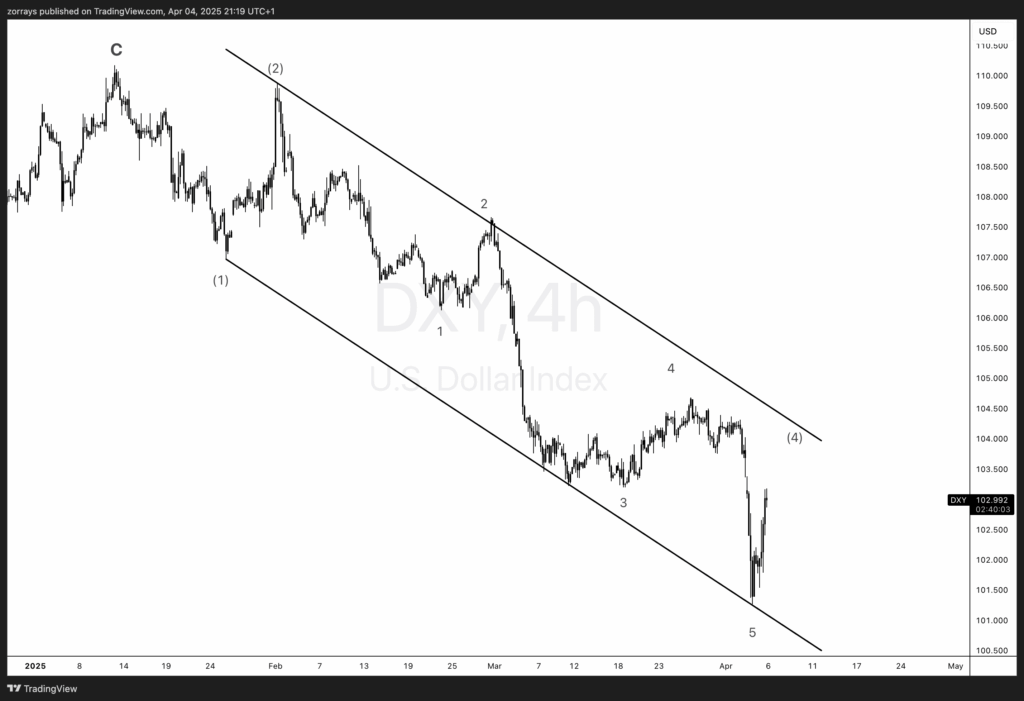
The U.S. Dollar Index (DXY) is currently showing signs of a technical retracement within a broader impulsive decline. Based on the latest wave count from the updated 4-hour chart, DXY appears to be carving out a classic Elliott Wave 5-wave structure, with the market currently rebounding into wave (4) after completing wave 3.
This wave (4) retracement comes at a critical juncture. From a macro standpoint, if the March CPI print (due next week) comes in softer than 2.8% YoY, it would validate this corrective rally as temporary, paving the way for wave (5) to the downside as inflation cools and expectations of a more dovish Fed grow stronger. Lower inflation could shift focus toward stimulating growth via lower real yields, putting more pressure on the dollar long term.
The wave (3) completion aligns almost perfectly with the recent tariff-induced financial tightening, suggesting that the market had priced in some of the fiscal policy risk. Now, as the Fed's dovish rhetoric begins to anchor expectations, wave (4) could extend modestly but is unlikely to break the descending channel (as shown in the second image). This structure should cap the retracement, particularly if CPI surprises on the downside.
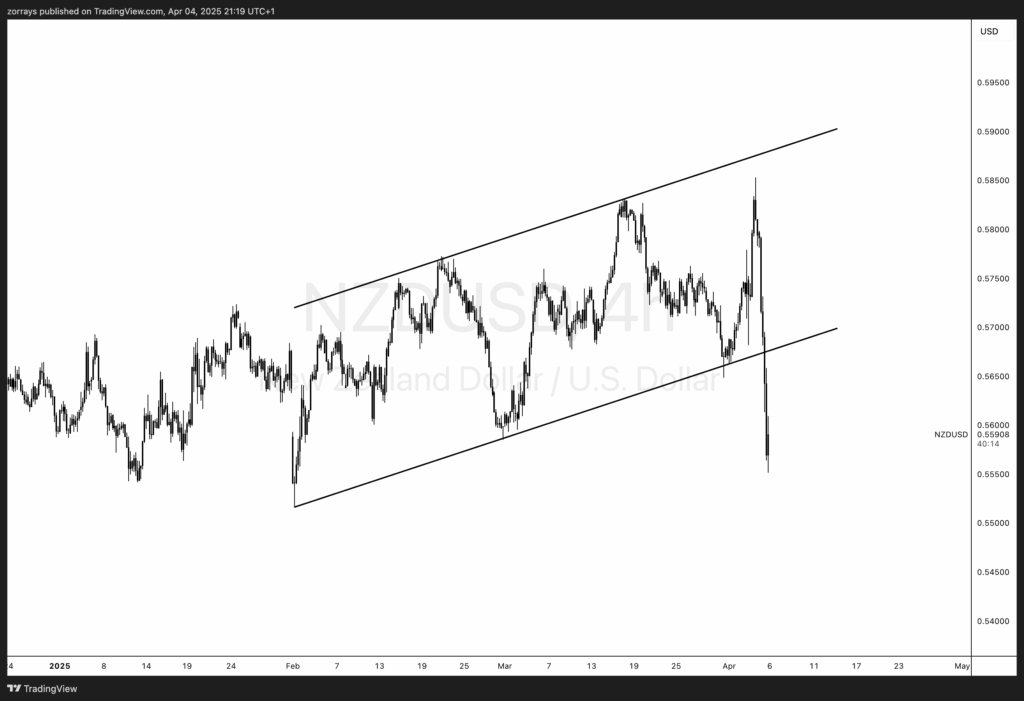
Over on the NZD/USD 4H chart, the pair broke decisively below a rising channel, which had been acting as a bearish flag within a broader downtrend. This technical breakdown coincides with growing market consensus that the RBNZ will cut rates next week, from 3.75% to 3.5%, as recent comments suggest the central bank is pivoting to support economic growth.
This dovish shift by the RBNZ provides a stark contrast to a potentially less aggressive Fed, especially if tariffs drag on GDP while inflation retreats. The sharp selloff in NZD/USD in recent sessions supports the broader bullish case for the U.S. dollar, especially in a risk-off environment.
Technically, the next support in NZD/USD comes in near 0.5550, while the previous flag base near 0.5700–0.5720 now acts as strong resistance. Unless RBNZ surprises with a hawkish hold (which seems unlikely), the path of least resistance remains lower, confirming USD demand.
| Asset | Technical Signal | Macro Narrative | Bias |
|---|---|---|---|
| DXY | Wave (4) bounce inside channel | Softer CPI + tariffs = dovish Fed | Short-term upside, longer-term neutral to bearish |
| NZD/USD | Bearish flag breakdown | Dovish RBNZ + strong USD | Bearish NZD/USD |
In essence, both charts reinforce a near-term USD rebound, especially as central banks like the RBNZ hint at more dovish stances. But the sustainability of this dollar strength hinges on next week’s CPI data. A print below 2.8% will likely cap this retracement, while an upside surprise might extend dollar gains.
Conclusion
The forthcoming week presents critical economic events that warrant close attention from investors and policymakers alike. The interplay between newly imposed tariffs, inflation data, and central bank decisions will be pivotal in shaping the economic landscape. Staying informed and agile in response to these developments will be essential for navigating the evolving financial environment.
Frequently Asked Questions (FAQs)
1. How do tariffs impact GDP growth?
Tariffs can hinder GDP growth by increasing the cost of imports, leading to higher prices for consumers and businesses.This can reduce consumer spending and business investment, ultimately slowing economic expansion.
2. Why is the upcoming U.S. CPI data release significant?
The CPI data provides insights into inflation trends, which are crucial for informing monetary policy decisions by the Federal Reserve. It helps assess the purchasing power of consumers and the overall health of the economy.
3. What factors influence the Reserve Bank of New Zealand's interest rate decisions?
The RBNZ considers various factors, including inflation rates, economic growth, employment levels, and global economic conditions, to determine appropriate adjustments to the Official Cash Rate.
4. How does a dovish Federal Reserve affect the U.S. Dollar Index (DXY)?
A dovish Federal Reserve, which favors lower interest rates to stimulate economic growth, can lead to a depreciation of the U.S. dollar. Lower interest rates make the currency less attractive to investors seeking higher returns.
5. What are the potential consequences of rising inflation expectations?
Elevated inflation expectations can lead to higher actual inflation as businesses increase prices and workers demand higher wages. This can erode purchasing power and prompt central banks to raise interest rates to control inflation.
6. Why might some economists oppose further rate cuts by the RBNZ?
Some economists believe that additional rate cuts may not be necessary if the economy shows signs of improvement and inflation remains under control. They argue that excessive easing could lead to financial imbalances or diminish the effectiveness of monetary policy tools.
Alchemy Markets is a multi-asset brokerage providing retail traders with the same elite trading conditions, tools, and transparency typically reserved for institutions.

Select the categories and companies you wish to follow directly to your person rss feed.
Create Custom RSS FeedSign up and join over 5,000 professional members who receive personalized news alerts, curated professional connections, and more for free!
Multi-asset trading broker AvaTrade has agreed to acquire the majority of FXCM Group’s business and brand, in a transaction that would bring a longstanding retail FX franchise into the AvaTrade Group.
LSEG and CMC Markets have signed a multi-year strategic data agreement expanding CMC's access to LSEG's real-time and delayed pricing, reference and corporate actions data, news and analytics, plus AI-ready content, to support new products, entry into new markets and the growth of CMC's institutional and B2B partnerships.
The Tel Aviv Stock Exchange is considering a bid for the Cyprus Stock Exchange, with Israeli media citing its EU licence, trading platform and clearing house. Euronext’s Athens exchange and India’s National Stock Exchange are also seen as contenders, and Cyprus aims to sign a sale agreement by the end of this year.
CME Group will launch baseball futures on 12 October, pending regulatory review, tracking CME FutureSports Performance Indexes built on Official League Data. Standard and micro contracts will start with the 2026 Postseason and the four clubs in the League Championship Series, trading around the clock.
ESMA has published an opinion stating that MiCA-authorised crypto-asset service providers should cease services tied to non-MiCA-compliant stablecoins for EU clients across MiCA crypto-asset services. National authorities should require remediation of existing exposures within three months, by early January 2027.
Nasdaq Ventures has made a strategic investment in Amsterdam-based derivatives and crypto exchange One Trading, with both firms to explore 24/7 trading of equity futures. The undisclosed investment follows Nasdaq's US$100 million investment in Payward, the parent of Kraken, and CME Group's move to 24/7 trading.
cTrader has opened multi-platform plugins to brokers and prop firms, which can pre-install their own tools for clients or list them in cTrader Store. The plugins run across Mobile, Web, Windows and Mac, and can be built and launched independently of core-platform releases, including trading journals and calculators.
Institutional brokerage and financial infrastructure provider Clear Street has joined TradingView’s broker network, allowing its clients to trade US stocks, exchange-traded funds and options directly through the charting and analysis platform.
Learn how to improve trading psychology, manage fear and greed, avoid revenge trading, and follow your trading strategy with discipline and a trading journal.
GTC Prime has announced a strategic partnership with Centroid Solutions to manage and distribute its liquidity through CS 360 Bridge, Centroid's multi-asset connectivity and execution engine, giving brokers and institutional clients access to tailor-made pricing, low-latency execution and real-time risk management.