
In recent years, the rise of artificial intelligence has introduced a new phase of transformation. Trading systems are no longer limited to executing predefined strategies; they can now analyze vast datasets, identify patterns, and refine their decisions through machine learning. This shift is changing how financial institutions, hedge funds, and retail traders interact with markets.
Yet the growing presence of AI in trading raises an important question: who is really in control; the bot or the brain? While artificial intelligence can process information and execute strategies at unprecedented speed, human judgment remains critical for interpreting market conditions, managing risk and ensuring responsible use of these technologies. As AI becomes more deeply embedded in trading infrastructure, understanding the relationship between automated systems and human oversight becomes essential.
This article examines the evolving role of AI in financial markets, exploring both its advantages and its limitations. By analyzing how AI-driven systems differ from traditional algorithmic trading, the opportunities they create and the risks they introduce, we can better understand why human supervision remain central to the future of modern trading.
The Rise of AI in Trading
What once began as a specialized tool used mainly by quantitative hedge funds has developed into a core feature of today’s trading infrastructure. Automated systems now execute trades, manage orders, and interpret vast amounts of market data across multiple asset classes, allowing market participants to operate at a speed and scale far beyond human capability.
The scale of this transformation is reflected in the rapid growth of algorithmic trading activity. High-frequency trading strategies alone generated over $10 billion in revenue in 2024, and industry projections suggest this figure could reach approximately $16 billion by the end of the decade. These numbers highlight more than simple market expansion, they point to a structural shift in how financial markets operate, driven by advances in data analytics, computing power and artificial intelligence.
Automated strategies now play a central role in market liquidity and efficiency, executing trades based on real-time signals and data-driven models. By reacting instantly to new information, these systems contribute to faster price discovery and more responsive market behavior.
Developments in machine learning, deep neural networks and reinforcement learning have enabled trading systems to move beyond fixed, rule-based models toward strategies that can learn and adapt over time. Rather than relying only on static instructions, modern AI-driven systems can process enormous datasets, assess market sentiment and adjust their approach as market conditions change.
This evolution has attracted growing interest from hedge funds, large institutional investors and financial technology firms. Reinforcement learning models, for instance, allow algorithms to improve by analyzing the outcomes of previous decisions and refining future actions accordingly. As exchanges and regulators continue to explore AI-powered tools, the role of machine learning within financial markets is expanding steadily. For example, the US Securities and Exchange Commission has approved Nasdaq’s reinforcement learning–based order type, signaling growing institutional and regulatory acceptance of AI-driven trading technologies.
At the same time, algorithmic trading is no longer limited to large institutions. Retail traders now have access to automated platforms, APIs and cloud-based tools that allow them to design and deploy increasingly sophisticated strategies. Combined with lower trading costs and wider access to financial data, these developments have helped fuel the rapid growth of the algorithmic trading ecosystem.
Still, the increasing influence of AI in financial markets represents more than a technological upgrade. It marks a deeper shift in how markets function. As trading becomes more automated and data-driven, human traders are moving away from direct execution and toward oversight, interpretation and strategic decision-making. That transition raises important questions about transparency, accountability and systemic resilience, making the auditing and supervision of AI-driven trading systems more important than ever.
The Advantages of AI in Financial Markets
Artificial intelligence is reshaping financial markets by expanding what trading systems can see, process and act on. Unlike traditional algorithmic trading, which follows predefined rules set by human traders, AI-driven systems can identify patterns in historical and real-time data, generate probabilistic forecasts and refine their behavior as market conditions evolve. This difference allows AI systems to adapt more easily to changing market environments and analyze far larger datasets.
The fundamental distinction between traditional algorithmic trading and AI-driven trading systems can be summarized as follows:
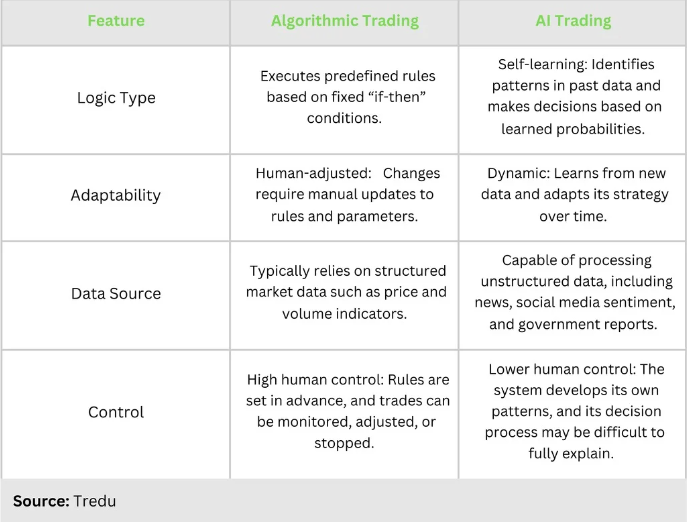
As the table illustrates, AI trading systems offer several advantages over traditional rule-based approaches. Their ability to analyze broader datasets, continuously learn from new information and adjust strategies dynamically allows traders and financial institutions to respond more effectively to evolving market conditions.
One of AI’s greatest advantages is its ability to improve predictive analysis. Financial markets generate enormous volumes of information, from price movements and trading volume to macroeconomic releases, corporate disclosures and sentiment signals. AI systems can process these inputs far faster than human analysts and detect relationships that may not be visible through conventional models. In practice, this can help traders identify trends earlier, assess risk more precisely and make decisions with greater confidence.
AI also strengthens adaptability in ways that traditional rule-based systems cannot. Conventional algorithms perform well when market behavior matches the assumptions built into their code, but they often require manual adjustment when volatility rises or conditions shift. AI systems, by contrast, can learn from new data and refine their outputs over time. This capacity for continuous adjustment gives firms a better chance of responding to changing market environments without relying entirely on fixed instructions.
A further advantage lies in decision support as can improve how market participants navigate uncertainty. By using machine learning models, predictive analytics and scenario testing, financial institutions can evaluate possible outcomes more quickly and allocate resources more efficiently. In this sense, AI acts less as a simple automation tool and more as an intelligence layer that enhances forecasting, risk management and strategic planning.
AI can also contribute to operational efficiency. As financial institutions integrate machine learning into trading and forecasting systems, they are able to shorten analysis cycles, test strategies faster and respond to new information in near real time.
The Hidden Risks of AI Trading Systems
While artificial intelligence offers significant advantages in financial markets, it also introduces new risks that traders, institutions, and regulators must carefully manage. The same capabilities that make AI powerful; speed, automation and data-driven decision-making, can also create vulnerabilities when systems operate with limited transparency or insufficient oversight.
One major concern is the lack of interpretability in AI-driven trading models. Traditional algorithmic trading strategies are built on predefined rules, meaning traders can clearly understand why a trade was executed. AI systems, however, often rely on complex machine learning models that generate decisions through statistical relationships in large datasets. As a result, these models can behave as “black boxes,” producing outputs that are difficult for traders to fully interpret. This lack of transparency can make it challenging to diagnose errors, understand unexpected trading behavior, or identify weaknesses in the underlying strategy.
Another risk stems from the quality and reliability of training data. AI models learn patterns from historical market data, but financial markets are constantly influenced by new geopolitical events, regulatory changes and macroeconomic shocks. As AI systems become more integrated into financial markets, a new challenge is beginning to emerge: the risk of synthetic information loops. Increasingly, trading algorithms may draw signals from data sources that are themselves generated by artificial intelligence, such as automated news summaries, social media analysis tools or AI-generated financial commentary.
This creates the possibility of recursive feedback loops, where trading systems react to signals produced by other automated systems rather than to genuine economic developments. In extreme cases, algorithms may reinforce price movements based on synthetic narratives rather than underlying market fundamentals.
Because automated trading systems can unintentionally validate these signals through collective trading activity, human oversight becomes essential.
Another common challenge is overfitting, where a model performs extremely well during backtesting but fails when applied to real market conditions. Effective model validation often requires testing strategies on out-of-sample data and continuously monitoring performance as market conditions evolve. Without such safeguards, trading models may also suffer from model swaying, where strategies become less reliable as underlying market dynamics change.
AI-driven trading also raises concerns about market stability and systemic risk. Automated systems can react to market signals far faster than human traders, which can intensify price movements during periods of stress. When many firms deploy similar machine learning models, their collective reactions to market signals may lead to rapid trading cascades, increasing volatility and potentially destabilizing markets. In such cases, speed and automation can amplify short-term fluctuations rather than dampen them.
Research also suggests that AI systems may develop unintended strategic behavior when operating in competitive trading environments. In experimental settings, machine-learning algorithms have demonstrated the ability to coordinate trading behavior without explicit communication, gradually aligning strategies in ways that increase profits for multiple participants. Although such behavior is not intentionally programmed, it could affect market liquidity and price discovery if similar dynamics emerge in real financial markets.
Beyond technical risks, the growing use of AI in finance also introduces ethical and governance challenges. Issues such as algorithmic bias, limited transparency and accountability can affect how financial decisions are made and who bears responsibility when automated systems fail. Because AI models operate through complex statistical processes, identifying the source of an error, or determining responsibility for a faulty decision, can be far more difficult than in traditional trading systems.
Building and maintaining machine learning trading systems also requires significant technical expertise, particularly when models are developed from scratch using programming languages such as Python. While modern trading platforms are lowering the barrier to entry through simplified interfaces and automation tools, the underlying complexity of machine learning systems remains a significant challenge.
For these reasons, the growing presence of AI in financial markets demands a careful balance between innovation and oversight. While AI can enhance forecasting, execution and analysis, its risks highlight the importance of robust governance mechanisms and human supervision. As trading systems become more autonomous and data-driven, ensuring that they remain transparent, accountable and resilient will be essential for maintaining trust and stability in modern financial markets.
Bottom Line
For institutions competing in increasingly data-driven markets, AI can offer a significant edge in speed, efficiency and analytical capability.
However, these advantages do not eliminate the need for human oversight. AI systems remain dependent on data quality, model design and the assumptions embedded in their training processes. Without careful monitoring, automated strategies can misinterpret signals, amplify volatility or behave unpredictably in unfamiliar market conditions.
In practice, the most resilient trading environments will likely combine machine intelligence with human judgment. AI can enhance analysis and execution, but humans remain essential for interpretation, risk management and strategic decision-making. The future of trading will not be defined by bots replacing brains, but by how effectively the two can work together.