
Search Companies, News, Members & more
Terms of ServicePrivacy PolicySecurity PolicyLegal InformationCommunity GuidelinesSitemapsCookie Settings
2026 Copyright © Liquidity Finder Ltd. All rights reserved.
Liquidity Finder Ltd is incorporated in England and Wales, company number 10610740, registered address 167-169 Great Portland Street, Fifth Floor, London W1W 5PF, United Kingdom.
6 Institutional-Grade AI Tools Retail Traders Can Realistically Use in 2026
Published on Sep 28, 2026
Updated on Sep 28, 2026
In 2026, many “institutional-grade” trading platforms are not fit to carry that tag.
As consolidated retail feeds with a language model bolted on top, they can be useful, but they don’t close the information gap between a self-directed trader and a major trading desk.
Knowing which platforms offer this institutional level of information can be difficult for independent investors, but there is a simple two-question test.
• Does the tool provide the information layer (filings depth and order-flow visibility) that institutions pay for, at a fraction of the price?
• Does it repackage what is already free and charge for the interface?
For most platforms, the second question is most likely to yield a positive response. The key for solo traders is to find those who answer the first question instead.
1 . IUX24

IUX24 Media launched its platform in late 2025 with the stated aim of putting elite institutional data in the hands of the individual investor.
Investors get screening tools, calendars, and heat maps in the platform’s Intelligence Terminal, and from here they can access two AI layers.
The first is the Xurve AI Analyst. This is an engine that saves hours of manually sifting through multiple data feeds by synthesising sentiment shifts and macro releases into clear conversational insights. The trader can interact with the engine directly, which also works alongside a second layer, the IUX24 AI Sentiment tracker, which looks into the psychological shifts across news and social sources.
IUX24 is a new platform with new developments, such as its Dark Pool Tracker, which is intended to surface large institutional movements that are not visible on retail feeds. Its current model provides institutional insights at a fraction of the terminal cost, with important developments still to come.
2 . Koyfin
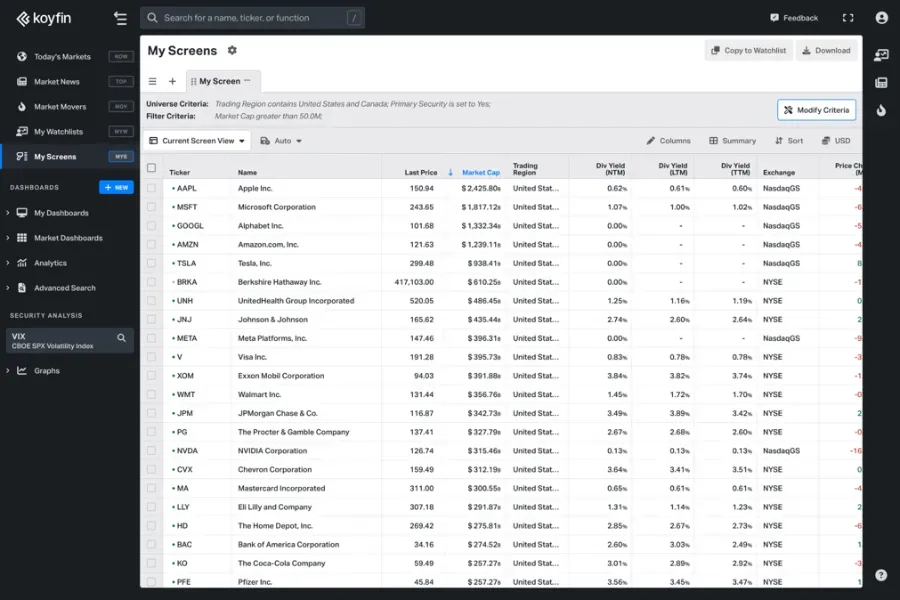
Koyfin is a strong alternative to a research terminal, priced at a point most retail investors can afford. It draws from a decade of financial data and forward estimates to offer a screener that holds up well against any research-based professional alternative.
It is not, however, a trading tool, so it does not offer visibility into trading flows or a meaningful sentiment layer.
3 . AlphaSense
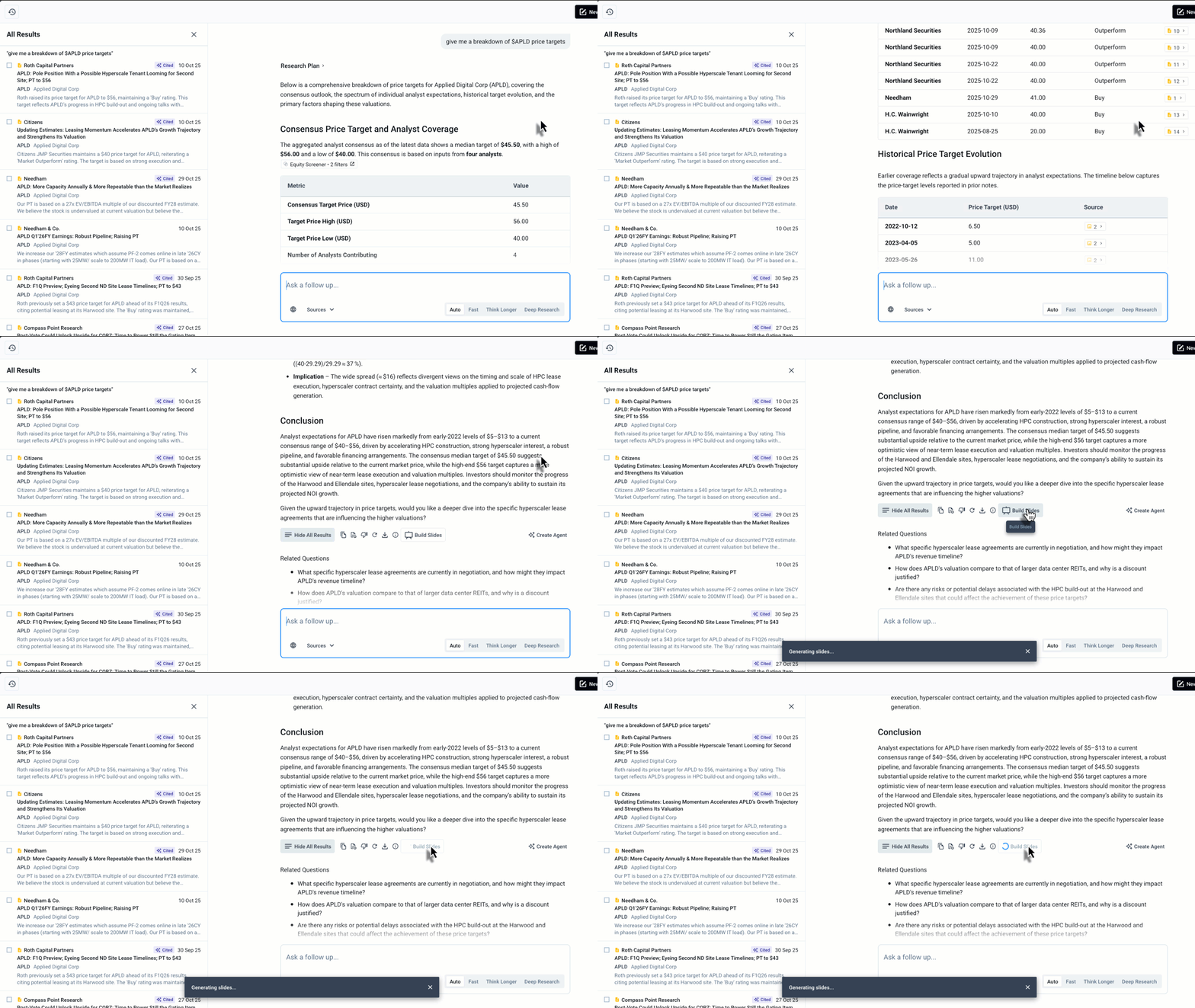
AlphaSense offers access to a deep well of broker research and expert-call transcripts, as well as an impressive search function into filings that is difficult to find elsewhere.
Its pricing is quoted per seat and can come up to a five-figure amount annually, which puts it closer to institutional prices than others on this list. However, it is the research benchmark by which many other platforms measure themselves, and dedicated solo traders may find the cost justifiable.
4 . TradingView
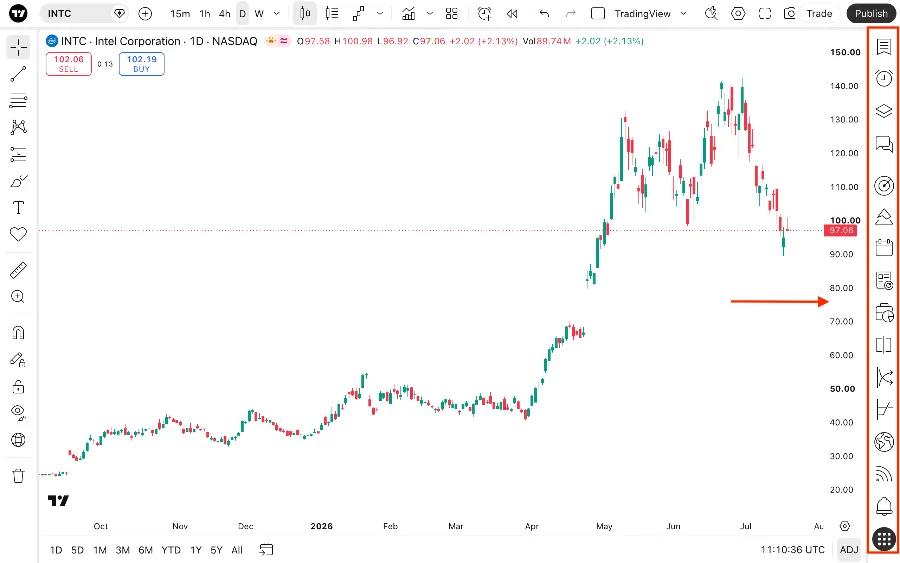
With excellent charting features and a deep community scripting library, TradingView is a popular option among individual traders. There’s the option to buy extra exchange fees for a competitive price.
Yet TradingView works best alongside other tools instead of its own intelligence platform. Its base data is consolidated retail pricing, and its AI features are limited compared to other trading options.
5 . Trade Ideas
Trade Ideas uses its distinctive Holly AI engines to run thousands of overnight backtests and generate a setlist of statistically weighted candidates each day. This is an impressive model that is attracting many interested investors.
The platform does, however, only cover US-based equities and ETFs, and pricing is higher than many traders can justify.
6 . LevelFields
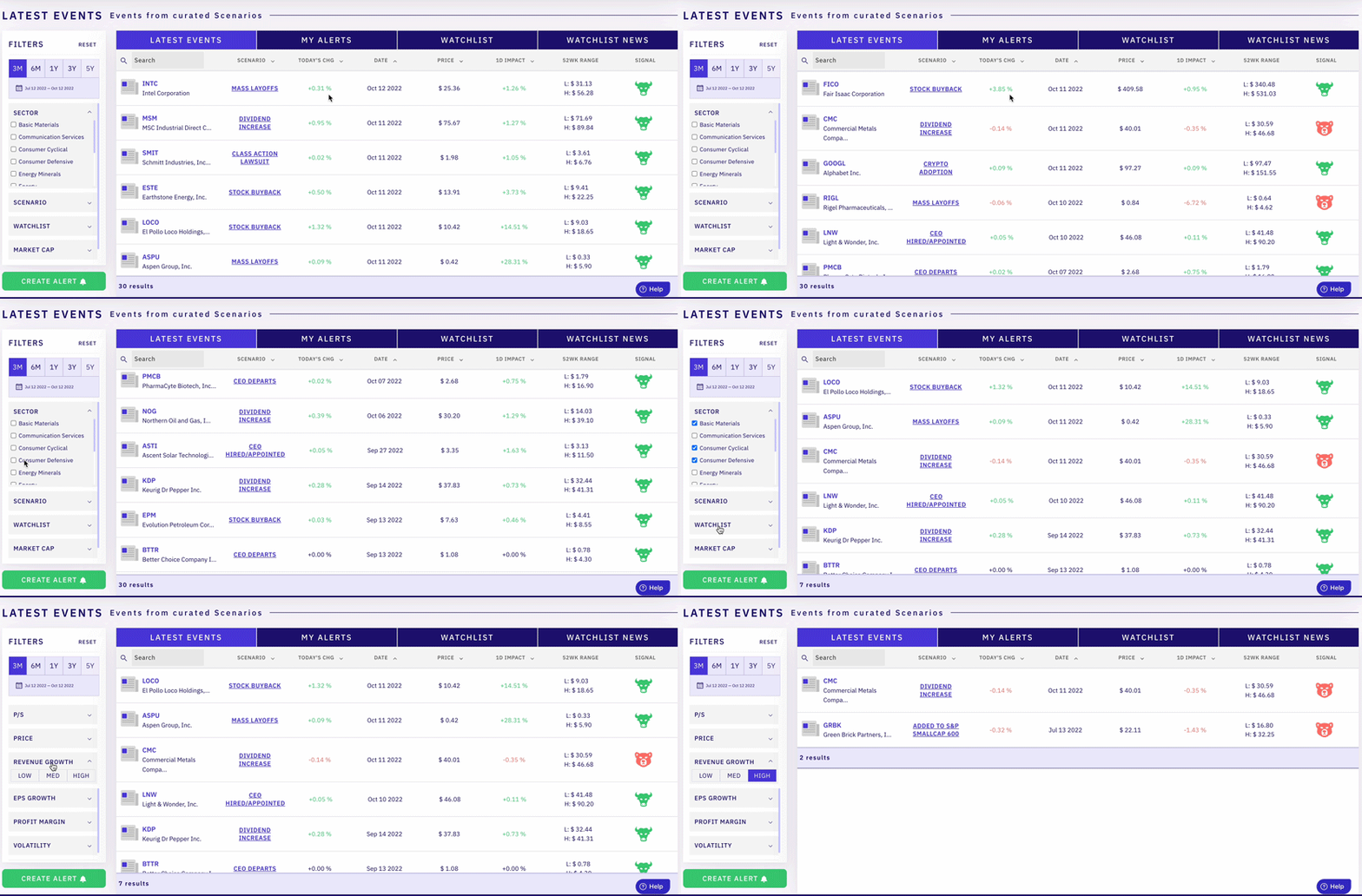
LevelFields provides event-driven scanning (buybacks, executive departures, contract awards) with historical price-reaction data attached to each event type.
The platform is narrow by design, yet narrowness is the point. It answers one question well rather than several vaguely.
How the information gap looks in 2026
The gap between what retail traders and institutions see in 2026 is much narrower than just a few years ago.
Filings and release information have always been in the public domain, but the capacity to read and interpret them at speed was not. This has changed.
It is now possible for individuals to synthesize market news and sentiment across thousands of sources and use it to predict how a release will affect a position before the market has finished reacting to it.
Some platforms will provide the tools to do this much more effectively than others. Traders who know which these are will gain an invaluable edge over the coming years.
Share this article

Comments
Most Recent
Find The Right Partners for
Your Trading Business
Sign up and join over 5,000 professional members who receive personalized news alerts, curated professional connections, and more for free!
Most equity volume now trades away from lit exchanges, leaving independent traders acting on information they cannot see. We assess six AI platforms on three measures: institutional data access, sentiment capability, and how well each fits an existing workflow.
7 Best Emerging AI Market Analysis Tools for Professional Independent Traders in 2026
Dark pool trading was once the preserve of institutional desks, but a new wave of AI tools is promising self-directed investors a look into non-displayed liquidity and where the big money sits. This article explains what dark pools actually are, why retail traders face an even bigger information gap in FX than in equities, and what AI-driven intelligence platforms like IUX24 can and cannot reveal about institutional positioning.
The Bloomberg Terminal has long been the reference standard for institutional market intelligence, but its $25,000-plus price tag puts it out of reach for most independent professionals. This article looks at seven platforms challenging that dominance in 2026, from AI-native tools like IUX24 to established names such as TradingView, Koyfin and AlphaSense, and asks how close they really come to replacing the Terminal.

In Part 6 of his A-Book STP series, Youssef Bouz from GCC Brokers looks at how the rise of algorithmic and AI-assisted trading is forcing brokers to rethink risk models, revenue strategy, and long-term sustainability, and why trader longevity, not short-term extraction, is the real measure of a resilient execution business.

From machine learning-driven execution to predictive market analytics, we break down the AI tools that institutional and quantitative traders are using to gain an edge.

Watch the LiquidityFinder webinar replay on A-Book vs B-Book execution models for retail FX/CFD and crypto brokers. Hear Lars Holst (GCEX), Rob Brown (MAS Markets), Jeremy Kinstlinger (Afterprime), Youssef Bouz (GCC Brokers), Victor Ivanchenko (cBridge/Spotware) and Sam Low (LiquidityFinder) discuss AI-driven trading, liquidity stress, regulatory scrutiny, risk transfer, LP/PB relationships, balance-sheet volatility and brokerage valuation over the next 3–5 years.

We examine Plus500's spreads, regulatory standing, platform capabilities, and who it actually makes sense for in 2026.
Create Your FREE Account
Get access to latest news, updates, real-time data, brokerage and trading firm insights and customized information feeds.


US stocks closed higher on Wednesday, with the Nasdaq gaining 1%, the S&P 500 rising 0.6%, and the Dow advancing 0.7%, as renewed enthusiasm for AI-related stocks lifted market sentiment.


SpaceX went public in June as a rocket company. On October 20 it reported as something else entirely: an AI infrastructure business, financed by a satellite broadband network, with a launch division attached. Rockets generated 12% of third quarter revenue and lost money. The AI segment generated 52% of revenue and consumed 84% of capital expenditure. Starlink generated 85% of operating profit.


Standard Chartered has signed definitive agreements to acquire 100% of Zodia Custody UK Limited, folding its regulated digital asset custody business into Securities Services. Zodia Solutions will be set up under SC Ventures with bank investors including Northern Trust, NAB Ventures, Emirates NBD and Investcorp.

Bybit Fintech FZE has secured a Virtual Asset Service Provider licence from Dubai’s Virtual Assets Regulatory Authority for Exchange Services, covering spot trading. Bybit’s Peter Loo said the firm hopes to add derivatives, subject to regulatory approvals. Its international Dubai headquarters opened in 2022.


ATFX Connect has released its Q4 2026 Institutional Edge, examining the geopolitical, monetary policy and fiscal pressures shaping global financial markets in the final quarter of the year.

The Nasdaq 100 is trading at 29,382. After reaching a recent high of 29,957, the index reversed sharply and has been recording a series of lower highs and lower lows.

FM Summit London returns to Old Billingsgate on 24 November 2026 for its 15th edition, with a curated one-day format aimed at senior executives. LMAX Group, Plus500, oneZero and MetaQuotes are among confirmed exhibitors, with Business Connect meetings, roundtables and an opening event at The Folly on 23 November.
GCEX has launched European-style, fiat-settled options on Bitcoin and Ethereum with monthly expiries for eligible professional and institutional clients. The service runs through the GCEX OTC desk, with pricing from Tier 1 liquidity providers and reporting on XplorPortal. GC Exchange Limited is authorised by the UK FCA

Wall Street closed mostly higher on Tuesday, led by a nearly 1% gain in the Dow. In Asia, South Korea’s Kospi rebounded 2.7% and Japan’s Nikkei gained 0.8%.

Brent crude is trading at $111.70. The latest price action show the recovery continuing toward $111.70, suggesting that demand has returned after the sharp correction.
Feed